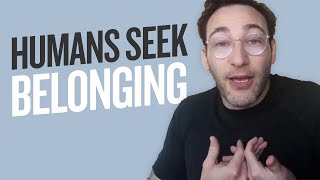
A short talk by Simon Sinek on human tribalism and how shared values and experiences create belonging. Sinek explains why humans trust and form tribes (shared values, shared hardship) and argues that good leaders acknowledge suffering while promoting realistic optimism and collective action during crises such as a pandemic.
Chapters
We're social animals. There's no getting around it. We seek belonging. Right. And.
I'll give you a funny example of how it works. So where do you live? Where are you right now? I'm in San Diego. Okay, so you're in San Diego. Are you friends with everyone in San Diego?
Of course not. That's ridiculous. I know where you're going because I use this one too. But of course. Ridiculous. But if you go to San Francisco and you meet somebody from San Diego, you're like, I'm from San Diego. And you guys are like, buzz shirt or something like that. You have that connection. And then when you're in New York and you meet someone, you're like, I'm from San Diego. They're like, I'm from Los Angeles. You're like, you're both from California. That's right, Right. And you go to Paris and you're on the Paris Metro with your family on vacation, and you hear an American accent and you turn around and say, hey, where are you guys from? You're from Wichita, we're from San Diego. We're American best friends.
Because that's human beings. We seek out people who have shared values, shared understanding of how we grew up, shared experiences. And we create tribes because we're safer in tribes. And that person that you just met on the Paris Metro, that tourist family, will say, oh, my God, have you eaten at this restaurant? And you go, no. And then you will go to a restaurant because tourists told you to. But if a French person, just random stranger, fresh person, told you to go to a restaurant, you'd be like that person, insane. Because there's no trust. Even though they're much better qualified to give you restaurant advice than a random person from Wichita on the Paris Metro. Yeah, that's my point, which is we trust people that we're in the tribe with, you know, for better or for worse. And so ideally, you want to try to form around vision and values, right? So Marines, if you meet Marines, Marines always talk about the intangibles. They're constantly talking about the intangibles. They're always talking about the intangibles. What they mean is the values, the trust, the love, the brotherhood, the sisterhood, the honor, the courage. They were values based organization and they understand that what makes them a unit are the intangibles. Just like in your relationship, what makes you love your spouse is not that they're pretty. That's nice. What makes you love them and trust them is the shared values, the shared understanding, the shared Vision, right? And so when we give an organization a sense, a really clear sense of cause, and it's a values based organization, it doesn't matter what our politics are. But if you take away any sense of vision or cause, what ends up happening is we start seeking out tribalism, tribal connections based on anything that we can see easily. So you get racial divisions, political divisions, you get all of these stupid things that really don't matter, amount to anything, and usually the greater the division based on superficial or political lines, it probably means that we are not being offered a sense of global vision and something that unites us in common cause. Because you know what it's like. Take, take any, take any city that has a natural disaster, earthquake, tornado, hurricane, whatever it is, all of a sudden politics goes away, class goes away, racial divisions go away, and we're all taking care of each other and we're all helping each other. Shared experience. Shared experience. Shared hardship is actually something that releases oxytocin. We talked about that chemical that creates those magical bonds. Shared hardship actually creates common understanding. And so the fact that we are all going through this pandemic.
Good leaders will talk about how we're all suffering and we all have to help each other, right? Because again, it's the light at the end of the tunnel speech. We are in somewhere dark right now. You know, optimism is not the denial of reality, right? That's positivity. We don't need that, like, everything's fine, everything's good. What are you talking about? Look at all this opportunity. You're insane. This is. No, no, that's positivity. That's not helpful. That's ignoring the reality. Optimism is the belief, the undying belief that the future is positive. But we can talk in realistic terms about what we're going through now. And the fact is it will be over. It will end. We want it to end sooner rather than later. And we want it to end with as little loss of human life as possible. And we want it to end with our doctors and nurses mentally healthy when they come out of it. Like.
We need to work on those three things. But at the end of the day, it is going to end. It is going to end. It always does. That doesn't mean denial of difficulty. That doesn't mean that it is not struggle. But it means now that we can start to work together to work through this and reinvent our companies and reinvent ourselves.
It will end. We want it to end sooner rather than later. And we want it to end with as little loss of human life as possible. And we want it to end with our doctors and nurses mentally healthy when they come out of it. Like, we need to work on those three things. But at the end of the day, it's gonna end. It's gonna end. It always does. That doesn't mean denial of difficulty. That doesn't mean that it's not struggle. But it means now that we can start to work together to work through this and reinvent our companies and reinvent ourselves.