Working at TikTok
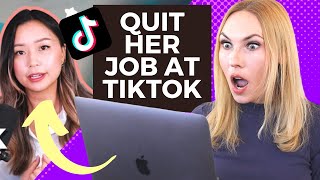
Chloe quit her lead PM role at TikTok after becoming the team's most tenured member. She left because of unclear promotion guidance, a brutal culture of 12-16 hour days across time zones, sparse women and BIPOC leadership, and health damage including sleep disorder and anxiety.
Chapters
Today I'm reacting to why I Just Quit my Product manager job at TikTok by Chloe of Colors of Chloe hi.
I just quit my job at TikTok.
We are hearing a lot these days about people throwing their hat down saying I don't want to work at this company anymore. A lot of resignations. I hear that there's a lot of tea spilled in this video, so I'm excited to dive into it from both a job search strategist perspective and also human resources leadership leader perspective. If you're new to this channel, welcome. I'm Madeline Mann. I am an expert in HR and the job search. You may have seen me in these places New videos on Thursdays let's jump into the video.
Yesterday was my last day at TikTok as a lead Product manager and I'm gonna talk about why I left. I thought a lot about whether I should share this publicly because it's so sensitive and risky to my career. It's always safest to say nothing. But the truth is a lot of tough things happen in our careers and we barely talk about it and so the same mistakes get made over and over again and it doesn't help anyone.
I was extremely impressed that Chloe posted this video the day after she quit TikTok because I've shared with you some things that happen in my career, but I typically wait several years and she's right. There is a risk to sharing this. So major kudos to Chloe and let.
Me tell you, I have gone through my fair share of toxic, unbelievable work experiences and I've never spoken up about them.
Yes, raise your hand if you've ever been a part of a toxic work environment. Put I've experienced toxic in the comments.
If you have, for some context. I joined end of last summer as a third PM hire. The two PMs before me quit. I quickly became the most tenured p.m. of the department. A lot of things happened, but it ultimately came down to four main reasons. Number one, lack of support in my career growth. How I normally approach this is that I usually have a formal career development conversation with any new manager that I work with in the first month and then I have that conversation every two months after.
This is something I love. I always say that if you are asking for a promotion or a raise by the time it's time for the official performance conversation or the time that they're reviewing all compensation, you've waited too long. You want to, exactly as Chloe says, be proactively having these conversations and asking what is the path to A promotion. What is the path to a raise?
I had many career conversations with the senior leader I was working with, and they were always like, oh, yeah, of course I will support you. And so two months before a performance review cycle, I popped the question, do you and the leadership team feel confident in nominating me for promo this cycle? They were like, no, your output is not enough. And I said, can you clarify what is enough?
This is so important. You never want to combat someone on something you don't fully understand. So I love that instead of saying, okay, I'll work on my output, or saying, no, my output's very high. Hi. She said, can you clarify? Love that.
And in my head, I knew I was the highest performer on the team. So where was the disconnect? They said, and let me read this. I cannot describe what output is the next level, because I didn't look at the leveling rubric. I cannot describe the work you need to do because I don't know it. You should know it. Then convince us and explain why it's important. Then launch the project, and when performance review comes, we look at your outcome and see whether you are worthy for promotion.
What they're essentially saying here is they have no idea what the performance standards are. And from what I know about TikTok, is that they're a company that has grown extremely quickly. And so it's actually not out of the realm of possibility that this would be pretty disorganized. Now, when a company says, basically come up with a case of why we should promote you and prove it to us, the issue here is that this creates a lot of bias. Typically, the people who then make the best case or are perceived with more leadership qualities, AKA people with certain backgrounds, characteristics that are more commonly associated with leaders, then those people get the promotion. So this is a problematic way of going about this, but that's essentially what they're asking for here.
My last tip to you is, don't pay attention to your job level, Just do the work. I said, I get it. I'm all about that entrepreneurial spirit. But leveling is a very real topic to discuss. Previously at Facebook, I had sponsorship from a manager, but I got blocked by HRBP because of leveling issues, and I just don't want that to happen here. And then they said without a beat, maybe HR had a different reason. They couldn't tell you. Maybe it's that you haven't demonstrated the capability.
It really seems like here, based on the way she's telling the story, that they are really trying to keep her from having this conversation, constantly putting it on her and skirting around the question of how can she get promoted? What steps are there? Because they can't really give any proof that she's a low performer.
Managers were there just to judge performance. They weren't there to lift the teams and elevate them to the next level.
Okay, A manager should always be someone who is in service to their employees, to their team members, making sure that they are being effective. That's the entire purpose of a manager, not to judge performance.
Number two, culture to give you a sense of what work is like. TikTok is owned by ByteDance, which is a Chinese company that is about over 100,000 people. You might have heard of 9 in 6 culture from China, which is working 9am to 9pm Six days a week.
Nine, nine, six. So brutal. I hear so much of this culture these days of be your own boss, leave the nine to five and become an entrepreneur. But yet what I see so many people do is they leave the 9 to 5 and when they're an entrepreneur it's like a 9, 9, 6, where they're working around the clock to get their own business up and running. This is my little warning to you of we can find jobs that are exciting, that are going to light you up, that aren't draining, that are not going to make you work around the clock like this. Not necessarily going. Entrepreneurship is always the right way unless you have a really sustainable way that you can do entrepreneurship. So just a quick plug there.
I'd have UK meetings from 8 to 10am and then US meetings from 10 to 6pm and then Beijing meetings from 7pm to like midnight. There was kind of a bizarre meeting culture too. About half the time I would have one on ones and senior managers would be like 15 minutes late or they would reschedule the meeting when the meeting was supposed to start. I regularly worked around 12 to 16 hours a day and I really questioned whether or not I could do this should I ever become a mom.
So this is an important point here, is that when you are looking at job opportunities, it's so important to not focus solely on the title product manager or the company. TikTok, that's a brand name, I love using their application. I'm passionate about their application. That's not enough. You shouldn't necessarily join a company because you're interested in their product. You actually have to make sure that your company aligns with your values. So if one of her values is being able to spend time with family and friends and potentially be a mother someday. This job is in complete opposition to this. Make sure that you are not blinded by the shiny names of these companies and you're being so excited to tell your friends and family that you work there when really you're going to be miserable day in and day out.
Outside of the hours, the culture was also a little harsh. And I don't mean the lack of happy hours or swag or no meeting days or awards. Culture to me is how people treat each other behind closed doors. And behind these doors I saw that people were kind of mean and they got away with it. There was this big emergency and I had to whip together this like insane proposal. Ultimately it didn't work out, but I shared my learnings with my core team, which I think is a very important thing to do so this doesn't happen again. Right after I shared a senior manager straight up said, let this be be a lesson to you to do your job right publicly in front of 30 people.
So one thing in a company culture is assuming positive intent. So if someone's being mean to you repeatedly and putting you down and perceiving what you're doing as having the wrong intentions, that's a huge red flag.
I talked to some of my colleagues about this and apparently there's this thing called workplace pua. PUA stands for pickup artist. And it comes from how pickup artists use emotionally manipulative language to get people to question their reality and then take advantage of them. When translated to the workplace, it refers to when colleagues and senior managers attack your character and your identity instead of your professional behavior. It's kind of like nagging and sometimes gaslighting. I learned that it was happening to me on a number of occasions and I felt crazy. I cried a lot. People I thought I should have trusted said some really hurtful things and it sucked.
Yeah, this is a common thing I've seen with a lot of employees. You are told by people who have higher status, who maybe have years and years more experience than you, that you are missing a gap, that you are not competent. And yes, it can really mess with your sense of self.
Number three, diversity. Big surprise. There was a significant lack of women and bipoc representation in the managerial and leadership roles. I mentioned that earlier that when I do become a mom, I wouldn't be able to work here. And I think a lot of people had the same thought.
Okay, so that's a really important point that is made many times over in industries like tech and consulting. One of the best solutions is to really Build a more balanced culture. Even if you look at studies of employee productivity, there is actually a ceiling of productivity after a certain amount of hours to where it's not advantageous to continue working people to the phone. As she said earlier in this video, she was the most tenured person on her team and she'd only been there for about a year. So that goes to show how much turnover there is. And it's so much better to have employees for long amounts of time. You don't have to retrain people, the retention there. And then they keep all of that internal knowledge. It's just a really. It's a better practice to make sure that your company is thriving.
I went to her first Woman in Product session. I decided to share my experiences of negging and being gaslit, and I just ended up bawling. It was a really vulnerable moment for me. And afterwards, six ladies reached out to me to tell me that they were actually going through or had gone through or no teammates that are going through going through the exact same thing. And a couple of them said that they were native Chinese speakers and that it wasn't a language issue. It's not you, Chloe. It's actually a problem with the culture. And just hearing those words from them gave me so much inner peace because I've been explaining this to my male colleagues, and some of their first words were, oh, I don't experience this. It must not be a thing.
So this is pretty common as well. I've seen this in organizations before. One incident of something being insensitive or off is seen as an isolated incident. But when you collect them across dozens, hundreds of people, you realize that, yes, it is a D, E and I issue. And so while, yes, the people who are impacted can speak up, and that's extremely brave, I understand why they don't always do it. So what's so important is for all of us to take classes on diversity, equity, inclusion, read books, do research, understand what are the signs so that we're, first of all, we're not contributing to the problem. And secondly of all that, we are intervening when we see things like this happening.
Number four, health. Yes, TikTok is notorious for having really intense work culture, as you can see on blind. And I'm getting to the age where I can no longer stand it. I actually think I developed a sleep disorder from working so late into the evenings. I am doing sleep studies and frequent checkups for it. But especially knowing that the majority of the company is awake when I am supposed to be sleeping gives me so Much anxiety.
I actually experienced this. So I work on the west coast. Even just having people on the east coast getting their days started three hours before me, I always wake up and I kind of am in a flurry. And what's so important to note is, like I was saying earlier, it's so important that we're choosing jobs that will prioritize things that we value. Our time and our health are things that are non negotiables. We need to make sure we're prioritizing those. I really, really emphasize to talk to employees who used to work at the companies you're interested in working in. Why former employees? Well, they will give you the dirt. A lot more unfiltered than current employees. I just want to make sure that you don't dive into a role that.
Has you compromising your health from a mental health perspective. Yes, I had been severely impacted. I've talked to my close friends about it and they've seen me through the ups and downs of me feeling frustrated, crying and feeling devalued. And they said that there's no amount of money that's worth your health, that you would have years of your life back.
Yes, there's no amount of money that's worth your health that's worth taking away so much time from your family. It's not about having the big shiny name on your resume if it is at this cost. The way we live our days is the way we live our lives. So make sure you're making the right choices with your career move.
I couldn't really invest in my relationships with my family, my friends, my partner. My evenings are all booked and I'd constantly be eating my dinners over work meetings, which felt really sad to me. So now space for my health has become a non negotiable.
So I want to say thank you so much to Chloe for sharing her experience. We all learned a lot from it. And I will say that there are also probably people at TikTok who love it and there's certain dynamics and on certain teams that are amazing. So we always need to balance different perspectives. But if you take one thing away from this video, look before you leave, make sure you really understanding what you're getting yourself into. Talk to former employees, really do your research on companies and also make sure you understand your strengths and your values before taking a job. Because if you don't know yourself, you won't know what job to choose. And I absolutely do not blame Chloe for choosing this role at all. That's not what I'm trying to say. I want to make sure that your health, your well being, your time spent is the best possible thing. Because personally in my career I've had multiple jobs that have absolutely lit me up, that have been extremely healthy, non toxic work environments that really made me excited to go to work every day. And you can have that too. Can you relate to Chloe story? What would you add to this conversation? Leave a comment below. Make sure you like this video and subscribe to this channel. You've got this wi Fi high five.
More from Clegg





AI Won't Tell You the Full Truth | Arthur Brooks + Simon Sinek | A Bit of Optimism Podcast



How To Make the Best Decision | Arthur Brooks and Simon Sinek | A Bit of Optimism


