Forget Gas Stations… Try This Instead!
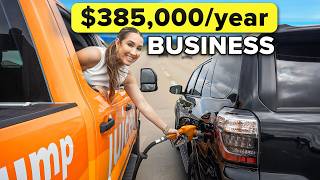
Corey and Caroline built Juice Fuel to deliver gasoline and diesel to driveways and docks. They grew from zero to multiple cities in three years using a simple model: fuel markups, delivery fees, and subscriptions. The operation runs on trucks, skids, and a mobile hose system that works for cars, boats, and fleets.
Questions this video answers
$77,000
$385,000
Over $1,000,000 (one plus million)
Four trucks
Three tankers (mentioned earlier)
Chapters
These guys make a million dollars a year making sure you never have to go to a gas station again. It's called Juice Fuel and they deliver gas straight to your driveway. No stations, no waiting. And nobody else saw this opportunity. Corey went from flying Apache helicopters in the army to building a seven figure business with his wife Caroline. No big tech, no investors. Just execution on a business model everybody else overlooked. Let's talk about how much revenue you guys made year one. What were we doing?
77,000.
Holy crap. OK, perfect. Pretty dang good.
Year two, 385,000.
Holy hell, that's a jump. Year three, though, one plus million. Nice job. I want to talk about, like, what, what changed?
We didn't want to be stuffy. We didn't want to be unrelatable. We wanted to show like average people can do something like this. And that's kind of like what drew our audience in. Pushing those family values, I think really is important to people because on a lot of my phone calls, people say that's the most inspiring part about this, is that you're working with your family and they want to do that too.
What's the most unhinged thing you've done to get customers?
I mean, my Instagram account in general just insults people daily. Apparently they get so triggered over the most basic things. And what that does is it leads to engagement. And engagement is really what builds our business up.
What you guys do here is deliver fuel.
So we have distributors come, bring wholesale fuel.
That means cheaper fuel.
Cheaper fuel.
Okay.
We take that fuel and we bring it directly to the customer.
You mark up the price because you deliver it to somebody else. Just like my Uber eats, but for gas.
Yeah, that's right. We're a mobile gas station.
Let's break down some of the costs here. So in order to do this, you needed not one, but three tankers. What do these bad boys cost you?
If you're moving enough volume, it doesn't cost anything. It's built into the freight rate of the supplier.
Oh, amazing. So basically you were like, we have a lot of customers. Give me this big holder.
That's right. Very simple. Business landed. Fuel price, you know, we mark it up and deliver it also.
You guys, what the. With that spider? Look at the size of that thing. Do you see that thing? Is he. Is that your mascot?
Protecting the Tennessee.
Corey tapped into something called domain expertise. This is a real advantage. Where do you already know an industry, a sector, maybe just a division of a company that you can tap into and make that company your own. He knew about oil and gas. He knew about delivery. He had worked on offshore rigs. So he's like, how do I just take this? Make it a little smaller so I could start it, but it doesn't have to stay small. So are you ever driving now?
Occasionally, when we get really busy.
But for the most part, you're doing this more than you're doing this. That's right. What were you doing at the time?
Caroline was pregnant with our second kid and she hated going to the gas station.
I do hate it too. I would totally use your service.
And, you know, me being the pragmatic husband, instead of saying, I'll go fill your car up for you, I was like, let's start this business and try to disrupt 100-year-old industry.
Corey didn't just build a company. He. He picked a recurring revenue business model in a high friction, high retention industry Instead of building the 900th dating app. Okay, we're on our way to go fuel a customer right now, right?
That's right.
But how do you know where to go? Can you explain how this app works?
Yeah. So when the customer places a request, they have to put in their address and the type of vehicle or boat that we're filling. And so they put in the address, and my guys just plug it into their GPS and go. Vehicles are a moving target. We don't want our customers waiting on us, know, to be there between 8 and noon or something. We want to be there within that 30 minute window that they selected.
I mean, I think one of my favorite plays in boring businesses is taking these old school businesses, adding modern tech and marketing on top of them, and then rolling them out again. You know, people think gas delivery, what, I'm going to be a gas station guy. That's not very sexy. But they don't realize, like, most billionaires got there from something super boring. So I think it's really smart.
Fuel delivery has been around, you know, ever since fuel has been around. So this isn't a new concept. Don't do any marketing. It's just referrals. They've been around for 40, 50 years. And so when someone like us comes in with a little bit of technology enablement and a little bit of marketing prowess, it's easy to disrupt the status quo.
All right, we're here. Let's go fill up some boats, huh?
Yeah, let's do it.
This looks sick. I kind of like this job. Simple businesses just scale better. You know what I love about this? You don't have 200 trucks and tons of Warehouses. You got a couple trucks. You got this thing. You've got really three types of customers and a business model that includes gas, subscriptions, and an app. That's it. Simple businesses simply scale better, especially when you're brand new and you're just learning how to do this. Okay, so how does this work? We've got our cart out here.
Yeah.
Do we need gloves off?
You might want your gloves for this one.
Okay, so now we've got this out here. It's connected here to the actual gas tank.
That's right.
You just got a typical crank.
Yep.
And we just pull it to put.
It in the boat. Yep, just pull that, Walk it out to where you need to go.
Okay. So we're going to fill up this guy's gas tank. But I'm wondering, what was it like when you first started this business? What was a day in the life of Corey?
Yeah. So, you know, when we first started, it was just the one truck with two tanks. We could only offer regular and premium. And so it was, wake up. What deliveries did I have for that day? And then it was, you know, back to my nine to five.
And then you're actually doing the fueling for the first year. This is you.
That was me.
Okay. And then year two, that started to change. So then what does your day look like in year two?
So year two, I hired some drivers to do this for me, but we were also growing. So I was also still delivering when we got busy. But we also added this service, you know, going out to boats in year two.
Okay. So year two, you're still driving. Now you're in year three. How often are you doing this? As opposed to our buddy and now me here doing it as little as.
Possible because we're just constantly growing. I'm focused on the scaling of our business. So we've got four employees now that are doing this. But, you know, this customer, we're here every week filling up five boats for him.
Dude, I love it.
That's not where the gas goes.
This is how we do it. Oh, my God. It's a penis. What is wrong with people? That is wild.
Here's your fuel tank.
Okay.
Right here. There we go.
Nailed it. Am I hired?
You're hired.
Okay, so you like this?
So you would give the tank operator thumbs up. You're ready to go.
Okay.
He'd turn on the pump.
And we're off.
Yo, I invented this. I don't want to say invented, but I came up with this solution to be able to not limit us to the Length of the hose right here, we're only a couple hundred feet. So you can almost get away with dragging a hose out here the whole way. But in Charleston, with the tides going six feet up, six feet down, with high tide, you have these long docks. So you'll see footage of us going out to 700 Foot Dock. And we're able to take this mobile solution to wherever we need to go. So we're the only existence not at this capacity, 100 gallons. So yeah, we're able to carry 100 gallons at a time out as far as we need to.
Do you have a name for it?
No.
What kind of brandy? And I thought you guys were good at this. You gotta name this.
We missed something.
Yeah, yeah. Okay. I'll get the white.
The juice box. Got it.
Oh, that's cute. I love that. Heard it here first. Nice job. Did you think it was going to work this well or were there lots of points where you were like, this might be a terrible idea and I might lose everything?
Well, there's certainly challenges. It seems like every step of the way. But I saw that our customers weren't just family and friends, and I saw that their customers weren't going anywhere. So I was like, man, if we just put a little bit effort into getting new business, these customers are very sticky.
I feel like if you're an entrepreneur right now and you don't know what your lifetime value is of your customer, how much do they pay you, or even what the annual value is of every single customer, you could just have a leaky bucket, keep filling it all you want and never realize it. But that's not what you guys have.
That's right. Our customers seem to stick around. And even if they don't like the subscription, we have a non subscription model. So they can just downgrade and we can still nurture drip campaigns. All those marketing techniques that we use.
The number one thing we want to try to do is we want to lock them into a subscription recurring revenue, and we want them to pay us every month. And we want to have their credit card on file. And we want that because typically they churn the lease. But also because when we, if we were to ever sell the company, that would be the most valuable customer. But if you can't get that, then you're like, we downsell them. So, like, no matter what, we either want to sell them more things or sell them something less expensive, but we always want to sell them something.
Yep.
Which is the name of the game of business.
That's right.
Here's what most people miss. Corey didn't start juiced fuel by buying trucks or hiring drivers. He started with a landing page. That one page told him everything he needed to know. Would people pay for fuel delivery or not? That's how smart entrepreneurs do it. Test the demand first, build the business second. And if you want to do that fast without wasting days googling, how do I make a website? Use GoDaddy Aero. It's their new AI powered tool that turns business ideas into a domain, a website, even full blown marketing in minutes. You bring the idea, Aero builds the proof. Most people waste weeks in startup mode. The smart ones, they go to market fast. Big thanks to GoDaddy for sponsoring this video.
Head to GoDaddy.com backslash Cody Sanchez to.
Try arrow and get your idea off the ground today.
What do you think is going to happen with this industry in the future? Like do you think there'll be a juice in every city?
That is certainly our goal, to be in every city. You know, the gas business has been highly fractured, you know, for forever. I mean, the largest retailers own, you know, 6% of the market. I think as mobility services become more popular, there's an opportunity for someone to be the winner. And we're going to be that winner.
Mobility services, you mean we deliver our food, we deliver our clothes, we deliver everything on Amazon. This is now getting normalized.
Yeah. You've got two things going. One, everything gets delivered. Two people are inundated with so many options they don't want to have to figure out, okay, which fuel points program am I going to? Loyalty program am I going to choose? There's so many things out there. And so our service is one that once you convert, like we're your gas people, there's no one else you need to go to. We're there on time and we deliver at a fair price. So you don't need to figure out, you know, how do I use my Harris teeter points or whatever.
You've got how many trucks now we're four trucks. Four trucks?
Yep.
But you started with one.
Started with one.
What does one truck cost you?
I bought that truck for 45,000.
This, this truck is 45K. 56 for a new one. You got it. 45. Do you finance that or you buy that with cash?
Finance it. And then the skid, you can also finance 24,000 for a skid.
What is a skid?
That is this whole system. So it's built in. One drops in the bed of the truck and you can deliver fuel out of it.
Wild. Can you come show me what we're working with here? This thing typically costs you 24k, but that's not how you bought it. What's the deal?
I had one that I started with and as we were growing, I knew I needed more. Quickly found these two from a company out of New Orleans that had shut down. I was able to get 2 for 20 and rank.
Love an asset sale. You could always try to find a cheaper way. And a lot of Times it's because 90% of startups fail, right?
That's right.
And so if 90% of startups fail.
What does that mean?
All of their stuff goes with them. So how did you find this? Is it just like a Facebook marketplace?
We post everything we do on social media. And so they actually found us. They're like, hey, I have the same equipment that you have. You want these? And so I was like, hell yeah, let's go.
You kind of seem scrappy in everything that you do. You guys didn't even start this business with a ton of capital. Like, your story is incredible. Can you tell us how you actually started this thing?
Yeah. So we joined a incubator to start with and their whole pitch was, you know, napkin sketch defunded. So they built like our original MVP version of the app. I was gonna take that to go raise money. And it was funny, during that process, that incubator actually shut down and went bankrupt. And fortunately I was able to get our assets out of there and just do a quick friends and family raise to get things going. So I raised a little under $100,000 to get started. And that's always taken off.
That's wild. And before you even started this business, you did something that I think was amazing. You did some pre sales, right? You tested the market.
The first thing we did was run some meta ads and does anyone want this? Is there a market for it? And so built a landing page, ran some test ads, and we were able to determine a click through rate and people actually signing up for this business that didn't exist yet. And so the same pro forma I'm using today to map out our growth is based on that click through rate that I ran before we did anything.
That's wild. I mean, I don't think people realize that the biggest reason why most businesses fail is you never start them and then you never test them to see if somebody actually wants to buy your thing. And you don't even have to have the business to do it. Okay, I think we should talk pricing and how you Guys actually make money. Wanna take us to pricing school?
Yeah.
Okay, so how much do you charge? What do you sell, what do you make?
People are very price sensitive on fuel. Ever since you started driving, you see, like to the nine tenths of a cent of the price. Right. Rather than marking it up a dollar a gallon, we mark it up based on how we source it. And then we add the delivery fees or the subscription fees on top of that. You see here, we can source from our supplier or we can even go to Costco. And then we're selling that for 299. So that's our cheapest commodity. Regular gas, we're making about 30 cents. And then a delivery fee or subscription on top of that. And then premium, we're making about 60 cents. Diesel 55 cents or so ethanol free. We're $1. $1.15 for that.
And that's for boats?
That's for boats, yeah.
Okay. And those people are probably way less pro price sensitive, I would imagine.
Yeah. The marinas help us out there because they're so much more expensive that we have a built in margin there that we can compete with.
Does the marina ever try to kick you guys out?
So we don't go into the marinas, but we can bring it to a customer's private dock and be cheaper than a marina and they don't have to take the time to go fill it up themselves and all that. So that makes sense. A win win.
Yeah. So the dock actually don't care unless they're owned by the marina.
That's right.
And if they're owned by the marina, I imagine they don't let you guys in.
Yeah, they offer fuel, they won't let us in. But we do partner with marinas that don't have fuel. And now we can give them that amenity for their customers without making the investment to put in tanks and hire people to do that.
Is there like a huge marina conglomerate that owns most of them?
Yeah, the sea couple, like Safe harbor is a big one. They own several of the marinas around here.
Do you think they eventually try to buy you guys?
I'm always listening.
He's like, there's always a number. Okay, this makes sense. We're making anywhere from 30 to $1.50 per gallon. So how do you guys make money? You make money. So the way one is what we call this like gas markup.
Yeah. Margin on fuel.
Second way is subscription.
Yep. Delivery fees.
Dude, I love it. Simple business model, but three ways to upsell. Okay, so somewhere between we're making 50 cents to $1.50 per gallon per customer on average. How much is each customer buying from you? Or is there way too much variance.
Way too much variance between a fleet and individual. But the individual vehicle spends 2500 a year on fuel. And so a family of two looking.
At 5000 a year from our cheapest customers that you guys have, they're spending like, I don't know, 120 to 500 bucks a month with you.
Yeah.
So that's. That would be. This is what's called residential. Right. And what's your most expensive customer? Like, who's your biggest boy?
Yeah, big boats, ethanol free. We're making close to $2 a gallon.
But, like, how much do they spend with you per month?
So it's a little bit seasonal, but some of these. Some of these bigger, take it by.
Year and annualize it.
Okay. Yeah. So we're probably doing about 150,000 just in Marine.
Okay. And this is like, marina. What are your. What's your biggest fleet customer?
$34,000 a month for one fleet customer.
So that's what I thought. The business is commercial. Like, that's where you want to be.
Yeah. So we look at this, these residential, almost like marketing.
They can be a loss leader. We can actually even lose money on them because those are ads.
Yep. And those people own boats and they own businesses. So they see our trucks coming through their neighborhoods.
Then you get these too.
That's right.
So then we got subscriptions. What do you charge here?
$30 a month.
And that's for residential?
Yep. You get two vehicles per month.
I like that.
Okay.
And then what about boats? They don't have subscriptions.
No subscription. Because they're unpredictable. But a boat on a dock, we charge $24 delivery fee. If it's on a trailer in your driveway, it's just 12 bucks.
So this is boats. So 24 bucks for 12 bucks. Cool. And then what about fleets? How does that work?
Fleets varies based on how many vehicles they have, how often they need us, but it's anywhere between like 8 to $12 per unit.
And so it's only delivery fees.
Yep.
Okay, interesting. And that's per car. Okay, fascinating. So, so basically what you said is, like, we know that we really want to get these fleet and boats, but they're going to be few and far between. So we can also have this, like, sort of consistent. This revenue is recurring.
Right.
And easy and cheap to get, I bet. But all the real margin is here. Yeah, that's fascinating. What a cool business.
Model.
I mean, I don't want to tell him, but it seems like he's underpriced. He's pretty cheap. I would increase these prices because that's a pretty good value for every single person that's using that. Let's talk about how you can get your money back as quickly as possible when you start a business. And a couple of metrics you need to know that Wall street does not want you to know. First one, we're talking in return on investment. But actually I want to talk about the velocity of your return on investment, which basically means how long does it take for you to go from $0 to money spent to money returned back to you? In this case, the payback period of $80,000, which was what it took to operate this business in year one, was about 12 months because they made 77k inside of the first year. This is an incredible return. And I think most of the time we don't realize that we're like slowly bleeding out a small amount of cash. Everybody talks about revenue, but when do you actually get your money back? Because that's the thing that matters. All right, I wrote down a bunch of ideas of what I would do in this business. First, I would test pricing. I think that he should increase his pricing slightly for some customers. You want to take care of your people, but you also need enough margin to keep scaling. So I would test some varying pricing tiers. Second, I think we should go deeper with commercial. He's already got a lot of commercial contracts. About 60% of his business is commercial. But I think we could accelerate that. And the best way to do it is called the center of influence strategy. Find the one or two or three people in your city that are connected to just about everybody. And then instead of doing ads, you actually just want to ask them for referrals or maybe even do small dinners to get them together. Next, I would think about bundled services. So we're already selling them gas, but what else could we sell them on top of it? The hardest part is getting the first customer. Once they've said yes to you once, getting them to say yes to you again is not so hard. So I would start thinking about what else could we bundle. This one's a big one. Government contracts. Cory's former military. If I was him, I would be thinking about what government contract could I apply for. He's a vet. It's a family owned business. It's a local business. I bet there is a ton that he could do on the government side. And those contracts are long and they are usually big. Corey and Caroline didn't wait for some sexy, perfect business model. They picked something simple, profitable, easy to scale, that didn't take much cash up front. I think we were lied to about business. They told us it was really complicated, that it was for other people, not us, so that they could build the businesses and buy them, not you and me. The entire point of this channel and everything we do is to break that. So if you haven't already subscribed, you should. You should also watch this other video because he did the exact same thing.
More from Codie







He wouldn't give you the dream if he didn't believe you had what it takes. You have what it takes.



What’s the one thing most job seekers overlook that could get you hired faster than you think?