Why Even Harvard Graduates Are Struggling to Find a Job
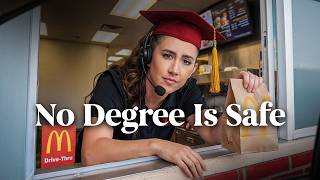
Codie Sanchez argues traditional MBAs are too expensive and slow for the AI era, pointing to Japan's business succession crisis as a warning. She says trades and buying existing small businesses offer better returns than a Harvard degree, and pitches her cohort-based alternative, Contrarian Academy.
Questions this video answers
January 1981
$32,000
$200,000 (cited as typical cost)
5.5 million (speaker's claim)
Over 3.5 million
Chapters
This building behind me costs students and taxpayers hundreds of millions of dollars. But what if I told you the entire institution might be built on a lie? Because if education is supposed to be an investment, MBAs are starting to look like a scam. You're paying 200,000 to learn outdated frameworks from professors who've never run a business. What if the smartest thing was skipping school altogether and doing this instead? By the way, I'm Cody Sanchez, founder of Contrarian Thinking, and we've built dozens of businesses with mostly non MBAs. So remember, throughout this, what we're getting into in this video, anyone can do. It's not about the money you have. It's not the education you have. It's something else entirely. Let's get into it. See, I spent the last four years teaching other people to buy and build businesses. I worked on Wall street for a decade before we built out our holding company, investing in everything from robots to roofers. And I also made a bunch of videos on the Internet. Or as my grandma says, the that's a job. So today, I'm going to start us with a powerful idea. Education is investment in your future. But if traditional business education were a stock, it would be the worst performing investment of the next 20 years. If you want to go study business, where should you go then? It's a rhetorical question. Kind of. Because of course you'd go to business school, right? Except today I'm going to show you that is no longer an obvious choice at all. Here's a recent article from the New York Times. Since you guys don't have bionic vision, I'm just going to tell you what it says. It describes how businesses are complaining about MBA graduates. What frustrates them. You guys have probably heard this before. Over reliance on mathematical management, expectations of becoming a CEO in four weeks. It also warns that at a time when American business is changing, business schools suffer from cookie cutter syndrome. They offer insufficient training for entrepreneurship and small business. My guess is some of you are sitting there saying, yeah, that sounds about right, except I lied to you. This study isn't recent at all. It's from January 1981, or almost 50 years ago, when the starting salary of a Stanford grad was $32,000. Now, let me be clear. I got an MBA. It opened doors for me. And the top schools know their customers. Like, what are us millennials more afraid of than war and death? Fomo. They're afraid of missing out. And what do the top schools really do? Well, they foster elite networks or the idea of them. So MBAs will tell you the network alone is worth the cost. And yeah, you could say maybe that's true. Because look, The S&P 500, arguably one of the best wealth creation tools in history, is like, largely a network of MBAs. But bottom line MBA programs, while they cranked out plenty of talent, today they're facing what I think is their first real crisis of purpose since creation. Two reasons. One, they're just not getting people jobs like they used to. Which explains this, why these poor guys who took the traditional elite MBA path get a degree, get a role in finance, big tech, or consulting, AKA some of the industries most immediately impacted by AI driven disruption. Who cost cutting, are now asking why? You know the old saying, nobody ever got fired for hiring McKinsey? New saying, good. Chances are you'll get fired by working at McKinsey. Good luck with your layoffs. All right? I hope your firings go really well. Thanks a lot. Great. And then people will say, well, what about MBAs for entrepreneurship? Well, one of the most successful business builders in history. Sure, many of them have MBAs. But go to a party in Silicon Valley this Friday night and tell people you have one. Cringe. Nobody cares. To half the folks in the valley, getting an MBA to learn entrepreneurship is like going to celibacy school to learn sex. How'd that get in there? Just doesn't make any sense. And so new college grads are facing their cohort's worst relative unemployment numbers in decades. Young male college grads in particular are having as much trouble getting jobs as those who never went to college. Look at this headline. Student coders seek work at Chipotle. Ten years ago, do you think that people from Stanford would be working at Chipotle? But here's the really weird thing. Despite all this, MBA applications, look at this. They're rising double digits. Law school applications up to. Grad school applications up to. Even though you make less jobs afterwards. So some of our smartest young people are lost. And I think they're just buying time. Do I think if you have $100,000 right now, you should put it towards an MBA because it will make you more money than buying a business or getting in the game of business? No. If you want to learn business, go do business. I'm not a rocket scientist, but that seems to make sense. And so I think it's a huge disservice that we have turned this idea of a Master's of Business Administration as some credential that puts you in a place where you understand how to run a P and L where you understand what it feels like when you can't pay your employees on Friday because the business is not doing so hot. When you understand what it feels like the first time you get sued that you understand what it feels like to have something go really viral and not be able to keep up with growth. Your teachers have never felt that they have sat behind a desk trying to tell you the theory of business as told by the Socratic method. So that's problem number one. Problem number two, utility MBA programs, they don't adapt. They're just not relevant to a lot of people and businesses. And what do I mean by they're slow to adapt? This AI moves at warp speed but curriculum development moves at DMV speed. Years and 200k to emerge with skills employers found kind of attractive. In 2017, not a great deal. And then people will be like oh, but the brand association with a top school is worth it. Well not according to the brand. Where Harvard says here, going to Harvard is not going to be a differentiator. Says Harvard. The market no longer cares what's printed on the diploma. It cares what you can do on a Monday morning. And props to Harvard I guess for like telling the truth. But by the way, no one has single handedly made it harder to figure out how much to save for your kids college or grad school tuition than Sam Altman. You know it's either going to cost half a million a year or zero. And on that note, how about irrelevance? To be clear, business schools are still required and highly relevant for like a very specific set of jobs I guess. But there are five and a half million businesses with less than 500 employees in the United States. Most don't look like this. They look like this. The problem is only 5% say their parents feel the same way for them. Welding over Wharton? Not in this house, Jimmy. You're going to Harvard and you're going to be a doctor. Look at this one. 56% of Gen Z now believe that blue collar jobs will offer them more job security than white collar jobs. And 33% say that white collar jobs are less stable today than they were for their parents generation. As more of America's youngest workers take to the trades at Wisconsin School of Technologies and trades at Madison College, recent high school grads are filling classes and wait lists in construction, electric, plumbing and welding. Nationwide the number of 20 to 24 year olds entering the trades is soaring, doubling among electricians and H Vac mechanics in the last decade. So what jobs are they trying to get? What jobs should you get? Maybe the ones that appear more durable than any other. The trades. The three out of every four home service jobs are must haves, not nice to haves. And this is only going to rise. Why? Because boomers are entering their hip replacement era and so are their houses. Look how old these things are. And so the professionals needed to operate on them far exceeds supply. Now I am not an electrician or a plumber, nor do I look like one. But remember, I do own a lot of laundromats. And when you try to buy or own a business, you inherit every problem all at once. Hiring, firing, cash flow, competitors, banks. No pause button to figure it out. And so if you're ready to step into ownership and buy a business, one of the first things you need to do is set it up for success. That starts with being discoverable to customers online. Which means you need a website and a good domain name. Here's the good news though. Right now you can get a clean and professional domain name for just 99 cents with.online most.coms are already taken, so don't settle for something clunky or spammy like this. Instead, get a dot online domain name that your customers can trust Right from the start. Over 3.5 million dot online domains have been registered worldwide by major brands and small businesses like yours. And because the word online is searched over 500 million times a month, having it in your domain can give you a real edge. More visibility, more clicks, more sales. You can find dot ONLINE domains at most website builders and domain providers. But if you want yours for just 99 cents for the first year, go to www.get.onlinekodi6 and lock in your domain today. The hardest part for me there was no place to go learn this kind of stuff and apply it in real time to my business. No school made sense. I felt like I was totally alone. And of course what you realize over time is you weren't alone at all. There were millions of other business owners just like you out there for whom traditional business education just didn't make any sense for you. So I ended up creating something different to serve this community. I another way for current and aspiring business owners to get the tactical education they need. Here's the founding idea. There's a massive market out there for business education that doesn't suck. And it is not in lecture halls that actually teach startup game and implement it in real time. Not case studies from 10 years ago, but real deals happening that day. Here's what you need a distributed system with concierges and administrators who keep you on track and make sure you have what you need. Coaches to help you get through roadblocks every day. Badges to get gamify progress, share wins with your peers. Constant visibility into how others are progressing. Live calls where coaches poke holes in your active deals and improve outcomes in person. Meetups and camps focused on connection and tactical implementation. And with this distributed structure, you're actually able to build something that's a fraction of the cost of a traditional full time MBA, but 10x more valuable. So right now, alternative formats are serving thousands of people all around the country. So. So who should go to an MBA versus go to a school like ours? Well, here are some of our people's backgrounds. You'll notice they come from all walks of life. You've got nurses, you've got engineers, you've got people coming straight out of college. The future of education looks like this. And here's why we think that's so important. Last year, newspapers reported on Mr. Yokohama, a 73 year old logistics business owner in northern Japan who did something crazy. He had a 30% profit margin, 17 employees, equipment, nearly 150 acres of land. Yet he gave it all away completely for free. Because in Japan, business sales aren't the norm. Traditionally you pass down a company to a family member or apprentice, but there was no one left to take it. His children didn't want it, not his employees, no young people in the town, they moved to big cities. So he listed the business for free on the condition that someone, anyone, move to his small town, learn the trade, keep it running. And he's not alone. Look at what's happening in Japan. Japan is facing a demographic crisis that threatens the survival of thousands of businesses. Young people aren't getting married, so it makes sense that the birth rates are at an all time low too. The result? In 2021, 44,000 businesses in Japan were abandoned. More than half of them were still profitable when they closed. And the problem is about to get worse. Japan now has an estimated 2.5 million businesses owned by people in their 70s. Most of them do not have a plan for their secession. In 2019, Japan's government said it was going to be so bad by 2030 that 630,000 profitable businesses would close, costing $165 billion and 6.5 million jobs. That's almost 10% of their entire workforce. For context, during the Great depression we had 24% unemployment. At the peak, that would be almost half of that now. That May be Japan's fate 5,000 miles away. But I want to make sure this never happens here. I want you as an aspiring business owner to have the skills, network and education to thrive. Like if you want to run a plumbing business or a car wash, you don't need two years and a quarter million just for tuition. Every profitable business can continue to live on if you actually learn how to take up the baton. You know this country, we were entrepreneurs from the start. We were a group of ludicrous idealists who decided we'd rather get on a boat, leave everything behind and build something great rather than settle for somebody else being in charge. Everybody else thought that was dumb, and I think that we were right. As showed by the GDP of this country versus the others, more than 5 million small business applications have been filed every year since 2021. We should be damn proud of this and unrelenting in the support of them so we never lose this spirit. You want to know what unites Americans more than anything else? The institution that 9 out of 10 of Americans agree is the most positive force in our country. Choose church? No. Education? No. Military? No. Small business. You focus your efforts there, you make more money, and maybe the nation gets more secure. And if we do focus here, I think we'll see the fruits for decades to come. Which brings me back to where we started. If you wanted to learn how to actually build a business today, not raise venture dollars, not chase hype, but buy something real, built to thrive in the AI age, something you could hand to your kids, something that leaves a mark on your kids community long after you're gone, and actually how to do that relatively quickly and affordably, then there's only one place to do this. And that's what we call owner nation. You're already here with us learning for free on YouTube for that reason. And if you want to go a step deeper, we got you at Contrarian Academy where we do the exact same thing. This country wasn't built by MBAs. It was built by people who bet on themselves. People like you. So with everything that you know now about what's happening with AI, what's happening with MBAs, and this huge giant question mark we have over our heads, I think the question you have to ask yourself is what are you going to do about it? And if you want me to write a video telling you what I'd do, tell me in the comments. Because this, I believe, is one moment that we either get to choose to change this country or watch it fall.
More from Codie







He wouldn't give you the dream if he didn't believe you had what it takes. You have what it takes.



What’s the one thing most job seekers overlook that could get you hired faster than you think?