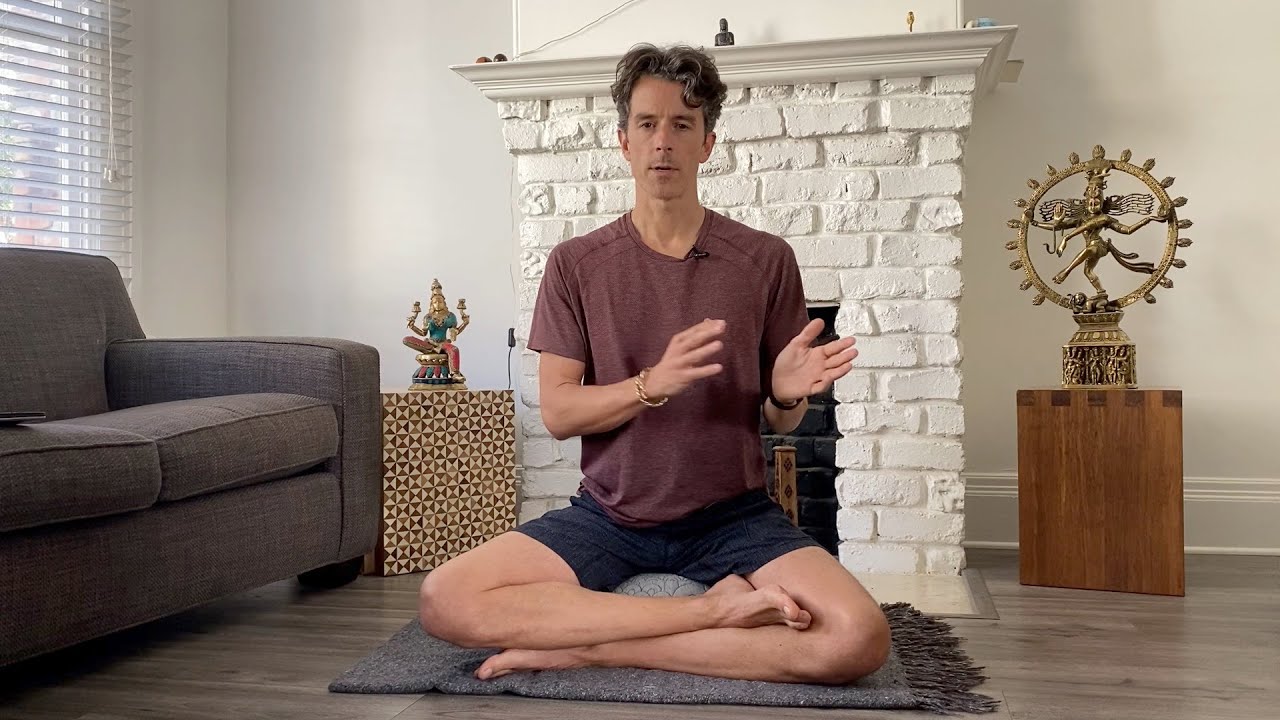
A 15-minute guided kriya yoga session with four breathing practices to calm the nervous system. The instructor explains how we mistake habitual stress for real stress, then leads through prana-apana mudra pranayama, alternate-nostril breathing, Sukha Shunya with an eight-part rhythm, and Amrita pranayama with visualization of golden nectar rising the spine.
Chapters
Namaste and welcome. Namaste. So today I thought we'd practice a kriya set for de-exciting and calming the nervous system. These days, who doesn't need that, right? Of course, a whole other topic will be how maybe we're not really stressed, we just like to think we are, and that we're just in this habit of feeling stressed. So, this practice hopefully will help us to break that habit and start to feel more regularly through our daily lives this calm, sort of abiding stillness that we can access today. So let's begin. There'll be 4 practices, about 15 minutes, and I'll walk us through each one, and we'll practice together, okay? So, the first of the 4 is Pranayama. This is a very grounding, centering, and stabilizing practice. In this one, there's 2 mudras. And so we have prana mudra, which is where the thumb is touching the ring finger and the pinky finger, and the index and middle fingers are extended. We'll have the palms facing up, resting on our legs as we do this one. We'll hold this as we inhale through the nose. Our eyes will be closed. And then just gently holding at the top, and then we'll exhale through the nose, keeping the eyes closed. But of course, first make sure you watch me. We're doing apana mudra now as we exhale. So this is the downward movement of the prana vayu, apana. And just one word of warning, if you're pregnant, then you want to skip this mudra, but you can, you can do the rest of this breathing practice. And so in this one, we're touching the middle finger and ring finger with the thumb and extending the index and pinky, and we'll just have those, our arms relatively straight, and this just kind of resting at the edge of the knees as we exhale through the nose. And so we'll just be going back and forth. You can follow me. But also you can go at your own pace. Okay, so let's begin. Prana apana. Okay, after this round, let go of the mudras, and then just sit quietly, breathing normally, in and out through the nose. Keep your eyes closed. We'll take a moment here just to feel the benefits of that. Very calming and grounding practice. And then slowly open your eyes. We'll continue with a breathing exercise called a lom v lom, and this one. We'll be using our right hand to open and close the nostrils. We're going to be balancing the left and right sides of the body and the brain through this exercise. And so, in this one, we're going to start by closing our right nostril with our right thumb, as we gently rest our index and middle fingers on our third eye, between our eyebrows. And then, we'll be inhaling through the left nostril, And then holding the breath gently at the top, just until it's comfortable. And then closing the left nostril with our right ring finger, exhaling through the right nostril. And then inhaling through the right nostril. Holding. And then closing the right nostril, opening the left, exhaling through the left nostril. And just going back and forth that way. We'll do this for about the same amount of time as we did the first one. So let's begin. Inhaling through the left nostril. Inhaling through the left nostril. Your eyes are closed, your spine is tall, holding the breath, and then exhaling through the right nostril. Inhaling through the right nostril, holding, and then exhaling. Inhaling through the right nostril, holding, and then exhaling. Just going at your own pace, keeping your eyes closed. Breathing in and out through the nose, alternating nostrils. Just a few more rounds here. You know, the breath is so powerful. It's the only bodily function that's both autonomic and sympathetic, and That means that, you know, it's something that we can control if we want to or not. And for that reason, I think it's the bridge between the mind and body, as they say. And learning to work with it can be so effective in maintaining your mind-body connection and in helping to regulate your nervous system as well. Okay, so letting go of the hand there, letting both hands just rest. On the thighs, keeping your eyes closed. Inhaling and exhaling through both nostrils. Take a moment to feel the benefits of a long balloon. Okay. Opening your eyes, we'll continue with Sukha Shunya. Sukha Shunya. Sukha is a Sanskrit word that means easeful joy, and Shunya is the infinite field of silence, which is also Shiva, if you're familiar with that. So this one is helping us to experience easeful joy and to have greater access to the infinite field of stillness. Deep inside of us, these these things always only exist inside of us, and what we're doing in yoga is we're cultivating them so that they can come out from inside. So in this one, we inhale in eight parts and exhale in eight parts. There's a little bit of a rhythm to it, so it's it doesn't require counting usually. But if you if it helps to count, I. I recommend trying that. We're going to always start with the nose. So we're going to inhale through the nose, and then inhale through the mouth, a little sip. And then nose, mouth, nose, mouth, nose, mouth. Hold at the top, and then exhale through the nose, mouth, nose, mouth, nose, mouth, nose, mouth. And we'll just continue that way. So it looks like this. Your hands are just resting on your legs. As you can see, we're not rushing through it, just going at your own pace. Inhaling through the mouth might take a little practice in the beginning, so just be aware that it may, it may not feel natural at first, but pretty quickly, I think, you'll start to feel right at home. So let's begin. Inhaling through the nose. Okay, just sit quietly. Keep your eyes closed, breathing normally in and out through the nose. With these breathing exercises, you may notice some energy moving or rising up the spine, or just being, feeling freed up in some way. And that's totally normal. In fact, you kind of want that over time, and it's part of the benefit of working with these kriyas and these pranayamas. In fact, recently I was thinking a lot about how a major impediment for a lot of people is not allowing yourself to feel good for some reason. I've had this challenge in the past as well, where There was a limit to how good I would let myself feel, and so I think there's a sort of practice and an intentionality around that kind of a limit or blockage as well that we can work with. Okay, and so the final practice here is a variation of Amrita Pranayama. Amrita means the golden nectar that's said to be sort of flowing. In the central energy channel of the body. And with this one, we're just going to have our hands resting on our knees once again. We'll be here for about 3 minutes, and we're going to be inhaling through the mouth as if we're sipping in prana, sipping in energy. And then holding for a moment at the top, and then exhaling through the nose. Let's begin that. Inhaling through the mouth, imagining as you do a golden light, or a golden nectar, rising up the spine. Whew. Exhaling through the nose. Ahhh. After this round, let go of the. Breathing exercise and just inhale and exhale through the nostrils, noticing how you're feeling. Noticing how much more present and grounded and just like yourself you feel. Now, this feeling is accessible to you whenever you want to practice. And today we did about 3 minutes of each of the 4. We actually did 4 minutes of the 3rd one, which was Sukha Shunya. So, you know, 3 or 4 minutes of each can be very powerful and very impactful. So hopefully you feel a lot more grounded and centered and joyful even. I appreciate you spending your time with me. And I will see you on the mat, hopefully. Until next time, thank you and namaste.