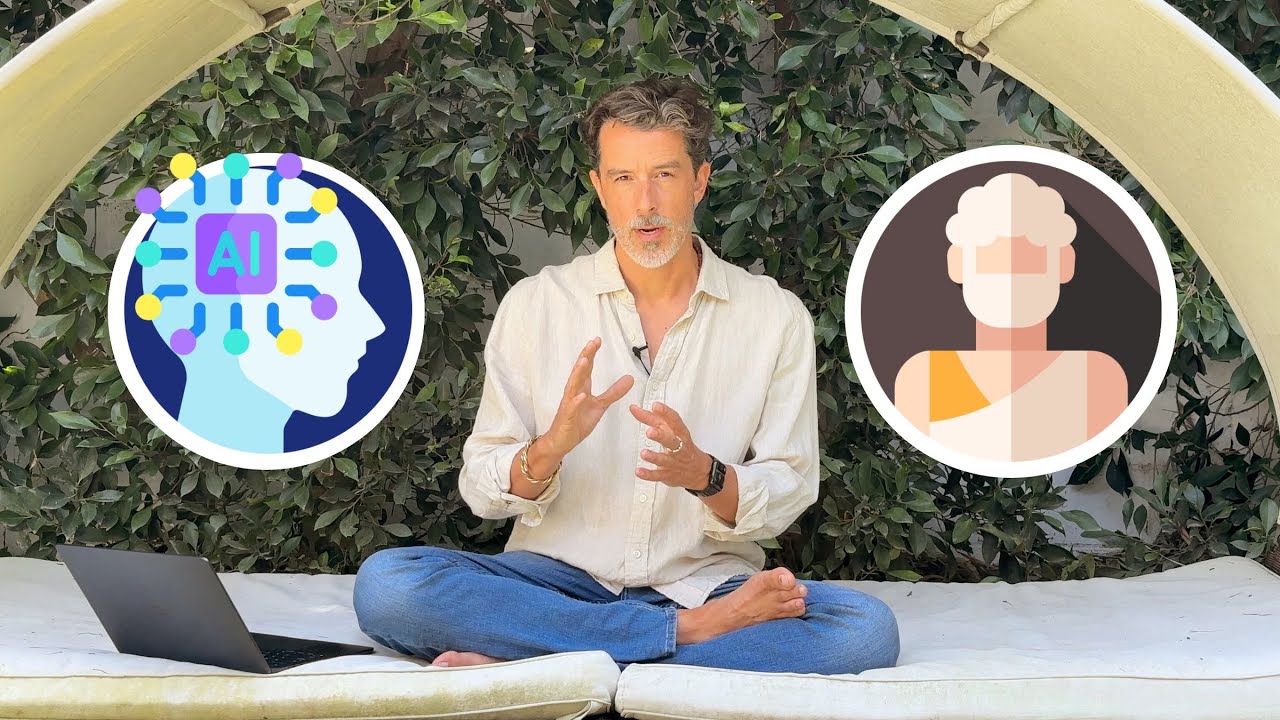
The speaker is returning to academia to study consciousness and AI after two decades as a lawyer at Google, Facebook, and Twitter. He's pursuing a PhD that bridges consciousness studies and artificial intelligence, driven by early work in AI during the 1990s, a transformative experience at Burning Man, and deepening practice in Vedic philosophy.
Chapters
So I'm broadening the focus of my content to include philosophy, cosmology, consciousness, and artificial intelligence. And this makes a lot of sense because that's what I'm studying currently in grad school as I work my way towards a PhD in consciousness and AI. But it also brings me back to my roots. It kind of comes full circle for me because Way back in the '90s, I was getting a master's in AI, and this was the early days of AI, so it was very rudimentary, sort of, yeah, just getting started in a way. It was part of, I think it's the second AI winter. So when I was in grad school in the '90s for AI, I ran into one of my ex-girlfriends in this bar in way up in upstate New York, and I was telling her what I was studying, and she didn't understand what AI was. Nobody really did at the time. And she was immediately concerned about what I was doing because I kind of phrased it like, I'm helping computers to be more like humans. And this was the time of like Terminator movies and all this dystopian science fiction. And so she was concerned that, you know, she told me that computers were gonna take over the world and, you know. that I should stop doing this, basically. And for whatever reason at the time, I was very optimistic, and I'm kind of an optimistic person. And so I tried to reassure her, and we ended up betting— we bet a dollar that computers would not take over the world. And so I guess that bet is still outstanding. I had 2 challenges in grad school, and one of them was my advisor. I had this advisor who was very myopic and just wanted me to focus on these kind of mundane questions of how to apply the current state of technology and AI to industry and how to, you know, create distributed systems to make elevators work better, all this stuff. And I was interested in the big philosophical questions, these cognitive science questions. What does it mean to be conscious, intelligent? You know, how do you make a computer think like a human? These are the questions I was trying to answer. And so I was always very much interested in the cutting-edge technology, and I was looking at— Chad Woodford. Genetic algorithms and neural networks and fuzzy logic. I was just, I was open to any and all sort of approaches to solving these problems. But there was this sort of tension, this conflict with my advisor, and he was constantly trying to discourage me from these technologies. And at the same time, the state of the art of these technologies was very early, very rudimentary. And so it was like I lost interest because it seemed like we were so far from making real advances in the field and there wasn't much I could really contribute. So I basically left the field and went into industry as an engineer for a while and then ultimately went to law school because I wanted to try to influence and shape technology and technology policy for the benefit of humanity, really. And that was my kind of intention, my driving motivation for law school. And so I did that. But what was interesting in law school was that I ended up kind of focusing on both IP and privacy and technology stuff, but also philosophy and jurisprudence and these other questions. And so that was kind of like this through thread of my whole life, which is basically philosophy. And so that's where I'm kind of headed right now, and that's why I'm focusing on that. But yeah, I worked as a lawyer for a couple decades in Silicon Valley. I was lucky enough to work at places like Twitter and Google and Facebook and Airbnb and some startups. And I also did some product management work. And, uh, yeah, I eventually had such good fortune that I took some time off, did some traveling, and decided to write a novel about spiritual crisis and what it means to be a man in the 21st century. So like often happens when you decide to take on a major writing project, it It sort of slowly and then really quickly changed my whole life. And the biggest piece that came out of that that's relevant today is that I ended up going to Burning Man with this camp that was all students and graduates and professors from the Philosophy, Cosmology, and Consciousness program at the California Institute of Integral Studies. And so I started to sort of enter that world in a sense, and it was simultaneous with this where I was going to India And very much deepening my practice as a yoga teacher and really studying Vedic philosophy and Vedic wisdom. And so bringing, you know, kind of exploring more of the Eastern traditions and then eventually coming back to the West and beginning this program where I could round it all out by studying East and West together. And so I'm bringing all that together. That's my part of my passion. And it's the perfect school for doing that because the school was founded by Alan Watts and a student of Sri Aurobindo. So it always has had this kind of Eastern influence, but it's very much rooted in the Western tradition as well. And so my intention there is to, to get my master's next year and then to continue on in consciousness and AI and a PhD program in Sort of conjunction with industry. I want to work in industry as an AI philosopher and ethicist, but also continue my studies and, and be kind of doing the deep research into a lot of these big questions. Thank you so much for watching. I'll see you in the next one.