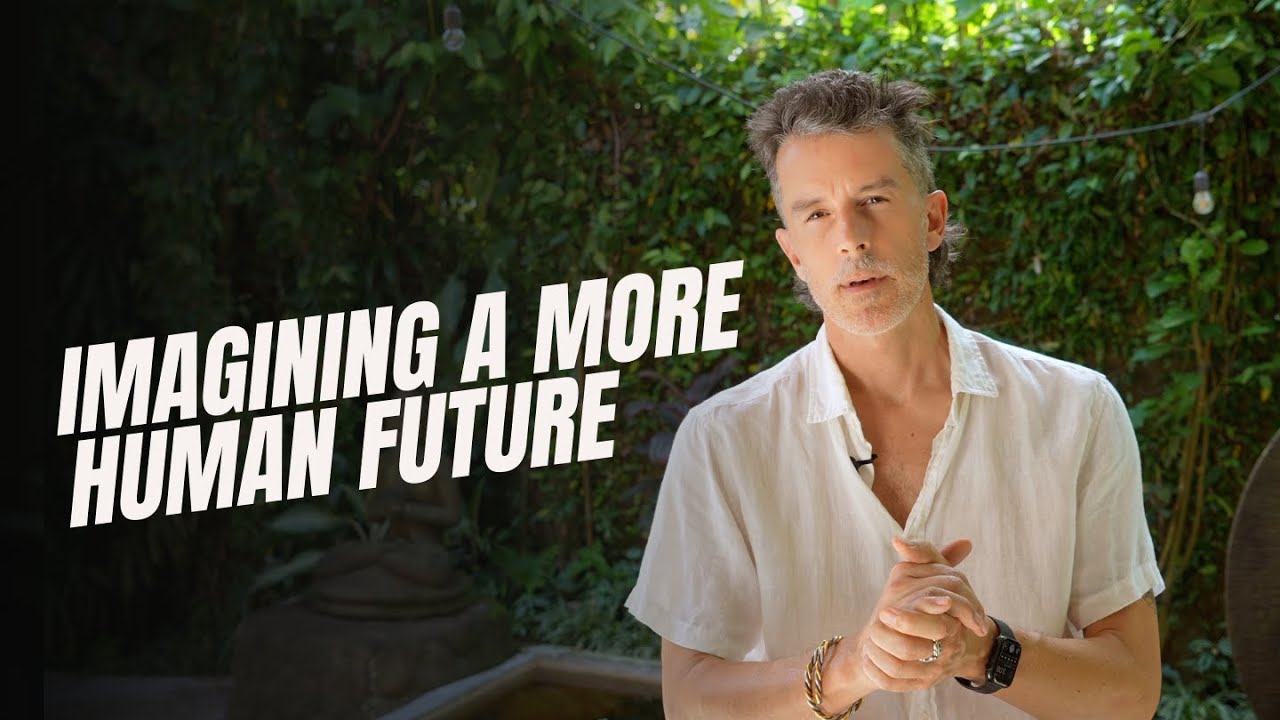
An AI researcher turned philosopher argues that Silicon Valley's AI utopianism, rooted in Gnostic rejection of the human body, treats people as stepping stones for an AI messiah. He warns the narrative ignores imagination, empathy, and embodied consciousness, and calls for AI shaped by diverse human values instead of narrow engineering ideology.
Chapters
What does it mean to be human? This has been the central question of my life and what inspired me to enroll in a master's in philosophy, cosmology, and consciousness, which I just completed at the California Institute of Integral Studies. It was the arrival of large language models almost 2 years ago that inspired me to begin to explore this question even more deeply, especially all the hype and mythology around artificial intelligence right now. And actually, I began my journey 30 years ago as an AI researcher. So this AI philosopher role is really me coming full circle. So what about this AI age, this AI revolution that we're going through right now? I think it's exciting, but it's also full of a lot of hype and hubris. I think there's this attitude coming from AI developers that they've solved intelligence, that it's just a matter of time and compute power and data And then we'll have not only human intelligence, but superintelligence. And I think that's a little bit premature. For reasons that are a little bit too complicated to explain in this video, there are a lot of hurdles to achieving that kind of intelligence, and I'll talk about that in a different video. Nevertheless, there's this sort of promise of an AI messiah that's going to come, and it's going to solve all of our problems: climate change, poverty, healthcare, et cetera, et cetera, et cetera. This This thinking sidelines the human, and I think that's creating a lot of confusion and fear, and there's this attitude that we're just a stepping stone to some greater being, some creature perhaps, and we just have to get out of the way and let this sort of inexorable march of technological progress happen without any fetters, without any regulation. Yeah. And then, yeah, then everything will be solved and we'll enter some kind of techno-utopia. These ideas about a techno-utopia and the inherent goodness of unfettered technological innovation, they're actually based on a bigger ideology in Silicon Valley that very few people are talking about. So many of us are enchanted by the technological innovations, AI developments coming out of Silicon Valley, like ChatGPT-4o and all that, but even the tech media is not really focused on these kind of strange ideologies that are driving AI development these days in Silicon Valley. So what are these ideologies? There's this cluster that academics have identified called TESCREAL, and that includes transhumanism, extropianism, singularitarianism, cosmism, rationalism, effective altruism, and long-termism, and they're all kind of related. These ideologies, which I want to explore in more depth in a future video, they're Gnostic in the sense that they sort of reject the body. They despise the messy organic nature, the animalistic nature of the body, and they seek a sort of mystical transcendence through technology. In my opinion, these ideologies, these technostic ideologies, are lazy and unimaginative, and they borrow heavily from old ideas including eugenics, but other ideas from the 19th and 20th centuries, but understanding these ideologies is important because to a large extent our culture these days is being shaped by technologists and technology more than even by the government, government regulations. It seems like technologists are the new government in a sense, and just as our government is founded on Enlightenment principles that we all aspire to and agree with. I think we need to aspire to and agree on the underlying principles that are driving technological advancement. I don't think that should be left to a bunch of guys in Silicon Valley who are totally out of touch. This is why it's so important that we understand what these technologists, what these techno-utopians believe. In terms of utopia, we need a new vision of the future that's ecological and humane and more inspired and inclusive and not strictly defined by these guys in Silicon Valley. So I think this moment is an opportunity. It's a critical time for us to think about what we want the future to look like and to decide on that collectively. I think part of that is thinking critically about these mythologies that are being built up around artificial intelligence right now. Again, technological advancement is not some inexorable process that's out of our control. It's entirely within our control. I feel strongly that the way we shape our technology will in turn shape the future and then shape us, and so we need to be intentional about this. I feel very strongly about this. Technology and artificial intelligence in particular— it reflects the mindset of the people who are creating it, and so we should first understand what that mindset actually is, and then we should make sure that we have people creating this technology that represent our interests as a humanity that are balanced, that are left brain and right brain, that are philosophical and creative and humane, and not strictly left brain engineers. I think that's the wrong way to go about it. Again, technologists seem to be our new thought leaders for better or worse, and the challenge there is that when you look at their ideologies, It is nothing more than a bunch of half-baked ideas that you might find with a 15-year-old boy who had just read Ayn Rand for the first time. This time is also an opportunity for us to think more deeply about what it means to be human, and to remember how great it is to be human. We have so many qualities that are not currently able to be replicated in a machine. We have imagination which is unique to humans. I think the AI today— the generative AI— is more of a mashup machine. It's not really truly coming up with new ideas, and it's not able to do that in my opinion, and I can explain why in another video. Humans have intuition. We have access to this faculty that guides us that is not strictly based on logic. Humans have emotional intelligence, and we have compassion, empathy. We are also complex organism situated in an environment, and we have a body. We interact with the world. We are conscious. We are wise. Some of us are wise. I'm not saying that I'm wise, but some people are wise, but what is wisdom? I think wisdom is so much more than just feeding a bunch of philosophical texts and philosophies into an AI system. I think there's something else going on there with wisdom that we are uniquely suited to engage in as humans. It has something to do with life experience and experiencing pain and learning hard lessons and things like that. There's no doubt that we're going through some kind of major paradigm shift as a humanity. The old is dying, and the new has not yet been born. In light of all this, I think we need to be much more intentional about the future that we're creating because otherwise fear and inertia and these bizarre transhumanist cyborg ideologies will win the day. My mission is to help people to understand these ideologies that are coming out of Silicon Valley, and to offer an enriching kind of humane alternative— an alternative that reflects human values. I want to celebrate and elevate the human. I'm actually thinking about writing a book about all this, but in the meantime I'm planning to offer a course that helps people to contextualize everything, and And to think about what it means to be human. In this course, we'll step beyond the limitations that are imposed by the AI hype and mythology, and we'll explore what it means to be deeply human. There will be embodied practices, ancient wisdom, explorations of the imaginal, and we'll uncover the power of intuition, imagination, creativity, empathy, and a deep connection with ourselves and the natural world. Through experiential practices, numinous philosophies, and community connection, we will cultivate calm and clarity and develop a clear vision and deep resilience and a renewed relationship with technology, a newfound appreciation for what it is to be human. We'll have modules like grounding into the body and the earth, deconstructing the myths around artificial intelligence, worldviews and the Great Turning, consciousness, and utopian visions and imagining a collective future together. I have been on an intellectual, emotional, and spiritual journey through Eastern and Western philosophies, embodiment practices, and an exploration of this question of what it means to be human in this age. With AI, we're all asking ourselves, like, what does it mean? What does it mean to be human? And I feel strongly that AI is a powerful tool, but it's not a creature and it is not a messiah. There is no inexorable march forward that's outside of our control and unable to be defined by our human values. I think these technostic cyborgist ideologies offer an unimaginative dystopian vision of the future. We need to ask our technology leaders to come up with a more imaginative, more humane vision of the future. Let's be more thoughtful about what we want to create.