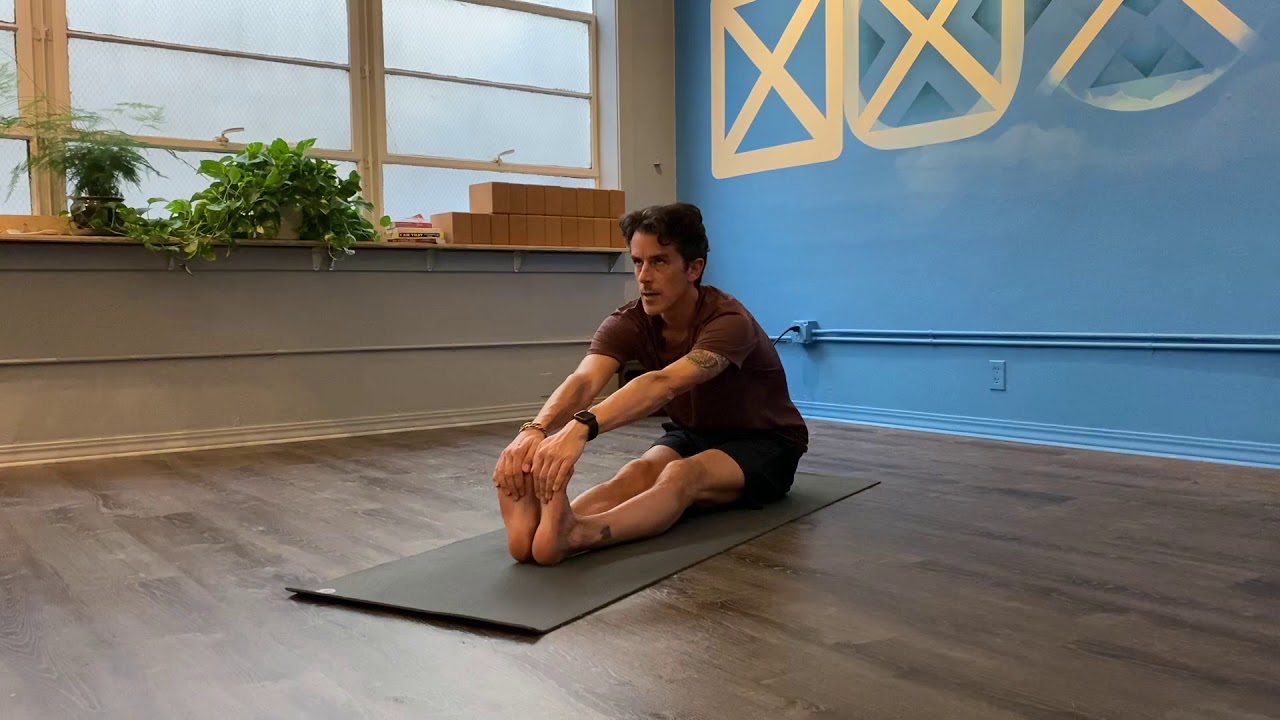
Learn Maha Mudra, a short whole-body yoga sequence combining specific poses with breath holds and third-eye focus. The practice lasts 12 to 20 minutes and moves through forward folds while inhaling, holding your breath as you extend deeper, then exhaling. It's designed to ground, calm, and activate Kundalini energy.
Chapters
Hello, welcome back. This is a session where we're going to talk about the Maha Mudra. The Maha Mudra is essentially a short sequence of yoga asana poses that you practice as a dedicated sort of practice in itself. Of course, Maha Mudra means the great Mudra, the great sort of body configuration. Oftentimes, or most of the time, mudras are hand configurations, but they can be a lot of things, including Sambhavi Mudra, which we'll talk about in this sequence. Sambhavi Mudra is where you're taking the gaze to the third eye, traditionally with your eyes open. So we'll be practicing that in this Mudra. It looks a little strange when you see someone doing it, but it has great energetic practices— I mean, benefits, including working with the Kundalini energy here, and also quieting the mind, working in different ways with, with the mind. And so, as we'll see, that's part of this, this Maha Mudra. So the Maha Mudra is actually a series of configurations of the whole body. And it works with the breath in kind of a counterintuitive way. So typically in a vinyasa class, you'll be breathing with the movement or moving with the breath. Here, we're moving with the breath, but it's sort of reversed. So the best way to show you is to demonstrate, but essentially we're moving with the breath held, which is a little counterintuitive. Okay, so I'm going to demonstrate the posture, we'll walk through it, and we'll do a few rounds together, and then I'll leave it to you to practice. So the way it goes is you start with your arms wrapped around your knees, and then your heels are actually off the floor, and your toes are pointed. You start here, you inhale through the nose. We'll go into Samadhi Mudra, so we'll go into gazing at the third eye here, and we're going to maintain that gaze consistently throughout the flow. Although I may look to the camera just to maintain some semblance of engagement with, with you, the viewer. But essentially the whole time you're like this. So inhale through the nose, and then you hold the breath as you extend into a sort of Paschimottanasana. You exhale here, but you're not, you're not trying to come too far forward. You're actually maintaining length in the spine. You exhale again, you exhale here, and then you inhale again. So it's an exhale, inhale, and then you come back. Exhale, and then inhale. And then holding the breath, we're going to come into Janu Sirsasana preparation. And so I'm sitting on my heel, the heel's in the perineum here, and we're going to now exhale here and then inhale. And then I'm going to come into Janu Sirsasana variation. So I'm still sitting on the heel behind And again, long spine here, we're not trying to come too far forward, foot is flexed, we're exhaling, and then inhaling. Holding the breath, changing the feet, exhaling, inhaling. Exhaling. Inhaling. Exhaling. Inhaling. Now in these in-between places, you can— it's not as important, you can have your arm wrapped around like this, one arm on the ground, both arms on the ground. But you've got one foot firmly planted and grounded, and you're sitting on the heel of the other one, the perineum. Okay, and then we finish that, come back to the starting position, exhale, and then inhale. It's one round. So I'll do another round without talking just to demonstrate. Okay. Now here, traditionally you would leave the breath held out as you change sides. That's the one time that you don't do an exhale and inhale. And then inhale here. Okay, so hopefully that gives you an idea. I usually do it for 12 minutes, longer, maybe 20 minutes, and I have to say it's one of my favorite practices. It's very grounding, obviously, working with the body, very calming, very centering, very— a little bit transcendental too. I find I'm a little I'm left in a very sort of meditative state. My mind is much calmer. I'm in much more of a place of stillness with this. And, you know, it's really, really effective, I find. And so it's a nice little practice to know, to have in your back pocket, because let's say you have maybe 15 minutes to do some yoga and you're not feeling very inspired, or you just want to jump right into it, you can just go into this practice You don't have to come up with some kind of creative sequence in the moment, and you can just use this as a home practice. I don't teach it as often in my public classes, but occasionally I'll work it in. It just takes a lot of, you know, sort of step-by-step instruction, which can be a little distracting. But yeah, once you get the basic sequence, it's quite a powerful, powerful thing. So try it for yourself. Maha Mudra, very effective. And yeah, that's all for today. But thanks for joining. I'll see you next time. Namaste.