PODCAST : Economic Champions Miniseries with Dakota Malone
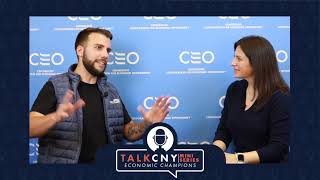
A TalkCNY podcast episode (Economic Champions miniseries) featuring Dakota Malone, managing partner of Community Solar Authority. Malone describes her personal journey into sustainability and entrepreneurship, explains Community Solar Authority’s turnkey model that connects large electricity users (municipalities, manufacturers, large commercial customers) to community solar projects and incentives in New York, and discusses regional impacts including partnerships (e.g., Onondaga County Water Authority) and the broader growth context in Central New York (Micron investment, Center State CEO).
Chapters
This is the TALKCNY Economic Champions miniseries presented by NBT Bank, a podcast by Center State CEO, Central New York's premier leadership and economic development organization. This series will shine a light on local businesses making an impact in our community and driving our regional economy forward, whether it's new jobs, company milestones, business expansions, investments in operations, or DEI initiatives. To join us as we celebrate CNY's economic champions.
Regional sustainability is the opportunity that everybody here has to play a role in making CNY a better place, a better community, and really helping everybody thrive. And I think that that goes beyond work per se and really just really gets down into the humanity of it. Yeah, I think it's an opportunity that everybody has. Not everybody will claim, but if you're one of the few that do, you'll make the world a better place in your community as well.
Today's conversation is with Dakota Malone, managing partner of Community Solar Authority. A do it all done for you. Bolt on partnership that delivers turnkey access to enhanced sustainability, leveraging the most significant solar developers in the country.
Hi, Dakota. Thank you so much for being here.
Hi, Kate. Thank you for having me.
Wonderful. I can't wait to learn all about Community Solar Authority with our listeners. Today we're going to hear all about who you are, why you do what you do, why you're operating in this space, and what your company can potentially do for the businesses here in Central New York. I know you serve other areas as well, but many of our listeners are business owners and executives, so let's tune them in for sure.
Yes. Thank you so much for having me.
Yeah, absolutely. So first of all, tell us what Central New York means to you. Are you from this area?
Yes. Yeah. So I always tell people because they have no idea where Hannibal, New York is, where I grew up and graduated high school. I tell people that I grew up in between cornfields in the middle of nowhere in upstate New York. And as you know, or maybe as you're familiar, you tell people you're from New York and they just assume the city and then you say, no, upstate, and they're like, oh, Albany. And it's like a little bit farther. And so, you know, I grew up in Oswego county and I went to Hannibal High School, as I had mentioned, graduated in 2011. My parents asked me to go to college, even though I knew it wasn't for me. So I went to community college for two years. I handed them my two year degree. I asked them to leave me alone. And then I went on to get into Entrepreneurship, which brought me all over the country and a little bit past outside of the US as well. And so originally started in CNY, I now live in St Louis, Missouri. I commute back to CNY about once a month. And as you mentioned, we do a lot of work in CNY for large entities and businesses alike. So that's what brought me back home. And I've got a lot of love for CNY as a place that raised me as an entrepreneur as well as my other co founder as well. He graduated from West Genesee High School. And so we are big believers in giving back to the spaces that raised us as entrepreneurs and to kind of grow into the people we are now.
That's wonderful. And we're obviously so glad that you made this choice because the work that you're doing is very impactful, obviously a very successful business, but especially for who you serve, and you serve actually quite a lot of people on a lot of levels. It's fairly complex. Could you describe a little bit about what your business does?
Yeah. The simple way to think about it, Kate, is we help large users of electricity unlock available commercial solar incentives. So in states like New York, you know, we have renewable energy commitments where the state says, hey, we're going to be 100% renewable within the next X amount of time. And so what actually happens are, you know, there are different strategies to be and go and pursue that. And so with us, Community Solar is actually state level legislation. It was really a product of an energy.gov initiative through what's called the National Community Solar Partnership, which we're stakeholders in. And it's really designed to bring energy equity into places that traditionally can't benefit from solar. And so, you know, the answer to cleaning our energy grids and all sorts of enhanced sustainability from carbon reduction, et cetera, you know, is not to go and install solar panels on every single house and building because it's mostly impossible. There's many reasons why it doesn't work. And so these solar farms that you see popping up throughout central New York and beyond is really one of the driving factors to that. And you know, those solar farms typically sit on 30 to 45 acres. It's known as community solar. And really it's a way for people to benefit from enhancing sustainability while helping New York meet their renewable energy commitments. And, and really through an intertwining of stakeholders and community engagement, we're helping those large users participate in that legislation, save money while enhancing sustainability.
Well, that sounds terrific. So let's take a quick jog back and think about how it is that you arrived in this area in solar. What got you interested in that, what sparked you in that way?
Yeah. So a little bit esoteric, but I am someone who is thriving. Post five heart surgeries and growing up, sustainability became a principle, not by choice that I wanted to live with or asked for. Maybe in a different lifetime I did, but it was one that I really had to seek to understand at a basic level for myself as an individual. And when I think about sustainability, I see it through the lens of the four pillars. And you know, Meg Tibb was on a while back on the show and she Talked about the three Ps, people, prosperity and planet and similar fashion. Yeah. And I really resonate with that. And you know, I see it slightly different, but really the same messaging which is, you know, human, social, environmental, and then, you know, economic sustainability. And I think through each of those pillars you can really start to reshape and think about sustainability and how to use it as a person on an individual level, which for me was all about, you know, preserving the health of a, of a given system is how I think about sustainability. So for me it was all personal, from a selfish level. Like I needed to figure out, you know, I wasn't supposed to live past my and into my 20s. I just turned 31 over the weekend and you know, now I talk about sustainability in the context of larger entities and organizations and that's really how it started, if you really want to go back that far.
I really do because that's a fascinating experience and not one we get to hear about often. So yeah, I actually love that, the idea of health of a system and that that can be in our bodies, in our environments, our communities and that you've really wanted to find a way to contribute to that. But you landed in solar in particular.
Yes.
Very interesting. Was there some sort of event or exposure for you that got you into sol? Yes.
So I've been in the energy space for over a dec this point. You know, I got my start doing door to door sales. So before.
Oh, that's awesome. Yes, yes. That's hard.
It is. You know, I started selling boy Scout popcorn as a kid and you know, when I first started, I would knock on people's doors and I'd say, hey, you don't want to buy some of this? Do you know, that was really my first experience at sales and selling and you know, I talk to and do a lot of coaching for entrepreneurs and you know, we always talk about building your skill acquisition and you could Take something like sales, and all of a sudden you can apply it to something you're passionate about. Yes, Same thing with math. You can turn math into an accounting, into being a cfo, and it scales up from there. And so that was really how I got into it, was I was doing direct sales. I was in the energy space. And 2017, I took a sabbatical. My best friend called me. He was a K9 officer in Italy, and he double dog dared me to quit my job because at the time I was very unhealthy. I was in a lot of pain. I also have a nice scoliosis curve, which is also really why I preserve my health so much and really care about it. But essentially I needed to take a. From what I was doing. I moved to Europe, took a three month sabbatical. I was committed to learning remote work. And as a result of that trip, I was able to kind of come back with a fresh set of eyes and rethink about what does entrepreneurship look like for me? How do I want to set it up in a way where it works for me, where I can make a big impact? And Community Solar Authority was born out of that.
That is truly inspiring. But we really can't just gloss over the K9 officer. Double dog. Daredevil.
Yes.
Yeah, we caught that.
You get the pun?
We did catch that. Dakota. That is tremendous. So you made this big move, which is very bold, adventurous, brave, but you had a very clear purpose for it. You wanted to make sure that you were in some kind of alignment, figuring out how to do this in a very specific way, I suppose, to retain that value of health in a sustainable way.
Yes.
Okay, so has that been something that you've been able to carry with you as you've built this business, those initial principles that you worked on in your European travels?
Yes, totally. And, you know, I think about, you know, we tell people that we're a bootstrap business, but we're also a lean startup. And for me, you know, using lean principles is the same way that I think about, because I prioritize physical health and I work out is just like a lean body, you know, when you are overinflated. And on a. On a business level, you know, there are a lot of businesses that without the funding that they receive, they would never be in business. And, you know, therefore they have an unsustainable business model. And so for me, I was never a good manager. I never wanted to have employees. And so we built our company in a very specific way where we have our Co founders, we have a support staff. But 90% of our business growth has come as a result of strategic partners and synergy. So instead of applying it from, you know, an employee level, we're actually working with a lot of strategic partnerships to be able to grow our business. And of course, we try to do that in alignment as much as possible. And so, you know, for example, Kate, we are a corporate sponsor and working with John Tamino over at my father's kitchen through Onondaga county. And they do a lot of work for homelessness, addiction services, and different sort of outreach services. And I was actually on my way to go to visit my friend Mike Durkin over at VIP the other day, and I ran into John in the street actively helping someone. And again, to me, this goes back to social sustainability, which is like, it's not just about the environment. It's like we have an entire community, you know, and I'm a big believer in regional sustainability, thus all about giving back. But that's really how I think about growing my business is, you know, how do we do it in alignment? How do we do it where we're staying with this lean model. And again, that was just a personal preference because I'm just not a good manager. And I knew that. And of course we could hire other people to do that, but for us, we had a very clear vision where we wanted to be able to drop our business into any given market to be able to help those people that needed it the most. And that's what we've kind of set out to do. And that's what we've done at a, at a statewide level.
Excellent. Now, if a listener today is wondering to him or herself, am I a client? Like, might I potentially work with this company? Might I benefit? How could you clarify that?
Yeah, so I tell people that we work with large users of electricity, which is pretty vague. That looks like municipalities, investors, big businesses, corporations, manufacturers, really people spending hundreds of thousands of dollars a year on electricity spend. Those are the clients that we help. And typically they look like investment grade clients, which kind of gets into what's called credit worthiness. And when, when I think about cny, for example, we're just recently finalizing some work with some large entities, which we can kind of talk about later and get into. But we're also working with, you know, some of the largest commercial real estate properties in central New York, which I can't announce yet, but hope to be soon. And those are the types of people that we work with. So it's not necessarily Just, you know, how much you're spending per se. But it's really, you know, is this business going to be a long standing partner for the solar firms that we work with? And so again, you know, we build these solar assets to last 20 to 25 years. And from a financier perspective, meaning the people paying for these solar farm to be built, they are looking for partners. So they are going to look for partners that are going to be around for 20 to 25 years, which is not every business. And that's okay, but that's really the criteria for how we kind of think about working through who our clients are and what they look like.
Okay, so going from there, let's say a listener thinks, oh yeah, that's me, I definitely fit into one of those several categories. What is the value add? What are they getting from agreeing to this service? What's the roi, what's the upfront investment? Can you give us just a sense of what a project might look like or what they could anticipate?
Yeah, and I think any business owner that thinks they're a good fit will appreciate this. So the wind up in the pitch is. And maybe just a quick backstory. Kate?
Sure, sure, let's go.
A lot of businesses struggle right now. They're at a stalemate, especially with big businesses, because they are worrying about capex, which is the money they have, where do they spend it? A lot of people, one half of the business wants to spend it on growing the business, the other half wants to spend it on sustainability. And so nothing gets done. And so with community solar, which is one of the services we provide, we always start here because of its simplicity. The wind up in the pitch to it is that on a $0 investment, without installing solar on site, you can get guaranteed lower electricity costs for decades to come. And so what we really deliver is turnkey enhanced sustainability and improved operating profit. It doesn't cost anybody anything to actually participate. You know, we get paid a fee from the solar developers that we work with, very similar to a real estate transaction. And everybody wins and we create what we call triple win synergy. And from there.
Oh, oh, oh, let's just give that a moment. Triple win synergy.
Yes.
Okay, say more.
Yes. So I am a big believer. I used to believe that synergy was just a buzzword and now I see it as the solution. And so again, when we first started the business out of COVID you know, we would be going to businesses one on one and we'd say, hey, we'd want to work with You. And every single time they would say, hey, we already have someone that does our energy. And so this is how we kind of got onto growing through strategic partners. And so instead of going to businesses directly, we just started going to their energy companies and we said, hey, we deliver turnkey access to community solar. You're already doing everything else in energy. We should become your official partner. And then you can recommend us to your clients and we'll help you make more money, keep clients longer, add more value. Your client will enhance sustainability on a zero dollar investment without installing solar. And we fill our solar projects and that's how we create triple win synergy. It's really about replacing the energy wasted and competition. So instead of competing, you're really aligning resources. And this really gets into, you know, the spectrum of the spectrum of resources, which gets into diversity and DEI and really combining resources instead of spending and wasting energy and competition.
Oh, incredible. We are just so thrilled to pieces about all of the growth that we anticipate in our community in the central New York region right now. So let's hear about how you're feeling.
Yeah, I'm super excited. And of course, this is coming off the back of the largest historic investment into cny. And as I mentioned earlier, I'm a big believer in regional sustainability. And when I think about the growth behind what's happening with Micron, but even setting that down and really thinking about the individuals in the community that are really driving that growth and including Center State CEO. You know, when I think about corporate entities and it's such an interesting word and I'm a big believer in language, when you think about the word entity, there is a spirit behind it. Again, not to get so esoteric, but, you know, I got into business to be a force for good. And I try to find clients that, you know, mirror that and also believe in that. And so I see the work that Center State's doing, I see the investments that's coming in with Micron. And, you know, I think Josh Hahn, who was another previous guest on the episode, encapsulated it.
Yes. They're getting all the good shout outs.
We love this. You know, he said the word hope. And I think that that's really, really important because, you know, again, like, I live in St. Louis and I've lived downtown before, and I was taking a walk around downtown Syracuse with Mike Durkin over at VIP last week and I told him, I was like, you know, Syracuse is outperforming St. Louis, and that's a city that is, I don't know, much larger. And you know, there are a few reasons, of course, Micron being one of them, but I really think it's about the hope that kind of is riding the tailcoats of that investment. It's got a lot of buzz, it's got a lot of activity brewing. And really just to see Syracuse transform over the last few years has been incredible. And so, you know, how do you really bring that regional impact back to save a city? And of course Micron is going to be a historic tale for central New York. But I really do believe, Kate, that you know, Syracuse right now and the CNY community and really the tech corridor that's spanning throughout upstate New York.
Oh yes.
I without a doubt think we are setting an example for the rest of the country to follow.
Oh, 100%. You've got that absolutely nailed. And so when you think back over the last 22 months or so, when we heard that Micron announcement initially and we all were like, okay, this is really happening. So exciting. How has that looked over time in relation to your company?
Yeah, so I think about with what we're doing in the sustainability space, you know, New York's made massive amounts of progress on their sustainability commitments. They are leading the way. You know, you think about states like New York, Illinois, California, but specifically New York and even more hyper specific to the community solar legislation, again they're really leading the way with what it looks like to have a high performing state meet the renewable energy commitments and then of course like at a broader level of sustainability. So for us, you know, again, it's created a lot of buzz. Without a doubt, Micron has these ESG commitments and sustainability measures they're already implementing before anything's even built, which we love to see, of course. And I think that that's just going to continue to inspire more people to think about sustainability and reflect on it. Again, it's not so much or it's not just thinking about from an environmental perspective. You know, Micron's coming in and they already have a foundation. They've already dumped a lot of money into the community to be able to support people that otherwise wouldn't have access to that. And you know, that kind of brings in the conversation of equity, which is really social sustainability. And so for us, I'm really excited because again, you know, CNY gets to lead the way. I'm super blessed to be from this area, to know a lot of people from, from this side of town and to really just be a part of it, you know, it feels like were really community led at this point, which, you know, again is, I won't say rare, but it's not the everyday city that has the buzz and excitement and really the groupthink that Syracuse has going on right now. And so from a top down level, I just think that it's going to get more exciting. I think more people are going to continue to care about sustainability, but I think we're going to see it sprinkled on in different realities and different lenses. And I'm really excited for that.
Yeah, absolutely. I think the inclusive nature of economic growth is really critical to Center State. When you talk about the community informing what's happening and who will be impacted and how, it is really a critical piece of the puzzle. And so when you think about how you incorporate that into your business practices, you've mentioned some things. Are there any other items that you want to mention, how you bring that ideal into your organization?
Yeah, for us I think it goes back to synergy. Kate. You know, again, I had mentioned earlier our partnership with in my father's kitchen, for example, which is very much a social cause, very much a necessary impact to create a greater image of sustainability. And you know, we incorporate partnerships like that all of the time. We also do a lot of social sustainability working with housing authorities and low income housing, which again, community solar is really about equity, but at an even larger level. You know, I feel really honored as a small bootstrapped entrepreneur. You know, we're partnered with some of the most significant solar developers in the country and it is truly a trillion dollar clean energy economy. And so when we have the influence to tell them where to put projects or where we can bring communities together to create more jobs, for example, or workforce development opportunities, I think that's going to become a lot more popular. And again, it's an honor for me to be able to work with people who have access to money that I don't and have access to resources that we don't, to be able to bring them into the community and say, hey, this is an area of opportunity for everybody. And it's really about getting stakeholders involved, which for us, sustainability and efficiency, these are also core values of our company. And so for us, we're streamlining access to these available renewable credits and incentives. And that's why we also do a lot of work with municipalities, for example, because in the same way we make them clients, we're also able to introduce them to these larger relationships which then flows down and kind of trickles down into the rest of the economy. And so That's a really big piece of the puzzle for us as well. We did just recently help, which is the first time this is coming out. We just finished up with Onondaga County Water Authority, and, you know, they are one of the largest water authorities in the country, and they provide clean water for, you know, over five counties in New York State. And we performed alongside one of our strategic partners, a community solar rollout for them. And so, you know, again, it's our bread and butter service where we're helping a large entity. They're spending a lot of money on electricity, and they want to find ways to enhance business sustainability practices and save some money along the way. In less than 90 days, we were able to deliver access to over six figures in savings, and they're going to be able to benefit from that for years to come. And may that inspire the rest of the work for the surrounding municipalities and other people to be influenced by. You know, they see a large entity of that stature and say, okay, well, hey, if they're doing it, maybe this is something that I to want, want to look at. And so that's what we're really hoping for from that work and soon to be press releases around that as well.
Oh, great. Well, we'll have to keep eyes open for that.
Yes.
And, wow, what a great incentive for any listener who might be curious to learn more. Hundreds of thousands of dollars.
Yes.
And you're giving back and you're doing a good thing all at once. It's covering all the bases. I love it. Fantastic. Well, Dakota, thank you so much for sending some time sharing about your company and about your history, how you got to be where you are. If someone would like to reach out to you, what's the best way to get in touch?
Yes, I make a lot of content on LinkedIn and so I encourage everybody to follow me. There it is. LinkedIn.com indecotamillone and if anybody wants to talk about anything we talked about today or anything beyond that, feel free to shoot me a message and I would love to have a conversation.
All right, well, thank you so much.
Thank you for having me. Kate.
Thank you for tuning in to the TalkCNY Economic Champions miniseries presenting by NBT Bank. Episodes of this Center State CEO podcast are available on ClickCNY.com and all major podcast platforms. After each episode, you can join us on Click, where we'll continue to talk about this topic and provide additional resources and links. In Qlik, you can listen to or watch every episode of TalkCNY. Qlik is Center State CEO's digital chamber platform where our members connect, learn and receive support from our staff. For new episode reminders, be sure to subscribe in your favorite podcast listening app. If you are enjoying our series, consider leaving a quick review or a five star rating.
I would recommend NBT bank to any business My name is Chris Palomino and I'm the President of Atlas Fence.
Chris decided to purchase Atlas Fence from the previous owner. He had previous ownership connections at NBT Bank.
NBT bank provided me equipment financing, doubling our entire production workforce. It's important to me as a business owner that the decisions of our banking relationship are made locally.
More from Dakota
Forcing Appreciation in Real Estate on Episode 53 of Sustainability Strategies
How we form strategic partnerships across the US for commercial solar: delegating value-add #cre