
Durran Open House for Designers - 2
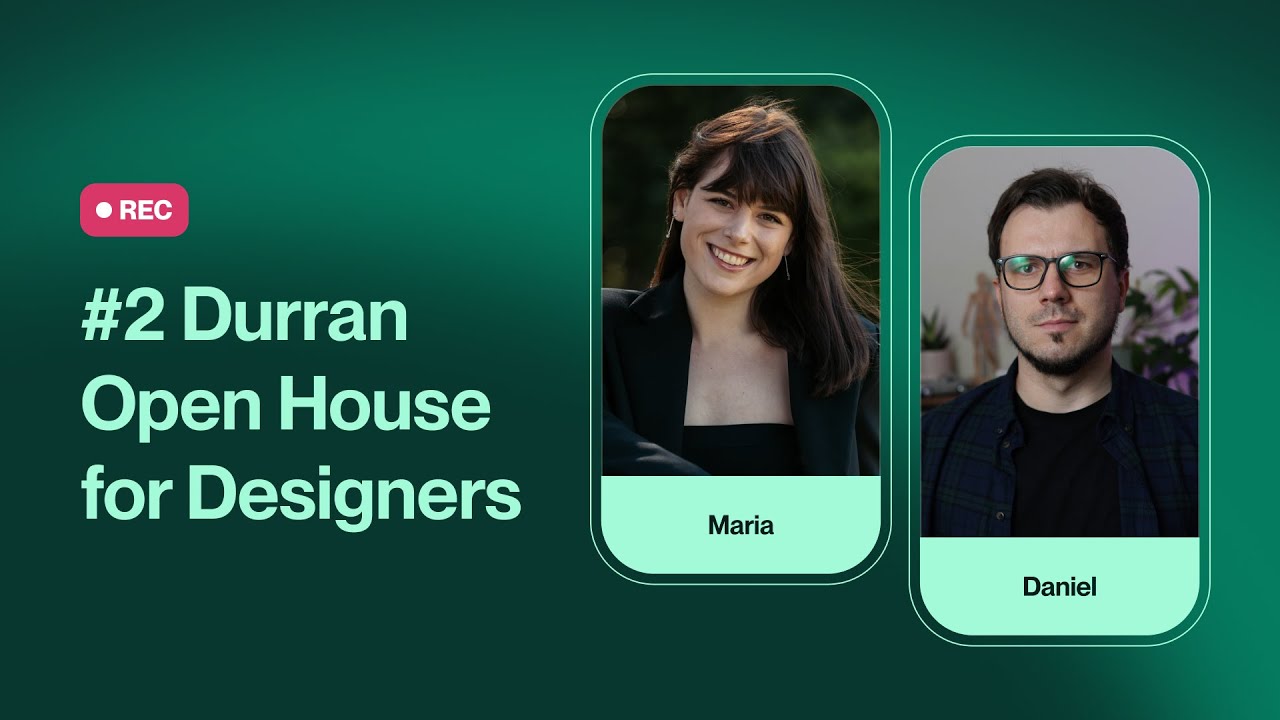
Maria and Daniel Andor answer questions from designers and agency owners about shifting from UI to product strategy, building discovery processes, landing research roles without a portfolio, and handling AI in design work. They recommend Inspired, Lean Startup, and Running Lean, and stress testing assumptions over copying competitors.
Chapters
Hi, welcome to the second Duran open house for designers. I'm Maria and this is Daniel, and today we will go through your questions and hopefully answer them as best as we can.
Yeah, hopefully, especially since we had to redo this, right? Because I made a very stupid mistake of trying out a new product and it didn't work out.
Also our mistake for not testing it firstly, but We are here. Yeah, exactly. Okay, so would you like to introduce yourself firstly a little bit for our listeners?
Oh yeah, they most probably know us, but yeah, I'm Daniel, I'm a product designer, also the founder of Turan. We mostly work with startups and scale-ups, I would say, at this stage, helping them with anything between UX and product, very focused on the discovery side and testing stuff.
And I'm Maria. I've been working at the brand for almost a year now. And previous to that, I also had some startup experience, both on the marketing side and as well as user experience. Great. So let's just jump straight into the questions and we'll see where it goes from there. Okay. So the first one was, how did you as an agency owner manage to move away from being yet another UI production powerhouse and have product strategy as your main offering?
It's a tough question straight from the— even if I have to answer it like the second, actually the third time, it's still not an easy way to answer it, right? Yeah, a very good question. I never was really creative on the UI side, I will put it that way. And when I started out, I started in a setup where I was very closely working with back then the product manager, managers. So it was quite easy to get an idea about how they deal with actually building the product and making trade-offs and trying to build something that's feasible and works. So that's, that's one of the, one of the things. The other one is that because I'm a very anxious person, I need structure and I need frameworks to function as a human being. So when I started to do these kind of In a way, working, you know, working as a freelancer in the beginning, it was always that thing, you know, in the back of your mind that it might not work out. I don't know how to do this. Maybe the client would not like the end results, stuff like this. And then I needed some kind of process that helps to transition from that need besides the fact that they usually came to like, oh, I need a design or I need you to design this or that, to understand a bit why they need this whole structure and what's What's the outcome in a way that answers their need, which might not be what they actually look for or what they say that they are looking for at that stage. So this is kind of how I, how the whole thing started. I needed a structure and I needed a process. And also I needed to make sure that what I deliver, it answers the challenges the customers have. So based on this, based on this, I started also to read a lot of books on like product mostly. I mostly read books on product. It was not that much on the design side, but I wanted to understand in a way how people build products, what they do, what processes they use, and how what we do as designers can come into that scheme and help them to actually create something that works, you know, that answers their problem, that helps them to build a business that generates revenue and so on.
So do you have any recommendations on that side? Some of the books that you read? I'm currently reading Inspired, but other than that, I'm also curious to find out even more titles.
Inspired is a good one because it gives you a good understanding of what the product manager does and the different roles in a product team. So definitely a good one. When I started, I didn't start with Inspired. I started with a book that has a very long, very long name for my own brain, but it's not that long. Creative something with business and creative. David Douglas or something like that is the author. And it basically— what does it— like, he describes a lot of these business-specific topics in a way that's easy to understand. So you can have a— like, you can have a discussion with, like, somebody who's talking, like, the business language in a way that you understand what that person says, and he also understands what you want to say. So You're not everybody using the same jargon just and like you are in your own bubble, but you have to have a common language in order to have a proper discussion, right?
Absolutely.
So this is why I saw it. Did you look up the name of the book?
It's like— Yes, Creative Strategy and the Business of Design.
Exactly that. So yeah, I saw it. That was one of the first things. And I also read books on like lean product development. So the blue one, I usually remember the COVID that is blue. So it's one, it's the blue one, I guess it's Lean Startup is the blue one, and Running Lean, Ash Maurya's book, is the other one. How I usually explain it is one, the blue one, it's the theory, the white one that has a white cover is the practical way of actually doing the stuff. And from there on, I started to actually do some like small workshops with clients. I started like with very basic stuff like defining user personas and competitors and stuff like this. So I basically just copied frameworks and I started to use them. Once I kind of got the hang out of this whole process and how to do it, I incorporated that in the process of how I actually do design. And then I learned about like design sprints and like larger workshops. And when I first tried that out, I just pitched it to a client. He didn't. I guess he didn't really understand it, but it looked looked interesting. So they asked for doing like a presentation. So I had to like wrap up a presentation in like one day or something. So I walked them through the whole process and I just explained like briefly what's happening. And then I even told them that look, if this doesn't work out, like I will just give you the money back and that's it. And we go like the old way of like doing design, no? And it worked out and. Since then we are kind of doing this.
I feel like what's important is to also be aware of what certain parts affect the entire process, like what's the outcome of each individual exercise, and then customize based on the client's needs.
Yeah.
Which I guess that also comes with practice, just doing them and seeing whatever works.
Usually you end up tweaking things. Like even now, I don't know, you didn't— you weren't part of a lot of the workshops yet, because we didn't have a lot of them. But even now, we change some of the frameworks from time to time.
Yeah.
Or even the structure of like the exercise, how— what's the order of the exercises? It's changed quite a lot. Like in the beginning, when I started to like test out assumption mapping, it was one of the last stuff that we've done. It was like, oh, we do this thing and oh, would you like to try this thing out? And now it's like In the process that we have, it's like the second framework or something, or the third one, but it's somewhere in the beginning either way. And that's because like a lot of people said that that was very helpful for them to just figure out what assumptions they have and put something there and then map the next initiatives back to those assumptions. So yeah, you definitely listen in a way to the feedback that you get and then you tweak and adjust these processes up to— The clients, also their needs, also the budgets and timelines and so on.
I feel like the next 2 questions are sort of related, but I will go through them individually and maybe we can answer them together. So the first one was, I really want to learn the research and strategy side, but no one is giving me a chance because I don't have anything measurable to show. Just yesterday I had an interview and it didn't go well at all.
Just yesterday was like 2 months ago. Yeah, unfortunately.
Hopefully, hopefully Santa brought him a new interview and a job. And then the next one was, despite my experience, I'm struggling to find a full-time product design job with limited hiring outside the EU and US and no relocation offers. It's really hopeless. Any insights on today's economy and how to adapt? So I feel like They're both on the same topic of finding a job with previous experience and without. Yeah.
That's tough to answer because I, I don't know when was the last time I interviewed for jobs. It was quite some time ago, but we have discussions with people. There are people that either reach out to me, either companies that I know hired, or I helped companies hire, stuff like this. It's definitely not easy to get a job now. And I don't know with whom I was discussing about this because being like when you start, the first one is regarding somebody that's at the beginning of the road, right? And don't have anything measurable to show and wants to learn because when you are at that stage, yeah, there is not a lot of stuff that you can show up there. And also now, like with the whole context, like There were layoffs, there are people on the market. Most probably the rates went a bit down. So you could get somebody more senior maybe instead of a junior for almost the same price. As stupid as it sounds, but it's economics in the end.
Personally, what I did, I mean, what I think helped me in this step, and I think it would help regardless of if they're working, looking for a research and strategy job or just for product design in general. I was really stuck when I was trying to work on personal projects because I knew all the theory from online courses and I was trying to imagine these scenarios in which I would apply parts of the frameworks but didn't really know the outcome. Was the outcome good? How would I structure it? And what actually helped was experience in a startup because there you learn a little bit of everything and It's not exactly the same experience as you would have in, I don't know, in a bigger size company, but it definitely helps with hands-on experience and trying with real customers, seeing the results, iterating based on other people's feedback. So maybe that's one thing to start, just looking for a startup to join, maybe to help here and there, could be one of the options.
A startup, it's a good option. When I started, I started basically in a startup as well, somewhat a startup. But besides the fact that you do your own job, you also get a good understanding of how things are actually working in developing the product and usually are way closer to the customer and easier to actually get in touch with the customer and have discussions than like in a corporate or in an outsourcing company. This also depends on what you want to do on the like longer term, right? Because if you want to do strategy and research, then you most probably want to be quite close to the customer and not work on an outsourcing company. But yeah, starting with actually reaching out to some startups or some accelerators might be a good idea. I know that we suggested that a couple of times, because then besides the fact that you actually learn about how to do your craft, you usually get the chance of putting that work in your portfolio and having something like they mentioned measurable to show. So that's, that's Definitely a big plus. It's better than just doing like fake projects. And it depends on what you want to showcase as well, because if you want to showcase, it's not the case here, but if you want to showcase like UI skills, then a fake project might be good enough. But if you want to showcase like research and strategy, then a fake project can, what can give you in the end? It's not a lot of stuff that you can do there.
I would argue that even on the UI side, it is important if your designs are actually implementable. And, you know, it's not something just— it just looks pretty and it doesn't actually function well or fulfill the needs of the customer. So I guess that does go into the UX of it all, but they're all connected.
So kind of goes into it. Yeah, that's true. That's true. It's very helpful if you actually can get hands-on work, but sometimes it comes with the trade-off of either being paid too little, either not being paid at all in the beginning. And some people are okay with that and some are not. Even for us, we had— I don't know if I told you this. During December, like, we had 2 or 3 people reached out. Just, they just wanted to shadow, just come see how things are going, eventually help with some stuff. And, uh, and that's the only thing, like, even for free, they just wanted to come and try out stuff. It's not like advertising, but, uh, the whole idea is to, like, you have to be near the people. Like, for me, at the beginning of my career, to be near somebody that I had the chance to actually learn from, it was, it was a major boost on whatever bootcamp you might think of.
Yeah, I totally agree with that. Like the things that I've learned since, since joining Turan were so much different than what I could have learned by myself, because then you get hands-on experience and interacting with clients.
There is like, especially in the beginning, I remember when I was hiring before I hired you and I was on a bunch of interview sessions and going through portfolios and I know some people sent PDFs and all kinds of stuff. You also have to make it quite easy for the people that wants to hire to get in a way the information of like who you are, what you can do. And that's not, it's not an easy job, but some people even overcomplicate it, I would say. So as stupid as it sounds, what I've done after like the first, I don't know how many, like the first session, like when I first tried out and I get like a couple of emails I was like, oh, I will just answer everybody and I will just like take some time and just say some nice words, even if I don't hire them. After— sorry. So after the first batch, I just— I got the same email from a lot of people. It was like the same structure, same structured portfolio, copy paste messages. And I was like, dude, if they don't put in like those 5 minutes to just at least tweak the fact that it's not to Duran Team, which at the time it was just me, but put my name there and like some small stuff, I just, whatever. And the portfolios were also a lot of times on the same structure. So I just like, just scroll them. It's like, you know, it's like, if I, if like really fast scroll and it's like, that's nothing and scroll back and let's try another project and it looks exactly the same.
And I just don't— And what would you recommend for that? Because a lot of people are new. And they're trying to showcase their work. So they're looking, okay, some tips on showcasing my work. And then you see the same— they all learn the same structure to go through. So the same stages, because which are not bad, it's just that they're used by everybody.
And it's not— the problem is not with the stages. The problem is that a lot of times those stages are not actually done, but they are still in the portfolio as they were done. There is nothing, you know, it's just like some Blah, blah around there to like add some content.
So the structure, the structure can be the same, but rather—
Make it easy for people. It's not, it's not an easy task, but it should be easy for somebody who scans because in the end they just scan, they don't read. Right. And in our case, I still had the time to like spend some time on it. But just think about somebody who gets, I don't know, maybe 10 of these per day or 15 or 100 of these. They spend like so much time, so little time, sorry, on on actually going through the portfolios and cover letters and emails and so on. So it has to be very easy to get the call and you won't get hired from a portfolio. You get the call from a portfolio, right? So in a way, make it easy for somebody to get the value that you can provide. And for us, it was like, because like in our, in our case, you split, you know, I split the process of hiring in some like milestones. Obviously, I check the portfolio. Like I check the email, if the email is not okay, then I didn't check the portfolio. If the email is okay, check the portfolio. If the portfolio is okay, I reach out. If they answer, I get on a call. If I get on a call, then I usually ask for a couple of things. And one of the questions, and this went a bit like sideways on LinkedIn when I said is that I was really digging into the fact that is this person open to learn or not? And a lot of people said yes, but they were not reading anything, not trying to learn anything, not doing any new stuff. They were just there. And honestly, at our stage, that's just risk and cost.
Mm-hmm.
So you won't hire a junior designer, pay them a mid-level designer salary, for them just to stay. And it's just a waste on both sides because if you want just the money, a studio like ours is definitely not the place. And for us, we can't get that amount. We can't pay that amount at this stage. This was like almost a rant. So yeah, just make sure that what you say on the portfolio or email, email in your case, matches the expectations. So you read through the job post and make sure that you answer that Because otherwise, honestly, you just waste time on both parts.
Another thing which is also related to careers, another question was that, do you think that kids should pursue this career, meaning UI/UX, taking into account that AI is on the rise, can design and draw things in seconds, and will surely be better and better at this this in time. I imagine that this will determine less jobs to be available in this field.
It is true. But I know that they even said then, it was a LinkedIn comment or something. And I even said there, at some point, I think about it as almost like a UIKit kind of stage. You know, for some people that might be good enough. And it will get you from nothing to have something that's decent. I don't think we are still there. Are there yet. People play around with AI tools, but at least I didn't find something that's good enough. It might be the designer of me, but whatever.
I feel like it would be represented in a shift in what's needed from you as a designer. Maybe the— I mean, clearly the UI part will change more, but you will need to be able as a designer to explain, I don't know, The prompts, make them very clear about what you want. You also need to take into account that we are designing for people and we are— everything needs to be user-centered. So simply, AI can't properly understand how a human would interact with the product per se.
They can mock it. Now, there are some tools that, you know, they try to mimic based on databases and stuff. And they can like create, what's the proper term for heatmaps? They can create heatmaps for websites. And that might be actually helpful. But in the end, yeah, as you mentioned, things will change. Nobody, I don't think there is a good answer of like how at this stage. I saw that there is a lot of like debate and posts and so on about the shift that will come and how the whole industry of like design will change from like creators to more like curators of Because you will have actually access to a lot of, a lot of scratch, like sketches and drafts and, and so on. So you, the designer will change more like to approve or disagree with something and just create the best ones. But even then, like the UX side probably won't change that much, I would say, as the UI side. Though I don't know if, if, if, if you read lately, there were a couple of posts, or at least I read it somewhere that there is like a almost like a reoccurrence of like the visual design side.
Okay.
And it's somehow the generalist might go a bit away and it will be more like it splits more like visual designer, design and like design engineer or what's the name they use now. So basically a designer who knows also how to code, which is back again. And it was back in the beginning, it disappeared somewhat and now it's back again. And also we have like, we have designers who are more towards like the product side, which honestly, that would be probably the product designer or should have been the product designer. So there are somehow maybe some verticals that in a way get more specialized in specific needs and problems they solve. But even then, besides the UX, you still have like the customer experience side. So Even if you don't go towards like the UI side of this design, you still have a lot of field to cover on the user experience, customer experience side.
So adapting. I feel like this also sort of relates to what you were saying before, that if we say that we want to learn things, we just have to be on top of everything and read continuously about it and be aware that things will change. And rather than just be scared by it, embracing the change or adapting towards it.
It's really challenging to stay in this industry and to not have a mindset of continuous learning. Because like, yeah, now it's changing maybe faster with AI, but we had blockchain before, we have Web3, we had Web2 and Web3. So there was a lot of waves, you know, even if you think about the design, we have like We had skeuomorphism, then minimalism, then flat design. Then what was the other one? Now we have the neomorphism from Airbnb. So there's like a lot of stuff happening. It's really hard not to have a mindset of continuous development, learning, even if it's not for, like in our case as designers, for the design side, but for you as a human being. Like we are reading different books, like I'm reading Stoicism and a lot of other stuff as well. I'm reading product books. I'm not reading a lot of design books. I'm reading business books. So it's, it, I don't know, for me, it's a bit weird to, it's weird that people don't read in that way. Or even if they are not reading books, like it's just, just, just read something, be curious of something, try to get better at something, whatever it is.
It's an easy way to also do that and stay on top of everything is just Also subscribing to newsletters and going over a couple of articles a day. And there are a lot of great ones that cover this.
Yeah, that's true. That's definitely helpful. Just make sure you don't subscribe to too many newsletters because that's another story.
We also had another question regarding AI. So it went like this: AI in search platforms, integrations, results optimization. Optimization prioritization, how to research and which methods are best to use? Personally, I was a little bit confused by this question, so maybe you understand it better.
I was like, what?
I don't know.
To research and which methods are best to use. Like, I know that there are a couple of websites that are now collecting, or they started to do this, right? Not now, but like for the last year, probably pulling together patterns in like AI products. It's definitely a good way to start. But from what I saw, at least when I started to do this, like Product Hunt product reviews for— this is like the 4th. If we also add the fact that I recorded a 40-minute long one without audio, it was awesome. So yeah, but what I wanted to say is like, there are a lot of AI products there. If you take a look, most of them are quite challenging, still quite challenging to use. And that's in a way also for the fact that it's very text-based. And then you as a customer have to figure out, you know, what to prompt, how to prompt, what do you actually want, and so on. And from other client projects that we had, and when we discussed with clients, it was the same thing. They don't know how to prompt. So it might be that prompting in itself, it might not be the best way to actually deal with these kind of stuff.
And also it depends how you teach your user to do that. If you realize that maybe prompting isn't the best way, do you suggest some options? Do you provide results based on what they're writing as well?
So there are more Make more sense. So if you check again, I'm not a I'm not that into AI yet. I've read stuff and tried out stuff though. If you check like products like Notion or Figma, in a way they integrate the AI side in in the product, right? So it's contextualized to what you're doing. So in Notion, it's quite easy. So you select something and you have options for that. Then it's contextualized to my use case. But if you go into a product that's more like a ChatGPT wrapper, when it's like you know, it's just an input field and you have to input stuff, that might be a bit more challenging to actually get people to use it because they don't know, like sometimes you don't know what you want. It's not just you don't know what you want, it's also you don't know how to ask for it and you don't know how to write it and what that tool expects from you and what's okay and what's not okay to write there. So it's like, in a way, it's almost like throwing this whole mental package on the customer side instead of helping them to figure out. Like if you tried, if you tried Adobe, it was Firefly, if I remember correctly, their image generation tool or Visual Electric. But in Firefly, it's more in a way, it's more visual. You go there, you start with a prompt, but then you can edit the image with clicking on different options and they have presets. It's way easier than like writing it down. Oh, I know I don't want the photography style, I want to be a drawing, like whatever. They have like a preset there and you just click on it. So giving, in a way, making a combination of these, I guess. Yeah, I guess it's better than just leaving it up to them. But yeah, it doesn't really answer the question.
Even just now I, I opened ChatGPT and it's very different from what it used to be. So you used to have your input field and just good luck writing your prompt. And then you are given these options like right now at least to create an image and then auto-completing like for my presentation of my patent and it gives you a direction in which to go. So this was definitely improved compared to back in the day.
Yeah, but even if you start like inputting stuff, once they are— sometimes when they put the results out or the output is there, they suggest next steps as well. So in a way to keep you engaged and keep you in the loop versus like, sometimes it's like some of the products that I tried is like, here it is, you can do whatever. We had a funny discussion with somebody like an hour or 2 hours ago with a lead and it was like, oh, we are building a complex, complex, is that complex or the other word? I guess it was complex. Flexible. Yeah, flexible products. I really like flex— I really love flexible products because like usually when people say that their product is flexible, that means you They don't know exactly what you want. Yeah. They have no clue. They have no clue what to do. But also it's frightening because you can do whatever you want and basically nobody knows what you do. And we had a story of like flexible products in which you can do anything, but nobody knows how to do it. So it's quite the same in a way. A lot of times, like for some people, it might be ChatGPT style, just an input field. It might be good enough because they are tech savvy, they like to play around and so on. But when you want fast results, the same quality output every time, then it might not be the best. Oh yeah. Hopefully it somehow answered some parts of that question though.
At least we mentioned AI.
AI, AI, AI.
No, it's bad. Okay. So we are down to the last question and it was, how do you deal with clients who blindly try to copy the competition despite team advice?
I saw this one.
This is a rant. This is a rant.
It's a rant. No, in a way it's a rant because I guess it's a two-sided discussion. You know, it's like, despite the theme advice, in a way it triggers, triggers some stuff in me. I don't know why, but it's like I have— how, for me, the first thing that pops in, in my mind is like, why do you think your option is better? You know, it's like, do you know what the other person like the client wants to achieve. Because I saw that a lot of times, not necessarily just from designers, but even with developers or product teams, our customers are stupid, they don't know, that kind of attitude. And it's just not working like that. They are not stupid. You have to understand what they want to do. Sometimes you can tie it back to a lot of stuff if you are thinking like, yeah, the client might not be in the best I don't know, way trying to solve their own problem. And they said, okay, this is the best thing I can do. This is the best thing I can think of. Like, let's just copy them. Definitely just blindly copying things. So I'm not advocating for it. Just blindly copy whatever the whoever did this, because you don't know on the product development journey where they are. They might already know that that thing is not working. So you just don't know, like you don't have the context, you don't have the strategy, you don't know if you're Hopefully you're not building the same business as well with the same business model and the same strategy and you bet on being cheaper or whatever, because that won't help too much.
Yeah, that's exactly what I was trying to— what I wanted to say.
Yeah.
If you're just blindly copying it, why would users switch to your product rather than their product?
But even there, it's like you blindly copy.
So something you're not sure that's working.
If you are blindly copying something, that's a problem, right? You don't want to blindly copy something because you don't know the backstory of that. You don't know the strategy. You don't know why they made it. You don't know the results. You don't know where they are going with that and so on. If you are on the side, if you are copying something, that's a different story. It can be a different story, right? And because you might build a tool in a different vertical that uses parts of a product and you know that that thing actually works. You know, like you would say that they blindly copy a messaging platform like WhatsApp. Dude, that's working. That's whatever. You just pull up whatever messaging tool you see and it has almost the same layout, right? So that's one side of the story, right? You don't copy blindly something because you don't know the story of it. You might copy something or some parts Because in the end we all kind of do it. If you are like, we don't reinvent the wheel, we kind of— you might name it in a different way. You don't copy it, you are inspired or whatever. But in a way you get ideas from other places and you put them into other places. So if you say that they are copying something and they are putting it in a different vertical, that might make sense in some specific discussions. On the other side, And this is in a way tied to how we are talking with startup founders is like customers, their customers, right? They ask for a lot of times when they see a problem, they just ask for a feature, right? Oh, I want to do this. And they don't say I have this problem. They say I would like a specific feature in the product because whatever, right? And you would say that you don't, even if you don't say that they are blindly copying, this is basically what they are doing, right? They are blindly copying something. And that's because this is how they think the problem can be solved a lot of times. And it's your role as a product builder to understand the need behind this and to figure out if the solution they came up with, it's the best one or not. A lot of times it's not the best one, but it's a good starting point to have a discussion. And in this specific case, it might be something similar. You know, they want to blindly copy something. You want to understand why they want to copy it. And then you have to make a decision, right? If you are a service provider, then, well, guess what? You have to make a decision, right? You either say, okay, we do it like that, and you are an executioner. Either you say, okay, let's test this, and then you just give them the benefit of doubt and you test it. And we've done that as well. Or you try to pursue the client in a different direction. But that might, depending on the client, it might be challenging to do, especially if it's the, it's a first-time engagement between you and the client, or they say a team. So depends on the relationships as well. So sometimes the easiest way and the fastest way is like, okay, let's mock this up and test it out. And then it might work, it might not work. But it's like your idea and my idea, and it's not about who's right or wrong, it's like, Which solution actually works for the product? So you have to in a way get the ego out of the discussion. That's also a good book. So we tie everything together. So yeah, this is why in a way triggered me because a lot of I found this thing when service providers client service providers founders said about the client that the client doesn't know blah blah blah and then put the blame on the client side instead of figuring out how they can actually use the information from there. That's one part. And the— but on the other side, also, the client might be an asshole and they don't want to be pursued in other directions because this is what they want. And then it's your call if you are a service provider or even if you're an employee, if you stay in that situation or not. So that was everything.
That was pretty much it. Yes.
Oh, awesome. This will be a short one.
So I feel like this is a wrap then for the second open house for designers.
Yeah.
From the run.
Yeah, that was short.
Yeah, definitely, definitely shorter than the first one, which you can also watch on YouTube. I feel like.
Yeah, it's still on YouTube. That's awesome. So we kind of covered, I guess, everything, right?
Yeah, pretty sure. Yeah, I did switch the order of them.
It's fine, it's no problem.
It's just me.
I just wanted to make sure that we kind of covered all the stuff that we've done in the first video, which didn't work out. But yeah, also one interesting stuff, and in a way it's tied to the first point, maybe mostly tied to the first point, also because The second and the third one, like moving to this like strategic direction and so on. This is one of the things that is recurring. And even when I interviewed people, like when I asked them, what would you like to do? It's like they said, oh, I would like to do strategy. And like, what's that? Well, and then it was a very weird discussion about what strategy. And figuring out like, what's this strategy? Because there are a couple of words that are like, in my opinion, they are overused and I'm ranting again. One of them is strategy, the other one is innovation. I know I've had this discussion with somebody that helped me with the positioning. Why would you like the the idea was about putting like innovation blah blah blah something in the title. I was like dude, it's just when I when you say innovation, it's like oh no because they were you know they were overused and then people just throw them around and almost feel like a corporate jargon for me that like. It's like almost like, you know, we just build this for you and you pay us, but you will see what you will get if you will get anything. So figure out if you want to do anything that's strategy, figure out what's that thing for you. What do you actually want to do and what's the outcome? But what I wanted to say is that I'm trying to put together hopefully this year, this year it will be hopefully this quarter, a collection of resources that I used to in a way to craft my knowledge processes and frameworks and so on, putting everything in one place. So yeah, that one will be probably on LinkedIn sometime soon. The books are already in there. There's a bunch of books that I read, but I want to add some articles as well and maybe courses, and we'll see some newsletters as well. There will be definitely some resources. If people are interested in that, just keep us in the loop and Check out, check, check our stuff. Maybe you'll find it at one point this year. Now it will be this quarter, hopefully.
Well, then I guess that's a wrap.
Yeah.
Maybe, maybe we'll do a third one if there's the need for it.
We'll see if there are questions. We can put something out, maybe a live session or something that will be more interesting.
Great. So thank you for watching and for listening up until the end.
Yeah. See you next time.
Hopefully.
More from Daniel


UX Insider: Product Hunt Roundup - E.19 - The Demo Account Is the Best Onboarding?


UX Insider: Product Hunt Roundup - E.16 - Too Many Features, No Idea What To Do Next




