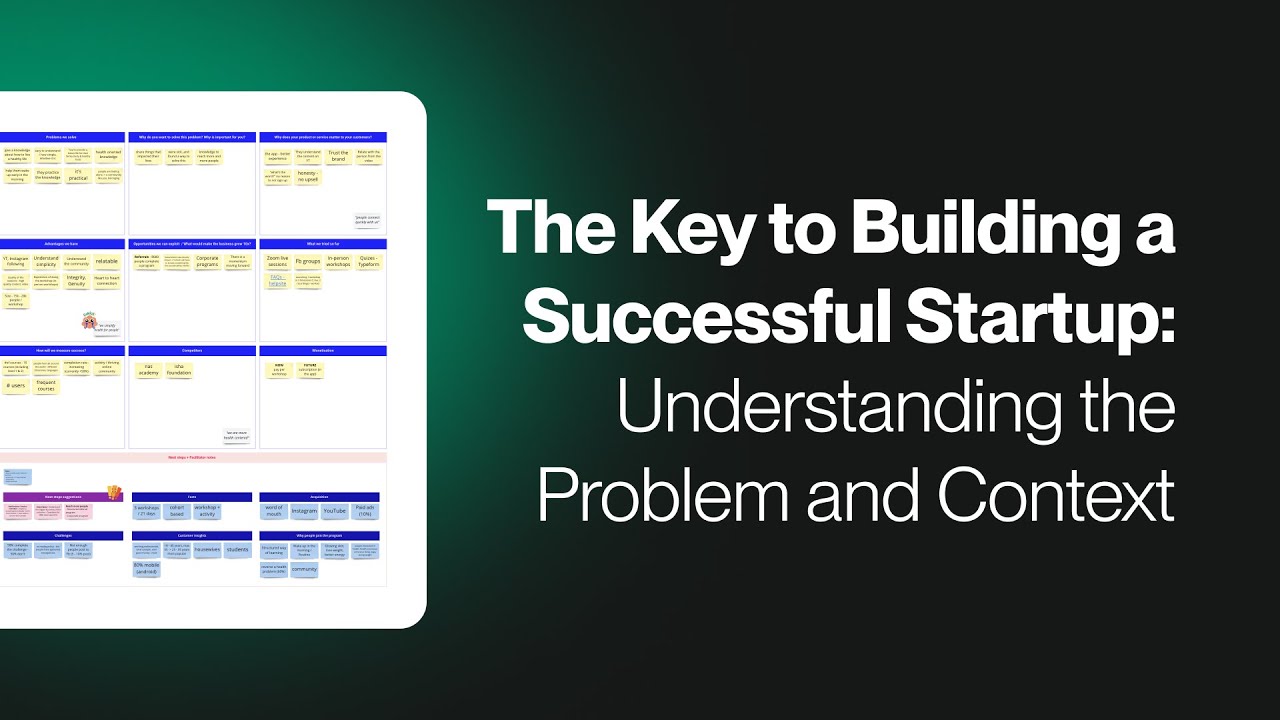
Daniel Andor shares a kickoff board template his team uses with startups to map the essentials: product definition, target audience, core problem, MVP features, challenges, competitors, monetization, and success metrics. Two examples show how it works in practice, from a health-and-wellness workshop to a healthcare career marketplace. The board takes an hour with decision-makers and feeds into later design work.
Chapters
Hi, Daniel here. I want to give you a taste of how we start our projects with our clients. This is the board that we start most of our projects with. So whenever we work with a startup or scale-up, this is where the discussions start. This is a board that evolved over time. You will see in the examples that there are a couple of different versions and it maps the critical building blocks of any product. Though the discussions are usually unstructured with the product leaders, product managers, founders, because these are the people that we talk with usually, we try to fill in all these boxes that you can see on the screen. We start our discussion about the product. So what is the product? If they have a unique value proposition, if they have a short description, and eventually how they would describe what they do or what the product does for somebody that doesn't have a clue about it. Then we want to see the target audience, how much information they have about it, how well they know them, who are they, stuff like this. These go in the target audience box. Obviously, there are side discussions that might occur. So some of them will go in the general notes. Some of them we will try to fill in the other boxes while we talk, but we usually try to have a somewhat box-by-box approach if you want, because it's easier to tackle all these aspects. So yeah, let's move forward. We then go to the problems that they want to solve. Then why they actually care about this problem, why they want to solve it. Because if you are in this thing for the long haul, usually it's good to have an incentive about why you want to do this. And eventually we also want to talk about why the customer should care or trust them in solving this problem. Because in the end, that's the whole thing. They want to solve something. The customer wants that specific thing to be solved, hopefully. And the customer should trust that they can do it. Then usually the slightly easier discussion, it's about core features. Most of the people like to list features. The thing is here we want to focus on the core features. So what's really, really important that goes in the core features part. Challenges, blockers, constraints, anything that might be a blocker, anything that might be a problem. Here you can have all kinds of challenges or obstacles from the standard, we don't have enough money. Or we don't have enough people to, I don't know, how we raise investment, or we don't have the specific knowledge to build this, or things like this. But anything that's like a blocker or constraint, that goes inside of that box. Then we try to see if there is any kind of angle, any kind of advantage that they can use. And again, it goes in the advantage box, obviously. Anything that can help grow the business, like opportunities that might occur, opportunities that they are aware of It goes in the opportunities box. Also, it's really good to have an overview of what they already tried and how that went to just try to not repeat the same mistake again. So if they tried different experiments, if they tried different solutions already, if they tried building something or an MVP or whatever they tried, it goes in the what they tried box so far. This again helps to have an overview about how they thought so far. What worked, what didn't work, and it's a good starting point. As I already mentioned, if you want to build a startup, it's good to be in this mindset, in this specific thing for the long haul. So obviously you want to see goals and visions, like where do you see this thing in like 2, 5 years? And eventually what has to be true to achieve that vision. This can give you an idea of how they see success. What other obstacles might be out there that are really important for the vision to come to reality? So these kind of stuff goes in these 2 boxes. How will you measure success? Obviously, this can be something particular for this part of the project, but even for the whole project, this gives you a good idea about what they want to achieve, how they know if they achieved it or not. Then we briefly touch on competitors. So it's like the most important competitors usually go here. And how they plan to monetize this whole thing. All this information, it's basically an overview of the whole thing, and it's a good starting point for the next phases of the project. Whatever you want to do from this point on, you basically have an overview of all these important building blocks. Once we go through this whole discussion, usually with product leaders, I have some time separate to go through the whole board, take some notes, rephrase some of the things, highlight some of the important stuff. And after that, we will discuss them on a separate call. Also, if this is part of a larger workshop, some of the cards from here will be reused. So this is why you see the How Might We section there. I rephrase some of them in How Might We, then we will use them in a design sprint or in other workshops as well. Cool. This is kind of how things work theoretically. Let's see the examples. This is one of the latest projects that we worked on. And you can see this is how a board looks when it's filled in. So you have the product. In this case, it was a couple of workshops and how the workshops worked. It was cohort-based. They wanted to have accountability. Everything that's important about the product, as I already mentioned, goes inside of that box. Then we have the personas. So who they target, how much they know about them. Briefly, we don't go like full user persona stuff here. It's just briefly the persona. It goes in the persona box. The problems they want to solve, as you can see here, they wanted to have a practical way of presenting the workshops. They want to give knowledge about how to have a healthy life and how they think about the problems they solve. You can see them on the screen. Then we talk about why they wanted to solve this problem. In their case, They wanted to share things that impacted their lives. Obviously, we talked about why people should care about this. They have quite a good online presence. They have a brand. So people trusted the brand. People trusted them in the end. And this is one of the quotes that I actually put there as well. People connect quickly with them. So this was one of the things that they mentioned. I really like to take some quotes as well from time to time and put them on the board. Then we moved to the core features part. So we mapped what they already had in place. This was for an MVP. So in the beginning, we focused on what they already had. They had a landing page. They had quite an online presence. They have a couple of Facebook groups. All this stuff in the end had to be part of the MVP that we wanted to build. Challenges. We mapped all the challenges that they mentioned. They had quite a lot of problems with chatbot spamming. People accessing their workshops without paying for it. Then we move to the positive part. So advantages and opportunities. They had quite a lot of followers on YouTube and on Instagram. So this is definitely something you can use. They had quite a lot of people in their workshops already, like 15 to 20K. They had experience running these programs for quite some time. And one of the things that they mentioned here is that they simplify health for people. I really like this quote. So again, you see the quote there on the board. Stuff that they tried: Zoom calls, Facebook groups, in-person workshops, and other tools used during the workshops as well, like forms. You can see their goal or vision and what has to be true to reach it, and you can see how they will measure success. So you have number of users in the workshops, the completion rate of the workshop, how active are the people in the groups and during the workshop, And the number of courses they take. You can see a couple of their competitors as well there and how they plan to monetize. So all this information, it was then translated into those how might we's that you can see towards the bottom. And also you have some notes on the right side. So regarding those notes, you can see there are some suggestions for next steps, some of the facts that they mentioned during the call and I really wanted to highlight them, how they acquire clients at this moment, challenges they have, basically extracted some of those insights that I found useful and important and highlighted them. So this is the board filled in. There is also an older project, and you can see that looks quite different without the boxes at this moment, but it kind of goes on the same direction. So we have the product, in this case it was a healthcare career marketplace. Then you can see the core features, what they had, their profiles, initial offers. You can see the user personas that we just briefly talked about, the candidates and the clients, the problems that they solve for them, the challenges they have, advantages, and this whole thing like opportunities, constraints, their goal and vision, and how they monetize. So everything, it's kind of here, and usually this is around Up to 1 hour of discussion, and it's quite intense, I would say. But what's important is that here we bring just the people that can add value, and those are usually people that can make decisions. So they are CEOs, C-level executives, VPs, PMs, founders, usually these kind of people. So that's it. Hope you find it interesting. If you want the board, let me know. I can send it over. Thanks.