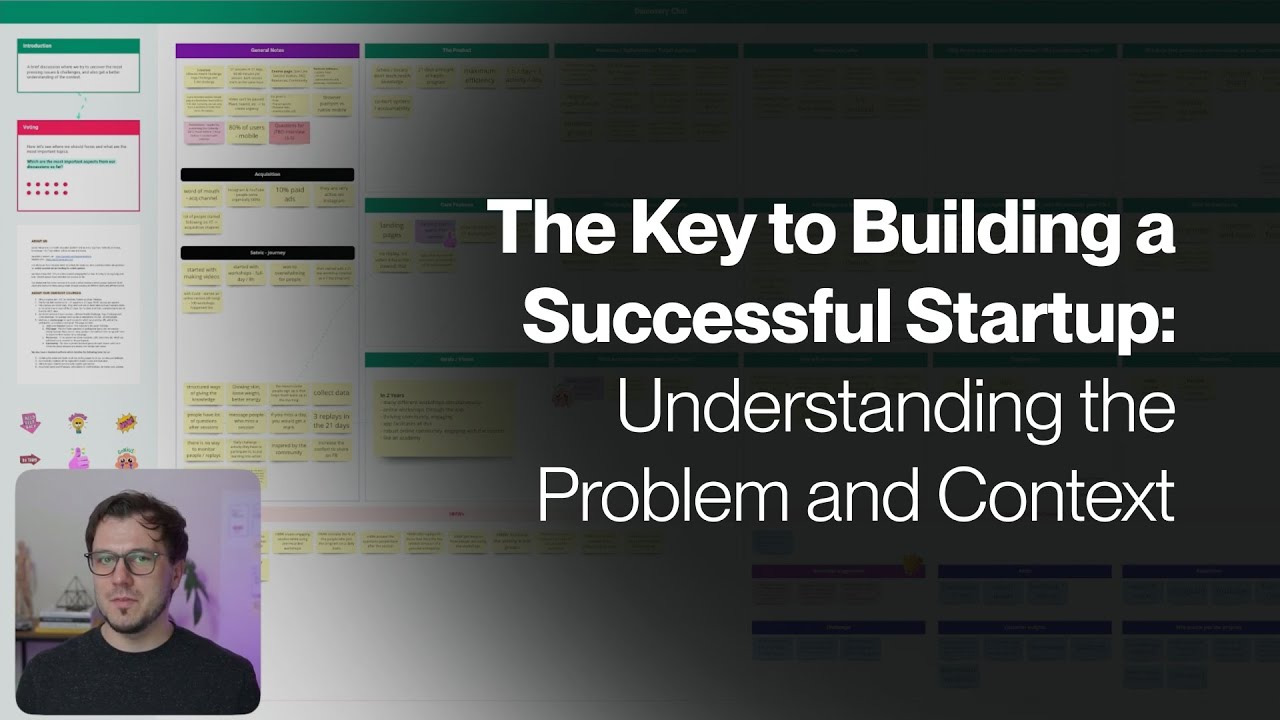
In this instructional video, the presenter walks through a comprehensive discovery framework used during 45‑minute to 1‑hour kickoff workshops for new projects or startups. The framework is visualized as a series of boxes that capture essential business information, which is later synthesized into actionable insights and "How Might We" cards for further workshop activities. The walkthrough proceeds step‑by‑step, covering: (1) product description and unique value proposition, (2) target audience identification and segmentation, (3) core customer problems and the founders' personal motivation for solving them, (4) perceived benefits and trust factors for customers, (5) core product features and current gaps, (6) blockers, constraints, and challenges, (7) competitive advantages, (8) growth opportunities, (9) prior experiments and learnings, (10) long‑term goals and vision, (11) necessary truths (key assumptions) to achieve those goals, (12) success metrics/KPIs, (13) competitor landscape and differentiation, (14) monetization strategy, and (15) general notes that are later transformed into "How Might We" prompts. Throughout, the presenter emphasizes listening for nuances in how founders describe their product, the importance of aligning passion with problem relevance, and the need to capture both positive and negative aspects to inform subsequent solution‑focused workshops.
Chapters
Hi, this is a walkthrough of one of our main discovery frameworks that we use whenever we start a new project. So during usually a 45-minute to a 1-hour discussion, we go through all these boxes and fill them out, and it looks something like this. We talk about things like the product, target audience, problems, challenges, advantages, goals, you know, the important parts of basically any business. Once the call is done, I will go through all this information, highlight some of the stuff, create connections, In order to have a proper understanding of what's going on, you see all these boxes on the screen. So we will tackle them one by one. What's also important is that all this information is reused during the workshop, and is the baseline for what's happening from this point on. So let's start. First of all, we talk about the product. It's usually the easiest way to start a discussion, and here I'm especially focused on. Understanding all the important aspects of the product. But if there are more than one person on the call, it's really interesting to see how they describe the product in different ways, what they highlight, what's important for them. So you will see those slight nuances and on how they talk about the same thing, basically the product. Okay, so as I mentioned, we focus on how they describe the product, the unique value proposition, And how would they describe it to somebody that doesn't understand this or doesn't know anything about what they are building? You can see some examples on the screen from different projects. We had a platform that automated a recruiting agency's hiring process for medical staff. We had a cohort-based system for taking different workshops, and you can see how they describe them briefly, all these activities that are happening around. Then we move to the target audience, and this is especially important to understand how much they know about the customer or the future customer. So we want to see who is the target customer, how much they know about them, any kind of specifics, interesting facts, research that they've done goes on the board. And you can see some of, some of the clients have quite specific descriptions and the proper understanding of who are their target audience demographics and specifics, even what kind of language they talk. And in other projects, we even segmented the target audience. As you can see, we had the candidate and the client side. They were looking for different stuff. They were different people. Then we talk about what problems they want to solve for their customers or potential customers, which are the most important ones. And you can see some examples here on the screen. Give a knowledge about how to live a healthy life. Health-oriented knowledge, had them to wake up early in the morning. These were some of the problems that they wanted to solve for their clients. And from another project they had during recruiting of doctors and nurses for the healthcare industry, and they wanted to provide fast access to relevant candidates. One interesting aspect is to understand why they actually care about this, why they want to solve this. Especially important if the founders are in this thing for the long haul. Because you need that drive, that passion for doing this. So I usually ask them about why they care about this challenge, why they want to solve it, what drives them to do it. And you can see again some people saying they share things about stuff that impacted their own life. They were sick and found a way to solve these problems, and they like to give knowledge to reach more and more people. Then we want to understand why those people should care about these services. What makes them unique and why should the client trust them? And you can see some examples on the screen, like a good experience through the app, because they understand the content provided in different formats like on YouTube, because they trust the brand, things like this. Then we move to the core features. So again, this is different. It's not about the product, but the main building blocks about the product. And here it's really essential to highlight those core aspects of the product that are really important for the client. So in some cases, we talk about the landing page, about the video content, about the experience provided during the workshop. In other contexts, we talk about the candidate profile, the initial offer they get, how they create the matches between the hiring part and the candidates. And also you can see on the screen some of the things that they would like to have, and those are highlighted in red, but they are not working properly at this moment. It's also important to understand the blockers, constraints, challenges they face at this moment to see how I could help them or what we should know about before moving forward. And you can see there are a bunch of them from chatbot spamming to lacking features to new type of products that are on the market to market cap, pricing, product know-how, stuff like this. So there are a bunch of them usually, but moving forward, we start to focus a bit on the positive side. To see advantages they have regarding competitors or in general something that's unique for them, if you want. In some cases, this might be about large following on social media because they already did it a couple of times, so they have the reps and they know how to do it. In other cases, this might be the experience in different industries because they were first to market and because they are really in touch with the whole community and they know what's going on there. Then we want to see opportunities, so things they can exploit to make the business grow faster. There are all kinds of ideas usually that came up around this stage. So you can see referrals, corporate programs in one case, or email marketing, or targeting different kinds of customers, reusing the data in different ways, recruiting for a different kind of job. One thing that can help move things forward faster is checking on what they already tried so we don't do the same thing again and again. And I just want to list all the things that they tried and see how that went so far, what they learned, any insights they have from these experiments. So you can see some tried different sessions for their workshops, groups in person or online, quizzes, forms, FAQ pages, launching different things custom work for different clients or different pricing models altogether. Then tied in a way to why they want to solve this challenge and why they want to build this company and how they see the future is this goals and vision discussion to get an understanding of where they see this going. What is their goal in like 2 to 5 years from now? How would success look like for them? And you can see there are a couple of Examples again on the screen from one project. It was having different workshops, a thriving community, an app that facilitates all that's happening in the community, and almost building an academy for what they were doing. In the other project, it was about the quality and quantity of the matches, the time frame required to match candidates with clients, and the fact that they could guarantee a 3-day turnaround from when somebody starts a hiring process to when they find the candidates. Once you have the vision or the goal, it's important to see what has to be true to reach that goal. And you can see some things here on the screen, also some stuff that I, as I mentioned, I like to highlight things for the client as well, but even for us to have a proper understanding of what's going on. And in this case, it was about creating an engaging, amazing community, courses, These would be the aspects that would move the needle towards that goal that they set in the beginning. Now, once you have the goal, once you have the understanding of how things should look like and what has to be true to get there, it's important to see how they actually measure success. We are looking on what success looks like, some important metrics or KPIs that they set. You can see on the screen we have the Number of users, the number of courses they would take, the completion rate, the activity that happens in those communities, things like this. Then it's important to have a brief understanding at least about the competitors. So who are the competitors? Who are the main competitors? And eventually a short discussion about how are they different. And because they want to build a business, it's important to talk about the monetization parts, how they want to make money, what's their business plan. And you can see some are changing. Now they have a pay-per-workshop kind of business, and in the future they want to create a subscription model. And the other place, it was a fixed price, so client pay per hiring. We also have a place for general notes. So while we're talking, there are all kinds of stuff that's coming on, different topics, different insights, ideas. All those things go usually on this general notes kind of board. After the call, I kind of revisit all this discussion and take some notes and repurpose some of the cards. And this is why some cards end up being these How Might We notes that we will use in other parts of our workshop. And this is especially useful to rephrasing some of those things that come up in a way that will further down help us and guide us to come up with different solutions. And it puts us in the proper mindset to try and find different ways to solve these challenges that we face. And also there are notes, usually my notes and insights and stuff that I highlight. So it's like insights, important notes, topics that emerge, highlights, possible next steps. All these go on this board. So kind of this is the whole thing. This is how it looks once it's done. And it's a good overview of what's going on, what's the context, and have a proper overview of all those critical aspects and insights. And that's it. Thanks for watching.