ADHD Awareness Month- Workplace Accommodations for ADHD
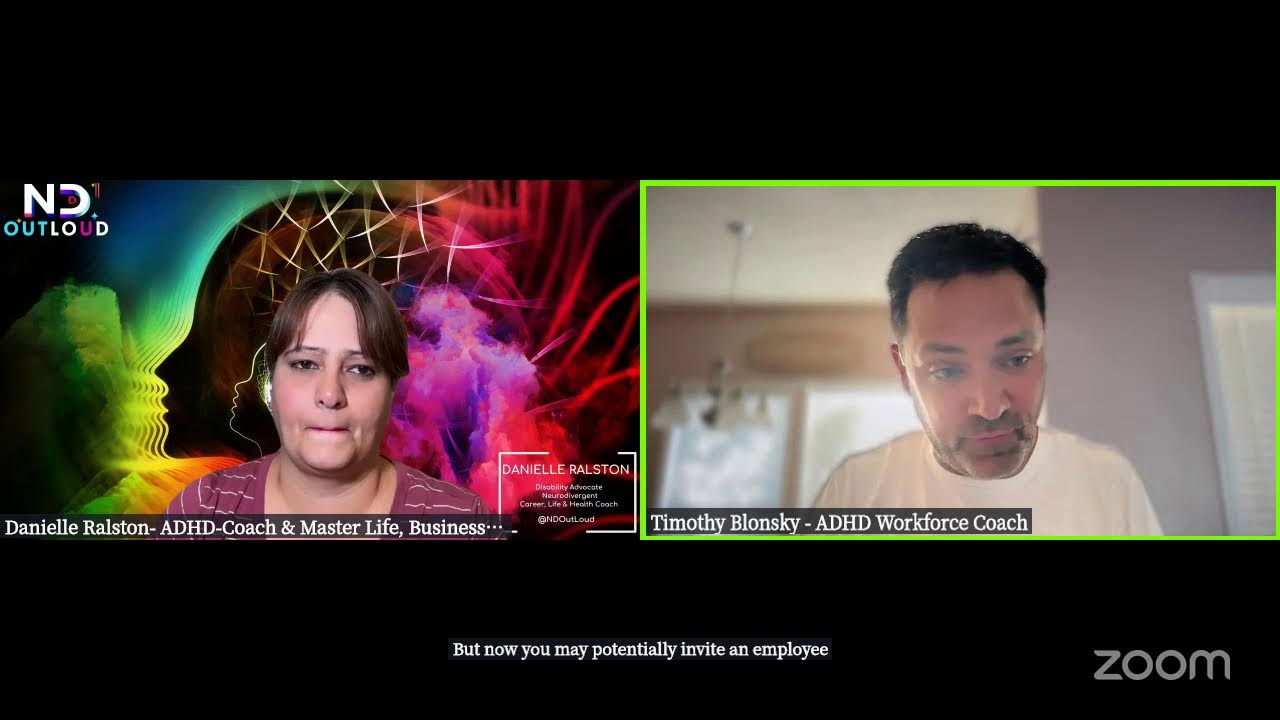
Danielle Ralston and Tim discuss how employers can recruit and support workers with ADHD. A Lightcast report found that a 10% increase in Florida's disabled workforce could add $111 billion to the state economy. They outline concrete accommodations: closed-captioning and AI transcription, quiet zones and adjustable lighting, flexible hours and frequent breaks, mentorship and peer-support groups.
Chapters
Good morning, everyone. This is Danielle and Tim with ND Out Loud once again. And today, this is our first live with ADHD Awareness Month. So we are talking about ADHD and workplace accommodations today. And there was this new article that came out from Lightcast recently that has— if you don't follow them on LinkedIn, absolutely follow them. They have some amazing information, and I love all of the data that they back, because we love all of the data and all of the numbers. I love all the data that they use to back everything up. So we're gonna be referring to that most recent article many times today. But As an ADHDer, we know that people— only less than 10% of people disclose that they have a disability in the workplace. Again, this is about having a culture of disclosure and accommodation and all of that DEI. That's that weird political thing right now that should not be. But we need to be disclosing and we need to change those conversations because Hello, you're going to lose your workforce soon. And we've been talking about this for weeks and weeks and weeks and weeks and weeks. So let's dive in and talking about— let's talk about this Lightcast article really first because it is fascinating to me.
Yeah, so Lightcast is a world-renowned leader in the space of helping whether it's a workforce program or a private employer or a nonprofit to kind of understand labor market dynamics and how they can use that data to, one, perhaps make some tweaks in their business model, but 2, to really help them understand the challenges that are related to talent acquisition and retention and what— and really the data behind that. Because, like, you know, we can talk anecdotes until, until we're blue in the face, but we really have data and need to have data to kind of back up that. This is the current situation that we're in. And in honor of ADHD Month, they put out a post that was really fascinating about that. And I think when we post this on all of our social media channels, we'll link that article. But really, it's the data behind how employers really need to be in a place in which they consider hiring from this incredible talent pool, understanding the numbers that are behind that. And understanding that once you're in a place in which you have even just a small percentage of the ADHD workforce that is not being tapped into the way it could be, you're adding hundreds and I mean even upwards of millions of workers that can be a part of the workforce that can provide a valuable contribution to your company. I just love how they do it with the graphics and just how they present it. It's amazing and I love them.
So one of the big things here, and one of the things I really put on, is they talked about the state of Florida, is they're taking a proactive approach to hiring people with disabilities. And they found that if the disabled population in Florida only increased just by 10%, hiring from that disability pool by 10%, that's Not anything. It's going to increase the Florida economy, economy by $111 billion in the next decade.
With a B.
Billion with a B. That is amazing to me.
Yeah. And so, you know, there's a lot of things in play in that. Obviously, Florida is a growing economy, and to such extent because Florida is not usually considered to be the type of state that's very inclusive, but they really, they just come to a realization that they need to do this or they're going to start losing companies in Florida. And so this is something that needs to happen from a government policy perspective. Florida has an incredible vocational rehabilitation program that is really robust and cutting edge, and that kind of plays into how they've been able to get some success. at the level that you just referred to. So, you know, it's a full— it's an all-encompassing picture. It's employers that were proactive, but it's also government policy that was proactive, and they kind of came together to make that happen. And, you know, we're seeing other states like Virginia is another one that's really good in the space. Idaho is working towards that as well. And I'm on the board for the council that oversees that system. So like—
Tennessee is starting to make some changes for that. Um, and even Alabama— and a lot of people are going to roll their eyes at me because they think of Alabama as this very backward state, but we have a huge amount of tech in Huntsville and even in the Birmingham area with having the Mercedes plant— is the one that actually started this. The Mercedes plant was finding that they weren't finding the quality of workers that they wanted and stuff. And we build here in Alabama, they build the electric vehicles from Mercedes, as well as all of the SUVs are built here. And Mercedes decided to change, and they are actively looking for people with disabilities, especially in their tech positions. So not just their labor force, the, the on-the-floor assembling cars, they're looking for high-level skill-based people with disabilities, which is fantastic. I actually had a headhunter reach out to me because my background in tech. and in combination of being disabled and talking with me about some stuff. So I'm actually meeting with them in a couple weeks because they recognize that this workforce is a qual— it's not just that we're looking to hire disabled people to fill our quota. It's the, no, these are fantastic people to have and they're willing to— there's some of these companies in Tennessee I've looked at that they're hiring based on skills, not education.
Yeah, you know, so just skill-based, which we've talked about that in previous conversations, and I'm sure we'll be talking about that quite a bit going forward, and maybe even having another separate conversation on that, and that very important thing. But it's interesting because, you know, going back to 2018, I was managing a workforce program in Hartford, Connecticut, and I'm now here in Idaho. And one of the programs that I wasn't directly involved, but I was a part of some of the ceremonies at the other end where they were celebrating the success of this program. And what they did is they took the German model for hiring individuals that were returning citizens in this particular case. So these are citizens that were incarcerated for nonviolent crimes, were released from prison, and they were put into the system in which they were able to get the skills that were necessary for the jobs that are in demand in that particular region. And now, you know, know, the rousing success in that. So one of the things that we've seen, states like Colorado, Connecticut, Rhode Island, Massachusetts, Virginia, Alabama, Florida, they're really emphasizing the German model for training up a workforce. So getting away from post-secondary education, not fully, but like more certification-based training for anybody in any demographic, including those with disabilities, including those with ADHD. And, you know, having a methodical career building process, that, that, that's what Germany has been doing for decades. And it worked because Germany has an incredibly robust workforce, but 85% of them are individuals that do not have a college degree. It's all apprenticeship-based. It's all, you know, starting off with entry-level building skills, having kind of a parallel pathway where you're doing your education and your on-the-job training at the same time. So it's a German model. And so it's no surprise that Mercedes, a German company, would, would really kind of adopt that model in Alabama as a way to, you know, not to overnight have success, but to kind of really methodically build the workforce and working with local government authorities in that process. So it's kind of a win-win. And I got a lot of expertise in that. So that's something that I can put my hat in the ring in terms of helping employers kind of understand local government and how they can navigate those systems. To get good work.
But, and, and I think it's really important to realize that at this point, college education— well, I'm not saying it's not important. It's especially in the US. The US people and US businesses have this stereotype that US people that go to college are smarter than anybody else. And let me tell you, our scores in the US are way lower than Germany and Japan and China and, and, and, and, and. The quality of education that you get on the job is way more transferable into skills than it— than a college education with random learning. And as those of us who have gone to college know, 90% of our education is so that We can pay the college's bills, and 10% of our education is actually on our core studies, which as an ADHDer, I have serious issues with because you are wasting my time.
Yeah. Yeah.
But if you're gonna teach me and show me how to do something while I'm doing it, I, one, will learn way more than you're teaching me in the skills-based learning. Because I am going to learn every single thing about it everywhere from every aspect I can possibly find. But I also am excited to apply and do the thing.
Yeah, you know, and I, you know, I've seen that model with, you know, in my previous roles where registered apprenticeship program, but also back in Connecticut where we were focused on getting people into the manufacturing workforce. Connecticut has some of the most advanced aerospace companies in the world. And their motto was a quick 6-month certificate at the local community college, and then on-the-job placement immediately, a 97% job placement rate or something like that. It was in the high 90s. And then like learning on the job with that machine operator that's been operating this machine for 35, 40 years, because that's the best education that you can get. So, but you know, the The purpose of what we wanted to talk about today, specifically in honor of ADHD Month, is what simple worker accommodations you can give for one, current employees that may have not disclosed yet in regards to whether they have a disability or they don't even know themselves if they have it, which I just recently realized in the last 18 months that I have it myself. But like, what worker accommodations can you provide your current and the new ADHD workforce? Because ND@Loud, you and me, our incredible team can help you with getting connected with the talent pool. So that's one, you know, that's a very easy thing that we could do. But 2, okay, now, now you've hired someone with ADHD. So what can you do to make them the most successful in, in an office setting or from a remote setting?
So, okay, one of the first things I want to do is I want to take out the thought process that accommodations are only for disabled people.
Yep.
Accommodations are for everyone. And almost especially with the neurodivergent ADHD autistic population, and even a lot of invisible disabilities, anything that we suggest or put in place for accommodations for them work for neurotypical people and increase their productivity too. So these are things to put in place that increase the productivity of your whole entire team, not just those with disabilities.
Yeah.
So one of the first things I'm going to tell you is have every meeting needs closed captioning on, even if you have nobody who is deaf.
Oh, yeah.
Every meeting needs transcriptions, and every meeting needs summary. And you want to know what that means? If you use Zoom, which most— I think Zoom is still 75% of the workforce uses Zoom. And Teams, if you use Teams, Teams also does all of these things. Turn on the AI stuff for your calls. That's it. You want to know what this also means? It's also going to show you where your productivity gaps are with your managers. If you have a manager who you often hear from employees that, well, that's not what they said. Well, that's not what they said. No, they never asked me to do that. And we all I mean, we've all heard these stories, neurodiverse or not. We've all heard these stories. And that's going to nip that right in the bud. It's going to make your— it's going to increase the viability and management style of your management team and your people who are pushing the buttons, doing the work.
Yeah. You know, like in the beginning of the pandemic when we were all forced to be in an online world, Which then we saw the benefits of that, you know, indirectly. But one of the things was at the time Zoom did not have a good closed captioning platform. There were real challenges on that. But Microsoft Teams had a closed captioning platform. It was pretty good. Like it was— nothing was perfect at that time, but it was much better than Zoom. So like I really pushed my employer that I currently had. And then in the middle of the pandemic, I moved to Idaho and we were kind of like implementing systems From scratch, I'm like, we have to use Microsoft Teams because of closed captioning, so I can be more involved in the meetings. And then, yeah, you're welcome to all of my other coworkers that loved having the closed caption feature there as well, because, you know, sometimes, like, after meeting after meeting after meeting, all the noise just really would get to people so that they can mute the computer, but they could still, like, follow along the caption and still be involved in the meeting. So yeah, we would come to find out that that was a benefit for Yep.
So closed captioning alone decreases Zoom fatigue, and Zoom fatigue is actually a thing. It decreases meeting fatigue, which is also a thing. It increases focus. Wow, imagine that. And it also increases processing, even for someone who is neurotypical.
Yep. Yep.
We, we often need multisensory input. Reading, hearing, seeing is a fantastic combination for everyone, regardless of— you don't have to have any disabilities. So transcription allows those who do process slower or who may have gotten distracted and had another call or a team member messaging them, or, you know, we all have these things. It allows somebody to go back through and The transcription with Zoom gives you the audio and all of the written transcription. So you can— well, that transcription isn't very good. What the heck did that person say? You can listen to it just for a little tiny section again to figure out what the context was because the AI didn't get it right. And then with Zoom, and Teams has this as well, we have the summary at the end for action items and all of that. So nobody has to take notes. Which the person taking notes is not paying attention to the meeting if they're taking notes. Fun fact. And I don't care whether you're neurotypical or disabled or whatever. That's true for everyone. 2, it holds everybody on the team accountable. Nobody can get away with nothing, which I know a lot of corporations don't like accountability.
Yeah, yeah, yeah, yeah, they don't. And that's a problem. But they're going to be left behind in the new workforce if they don't take proactive measures to address that. So I have one of Tim's famous lists of other potential worker accommodations. So I'm going to read out these 4, and then we can kind of talk about this from a physical workspace adjustment. So I have got different categories there. So for the physical aspect, a quiet workplace. So providing quiet, distraction-free work area or noise-canceling headphones. To flexible workspaces to allow for changes in seating or environment and working from home or in less crowded spaces.
So let's tackle those 2 first. So— ah, got a hair. For noise-canceling headphones or quiet workspaces, most buildings, especially now, are not set up for quiet workspaces. There's very few quiet workspaces. Almost everyone— this is not an accommodation that you have to shell out money for. Almost everyone owns noise-canceling headphones at this point. Or you can buy them very cheaply now. Earbuds, headphones, all of those things. They are a very cheap accommodation now.
And if you are an individual with a disability, you can tap into your local vocational rehabilitation system, and they'll buy them for you.
Yes, exactly. So one, just allow people to use the thing they already have. Because as a neurodivergent, I don't know a neurodivergent that doesn't own loop earplugs. Noise-canceling earbuds and headphones. Like, almost all of us own all 3. Allow us to use those things. Thank you very much. That's it. End of story. Now for lighting and things like that, allow someone to make the changes to their cubicle. I have seen— and, and this is the joy of TikTok— is I have seen really cool things where people are able to decorate their cubicles. There are neurodivergent people that just want to put a blanket over their cubicle so it's dark in there.
Yep.
Why is that affecting you? That's not affecting you or anyone else. Allow them to do that. One, that decreases noise. Two, it decreases the horrible lighting in most offices. Uh, and, and that is free to you because we will bring in our own stuff. Allow us to accommodate ourselves.
Yeah.
And don't make us ask for it.
Yeah. And then how about the standing desk and ergonomic chairs, which are not a big deal?
I mean, every office— I mean, if you have humans that work for you, give them a comfortable space to work in. I mean, it's ridiculous that we're still using the old office chairs from like 1990 that have no support and no padding, and you expect them to sit there for 12 hours a day and wonder why they're not productive.
Yep.
Come on.
And then, you know, we already talked about the visual barriers, you know, so, you know, cubicles, screens, or partitions to reduce visual distractions. Totally.
That's easy. And if you have quiet spaces and like conference rooms and stuff, allow people to use them to work in if they're not being used. Obviously have a booking system. I mean, it's as simple as setting up a free Calendly system to allow people to book space in a room that is quiet, that they could shut the lights off completely, that they can hide under the table. Who cares? Set up a simple free Calendly. And if you're using Microsoft Teams, it's already built in. Set up a room that people can book so that they can have that quiet space. If I— when I was working in corporate world, if I would have gotten an hour 2 or 3 times a week to have some quiet space, I would have been way more productive.
Yeah, you know, you know, this is prior to me realizing that I also have ADHD, something that kind of runs in the family, I think. And but like, I, I had come to realize that, that there were certain times during the day when I was in the office all day that I had to go to the quiet room that had a couple couches and bring my laptop and just work on the couch for 45 minutes. And I would, you know, like, it's something like I had the pull to have that time. And I, you know, so like, how much does it cost for an employer to, you know, just have like that separate space and a comfortable space?
They already have them.
Bold lighting. Yeah.
Yeah, they already have these spaces. Just allow your employees to use it. And I don't care why. One of the big things is not Making it a big deal and creating barriers to usage of these things that you already have in place. This costs you nothing. And that's one of the big things about most accommodations. Obviously, sit-stand desks and good chairs, that is an investment for a company. That is an investment for a company. But your neurotypical employees need these things too. Everybody needs them. So provide them slowly. If you could only buy 2 desks a month, great. If you could only buy 5 a year, great. At least you're slowly trickling them in. By requesting and making us ask and demand and like have a temper tantrum and have to bring in the ADA and all of this stuff to ask for these things that are just basic human requests. Because neurotypicals, the exhausted mom who has zero disabilities, needs the quiet space to work sometimes.
Yeah, absolutely. And then, you know, something to keep in mind is that I see a lot of employers that do that, but not nearly enough. If you have a work-from-home policy, then provide some type of stipend that is once every 18 months to once every 2 years in which you allow the employee to buy those things at home so they can be more productive at home as well. So, so, you know, that money to use to buy that chair that is a little pricey, but it's going to help them be more productive. And it's a very simple thing.
And if you are an employee who happens to work remotely and work from home and doesn't have that stipend, reach out to me. I actually have plans because I've shared these with other clients and stuff to help you create those spaces for yourself for little to no money.
Wow. Yeah, that's huge. I didn't realize that that was something that you, that you did. That's awesome.
Yeah. Well, my husband, who is an engineer, actually created plans and like material lists and stuff for people to build a sit-stand desk out of like, and it was less than $100 worth of materials.
Well, awesome. Awesome. Okay, next category, scheduling and time management. So 4 things in this as well. Stop me if you want to. Flexible scheduling, so allows for varied work hours to accommodate peak times for focus. Frequent breaks, permit short frequent breaks to maintain focus and productivity. Time management tools, provide access to digital or physical planners, task management apps, and visual timers, which I think Anybody does anyways. And then chunking tasks to help break larger tasks into smaller, more manageable ones with clear deadlines.
The big thing there is be a good manager. If you have— and I don't care, again, this is accommodations across the board, not just for your neurodivergent or disabled employees. As a manager, you should be making sure that you're operating and supporting strengths and weaknesses of every single employee on your team. And again, neurotypical, neurodivergent doesn't matter what they are. There are so many options out there. And one of the big things that I've done is gone into companies and taught sales teams how to use a second brain. They're really fast-paced. They're always talking to people. And how do they track those conversations? And how do we do that? And by teaching sales guys how to carry a little tiny notebook or create a note on their phone to keep track of everything, They increased sales by 60% in less than 90 days. Just something as simple as bringing a coach in to help with time management planning. And again, not just for the disabled people, but for everyone, creates those things. And by being a manager, a good manager who has professional and gentle accountability built into their management style, every company who has managers who are providing that accountability on a person-by-person basis, Or putting people with mentors and having an ERG-type situation in your company and having mentors and coaches and things like that within your company, that increases productivity, increases workplace happiness and work-life balance. And that is an important part of increasing productivity and your bottom line.
Yeah, you know, I've seen that with large corporations like HP, which I recently did a presentation for International Sign Language I should say. And the synergy that they have between all the ERGs that are really doing everything that they can to provide the best type of workplace for their fellow coworkers is incredible. And it was so fun to see that this large multinational corporation had really taken on that mantra. So we need to see more of that. And that's where you and I can come in and help. No matter what the size of your employer is, we can help with Developing those internal policies that can create that, that synergy that you have between managers, coworkers, and all staff.
Some of this stuff, if you're a manager listening to this, you're like, yeah, you're increasing my workload by this. I will tell you that by doing this, it was like 10, 15 minutes. Once you got moving and had a system for this, it was 10 to 15 minute conversations via Slack, mostly with people just checking in and helping them chunk up their tasks. If they're overwhelmed by a project, helping them chunk it up, which is going to just increase your, your value as a manager. manager and your team's productivity, which means more money. I mean, all of those things, that's all that means.
So, uh, this, this kind of goes along the lines of, um, good manager, but having written instructions, so offer written instructions, a checklist to ensure clarity and reduce memory overload. Task prioritization assistance, uh, which we kind of already talked about that. Regular check-ins, so have scheduled regular meetings, have recurring meetings, set them up. So like have once a week, once every 2 weeks, and if you miss one, it's okay, but you have those recurring meetings and it's something that's expected. Extend deadlines. You know, it's okay if you're a little late on a particular deadline. If the job is done well, that's better than having not done it at all. And then project management software. So things like Trello, Asana, Teams can be helpful in organizing tasks and deadlines.
All of these things. The first accommodation that I mentioned with having Zoom with the AI and the submarines and all of that, that's part of that. I mean, that cuts out a lot of the physical work for that. And by doing that, again, one, you're holding your managers to a higher level of accountability. That's a big deal. And that is where the failure point is for a lot of companies is they have managers who are promoted because they were bad at their job. That is, unfortunately, that's called the Dilbert principle. For those of you Gen X or ish know who Dilbert is, there's There's a— that there is an actual scientific principle called the Dilbert principle of promoting managers because they were bad at a job. But that means that your team is not operating well. And we need to— and that is part of why millennials and Gen Zers are not willing to go into the workplace.
Yeah. Well, you know, if you're talking about promoted managers or managers that won't leave, you know, we have to talk about the baby boomers that eventually are going to have to leave. You know, that's the big thing that shifted within the workforce that Lightcast has brought up several times, is that we are in a demographic drought. And I believe that in that we have, we have millions of baby boomers that will not leave their jobs for whatever reason. It might be financial, might be just because they're, you know, they're used to it. But we're at a place now where, yeah, you know, we have a lot of disenfranchisement when it comes to the subsequent generation not wanting to be part of the workforce. Labor participation rates are on the lower side. They should be much higher than they are. It's all part of that puzzle that we're trying to help employers understand.
Yeah. And again, better managers make better employees. People don't leave a job, they leave a manager.
Yep. Yep. I love that quote and I've written it down many times. All right. Next thing. From a technology perspective, task reminder apps like, you know, something as simple as Google Calendar and just having the task in there. Screen management software, so tools to limit or block distracting websites during work hours. So RescueTime or StayFocusd are 2 apps that are for that. I'm not really familiar with them. And then text-to-speak software. So for those that find typing to be a barrier to productivity, You have that as well.
Yeah, all of those things. Again, text-to-speech, use Zoom. Even if you're only talking to— you want to know how often I open Zoom some days and just talk at Zoom so I can get the transcription and then send it to my VA?
Yeah, I've done that as well. Yeah.
I mean, I have an iPhone, so if I'm out and about, I can do that, but then I have to convert it and get it because she's on an Android and whatever. So I find Zoom like the easiest thing. So I'll open Zoom on my desktop. I open Otter AI. Otter AI is one of my favorite tools for this because I can do notes on my phone. I can turn it on while I'm watching something and it can record transcriptions in the background. I used it because a movie just really struck me as very something I could use as illustrations. So I turned my phone on with Otter AI and put it next to the TV and walked away and let it play the movie and then was able to pull chunks out. For marketing for myself.
Yeah, I love AutoAI. I've definitely heard of it when people use that religiously. Yeah, so that's great. How about this one? Communication adjustments. Clear, direct communication.
I don't know. I don't understand why this is an accommodation that we have to ask for so often. This should be standard. Because clear, concise communication means clear, concise job, clear, concise roles, clear, concise results.
Yeah. Well, and then how about this from, from kind of another, another side of this coin? Allow flexible forms of communication. So permit the use of email or messaging instead of phone calls for those who struggle with verbal communication.
Absolutely. And if you are someone who struggles with verbal communication, again, Transcription, closed captioning, so that you can. And how I suggest somebody who has trouble with verbal communication set up meetings is if you have a client that they only process verbally, you have to meet with them verbally. It is, it is, it is, it is, it is. That's fine. But tell the client that I do not process verbally. So it takes me time to process. It will take me 24 hours after our meeting for me to get back to you and answer you on any questions that you asked during the meeting. Set that expectation. There is zero wrong with that. And I think that we have been set up for failure as people, not just disabled people, but we've been set up for failure thinking that everything has to be instant and instant decisions, instant responses, instant, instant, instant. It does not.
Yeah. But, you know, someone like myself who has a form of ADHD, I'd like that instant sort of communication.
So, you know, I have to— I need it badly. But I have someone on my team who does not process verbally and closed captioning and all that. She can do it, but it's not the best. So I have to— I have to be able to blurt out at her and tell her all of the things. And then I need to give her the same courtesy and allow her the time to process and get back to me.
Yeah. Yeah. So like, it's a matter of me— if someone's managing me, they need to kind of understand that. And, you know, accommodate me. And then therefore I'm now going to be a more productive worker. And—
And you're going to laugh. People are going to laugh at this. She cannot handle paying attention to the video like she can't. It's, it's very distracting. It's overwhelming. It puts her into sensory overwhelm. So we have a deal. She has a game that she plays on her computer that she has to play in the top half of her screen. So it's up near her camera. So I think she's looking at me and communicating with me. She plays the game while I talk everything out. Then she gets back to me in 24 hours.
Yep.
I'm okay with that. We have those expectations set for each other. It's totally fine.
Yeah. So it's a matter of that clear communication or that conversation that you had with her, and then you, you worked out the details. Didn't take that much time. And now you have a productive employee that feels heard and seen. And, you know, exactly.
And I feel seen and heard too, as the manager, as the business owner. I feel, I feel seen and heard. So that I can get everything out that I need to. She feels seen in her, so she can process it the way she needs to.
Yeah. Okay. Now the workload and performance accommodations. Now this one is huge for me because I've done this in the past, is job restructuring, or what I used to call job carving. And it's a modified job duty to focus on the employee's strengths and limit the exacerbated challenges. So, and, you know, like we would go to an employer and say, okay, you have these 2 open positions. And I have the 4 people that I think would be potentially qualified for a portion of that position. So would you consider having, you know, like 2 part-time positions to cover that full-time position of 2 individuals that have some type of disability, whether it's neurodivergent or a physical disability or you name it, whatever it is? Now we have—
Or a mom with kids, a single mom with kids.
Exactly. So, like, in that case, like, it was a little bit of lead work with the employer. But what happened is, and I've seen this, I've actually seen this, and I know people that are still working with these employers, that they started off part-time. They took half of that role or 0.5 FTE. And but now they're there 20 years and they're full-time employees and they're super productive just because they made a tweak in a job. 20 years ago. So that's something that can be kept in mind is that employers need to be flexible in how they got their walls open for a while. Consider tapping into a local disability talent pool and put those positions up. And, you know, in the long run, it's going to help you.
And even accommodating for time, a lot of ADHDers prefer to work at night. Like, they are much better after 11 AM. allowing them to come in later and be with the team. So that— I mean, because I do, as a manager, I understand you need somebody face-to-face with you, or on Zoom with you if they're remote, during actual work hours, so that they can communicate with clients and stuff. But allow them to work from 11 AM to whatever the 8 hours later is, because I can't do that math. But there's nothing wrong with that. This And this is an antiquated thought that we all have to work 9 to 5. There's no reason for that. There is zero reason for that. Because again, if there's good work-life balance, you've increased the productivity of your employee. End of story.
Yeah. Or, you know, consider changing your, your workload to 4 12-hour days, or look at not requiring 8 hours, but require 8 hours availability. If they complete the job, then They've completed the job. And we're seeing a lot of companies do that, understanding that, you know, it doesn't necessarily have to be a 40-hour workweek. You can do everything in a 25, 30, 32-hour workweek.
And if you want things done efficiently and well, hire a neurodivergent person because we hate wasting time on stupid BS and we will figure out how to do an 8-hour job in less than 4 hours and we will do it well and we will have created a process for non- neurodivergent people to be able to do the same thing. So you can increase productivity.
Yeah, absolutely. Now, last category here is emotional support, mindfulness and stress management training. So offer and encourage programs that can help with emotional regulation. And that's where NDLA can come in and provide professional development in person or online. We've done this.
Yeah, we can either come in as a group And do a whole entire thing for groups, or we can do one-on-one. We have, and we do have hours outside work hours because some employers have asked me that. Well, I don't want my employees taking time off to meet with you every week. Well, we offer night and weekend options. We all do. But we also offer just text-based as an SMS communication so that if somebody is struggling with a particular task at work or a relationship or communicating or whatever, they can reach out to us immediately, tackle that problem, navigate that problem, and and move on with their day rather than being stuck for 5, 6, 7 days in this spiral of dealing with something. Um, and, and there's so many ways. Again, we've done group trainings coming into a company and doing full trainings. We're actually pitching a massive defense contractor right now for a 5-part series that they're going to roll into their HR training forever and ever, um, on things just like this.
Yeah, and I'm looking forward to being, uh, being a part of that, that, like, That previous presentation that we did was so, so amazing. And I would love to do more of that. Workplace coaching. So provide access to coaches who specialize in ADHD-related challenges in the workplace.
That's exactly what we do. I mean, this is exactly what we do. And we're not just life coaches. We're not just going to tell them to eat better and all of that. I mean, that is part of it because we are holistic coaches, but we both have labor intelligence and workforce development and career development and all of those things, time management plans. All of these things, we can help your employees with all of these things. And having a company roll us into their benefit package so that we are part of the benefits is an easy way for a company to offer that so that it's not something that they have to ask for. It's just something that is in their benefit package they can take a look at, reach out and do that. And we offer discounts and, and we take HSA and FSA funds here so that we can work that into all of those benefit package things.
And then last thing is, and this goes into some other conversations that we've had many times in the past, is, you know, having employers that are proactive in creating a culture of disclosure where current and new employees feel comfortable in asking for the support that they need, understanding what supports are out there that they could potentially tap into by having some clear communication with your employees about, you know, here's all the things that we offer. and related to ADHD or any other disability is providing peer support groups. So making sure that you kind of understand that you can get together with your fellow coworkers that have ADHD and, you know, really kind of like talk to each other and kind of understand what your challenges are, and they can help each other, which now you have a more productive team. But now you may potentially invite an employee that's been a part of this company for 10 years that come to realize, hmm, maybe I have ADHD in some form along that wide spectrum that encompasses that. You know, like creating those peer support groups is huge. And that's something that you could really do today.
Absolutely. And that's really easy. ERGs, all of that kind of thing is a very good way to do it. We also have gone in and offered one weekly group support, like call, and us as coaches coming in and doing that and a lot and facilitating those things for companies to make to just have somebody who's also there to guide them or just hold the space.
Yeah, yeah. So that's my list. You know, I think these are very reasonable things that employers can do, they could do today. But please reach out to Danielle and myself, and we'd be able to help with something that's specific to your employer. So if you're an employer that's a concrete building supply company, Like, and then we can offer a program that's tailored to that specific type of employee— employer that you are, or it could be an IT company or across the board.
IT company, law firm, everything. I mean, there isn't an industry that we can't adapt to you, and we'd love to learn to adapt to you. And we're going to make sure that you as a company are your— I mean, honestly, it comes down to your Economic and profit is, is the center of why you hire somebody like us. We're going to help you make more money. We're going to help your team be more productive. It's not just the mental health side of productivity and all of that. It is the company's bottom line that really has to be considered in all of these things.
And we can combine them because supporting your employees Yeah, you know, you kind of hit the nail on the head that this is very much a data-driven endeavor. So like, we, we have a personal passion and, you know, there's kind of an emotional pull that's into this, but it's all based upon data that you as an employer, no matter what part of the workforce you're in, need to do this. And you needed to do it last year, you needed to do it 5 years ago, but today is the day that you need to do it. So for ADHD Awareness Month, we're going to be doing a lot of things. Please consider, you know, kind of being mindful of all these things and reaching out to us, and we'd be able to help with, again, something tailored to who you are as an employer.
How we do it is we have our wide survey where we push it out to everyone on your workforce, and we're looking at increasing productivity across the board, not just for your disabled employees, so we can get a handle on what strengths and weaknesses are for everyone and increase the bottom line for everyone. I hope you have an amazing day. Let us know if you have questions. Reach out to Tim or I. We're always here to help. Happy to answer all of your questions and give tips, tricks, all of those things. And if you are neurodivergent and you would like to see us come into your workplace, reach out to us. We'll let you know who we need to talk to and see if we can have you help us get it in the door so that we can help you.
More from Danielle

Why Disney is what you need as an ND human #Neurodivergent #disneyadults #disneyscience #disneyworld



Follow along if you want to watch me finally finish what I started… #adhdcommunity #bodydoubling

The last 3 months I … wait no … all of us here at The Hive have been rebuilding from the ashes… we

The last 3 months I … wait no … all of us here at The Hive have been rebuilding from the ashes… we



What if the silence didn’t stop you because you never lived life alone? Katie Karayianis

What does getting ready for a road trip look like for you with adhd? #adhdcoach #ndhive
