Communication Mistakes Between Neurodiverse Couples
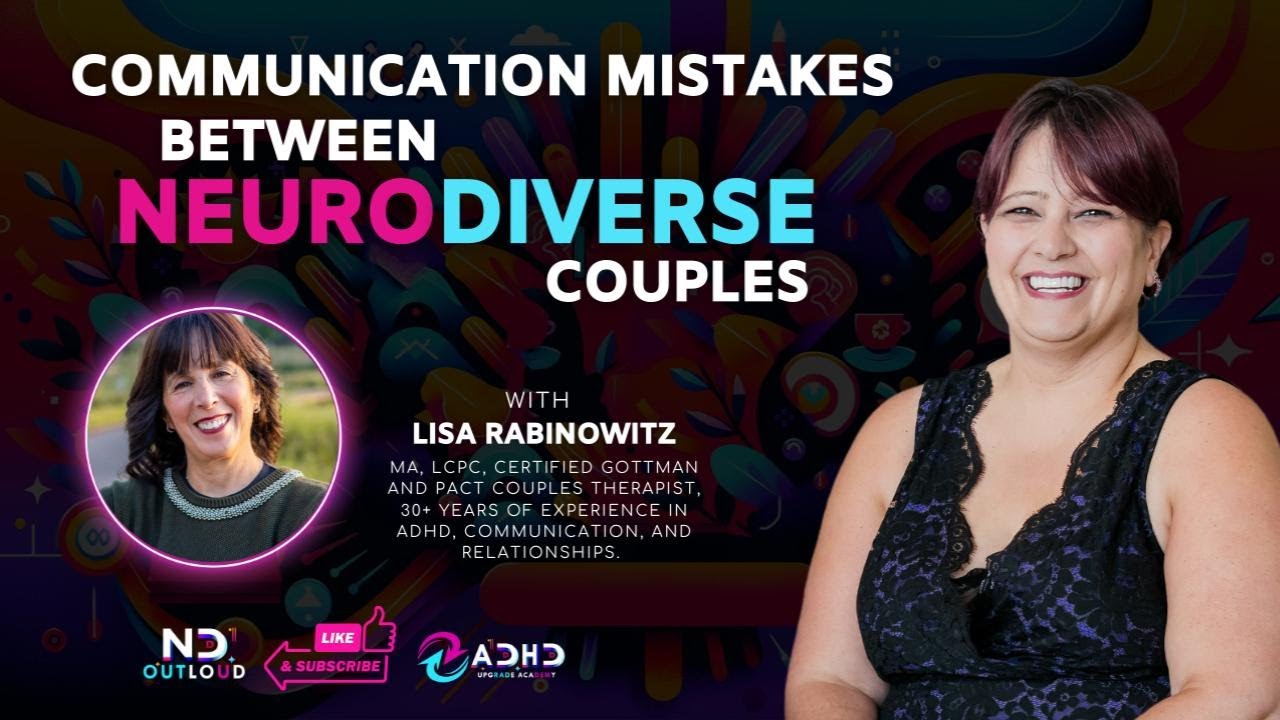
Danielle Ralston talks with couples therapist Lisa Rabinowitz about communication problems in neurodiverse relationships, like interrupting and attention issues. They cover practical fixes: notebooks, timers, and structured check-ins. Rabinowitz discusses her book's house metaphor and upcoming workshops.
Chapters
Hello there.
I'm Danielle Ralston. I am the founder and head coach here at ND Out Loud. What is ND Out Loud? ND Out Loud is a team of neurodivergent coaches. We are neurodivergent, every single one of us. TBIs, PTSD, ADHD, autism, AudiHD, and so much more. Bipolar disorder, all of the things. We also have a passion for supporting others like us so you don't have to struggle like we did in our past. We have All taken trainings and certifications and all of that so that we can support you in living a better life and upgrading all of the things that are frustrating about your life. What is this session going to give you? This session is going to give you actionable tips. So yes, we're gonna talk about our programs and all of the things that we offer, but I want you to walk away with something actionable for something that is overwhelming, frustrating, or just plain annoying you right now in your life. Or if you're a parent or a spouse of someone with neurodivergence, To help them as well. I want you to walk away with something today. So please sign up today for a free call. We can learn more about each other. Hello, everyone. Thank you for joining us today. Today we have Lisa, and I'm not going to even try to say her last name because I am terrible at that, and I mess up my own last name half the time. So it's no offense. But we have Lisa with us today, and she is a therapist, and she has an amazing book out. And I cannot wait to talk to her because she is a couples therapist. So, Lisa, please introduce yourself. Tell us all about you.
Okay. Well, first, I will introduce myself by my first and last name. And don't worry, everybody has trouble with it. Lisa Rabinowitz. So, and I will share with you my front cover. That's upside down. Let's try this way. Oops. And now with the blurring. Okay. It says, Why Won't You Stop Interrupting Me? Simple Solutions for Couples with ADHD. So, so I am a couples therapist. I'm actually also a relationship coach. I do some relationship coaching also. Let's see, other than an author, a speaker, I speak internationally like we were speaking right before. I speak at corporations on communication. I speak at the International ADHD Conference, which we missed each other at. And a lot of other conferences that are regarding like mental health and things like that. Because certainly neurodiversity is a big issue, but there's a lot of other challenges that people are struggling with, whether they, you know, are neurodiverse or not, that as a couples therapist are coming in my office and, you know, struggling with, it's anxiety, it's depression. We talk about it all. And certainly neurodiversity, whether they will come in with those issues or trauma. And so I just ran a workshop on my book and I'll be running another one. And I just love working with couples. They just so, So wonderful to see them make changes and improve their relationship. So thank you for— I love that.
I love that so much. I mean, couples, I have a heart for couples and I work with couples as an ADHD coach. As most of you know, I am a therapist, but I'm licensed and I just, I love watching the changes in relationships. So I'm excited to talk to you. So let's talk more about your book.
Yeah.
And it's Communication Mistakes Between Neurodiverse Couples. So I have not had a chance to read the book yet. I ordered it. It is not here yet because I Meant to order it 2 weeks ago and I forgot cuz I'm ADHD. Please tell me, do you work with couples that are both neurodiverse or just one neurodiverse?
Do you work with both of 'em?
Cuz that, that's something that's so hard to find.
Yes. Yes. Thank you for asking, Danielle. So some people, one partner is neurodiverse and the other one's neurotypical. Sometimes they're both, sometimes they've been diagnosed from 30 years ago and sometimes they just found out yesterday. And sometimes they're like, I think I am, but I'm not sure. So it really, to me, when you come in, it becomes Pretty clear as we go through the challenges because I actually, in my book, I came up with 15 for the neurodiverse partner. And I did, I thought it was really fair because somebody who's neurotypical can have communication challenges also. And so I don't wanna pin everything and I am not pinning. I, I, that's one of the important things when people come in, they'll say like, oh yeah, with other therapists, I've been the bad one. I've been the one that messing, that I'm messing up because I didn't do this or that.
Yeah.
And I'm like, you're both fair game in here. You both have challenges and let's deal with both of them. So we talk about, there's 8 of those for the neurotypical, but, and sometimes even with the neurodiverse, they'll might, they might say like, oh yeah, you know, I have issues with interrupting, say one of the partners and the other one's like, oh yeah, but I share all sorts of things that don't need to be shared. And sometimes they'll even go into the neurotypical chapter and be like, oh yeah, I'm doing some of those things too.
It's— we're, we're all neurodiverse.
Yeah. Yeah. I, I believe, I believe so. I believe so.
I, I absolutely—
Yeah.
So what's one common communication mistake that couples make, especially ADHD couples?
Okay. Well, there's a lot of them. Let's pick one.
So let's go back. I know.
Because, again, let's talk about the one, the reason, you know, people will say to me, oh my, you know, why, why won't you stop interrupting me? Why did you pick that? I'm like, okay, does that happen in your relationship? They're like, yes. And I'm like, that's why I picked it. Because when I was talking with my team of like, what should we name the book? What should we name the book? And we kept going back and forth. And I said, you know what? I've heard this 10 times this week. And it was, why don't you stop interrupting? Stop interrupting me. And so that's one of the big challenges for couples. And I think you're probably gonna ask me, so now what? Yeah.
I mean, so interrupting is an issue, but Now what do you do with that?
Right, right. And so first I try to ask the couple, like, what have you tried before? And some of them say nothing. Some of them say, like, I'll say, stop interrupting me. And I go, did that work? And they're like, no. So I go, okay, well, let's try to do a couple other things. And again, whatever— I want the couple to find what's gonna work for them and what resonates for them, because I can give a whole list of 10 things, but what's really gonna work? And we'll just try things. I'll say, okay, What we're gonna try is this today, because sometimes they're like, I have no idea. What do we do, Lisa? So I say, okay, let's try this. I want you to get a notepad and stick a pen and the notepad next to you. And I'll say to, you know, ask your partner, is it okay if you're talking that I write down things if something pops into my head? Because things pop into our head. So though usually, usually they're like, okay, if I know that's what you're doing, it's not like you're sitting there taking, you know, oh, I forgot the groceries. Let me write that list. No. Like, you know, is this something popping in about our, our relationship though? I do actually have a thought on that. But let's just go with this, that you're saying something, it popped into my head. I want to write it down because then I also explain the challenge. Because if I don't write it down, what does the person do? All they do is think about that thing. I'm not going to listen to you at all. So that doesn't help the relationship, right? So that's an important thing is if you can write it down, we're going to come back to it, come back and pay attention to the conversation. And make sure that works for the system. So that works for some people, not for everybody. The thing I was gonna say about the grocery list is sometimes my partner's talking and the grocery list does pop into my head, right? And I'll go, hang on a second, random thought, write it down. But again, I know I'm gonna deal with that later. But Elise is not going, oh, don't forget the milk at the store. Don't forget the milk at the store. Don't forget the— again, I'm not listening to my partner, right? And that's the goal is if we're trying to communicate, if we're supposed to be listening and we want to listen and we want to understand, then I'm not gonna be able to do that if all this stuff is chattering up here and it's distracting me from what you're saying.
Exactly. I mean, that's a thing I talk to my clients about all the time. That notebook I carry around.
Oh, yeah, I know.
I carry around a reMarkable tablet everywhere with me because I have, yes, ADHD and I'm autistic as well, and I have MS. So my cognitive issues some days are absolutely terrible. Writing everything down is a second brain, saves me, and it allows me to focus on my husband when he is talking because I'm not worried about the thing I'm trying not to forget or the thing I don't want to forget to say or, or, or, or, or.
The other thing, just a lot, you know, regarding the conversation is sometimes I find sometimes that one partner is speaking a little bit too long and it's a little hard sometimes to say, you know, Your ADHD partner is having a really hard time continuing to listen to you because you just spoke for 15 minutes, right? So could you take a breather? And sometimes I'll say, can we take a timer? For some people it's 2 minutes, sometimes it's 5 minutes, but do not go longer than 5 minutes, right? Pause. And then, you know, then we'll have a conversation of now, is it your turn to talk? Or is it— Um, take a breather. Let me just process what you're saying. Okay, I can continue listening. Let's try 5 more minutes. But the talking and talking and talking and talking some more doesn't usually go over very well when the ADHD person's, you know, not gonna be able to stay focused for that long.
When you were writing this book, that you writing the book is a fascinating process to me. What were some of the things that came up for you as you were writing this? Because the process of writing a book, I'm, I am in this process too for most Most of you know that. What kept coming up for you as you were writing this of things that you wanted to make sure that you didn't forget to add in?
Right. So that's actually a very interesting question. So the book is formulated on a house image and visual. Most of us are either working from home or we are in our home for many hours. And so I have different things to be doing in different aspects of the, of the house. And so each chapter is about a portion of a room in the house. But I was done talking about the whole house, and then I was just like, but I wanna talk about the newest research on this. And oh, I, I wanna talk about the newest research on that. And so we added a few extra chapters, and I wanted to add some more, but I had to stop. So I'm writing a second book now. It's been— that first book has been in my head for a very long time. And so it just very easily came out onto a piece of paper and, or computer. And it was, it wasn't so hard to write. It was sort of stopping. So that was the difficult part.
So I get started on a chapter and my editor has so far had to edit out some of the things to go, oh, this would be great for a second book. 'Cause she, I think she's worked with neurodiverse people before and she's like, nope, second book. This is not, does not, this is not in our framework, Danielle. But she's told me not to stop writing. Write until it's out of your head and we will figure out what to do with it later.
Yeah, 100%.
So with what you do, what do you cover? Like, areas do you cover for therapy? Because that's a really big question that so many people know that it's state by state. So I know that you cover a large network. So please tell us more about where you cover and where you work with people.
Sure. So as a licensed counselor, I can work in Florida and South Carolina, in Virginia and Maryland, Delaware and Vermont. Might be some other states sometime soon, but those are the states I can work in.
I— that is amazing.
Yeah. Yeah. The relationship coaching, which had been sort of percolating for a long time, came about because many couples will call me and they'll be like, there's nobody in our state. That can counsel ADHD couples. What can you do? How can you help us? And so it's, it's really on the newer side, but I really have been working on because, well, I mean, working on the relationship coaching to be around ADHD. And I don't know if at some point I'm gonna just switch it all over into the relationship coaching. And I'll tell you why is that. It's, you know, the, the counseling, it's typically once a week. But ADHD relationships and couples frequently need other check-ins. And so with coaching, you know, I can say like, hey, let's meet up for half an hour. I did that with one couple. We met earlier in the week. I said, for tomorrow, we're gonna do this hour, an hour check-in. Now that you might be like, isn't that an hour therapy session? No, therapy is actually 2 hours for me. I see couples for 2 hours because I wanna hear this partner, and I have to hear this partner, and they don't wanna just dump everything all over the floor. They want to then resolve something. Funny thing. So we need time to resolve it. And so that's what we did. Yeah. Yeah. So that's what we did on Tuesday. We, we were working on resolving something, but it was a major thing, and there was some other pieces That we needed to sort of work on and have some accountability. So we'll meet again tomorrow and, you know, again, just for an hour. Sometimes it's a half an hour when I'm doing coaching and there's, it gives me a lot of, a lot more flexibility with the different exercises and the different activities that I do with them. And I just find it works a little bit more with the ADHD couples, but Right now, I haven't changed everything to coaching, but it's out there, so we'll see.
There are many of us that have switched completely over, so come join us.
Yeah, I understand very much. I do so much. Someone said to me, well, if we go do coaching with you, what are we missing out if we're doing counseling? And I said, you know what? With couples, there's so much coaching that has to happen.
You can't just—
with an individual, it's very different. with an individual and you can dig and dig into the past. Not that I don't do that. I sometimes do that with the couples too, but it's just such a different feel than when you're working with somebody with ADHD. They're trying to communicate their struggles, their conflicts. We need the here and now. We've got to figure out how to fix this thing now. I don't want to leave the office and have to wait another week. And there's, there's things like whether it's mindfulness or some other kinds of things that I love to have check-ins and accountability with couples in between sessions. So, and that's not very typical with counseling.
So that's really not. So if you are looking for someone to really help you on the pieces of your relationship and help you with counseling and coaching and being able to communicate better, Lisa is absolutely your person. So tell us more about your, uh, other workshop that you have coming up.
Oh, yes. So I'm actually taking the book, and this is what I had done. Knowing ADHD folks, I felt like it would be helpful if we do. All right, week 1, we're going to review chapter 1 and 2, and week 2, we're going to jump. Because let me explain one piece about my, my book that will help you understand why I'm going to say let's jump to chapter 3 or 4, whatever the case might be. So I wrote my book This is how my book came about. I took— everybody would come to me and say, like, you know, this book I liked, but this was a problem, and I like this book, and this was a problem. So I took all that information over the last several years, and I said, okay, I'm gonna do this book differently. So what I do is I do this little teaching, and then after the teaching, I do questions on that that you can just like really like, how are you gonna apply that? Like, it's great to like Like, oh, this is what we should do. How do we apply that? So I'm going to ask the partners to have conversation, ask each other questions. What does that mean to you? What do you like about that? How can we do that more? How can we, you know, add this into our relationship? What would that look like? How do we— right? So there's a lot of questions. And then there's a takeaway exercise, which is like, okay, we're done with this chapter. Now we're going to fill in the line here that says, this week I'm going to do this.
And you're just—
Fill it in. I want you to take that, have that accountability. But there's chapters that are stories because a lot of times people will be like, I am the only one dealing with this. And I'm like, no, you're really not. Now, I don't want to be dismissive like that, but it normalizes couples so much to know like, oh, you mean you guys fight in the car too? We do too. Why are we fighting? Oh, this is why we're fighting. Oh, now I understand. Now it makes a lot of sense. And so I love the stories. But in the workshop, we're gonna skip the stories. You can read that on your own. And I really wanna make sure that you're reading the act— you know, reading the information, that you're doing the questions. I wanna be able to answer if there's things that you have questions on that you didn't understand that you would like me to expand on more. It's really that one-on-one support that people can get around the book, but they can also have a community because to know that, like, Oh, that was really helpful for you guys. You have a— you have another idea? You, you, you think that you did it this way and it worked for you? Oh, well, we didn't think about it that way. Maybe we should do it that way too, right? So people— I love people generating more information and more sharing information and sharing things that worked. Like you mentioned Remarkable. I didn't know about that until maybe, I don't know, 6 or so months ago when one of my clients said to me, oh, I use— I was like, Really? I never heard of that. So I started Googling it. I said, oh, that really helps. Now, that didn't actually make it into my book. I'm almost certain. Um, I have a whole— yeah, I have a whole resource section at the end of the book. It— we're making an edition already, another edition. Um, we are going to expand. It is gonna be tremendous because people need to know, like, you know, I'm struggling with time management. What do I do? I'm struggling with organization. What do— where do I go? I need a nap on this. Where do I go for that? It's all going to be in there. As many places and as many things as I can think of and I've heard of and my clients have told me about is going to be in there to really support people who are struggling because it's not easy to navigate all these things. So I want to make it as easy as possible.
So I love this. I am so happy that we got to talk today. So if you want to reach out, we will have all of Lisa's information below. Please reach out to her at any time. I'm sure that she would be glad. And purchase her book because I have ordered it. I have ordered it, is on the way. So read it. And because even if you are not neurodivergent, communication with your spouse is, is a touchy subject for all of us. So please, please read today. I hope you enjoyed being here with us today, and thank you for talking with us.
You're welcome.
And please reach out to Lisa with any of your questions.
More from Danielle

Why Disney is what you need as an ND human #Neurodivergent #disneyadults #disneyscience #disneyworld



Follow along if you want to watch me finally finish what I started… #adhdcommunity #bodydoubling

The last 3 months I … wait no … all of us here at The Hive have been rebuilding from the ashes… we

The last 3 months I … wait no … all of us here at The Hive have been rebuilding from the ashes… we



What if the silence didn’t stop you because you never lived life alone? Katie Karayianis

What does getting ready for a road trip look like for you with adhd? #adhdcoach #ndhive
