Deaf ADHD Leadership: Tim Blonsky on ASL AI and Body Doubling
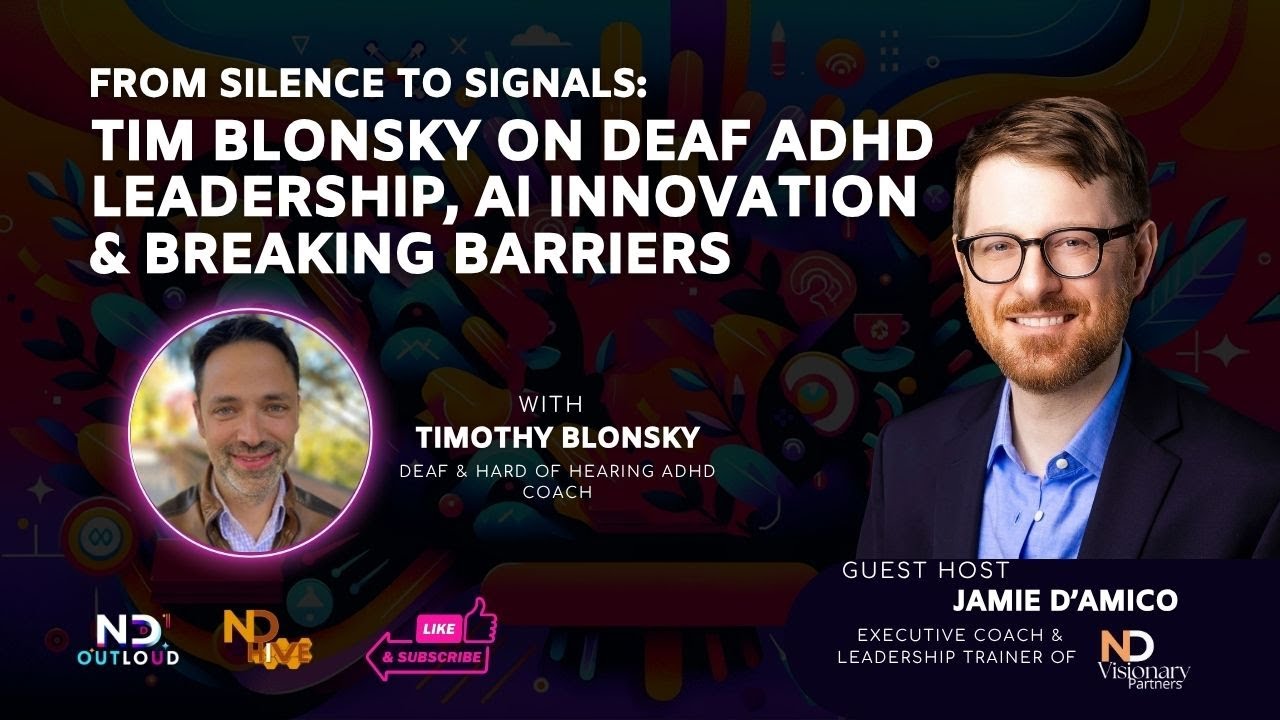
Jamie D'Amico talks with Tim Blonsky, co-CEO of DeepSign AI, and Danielle Ralston, founder of ND Out Loud, about ADHD, deafness, and body doubling for accountability. They discuss DeepSign's ASL sign-language recognition AI and how ND Out Loud coaches neurodivergent people.
Chapters
Hello there.
I'm Danielle Ralston. I am the founder and head coach here at ND Out Loud. What is ND Out Loud? ND Out Loud is a team of neurodivergent coaches. We are neurodivergent, every single one of us. TBIs, PTSD, ADHD, autism, ADHD, and so much more. Bipolar disorder, all of the things. We also have a passion for supporting others like us so you don't have to struggle like we did in our past. We have All taken trainings and certifications and all of that so that we can support you in living a better life and upgrading all of the things that are frustrating about your life. What is this session going to give you? This session is going to give you actionable tips. So yes, we're gonna talk about our programs and all of the things that we offer, but I want you to walk away with something actionable for something that is overwhelming, frustrating, or just plain annoying you right now in your life. Or if you're a parent or a spouse of someone with NeuroDivergence, To help them as well. I want you to walk away with something today. So please sign up today for a free call. We can learn more about each other.
Hi there, everybody. Thank you for joining us. This is the ND Out Loud podcast vidcast series. And I know that you're used to seeing Danielle Ralston on here. She is the OG and founder of ND Out Loud. But today we're doing it a little bit differently. I'm Jamie D'Amico, and I work alongside of them working on the corporate consulting end of things. Now we have somebody who is, I know, very important to Danielle and important to all of Bill's Mafia for good reason. With me today is Tim Balansky. He is the brother of Danielle. He's also the Director of Business Engagement at NDOutLoud and also the co-CEO of DeepSign AI, straight out of Boise, Idaho. This is Tim Blonsky. Tim, I'm so glad we can do this. We've talked about it for a while. Here it is.
Yeah, you know, I think the timing is right because we just started training camp in Rochester, New York, our co-hometown. And so, you know, we definitely have a lot to talk about with the Buffalo Bills, plus everything else that we're doing in our professional endeavors. So yeah, I'm excited to have this conversation, and I think we'll probably have more like this in the near term.
Yes. And Tim and I had to pledge that we were not going to make this entire vidcast about the Buffalo Bills. Unfortunately, you're probably going to end up hearing some of it. But hey, that's how, as we refer to ourselves, Bills Mafia, that's how we roll. Anyway, Tim, you're doing some exciting things. And there are maybe people in my network that haven't met you before. And the first thing I wanted to touch on is you consider yourself to be profoundly deaf. What does that mean?
Oh yeah, that's a great question. Thank you for asking me. So yes, I was born deaf. I grew up in Rochester, New York, which, you know, if anyone knows anything about Rochester, they have a very prevalent deaf community. So they— my parents were in a position, and once they found out that I was deaf when I was 11 months old, they had access to all of the proper services that a deaf child could have. There are so many people throughout the United States and throughout the world When they find out that a child is deaf, usually a medical professional will tell them to not teach them ASL. Don't do that. That's not a language. That's just, you know, it's not, you know, you need to teach them how to talk and speak. And, but they weren't told that. My parents were not told that. And so I had access to really what they consider the best of both worlds in which ASL was my first language, but I also had speech therapy. I had the best of the best in terms of hearing aids and the other technology that is But what was the best in the early '80s? And so like I was in a place in which I was able to learn how to speak fairly well, and I'm able to do things like talk on the phone with certain people, not everyone. And so I'm at a place in which I'm hard of hearing where I'm sort of like, for a good portion of my life, I've always been kind of in between the Deaf and hearing worlds. I've really kind of immersed myself in the Deaf world within the last 3 or 4 years, and I've really enjoyed that, but Yeah, so I am profoundly deaf. I have just one hearing aid. I'm completely deaf in the other ear. So I depend on reading lips. The closed caption that I have here on this Zoom right now is also helpful. So yeah, you know, I feel lucky and privileged that I'm able to kind of like be in both worlds and wear both of those hats.
And the fact that you are deaf, and I have so many questions about that that are probably very interesting, but you also are a person who identifies as having ADHD as well, correct?
Yeah, that was actually kind of a, you know, a fairly recent realization. Yeah. I mean, my sister who runs NDL Loud, uh, her whole life, and she, she has a very interesting journey and figuring that out herself. She's spoken to that many times. But like for me, I was always told growing up that it's like, oh, Tim, you're fine. You're different than everyone else. And that actually was almost a burden rather than a positive in which I sort of like brushed everything aside for many years. And yeah, I, it was kind of funny. I was on a hike with a friend and my friend who herself has ADHD and she was like, yeah, I'm actually going over to a friend's house after the hike to do some body doubling because she is packing for a trip and she just needs a little help by having someone there. I'm like, what? Body doubling? I've never heard the term before. And she started explaining that and the light bulb went off in my head. I'm like, Oh, interesting. Because in my previous role, previous jobs, when someone was in the other cubicle right next to me and they weren't involved in anything that I was doing, but they were just there, I would find more productive in my work. And I'm like, and then that's when the wheels in my head started turning and I started talking to my sister about this more. And yeah, so that's where I'm at. And that's within the last couple of years.
Okay. That's really interesting how you found your way into it by simply saying, I work best when I see other people working. That's something that, as a person with ADHD myself, I have always felt that way. It's, it's like I can't work unless I see other people working. Drives my wife nuts. She has a separate office space in our house, and I will grab my computer and go down and sit on the couch next to her and start working. She's like, what are you doing? You're distracting me. I'm like, I need this. But, and I know that there's a lot of people out there that could relate to that.
But.
Your combination of ADHD and deafness together, you started working with people who are ADHD. This puts you in a very unique position, correct?
Yeah, you know, that's kind of how things started with me and Danielle. Danielle and I have had a unique sibling relationship where, you know, we'll, we'll be in touch and then we'll, we'll even go Several months or years where we were not as much in touch for various reasons. You know, Danielle and I have a very, very interesting upbringing and family drama, mental health and all that. No judgments in any of those realms, but we had a very complicated childhood. But like the light bulb went off in my head again several months after I kind of like figured out that I also have ADHD. And I started like thinking of like, there are so many deaf people in the United States and throughout the world that are generally in a lower socioeconomic background. And there are so many deaf people that don't work or just work very limited, and they just sort of reside to the fact that, you know, I'm deaf, so that's why I can't be as successful as a hearing person, which is simply not the case. You know, deaf— there are just so many incredibly talented deaf people within my world and throughout the whole world. And so I started thinking like, well, how many deaf people also have ADHD and are not where they could be in life because they just reside to, oh, I'm deaf, that's why I can't focus, or I have a hard time staying on task, and like all the things that are more related to the ADHD piece rather than the deaf piece. And then you add language deprivation to that, which so many deaf people suffer from. So like those are all factors where we started saying, hey, maybe we can be an outlet. So that's what we're working towards.
Wow. And how is that landing with the deaf community?
So generally, like, it's interesting that there's a lot of deaf content developers that are also just starting to talk about that piece of it. So we're starting to collaborate with some of them. To get the word out about what NDL Loud is doing, because like if you're talking about deaf people that are generally in the lower socioeconomic standing, they can't afford life coaching of you know $900 a session. I've just seen some of the other competitors. So like what NDL Loud is doing is is sort of like the Netflix approach to providing life coaching and body doubling and group coaching and. Just peer-to-peer support. So we're really like, we're still in the very beginning stages of it, but we have a lot of hope that we're going to be able to get a lot of deaf people to be a part of our platform. But then the deaf community is very small. So like once we get just several people that are, that have some buy-in to this, we'll have the whole American deaf community within a very short period of time.
And I want to, I do want to touch on that a little bit in that I mentioned that I work on the corporate consulting side of ND OutLoud, which referring to as ND Visionary Partners. What we're doing on this side is we are going into businesses and other types of organizations to really help them become more understanding and accommodating of people who are neurodiverse and how to make it a really a more productive environment because it becomes a very, especially large organizations, becomes a huge competitive advantage if you can keep great minds in your organization. And just by simply doing a couple of small things that make it a little bit easier for people, say, with autism or dyslexia or deafness to reside there. Now, something that we've talked about a little bit that I think is incredibly exciting is you don't let any moss grow under your feet. You're probably one of the busier people out there. I mentioned you are co-CEO of a company called DeepSign, and this is some very exciting stuff. You've been in that role for— it's been a number of months now. You were promoted into it for Good reason, obviously. And please tell the people out there what DeepSign is and where it's headed.
Yeah, thank you for asking. You know, there's a lot of exciting hats that I wear, but I, you know, I know Danielle won't be offended by me saying that this is the most exciting hat that I wear. Well, I am— so I'm the co-CEO of DeepSign AI. And we are a sign language recognition company through AI. So what we are able to do, and we legit are able to do this, like we actually just had an internal deadline for a specific program that allowed for the full translation of the whole language in ASL just a few weeks ago. And so we're in the process of doing the internal testing and talking to some potential collaborators and all that. And some of that stuff is a little proprietary, but what we're able to do with this is you We were able to sign into a single camera and thousands of words and be able to have that converted into spoken English. So like you can imagine that American Sign Language is a 3D language, so it's multidimensional. Just even a slight of a hand or how you move your head or your body language can completely change the sign itself. So it is an incredibly complicated problem that we're trying to solve. We have a team of engineers in Europe and an American founder here that are all either deaf or know ASL and are people that are really passionate about this. They have dedicated their whole lives in developing this technology. And so, like, I am incredibly honored to be able to lead that effort. So we're in a place in which this can be used for— you know, we've seen other competitors use this for captioning videos for social media, which is kind of fun, but like to be able to sign ASL and have it converted to English and caption within the social media video. Or it could be things like, you know, you being able to go into a restaurant and go into McDonald's and order food in ASL and have that done without having to be able to write back and forth. Or, you know, for those that are deaf that also have language deprivation, a menu on a kiosk is not something that is the most conducive. So this is going to increase accessibility across the board. Going to the pharmacy and picking up your prescription and just be able to say, hello, my name is Tim and my birthday is thus, and be able to do a boom, done. And then it goes well beyond that. The use cases are really innumerable. You know, we have come up with more use cases than we have the bandwidth to be able to apply to with the tech. So we're like, we're in the beginning stages of it. We're at a place in which we have been very quiet deliberately. We are very deliberate in that case in which we don't want to make claims that we weren't able to keep. Keep first of all, and second of all, we don't want to be a typical company in the tech space that comes out with the big announcement. Hey, we have this really cool thing. You know, give us money because we you know we have this thing that we can that can change the world. And then when you actually do a deep dive in the actual tech, they haven't really developed anything. They're just saying that they're about to develop something, but they need the money first to be able to develop. But we really did a the approach of self funding ourselves. Until we get to a place in which we have something that we can actually sell, and then, you know, go from there. So like, we're like, if an investor wants to knock on our door, we may listen, we may not. It really depends on the right— we have the right investor, or, you know, we'll just keep going with what we're doing now. So like, you know, we're not going to just open the doors for anyone. Like, we're very particular about making sure that this is technology that's developed for deaf people first, period. The tech itself is something that the whole world wants eventually for various reasons, but that's not where we're going. We want to develop it for deaf people and by deaf people. So I am really, really excited about it. I think in subsequent conversations I could talk a little bit more and I could show the actual tech, but it's so mind-blowing. And I'm saying it from a place of bias because it's my company that I'm a part of, but we've had tears sometimes internally when we see what we've developed. And, you know, the goosebumps that we have of like, wow, like we have something that can change the world and it's not a misnomer, it's an actual thing.
So I think that there's lessons to be learned here from a number of perspectives. But one thing I would like to ask you about, because this is in fact a podcast for people who are neurodivergent, you are a CEO. You are the leader, co-leader of an organization, and you've been able to get there despite the difficulty that comes as having an ADHD brain, difficulty communicating. Since we're talking about this, tell me what allowed you to ascend to the position that you are and overcome the challenges that ADHD presents.
So, you know, I think number one, especially for me, and I think this is probably applicable to anyone, the just being authentic with yourself and like accepting who you are and like just being in a place of understanding who you are. And, you know, sometimes that can be a hard thing because like you may not like what you see within yourself, but like you got to be honest with yourself about that. So that's number one. So like full acceptance of who you are as a person. You know, external authenticity starts with internal authenticity. So that's number one. So, and that, that was something that happened over the last couple of years and me kind of realizing, oh, I do also have ADHD. So that piece of me, all those shortcomings and mistakes that I've made in the past and, you know, coming up with sort of like owning up to that, you know, not that I need to own up to it, but you know what I mean? But so that's one too, you know, once you kind of like realize, like, you know, ADHD obviously is a spectrum and that's not like a medical way of saying it, but like varying forms of ADHD and levels of it. And so like my girlfriend, my life partner, also has ADHD, which kind of adds an interesting element to everything. But she, like she herself would say that she has a more extreme form of ADHD than I do. I'm not medicated. She is, all that. And the, you know, the thing that I know as a result of being honest with myself and knowing that if I want to stay on task, There are certain things that I can do for a certain period of time that works well. But at some point, I'm going to switch to another way to keep myself on task. So like, it's not a, you know, a one approach to how to make sure that I'm, you know, meeting all my appointments and completing all my tasks and all that. Self-accountability and the accountability of my team. So like, one of the key things— this is something that's wonderful about Indie Allowed, where I'm sort of like leveraging my role in that to help me to be on task with everything else that I'm doing, which is really what NDL Loud is about, is having accountability. So a place of, I can go tell the team, hey, I'm really having a hard time today. Can you help me with, you know, these 3 things that I need to get done? Can you follow up with me a few hours from now to make sure that I completed these tasks? Because I really want to make sure that I do. And now we're having honest conversations back and forth. I'm not annoyed that, say, what Tara or, you know, Jamie is reaching out to me a few hours later to say, hey, Tim, did you do that thing that you wanted to do? Like, we're all honest with each other as well. So, you know, there's no one way to kind of address all of the challenges that come with ADHD and also the deafness piece of it. But like, I think I'm just in the right place at the right time with all of the different resources that are available to me to make this all happen.
Well, when you touched on the self-awareness part, that really spoke to me because I had a huge lack of that, I think, throughout the majority of my adult life. I was diagnosed with ADHD in 3rd grade, which for me was, I think, 1984. So I was like, and then I was put on Ritalin. I was like a, an ADHD pioneer. So I didn't have necessarily the same understanding from people or type of support. I mean, I was living through the era where everybody was telling me that it didn't really exist. I just didn't want to do better. I didn't want to pay attention in school, those sorts of things. And I really internalized that and tried to make myself to be just like everyone else. And I would say, well, I should be able to do this, and I should be here in life, and I should be there. And by shoulding all over myself, as I heard somebody say, I ended up putting myself in a terrible position as an adult because I ended up going off of my meds. when I was in college because I couldn't metabolize it the right way. And I was looking at all of the other people my age and what they were accomplishing. And I was getting more and more upset with myself because I wasn't where they were. But deep down, deep down, I knew I didn't have what it took to be where they were at the same time. And I think generally the men in my family don't, I don't think our frontal lobe fully develops until we're in our mid-30s. Like, you hope that's done by 30, but I think I was about 35 before I knew which end was up. Anyway, it wasn't until I started embracing it a couple of years ago, about 3 years ago, and got re-medicated for it that I started saying, okay, I now admit my brain does work differently than other people. And by having the wrong expectations of myself, I was dealing with far more of the mental health battles than I probably needed to. And I almost forced myself in that direction. With greater self-awareness, like, my advice would be, if you're 28 years old and you see your friends doing better professionally than you are, don't sit there and tell yourself, I'm failing. Say, my brain is different than theirs. I just haven't figured out how to maximize the value that my brain gives. And it takes time. Our society isn't set up for people with ADHD. So it takes time, but more than that, when you tap into the support the way you did, Tim, it goes a lot faster. And I just discovered ND Out Loud back, oh gosh, about 9 months ago. So like, I could have been much farther ahead had I been tapping into the support that is around me and had the awareness sooner. So I realize I'm bloviating a little bit here, but I'm really glad you touched on that. Because I think that can really help a lot of people with understanding where they're at and tempering their expectations, or at least putting their expectations in the right directions.
Yeah, absolutely. 100%. Yeah. So let's shift gears a little bit. We're from Rochester, New York. So interesting town. And I have to tell you, I went back to Rochester for the first time in a few years because of the pandemic and me moving to Boise. And so I went there last October, which is like the perfect time to go to Rochester. And one thing that really got to me, something that completely surprised me because I went to Rochester with my older daughter and my girlfriend, my partner. And so like I was seeing Rochester through their eyes.
Hmm.
And something that was interesting for me because I never, like when I would go to Rochester in the past, I would just go to my sister's house or my older sister's house and, you know, have dinner and then go home. And then that, that was that because I was living in Connecticut at the time. And so actually seeing Rochester through their eyes and, and showing them all the different sites, you know, the, the High Falls and downtown, went to Genesee Brewery, to Lake Ontario, to Charlotte Beach, you know, went down to Lackawanna Park, down to the Southern Tier where I grew up. Rochester is cool now. And that's something that, that really surprised me. So I, I don't know if you have the same viewpoint.
So I've been going back very regularly. I haven't lived in Rochester full-time since the first half of 2000.
Okay.
Yeah, first half of 2000. But I had an employer there. I was going back pretty regularly, but I kept the same sort of view that I had growing up of, oh, this is a sleepy town. Nothing happens here. It's really boring. And to a degree, geography makes that necessary. Anybody who's watching this right now or listening to it, Rochester is in the western part of New York. It's like a 6.5-hour drive from New York City. It is between Buffalo and Syracuse, right on Lake Erie. It is in the snowbelt. It is extremely gray. In fact, I believe they have more overcast days per year than even Seattle does, even though it doesn't have as much rain. And for me, like, the seasonal affective thing was always kicking in because, you know, you don't see the sun, you can't go outside, the weather's crap. I have recently been going through the same sort of internal renaissance that you have regarding the area. I brought somebody up there for the— who had never been there before for the first time last year to go to a Buffalo Bills game, and she was in love with the town. I brought her to a couple of the suburbs, and my family lives in Fairport, a suburb of Rochester on the east side, which has really sort of taken off as the nightlife epicenter of the area. And right now it is amongst the top 3 most in-demand real estate in the country according to Forbes magazine, because the Erie Canal goes right through there. So you can be on the water and this old-timey village that got built because of the Erie Canal, and you have all these buildings from the 1800s. It has this extreme charm to it. And when I go back now, I cannot believe how the town has grown up around me. And oh, by the way, this friend I brought to another town on the Erie Canal that is really adorable, and she got her first garbage plate, which we split. And it's my first garbage plate in probably 15 years. I remembered why I don't eat them as a middle-aged man. However, It was beautiful. Tim, I'm sure you've had a number of garbage plates. You want to explain what that is?
Yeah. So, I mean, it's a Rochester phenomenon. There's various comedians and, you know, foodies on YouTube and the Food Network that have covered it several times. Basically, like, it was actually a plate that was made out of a restaurant called Nick Tahoe's in downtown Rochester. Now, like, pretty much every restaurant in the area has their version of it. But like, basically, it's food that is ideal if you've had a night of drinking and you just need something to fill you up with pretty much every food group on one plate. And that's basically what it is. So it's usually home fries on the first layer. I typically go with the cold macaroni salad on the second layer. Whitehots, that has to be Whitehots in my opinion. So Whitehots, they're my thing. Mija sauce is the next layer, and then raw onions, and then I tend to do just mustard on top of that. So it's, you know, 3,000 calories on a plate. Then you get a side of bread with that as well. So it's just absolutely delicious. I had one when I was in Rochester last October, and my girlfriend was sitting next to me. She's like, what is that? You know, like, she's gluten-free. She couldn't have it, but Yeah, something that I that I absolutely adore. I make them myself. I order hot dogs from Dwaggles and pay ninety bucks for the shipping to have it out here, and that'll usually last me about seven to eight months. I'm actually out. I need to buy some more. Podcast, if you want to donate to for my Dwaggles fund, I'm totally okay with that. Yeah, so I love garbage plates, and I would say that in my opinion, Aranda Gray Hats has the best garbage plate in the Rochester area now.
Okay. Good to know. So there's a couple of Rochester phenomenons you just talked about that people are going to say, what? Number one is the white hot dog.
Okay.
The brand Zweigels does a white hot dog. And I believe, don't quote me on this, but I believe they are entirely pork products in that, and they don't use the dye. And I think they're spiced slightly different than the red hots. So they do actually have a slightly different flavor. Specific to Rochester, everybody says, "Oh, that sounds disgusting." But you know, they're shaped like sausages, and they're amazing when you throw them on the grill and you get those grill marks on them. Yeah, it's excellent. But the other thing is the meat-based hot sauce, which is there's ground beef in this hot sauce, which is extremely interesting. And whenever you cook it up, you wait a little while, and the grease just completely separates out of it and is up on the top. But it's something very unique, and I actually. I would actually encourage anybody watching this to look up a recipe because in addition to being spicy, there's some brown sugar in it to sort of offset that spice and really deepen the flavor. And now I do my garbage plates different. I get the cheeseburgers on top, but I definitely go with the macaroni salad and the home fries next to each other. Yeah, the cheeseburgers on top with the hot sauce. They throw diced onions on it. They automatically put mustard on it. I usually put a little bit of ketchup on the side. I know other people just drown it in that. And this is such a cultural phenomenon in Rochester that the AAA baseball team, the Rochester Red Wings, which are the top affiliate of the Washington Nationals, they have an alternative jersey where they are the plates for—
Yeah.
Game out of the year where they literally put an illustration of the garbage plate on their hat and their jerseys.
Yeah, it doesn't look appetizing. Yeah, yeah, it's, uh, I know it doesn't look good, but it tastes good. It really, it really does.
Yes, it is the ultimate late-night food, even more so than I would say White Castle, which can be found in the Midwest. Anyway, anything else on your mind, Tim?
Yep, yeah, Buffalo Bills. So I'm wearing my Stevie Johnson jersey. So he was like my favorite player during the dark ages of the early 2000s to the 2017, 2018. So, you know, like I would tell people that, you know, there were so many years of the playoff drought that it could get a driver's license. You know, so like we lived through the dark ages where I was questioned often as I was living in New England. It's like, why are you a Bills fan? You know, when the Patriots were good at that point in that Always used to annoy me, but I would wear the jersey proud because you know the Bills Mafia is not so. It is about the team; it is, but like it's a culture. It's really it's embedded in you to the point that like it's it's almost as if something's in the water. Like it's something that is like it's ingrained in you. So like even when they were bad, you know we would still sell out the stadiums, which like was always you know incredible to me. You would even have people that Bills fans that would travel to other stadiums when they were bad and take. Stadium, so I'm really proud to be a fan. And they like I'm really proud to be a part of Bills Mafia because like it's not just so much supporting the team; it's also a charitable organization that has helped so many people in the past. There was so many stories about you know so like we're a fan base that actually makes a difference.
Mm-hmm.
And you know when you mentioned that there's a gentleman named Del Reed who is the one who actually owns the term Bills Mafia accidentally. He owns a t-shirt company and often leads the charge for raising funds. In fact, monthly they do specialized t-shirts to raise money for children with cancer. And the Bills Mafia is renowned for raising money for causes. So if something bad happens to a player on another team, they will start donating money to that Players Charity, and through the years have raised hundreds and hundreds of thousands of dollars for charitable causes that are related to other fan bases. It's how they do it. It's a, it's a community that comes together to help people despite the fact that they are some of the craziest people in the parking lots, partying before games, crashing through tables. Beating each other up, doing shots out of bowling balls. I mean, you name it, there's some very strange yet entertaining hijinks that goes on with great tradition. It's a lot of fun. Now, I went to my first game in 1984.
Oh, wow.
'84 again, which was the first of their 2 consecutive seasons in which they were 2-14. And in my first game, They went up against the Denver Broncos and Hall of Famer John Elway, who put up 35 points by halftime, and they didn't even play Elway in the second half, who was a rookie that season. The Bills lost 35-7, and that cemented my fandom right then and there. How could I get into a team that was that bad? Well, It became worth it for a few years. But through that mistake of geography, you can't give up your fandom, right?
No, no, you can't. You can't. I've been asked before, like, hey, I dare you, try to not be a fan of the Bills. And I just, I can't. I can't.
And, you know, through the drought, it was very funny because I would go to opposing team stadiums and, you know, people, they like talking smack to the other team and they'd be like, hey, Bills suck. And I'd be like, I know.
Yeah. What do you think about this year? Do you have some hope?
Yeah, I do. They're probably one of the 3 best teams in the AFC. We'll see how that shakes out. A lot of it is going to come down to how healthy the team is and, you know, the new additions. Are they going to— are they going to assimilate well? Are they going to have career years? I don't know that they are significantly better than they were last year when they made it to the conference championship game. I don't think they're any worse. You always have a chance when you have a good organization, which they have. When you have Josh Allen, you're always going to be in it. I can't look at this season and say, yeah, they're definitely on their way to the Super Bowl, but their floor is higher than it was last year because it seems like they have more depth at some key positions. But there's going— they're going to be relying on a number of new players. Like I said, the health and their ability to play up to their potential, which You never know how long it's going to take somebody to assimilate into a new system or get used to rookies playing in the NFL. Yeah, I don't know. I imagine that they are going to be— they're going to get at least to the second round of the playoffs. They may get to the Super Bowl, and I don't have any prediction beyond that.
Yeah, I think that one of the bigger positives is actually something that ended up being a mistake during the free agency period. It's where they signed 2 defensive players, a linebacker, a defensive tackle, and then they found out basically the next day that both of them were suspended for some type of substance. You know, the NFL is very strict with if they take some type of performance-enhancing substance, which they didn't know they took, they even took.
So— They always say that.
Yeah. One player was suspended for 6 weeks, the other for 4 weeks, and they're both going to be really good players, I think. And you know what? They can't get hurt in the first 4 or 6 weeks, so they're going to be starting healthy toward the middle of the season. And it's inevitable they're going to be injured, then they're going to be able to come in and replace them and be fresh from that point on in the middle of the season. So I think that's almost a positive where, like, we— the defense may not be quite what we want them to be for the first 4 or 5, 6, 7 games. But, you know, when it really matters, like when we're talking in the middle of the season, we're talking the Chiefs game, the Eagles game, Cincinnati, some of the harder games toward the end of the season. So I think that's a positive. I think that the receivers that they got in addition to Coleman in the second year are going to be good. I have high hopes for— who's the tight end that we drafted in the first round a couple years ago?
Dalton Kincaid.
Yeah, I mean, he had an off year last year. I have hopes that he's going to be back to where his potential this year. Our running game is great. We probably have one of the top offensive lines in the NFL. Defense is really a key. That's the thing that always kills us at the toward the end of the playoffs, and I think we have a better defense this year than we did in the previous years. So I have high hopes. I don't want to predict anything because always doesn't turn out the way I want it to, but I really do have high hopes.
You know what's really funny? If you compare now to ten years ago, ten years ago we would have been looking at the power rankings that the various pundits put out and. the Bills would have been listed at, you know, 28th, and we would have been arguing how they should really be 21st. Yeah, like, that was it. Like, oh, we should be at least 7 slots higher. And now I actually have to ask you this question: as long as the Bills make the playoffs, do you even care about the regular season?
I mean, I do from a playoff seeding standpoint. Like, I want an AFC Championship Game in Buffalo where it's -5 degrees I want that more than anything, and I think I would pay whatever I need to pay to be there to watch that. So yeah, I do. But at the same time, you know, like I see on Twitter, I'm always on X. I can't call it X any. It's always Twitter to me. But I'm active on Twitter during the football season, and I you know follow all the other Bills Mafia. And there's a lot of people in our fan base that are like they could have been thirteen and three rather than twelve and four. And I'm like, you know, or like they're in a place of like, you know, they, they could have been better, but like we're in the playoffs. Like this is something that like wouldn't have happened 6 or 7 years ago. And now we are regularly in the playoffs every single year. This is amazing. Like, you know, like revel in that. But I think we're in a place in which we really, as a fan base, need to expect a Super Bowl or to be there. Like we need to be there.
We need it.
Yep.
And oh, by the way, I have been doing a Buffalo Bills podcast for 6 years, Jamie D and Big Newt. Uh, it was through Buffalo Rumblings for the majority of that. I'm giving it up this year.
Oh really, are you? Yeah, I followed Buffalo Rumblings right when they first came out. Like, I was one of the first people to sign up for all the, the articles and was on the mailing list and all that. So that's that small world.
Bunch of good folks over there. Anyway, Tim, anything else before we wrap up?
Yeah. Uh, no, no, I, I think we're good. I really enjoyed this conversation and I look forward to some more.
Yeah, this was great. Uh, we got to do it again. And thank you to everybody who, uh, who joined us. You know, ND Out Loud, you need support, get on there. It's what it's built for. And trust both of us, It really works. Good luck with your ventures. If anybody's looking to invest, get a hold of Tim.
Yep, absolutely.
So long.
More from Danielle

Why Disney is what you need as an ND human #Neurodivergent #disneyadults #disneyscience #disneyworld



Follow along if you want to watch me finally finish what I started… #adhdcommunity #bodydoubling

The last 3 months I … wait no … all of us here at The Hive have been rebuilding from the ashes… we

The last 3 months I … wait no … all of us here at The Hive have been rebuilding from the ashes… we



What if the silence didn’t stop you because you never lived life alone? Katie Karayianis

What does getting ready for a road trip look like for you with adhd? #adhdcoach #ndhive
