Getting Things Done With ADHD: What Actually Works
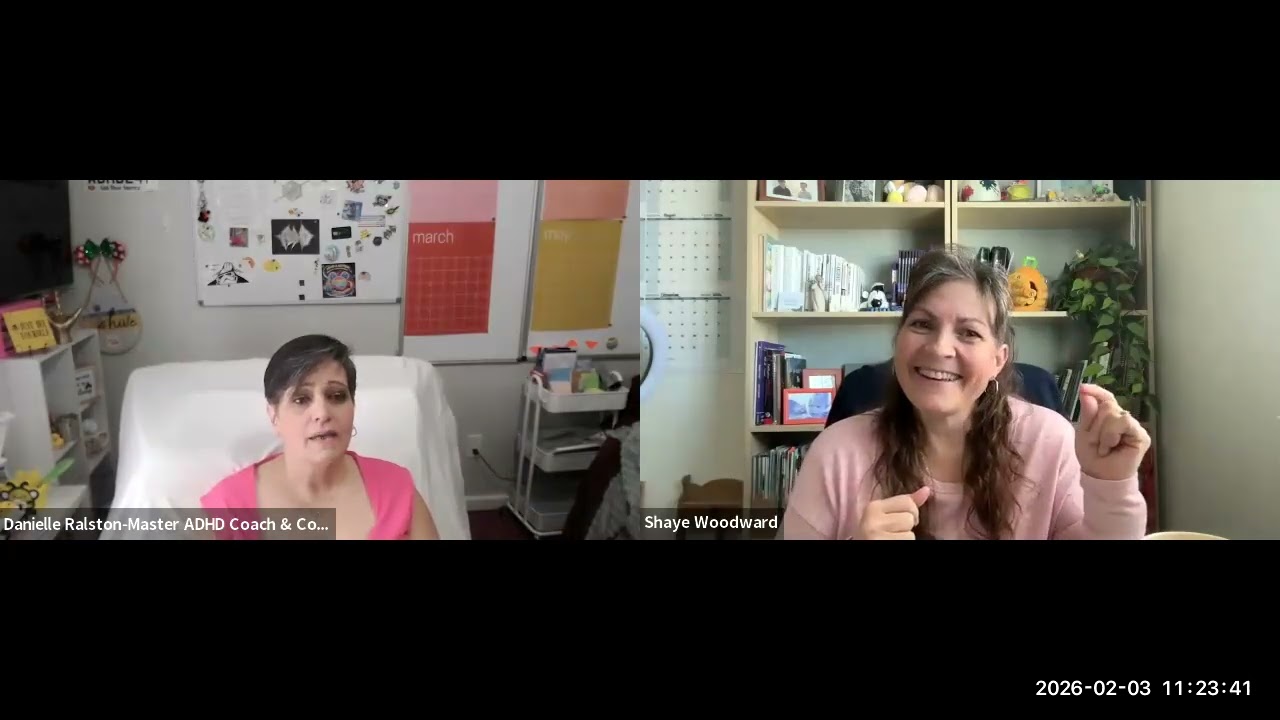
Danielle Ralston and Shay talk practical strategies for getting things done with ADHD and autism. They cover routines, body-doubling, planning systems, energy management, and reframing days as good, better, or best instead of productive or wasted.
Chapters
Hello.
Hello.
Hello.
This is Danielle and Shay with NDI of NDL Loud, and we took most of November and all of December off, and now it's February. We're getting back to it. I'm so excited to get back to this because I kind of felt like part of me was missing when not doing all of these recordings with you.
I know, right?
It's—
it was too long.
It was too long, but we needed it. We had so many cool things happening. You guys will hear about that separately from this. But we've got a lot of really, really cool things happening and launching here over the next couple months. All kinds of cool things happening. So today we want to talk about success with ADHD and autism and Audi HD and other neurodivergence. Let's let's just use the whole entire bucket and how we as experts in this field have success every day, and you don't have to be. an expert to find success. So I want to say that first.
Right.
I'm going to use an illustration first. And we all know Iron Man. I need a Tony Stark, guys. If anybody has a Tony Stark or knows where I can find a Tony Stark little guy here, let's get me one. I want to talk about this Iron Man specifically as an illustration here, and then we're going to fill in the blanks here for you.
So Iron Man.
Iron Man, as Tony Stark, he's just a smartass. He's really smart and a billionaire, but he's also an idiot whose life is falling apart without somebody else to run it for him, Miss Pepper Potts. But when he becomes Iron Man and puts this amazing suit on him and adds Jarvis in a computer and a second brain to his ears and his eyes And controlling what he does, sort of. Uh, he's still ADHD. There's zero doubts in anybody's head that even with all of this, he's still ADHD. But when he does that, he literally becomes a superhero and saves the world.
Mm-hmm.
And saves the, the little town in Europe. And he does all kinds of really, really amazing things when he has the whole entire system. And structure and protection around him. And that's what we want to talk about, is those things that we create around ourselves. And there are a million options here, but we have things that we create around ourselves that create that superhero structure. And some days we are superheroes, some days we are complete and total ADHD disasters, and that's fine. And we understand that we have good, better, best days. And you guys have heard me talk about good, better, best days. But we want to talk about best days today. I want to talk about our ultimate best days. So, Shay, what are like 3 things that you use that make you have your best days?
I think it's a schedule for me that works for me. So, you know, I get up and I work out every morning. That is routine. That is the thing I do every single day. And I do that because it helps me turn my brain on, get rid of that excess energy that a lot of us carry. I mean, we may not be hyperactive, but there's a lot of that feeling, you know, of I got to do, I gotta do, I gotta do. That's one. A second one is that I have my brain in my book, which is right here, and I create my system of tracking my day. And I don't mean like the nitty-gritty all the time. Just making sure I have all my appointments so it's at a glance. I look at it and I'm like, oh, today I have this meeting here, I have lunch here, and I have, you know, free time here. So I try to create that. And then the third thing through the day is making sure that I get the things that my body needs. I get hydration, I get food, and I get movement. Those are very important. We don't realize how important they are until we don't have them for, you know, maybe a day or two, and then we're kind of obnoxious and ornery. irritable. And a lot of us don't realize that we even need those because we haven't been taught that or we haven't figured out the signals. So like, what's the signal for me to know that I need to eat something? Well, I get even more brain fog than I normally have, or I start talking and I just don't make sense. I do in my head, but coming out of my mouth just doesn't work. Or I just feel kind of icky for a minute. I just need to walk away. And then I come back. Doesn't matter what it is. If I'm cooking, talking to my kids, hanging out with grandkids, whatever it is, if I start feeling like that, then I need to take a minute, step away, come back. And it's like your brain is like a light switch. Turn off, turn on, turn off, turn on. But that's sometimes how we need to work it. So those are some of the top 3 that I do every day, Danielle.
So for me, My top 3, you guys have heard me talk about my top 3. They're changing right now. And Shay has been— Shay and my friend Gina has been helping me kind of change this up because I need to modify things and create some different systems that have not worked in the past for me. So for me, number 1 is always community. Body doubling coworking is my number 1 to having success with everything that I do. If I don't cowork, then I cannot find success in my day. End of story. If I'm not on there, and Shay knows this, if I don't show up in coworking, I— disaster is putting it mildly.
We start checking on you because there's something missing if Danielle's not there.
And I need it. Number 2 is I have to have a planning system. And right now I will tell you, I'm trying out new planning systems. So it's not there yet for me because my previous one is not working. Why is it not working? That's a whole other story, and you can start watching my stories on the original ADHD Coach to hear about that because that's not for here. But I have to have a system to write things down and do things. If I don't have a capture system, everything is lost because I can't process things unless I write them down. Typing them in a note on my computer or on my phone is not good enough for me at all. I have to physically handwrite. I have to engage with information for it to become information that I need and can use again. End of story. So coworking, writing things down, having a capture system. And number 3 is taking care of my energy. And for me, that's very, very different from Shay. I cannot work out. Working out does not work for me. I have MS and hold on one second, my dog is going crazy. And I can't work out. I can't. Movement is an enemy for me at this stage in my MS. It causes amazing fatigue and muscle fatigue creates muscle pain and then nerve pain. Um, and, and it's a bad thing. So I can't move. I have to know what my energy is every day, but I still have to get everything out and have a system for getting everything out and getting all of that nervous energy out. So what do I do? I journal. So for me, again, it's handwriting something, but it's just getting every thought out of my head. That is not as good as working out, I will tell you. I miss being able to walk when when I'm overwhelmed and my brain is going a million miles an hour. I miss that. But I had to find something else that worked for me right now because, again, I can't physically move. Now that it's starting to get nice out and we're getting past winter here in the Deep South, thank God. We've had a horrible winter down here. I'm going to start being able to go out in my wheelchair and at least go around my neighborhood because we as humans need fresh air. We need sunlight. We need, need water. We need food and sustenance. And I can do that even just in my wheelchair, which is awesome. And I have been missing that for the last couple months because it's been miserable. How do you— and for me, it's really evaluating where my energy is every day. Where— what can I do? Because I can still have a best day and a high pain day here if I use the tools that I need to use.
And I think it also goes with, are you really paying attention to you? Or are you trying to take what everybody else is telling you that you should do and do that instead of listening to your own self? When she mentioned the coworking, I was like, oh yeah, I use that too. And if I'm not in coworking, I don't get stuff done.
Mm-hmm.
I just don't because I'm bouncing around. You know, as soon as you see your eyes on it, you're like, oh yeah, I forgot to do that. Let me put that away. Oh, I forgot that needs to go somewhere else. And you start bouncing around. Now that works for me on my Saturdays because I already know that's how I'm gonna be. But that doesn't work for a day-to-day, for every day, you know. And creating a process for you depends on what your physical needs are, your emotional needs are, your mental health is, what you're dealing with that day. Because like we're talking about right now at this moment, best days. Okay, do we have best days every day?
No. I get maybe one of those a month, maybe.
Yeah. And if you throw any type of chronic illness on it, it's a crapshoot each day. Danielle deals with the MS. I deal with chronic headaches and migraines. And there's a lot of things that we just don't— you don't see outwardly, but we're dealing with internally. So we have to evaluate internal along with what's going on outside of us.
And I think that's really one of the things that I had to learn to do is look at myself internally each day to figure out where I am. Now let's talk about good days. And good days are what most— I want to reframe them that no day is a bad day unless you're in the hospital, in the ICU. Even if I'm in the ER with a bad pain flare, that is still not a bad day for me. And I had to reframe that mindset That there are very, very few bad days because I was living in that negativity of my ADHD, my autism, my pain, always creating bad days, and I never could have success, and I was always bad. Everything was always bad. And when I reframed to, I have good, better, best— my bad days are if I end up in the ICU. Have I ended up in the ICU before? Yes, absolutely, that has happened, and those are bad days. We can all admit that, and that's okay. But good days, what do good days look like for you? Your lowest energy, your highest chaos. What do those days, what tools work for you on those days?
Are you asking me directly? Yeah. For me, on a good day, those are the days where I'll be dealing with pain from a migraine. Don't want to have the light, like right now you see the light coming in my window. I'll usually close the blinds. And it's kind of dark in my office. That's, that's one thing. I make sure that I'm getting enough fluids. A good day is a day where you can just get through the things that are of high necessity, like they're up here on fire that you have to deal with. They're not things that you could set aside for the next day, or things that, you know, you don't really have to. I mean, Like, do you have to fold your laundry? No. Leave that for a better day. You know, do you have to sweep the floor? Okay, maybe if there's a mess on the floor, but if it's just a few crumbs, do it the next day. There's no thing that you need to stress over and put your health at risk for to have it be a better or best day. So on a good day, I deal with what is of high necessity. Or is high importance, I guess, is a better word. But you also have to define what is important.
Yeah.
Because some of us think certain things are important that really aren't.
I think the big thing to know is you have to know what your limits are and what you can and can't do. Even a good day, I find success for, okay, I'm in the ER, I've had a bad day, I haven't slept all night because I've been in the ER all night. What can I still accomplish? What are the necessities to keep people fed, including me? People, fuzzballs, littles, whatever you have in your household, keep them all fed. And for me, that means we're eating air fryer food.
What's wrong with that?
I think there's nothing wrong with that. On a bad— on a good day for me, right? Keep myself hydrated. How am I doing that? I may not make myself fancy coffees or anything that day. I might order a smoothie from Smoothie King and have it delivered to my house. Great. And what are the things that I have to do so I don't lose customers? Because I own my own business. What do I have to do? What was a delivery deliverable that had to happen today so that I'm still making money today and not losing my business over it?
Right.
You will notice there's no shower in there. There's no other self-care other than feeding and watering myself. There is no folding laundry or cleaning my house or doing dishes or none of that on a good day. There's none of that on a good day because those things can wait.
We just have to realize those things can wait. And if we don't finish them that day, we're not a failure.
No.
In fact, I'm gonna say something.
I am still not letting things fall apart. I'm not, I'm not falling apart. My business is not falling apart. End of story.
Well, and, and remember that you're still, you're still being successful even if you're allowing something to move to the next day. As long as it's covering like what Danielle just said, what is of the necessity to make sure that your, your children are fed, your animals are fed, you know, maybe that means your husband, significant other, or you get a DoorDash. I mean, it does not have to be something that you have to slave over to cause the problem more exacerbation.
Exactly.
Where it's worse. So on the bad days that we used to call bad days, they're now our good days because guess what? You just achieved success of getting through that day, taking care of what you need to take care of, and by the end of the day, go to bed and go to sleep and get your rest that you need.
And the things that work on my good best days still work on my bad days, on my good days. I still have to write things down. I have to, otherwise I'm gonna lose them, and I'm definitely gonna lose them on a good day. But if I would lose them on my best day, I'm gonna lose them on a bad day or good day. So, and I keep saying those together for, for a reason, because I want you to hear that difference. On those good days, I still have to use my regular resources.
Mm-hmm.
They may not be for an all-day coworking session. I'm not— I don't have the energy for that. But when I have to do those things that have to get done, I'm going to hop in for 15 minutes, 5 minutes, even 2 minutes to get that one thing done that I got to do.
Right. And you're using your community. Your good days may be more reliant on your community to help you get through it, whereas your best days, you're giving back to the community because you now have more energy to do so. So there's a lot of variables. Like I said, we really have to pay attention to ourselves and start gauging where we are. And start realizing what the best, the better, and the good days are to be able to have those processes and systems in place that work for you and for your business and for your home and for anything else that you're involved in.
Understanding that we have to have a way to support ourselves. We don't do well when we are isolated by ourselves. ADHDers that fail the most and don't have successful businesses— if you're an entrepreneur, jump from job to job because you keep losing your jobs— don't have a community and don't rely on their community when they need it.
Amen to that. I mean, I honestly would not be where I'm at in my business and working with you if I hadn't started using those tools and systems— the, the coworking, the check-ins, The the daily, you know, not daily affirmations. I hate saying that because it's not that's not the truth. But telling yourself the truth daily: I'm a good person. I'm capable. I'm going to be able to do this. I am doing this. And then having others be able to say, "Yes, Shay, you are." Yeah, you've got that done. Way to go. And it doesn't mean that you guys need to sit there and shower each other with all the oozy oozy stuff. Sorry, that's the only way I know how to describe it. That's what it feels like to me when it's not sincere.
Absolutely. So use your tools or find your tools. And if you don't know how to create tools, you don't know what works for you, like you just plain don't know these things, come join us at ND Hive. We have a special right now where you get 7 days for free to come try the Hive out and And if you try in the next couple of weeks, you get some other special things going on because we're in the middle of launch. We got some cool things going on because of it, all kinds of stuff. Come join us for 7 days. It's free. And then after that, it is $19.99 a month for 10 hours a day of coworking, if that's what you need, all 10 hours a day. Or if you need on-demand coaching, if you wished you had a neurodivergent coach in your back pocket, you also have that for 10 hours a day. If you wished you had a community that you could get information from that would go down your current hyperfocus with you and celebrate your hyperfocus with you, even if we don't understand it, we're still gonna celebrate it. We will come join us all for $19.99 a month. We look forward to having you. Please come join us and find out how to have good, better, best days because best days are possible and even good days are possible even at your worst. I promise. Have a great day, everybody.
More from Danielle

Why Disney is what you need as an ND human #Neurodivergent #disneyadults #disneyscience #disneyworld



Follow along if you want to watch me finally finish what I started… #adhdcommunity #bodydoubling

The last 3 months I … wait no … all of us here at The Hive have been rebuilding from the ashes… we

The last 3 months I … wait no … all of us here at The Hive have been rebuilding from the ashes… we



What if the silence didn’t stop you because you never lived life alone? Katie Karayianis

What does getting ready for a road trip look like for you with adhd? #adhdcoach #ndhive
