Growing Up Deaf and ADHD: A Sibling Story of Inclusion
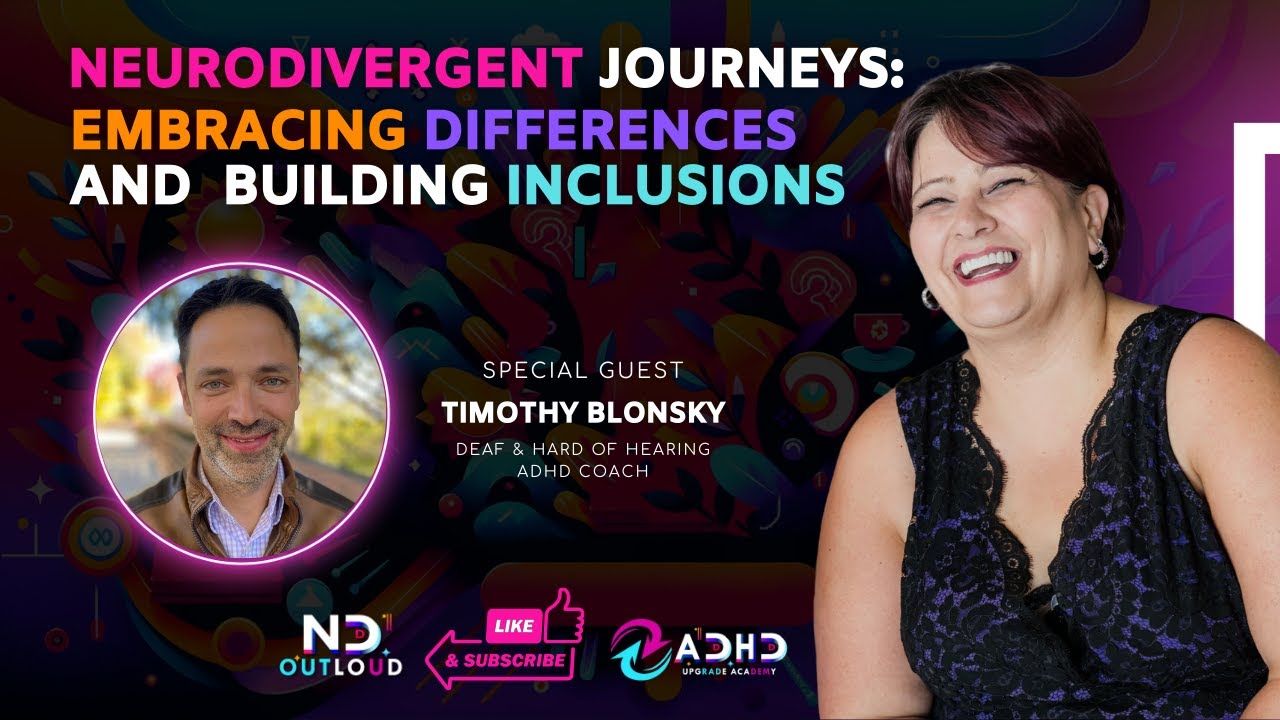
Danielle Ralston and her brother Tim Borowski grew up deaf and ADHD in rural Idaho, shaped by a teacher named Mrs. Donovan who taught them coping tools they now use in their coaching practice. They founded ND Out Loud to help neurodivergent people navigate work, offering free community groups, one-on-one coaching, and corporate consulting as labor shortages make inclusive hiring urgent.
Chapters
Good morning, everyone. This is Danielle with ND Out Loud, and today I have a different face with me than any of you have seen before. However, this is a face I know well as it's my baby brother. Yes, he looks older than me.
Ha!
Hair dye goes amazing. He is my baby brother. He is profoundly Deaf. He is also ADHD and he is one of the new coaches here at ND Out Loud. And we're doing something very different than what exists out there now. For those of you that don't know, we've hired a bunch of new coaches here and offer coaching for everyone, every age that is neurodivergent, for them, their parents, their families, their spouses, their moms, their dads, whoever in the extended family. And something that Tim and I never thought of until what, a month ago?
Yep. Yep. Yeah, yeah, I think about a month, a month ago.
Okay. Tim was like, why aren't we doing things together?
Yep. Yeah. Yeah. I mean, so, you know, first of all, I just want to speak to the fact that I can sign, but signing and talking at the same time is 2 different languages at the same time. So I'm not going to do that going forward. So you're going to hear my deaf voice, but I just want to emphasize that I can sign. Anyways. Yeah. I mean, I think it's a combination of a timing of a few things. And Danielle, I think you probably agree that one, an adult enters their 40s, they come to kind of realize a lot of things that affected them their whole life and just kind of putting things in words, I guess, like, and, you know, really kind of having a better sense of self-understanding. So, you know, so the last few years has been that for me. And I've also faced quite a few challenges in the last year, last few years that has resulted in this place of like, hmm, I have ADHD. That's, you know, and that's a good thing for me to know that I realize that so I can cope with that and I can come up with strategies and talk to other people that have also struggled with it and learn from them some of the things that they have done to help cope when it comes to maybe getting things done or just day-to-day existence. And then one of the other key things in this, and we'll probably talk a little bit more about this as we kind of progress in this conversation, is So, you know, I'm profoundly deaf. I am completely deaf in one ear and I wear the hearing aid in the other. And, you know, you and I, we were, we grew up in the same house and we went through an incredibly amazing mainstreamed deaf and hard of hearing program, which we're probably going to talk about that quite a bit. But in the last, last couple of years, I've come to a place to really accept my deaf identity. I've been given the privilege of being able to live in both worlds for, for quite quite so long because of our incredible upbringing, that piece of our upbringing that was incredible. So, you know, and kind of really understanding myself as a deaf individual and as someone that also has ADHD, which is a fairly recent revelation, I've come to this place of like, wait a minute, you know, I wonder how many other people in this world are struggling when you have the deaf aspect correlated with the ADHD aspect.
So, and the funny thing is he knows I'm an ADHD coach. I've been doing this for years. I talk to people about this. I've been doing this. I'm very vocal about the fact that I'm ADHD, AuDHD. So AuDHD, A-U-D-H-D. I'm autistic and ADHD combined. And my family knows this. I mean, this is not a revelation to him at all that I'm autistic and ADHD. We've known my whole life. Well, we haven't known my whole life because it wasn't a thing until my 20s. But still knowing that, it was still this disconnection because— and honestly, it's because of trauma. We as a family have a lot of trauma on how we were raised. We were raised by an incredibly neurodivergent mother who had some very serious mental health issues, and that affected All of us a lot. And a very ADHD father because we all know where we got the ADHD from is our grandmother and our father were very, very, very— our one was, one is very ADHD, very normal. And back then, obviously with our, our, our dad is gonna be, oh my gosh, I'm trying to think of how old dad is now. Almost 70, 70, something like that. Don't kill me, dad.
71. 71.
Yeah, don't kill me, Dad. I'm bad with math.
It's—
that was not something they diagnosed or dealt with. They just found jobs that worked better for them and did things. And our dad, incredibly active human, incredibly active human. And our grandmother was mowing the lawn into her 80s and doing laundry, everybody's laundry that she could do, and walking and all of these things. So We come by the ADHD very honestly, and then we had the trauma of childhood with being raised by a very, very, very unstable mother with a lot of mental health issues, and that caused a lot of not communicating well as a family.
Yeah. Oh no, I completely agree. You know, I want to say though, like, as a part of that journey that I've been on, I've been in a place of like, You know, like I acknowledge that, that yeah, specifically when it comes to our mother and, you know, the mental health issues and the lack of stability. I, you know, further in life where I am now, I don't judge her for that. But yeah, I mean, I think it's safe to acknowledge that that was a very big piece of what we had faced. Yes, and the same with our dad and, you know, seeing some of those signs that we you know, what that was, just normal parts of our childhood that were in both, both our parents and then our grandmother, who was our saving grace collectively. You know, one of the things that I, I think is interesting, and I've been talking to some other people about this, is that all 4 of us were basically in various facets raised in the same home. But all 4 of us have a completely different experience regarding, regarding that upbringing.
Oh, yeah, absolutely. And part of that is, I mean, one, age. There's There's a 4-year difference between myself and Tim, and then a few years between you and the next one down, Melissa.
Yeah, I, I think I'm 3 years older than, than Melissa and 5 years, 5, 5 years older than Adam. I think so. Yeah.
Yeah. So there, there's 7 and 9 years between me and the youngest, 9 years between me and the youngest. So we all have very, very different and And then we add each of our own crazy neurodivergent brain. All of us are neurodivergent. So if you're one of the other siblings, you, you're neurodivergent too. Melissa knows this, and Adam, and all of that. We are all. But I will say the one thing that, going back to the mother thing, our mother and our dad and our grandmother, who is a huge, huge part of our lives, made sure that all of us had the things that we needed to be successful in life. Because I— now, something I remember that Tim doesn't. Tim was born and was— we knew from birth that he was deaf. My mother, there were fights with doctors. I remember, like, I'm old enough to remember the fights with doctors and stuff to get him into a program because they weren't going to allow this to be— and I'm going to put this in quotation marks— a disability, a crippling disability, because when you were born, that, that was still in the early '80s, very much a crippling disability. My mother was determined it was not going to be. Very determined.
Yep.
And then we had this amazing opportunity, and I'm gonna stop with the childhood stuff and go to the amazing opportunity. Uh, the school district we were in, extremely rural. Like, when I say extremely rural, it was a 45-minute bus ride every day to school. Okay, people. Middle of nowhere, middle of nowhere. And our high school, our whole entire school district from kindergarten to high school had 800 children.
Yep.
My graduating class, there were 35 of us. Okay, a very small school district.
Our—
this amazing school district had a deaf program.
Yep. Yeah, so, you know, it's interesting because, uh, Mom and Dad Built their dream home on a dirt road across from a cornfield. Like, yeah, you know, like the background here is Idaho, and Idaho is a lot of rural places. And I explained to people that I also grew up in a rural area, and I explained, they're like, wow, like New York has rural areas like that? Yes, yes, they do. Yeah. So like, they, you know, the stars aligned, I think, for the fact that they just happened to build a— buy a piece of property and build a house in a town that had a deaf program.
And then in the middle of nowhere, in a county— in our county was even like the whole entire county. All of the, all of the deaf students in our county all went to this one school. So there were kids bused in from like almost an hour and a half away to go to this school. The fact that this school district, this county had this program was—
Yeah. And it was one of a kind, um, head by an incredible Incredible lady that I love. I have goosebumps just even just mentioning her and who she is. But Mrs. Donovan, Mickey Donovan, and you know, here I'm at 44 and I'm still going to call her Mrs. Donovan. That's her name. That's always going to be her name. But yeah, she's a little feisty Irish lady that, you know, really like dedicated, literally dedicated her life To helping deaf and hard of hearing students and making sure that they have the best of both worlds. You know, integration of English and ASL was a very big part of the program. Again, you know, just the fact that it was in Nundae, New York, at Keswick Central School, it's just incredible. So, you know, when I talk to people about it, their eyes just light up. It's like, wow, that, you know, it's incredible. And, you know, I learned an interesting ASL sign that I didn't realize before about The, you know, technically we were mainstreamed in a deaf and hard of hearing program in a hearing school. And there are 2 different signs for mainstream. There's mainstream like this where you have like multiple fingers, and then you have mainstream like this where just you're one singular deaf child in a hearing school with the services. I had peers of other deaf students that were part of that experience, and which is really kind of a key in that. So I, I, I forever will, will appreciate that.
So I'm not deaf. I am not deaf. I am not hard of hearing. Never have been. However, I went to a private school for my kindergarten and first grade, and it was unfortunately a very, very bad private Christian school who believed in capital punishment. I couldn't read. I did not speak very well. I couldn't do any of the work of the program that they had. And unfortunately, I was just considered lazy and everything at that school. And I got punished constantly. I got spanked in school constantly because I wasn't doing the schoolwork. Newsflash, I couldn't do the schoolwork. Then they put me in public school. When Tim started school, I got put in the public school. And in the beginning part of 2nd grade, I got diagnosed as mentally retarded.
Hmm.
I remember sitting in the school psych— and I remember her name. I'm not going to say her name. I remember sitting in the school psychologist's office and them telling mom and dad I was mentally retarded and I would never, never amount to anything and never be smart.
Yeah. Yeah. You know, when you mentioned that, when you and I, we talked a little bit about this last week, I forgot about that piece until just until you brought it up. And then I, that all came back, remembering how that was mentioned several times throughout our childhood. So the fact that you went from there To yourself as a hearing child was put into a deaf and hard of hearing program.
So Mrs. Donovan is my lifesaver, and I'm in the process of writing a book. Okay, so let me go back to that story. Mrs. Donovan, my best friend in school was one of the children in the deaf program. Her name was Becky, and I was going to go home with Becky one day, and I was sitting because we had after-school buses because everybody in the deaf program went home later, and I was going to ride home with Becky. Becky to— for her birthday party. So I remember this so well, and I think I was in 4th grade. I think it was 4th grade, maybe it was 3rd grade. And I'm sitting in the back while she is working with her interpreter on homework and stuff like that. And Mrs. Donovan, who I knew well because Tim was in the program and all of that, and we did family days and all of that, so I knew this woman. I knew her well. I loved her. She was amazing. She would say hi to me in the hall, whatever. Was like, why aren't you doing your homework? Because I'm sitting fidgeting with something. I'm sure I was fidgeting with something, probably breaking something, ripping something apart. I'm ADHD. And she's like, why aren't you doing homework? And I'm like— and Becky turns around and says, she doesn't have homework. She doesn't have books. You want to piss off an amazing special ed teacher? Point out that they aren't even trying to teach a child. By Monday— and this was in April— by Monday, I was in the deaf program at school.
And so I, I don't know, it's, it's so unique, but she was just someone that, um, you know, like every, every child of hers was her child. Like she, she had her own personal children, but, um, every, every one of her children were her children. And, but I would say, um, you know, maybe, maybe some of you, some of, some people that'll be watching this may be jealous, but She will always say that there was just something about the Borowski kids. And so like we were her favorites, like all of us.
Oh yes. She probably says that to everybody, but we were absolutely her favorites. But this woman changed my life. She, her and the audiologist that worked with Tim and Melissa, our younger sister is hearing impaired, and worked with them, realized I had auditory processing disorder. So they got me hearing aids. Tuned very low so that when I was in a school classroom, back when we had units—
Yeah.
Do you remember those? Those big, huge—
No.
And the teacher would wear a microphone around her that I could tune out class noise and tune into the teacher. And I will tell you, by the time I hit junior, junior high, I was in AP classes except for math. I will never be good at math. That will never be something I'm good at. We gave up with that a long time ago. But I was working in AP level all the way through high school because of Mrs. Donovan. I have 2 master's degrees. I mean, I was diagnosed as mentally retarded, and I will tell you, it's not because I pulled myself up by my own bootstraps or anything like this. It's because of Mrs. Donovan. I don't know if, if she would've known about autism and what autism looked like, cuz I'm not sure if that's something It was never mentioned to me, not even once. ADHD was quite a few times, but autism was never mentioned to me. And now, I mean, I did not get diagnosed until my son got diagnosed, which was 25 years ago now, because I'm filling out the form for him going, oh, this is me. Oh my gosh, this is me. I'm actually— and then I got tested and all of that. I'm actually much worse than my son is. I am actually considered autism too. I was nonverbal enough as a child and all of that to be fairly severe autistic. Obviously, in the '70s and '80s, they didn't diagnose girls with autism unless you were completely nonverbal, sitting in a corner, unable to communicate. I was disruptive. My ADHD— those that don't know, my ADHD wins way more than my autism does most of the time. But this Teacher is the reason that Tim, you speak on stages as a profoundly Deaf male.
Yes, yes. She gave me the confidence. Well, I don't think she gave me the confidence, but she really kind of uncovered it, you know, because like nobody gives you that. But yeah, you know, I find myself to be a very odd Deaf individual, I guess. And the fact that you would think that someone like myself would be timid And wouldn't want to be on a stage speaking in front of people. Um, but, um, it's the thing that I love the most. I love connecting with people. I love talking to people. I love, you know, sharing my story. So yeah, I mean, it really started with her and the foundational elements that she built. And, you know, like, I'm not the only one in that program that can speak to that as well.
So. And this woman now has been retired for years and years and years. Every one of our children Knows Mrs. Donovan.
Yeah. Yeah. She's been to weddings. She goes to family parties. You know, like, what, what, when else does that happen? And, you know, it's other families as well. The Niedermeyer family, a very big part of her life.
And Becky Gilman's family, she knows her boys and she's met Rebecca's boys' kids. You know, like we all, she built an amazing supportive Community for us that has been part of our whole lives.
And, you know, not only them, but like all the interpreters that we had that were part of that program. Like, I want to have a shout out to them, you know, Sandy, Pamela, Palmer, even Miss Fletcher. Yeah, yeah. You know, I just talked to her a couple of weeks ago. We just had a random conversation. And yeah. Really, really incredible. It's, um, um, yeah, I don't know. I mean, we could spend hours talking about this.
Oh yeah. And we had— do you remember? Oh, I can't think of her last name now because she hasn't been Mrs. What— Miss Whatever to me in years. The music teacher that we had, Wendy.
Yeah, I know, I know who you're talking about.
So she's a missionary, and she's been a missionary for years because she left our program to be a missionary, but she did She was a music teacher who, in an elementary school with no funding, let me tell you, and she created music therapy for us, which for me was— that opened up so many worlds for me.
You're very musical now. Yeah.
Yeah. I mean, she is that reason. She is the reason for that. I play flute. I took private lessons for years. I I took private voice lessons. I did— I'm a music theater kid. All of those things because of that woman, because Mrs. Donovan built that into the program for us. Every morning we started our day, and you might be young enough that you don't remember that we started the day with exercising our voices with her so that we could loosen everything up.
Yeah.
And it was for all of you more than me, because obviously I— well, I needed it too because I had some speech issues. But I still like every day, those are still things I use now, and I help my clients with the things that Mrs. Donovan did. You have no idea how many things Mrs. Donovan that I use, that you used with all of us when we were misbehaving and overwhelmed and frustrated and all of that, that I use with my clients. And one of the big things, and one of my clients showed me this the other day, is she has a coffee can, and I don't know why I mentioned this to this client. a coffee can full of peanuts and raisins on her desk, and that's what she uses to help calm her down and keep herself fed throughout the day.
Yeah.
I mentioned that once, that you really need protein and some good healthy sugars throughout the day and be eating often. Those long stretches between lunch and breakfast and all of that are not good for an active brain. So those of you that don't remember this, in schools we used to have these big metal coffee— basically big coffee can full of peanuts. And Mrs. Donovan would get peanuts and raisins and mix them in this big coffee can looking thing, and we had it in the room to snack on all day.
Yeah, yeah. I, you know, so like you mentioned any of this, and this is the first time I've remembered this since, I don't know, I was 5 or 6, 7 years old. To this day, every couple of weeks I get a big, big bag of peanuts and raisins and mix them up and they're my snack. Like, now, now I know why. Like, it's, it's maybe a therapeutic coping strategy.
It's comfort. It's comfort food for us.
Yeah.
It's a huge— it is. When I'm upset, when I'm frustrated, when I'm overwhelmed, I have peanuts and raisins.
Yeah. Wow. That— I'm—
And I get a paper towel to eat the peanuts and raisins on because that's all we had in school is paper towels. It's folded. Like, Art's like, get a bowl or plate or something. I'm like, no, there's a go. Go away.
Yeah. Wow. Oh, thank you for mentioning that. Like, I have goosebumps going out thinking about that.
But there are things, all of those concepts that I— and like I said, I don't know, Mrs. Donovan, I would love to hear from you if these were things that you were taught to do to help us, or if there are things that you just intuitively knew to do with us, because these are things I use in concepts with every single adult client and child client that we have. And there's a lot of science behind them now too, but they are such a huge part of me being able to focus. If I'm having a hard time focusing, peanuts and raisins on a paper towel on my desk.
Oh, that's—
Voice lessons where you're doing the big voice lessons and stretching and reaching up and then bending down and letting it out. That I have worked that into one of my core things I teach every client for decreasing overwhelm and increasing their focus. And I do that constantly.
Yeah. So yeah, you know, obviously this is a podcast to kind of talk about, you know, like how I may be able to contribute to this team, but it's been much more than that.
So what are we— why did we come here? I mean, obviously it's so weird that we connected. So Tim, what do you do now? What is your day job or what is your consulting that you do? Tell us more about that.
So I'm in consulting work. I'm sure Danielle will share my website as a part of this. So I come from over 25 years experience in the nonprofit world, disability employment. So I've managed and been part of programs that have helped get individuals with disabilities into gainful employment. I have worked in workforce development for over a decade that was specific to managing workforce programs for Really all varieties of individuals of all demographics. And that program, that experience brought me to Boise, Idaho, which is where my background is, you know, up in the Sawtooth Mountains. And like eventually I got to the place in which I wanted to get into some consulting work and take the combination of experience that I have and help for-profit employers, nonprofits, to help them with finding sustainable talent in today's job market. which is an incredibly difficult thing to do no matter what type of employer you are. I'm an adjunct professor at Boise State University, famous for their bright blue football field. So I've been doing some work there. And so, you know, I wear a lot of different hats. Like one of the main hats that I've been wearing lately is I partnered with a company called TranslateLive that does instant translation of over 200 languages and dialects in real time, including ASL. So I've been trying to get that platform integrated into workforce sectors all throughout the United States. And that's, that's been really successful. It's been a really fun project to work on. So, you know, I'm doing lots of things, like my day-to-day existence is completely different every day. I'm just randomly on a podcast on a Friday morning. So yeah, so I do a lot of different things. What, what kind of like brought us to this place of ADHD and deaf people is, you know, Danielle, you've talked about like how, you know, here you are and You know, first or second grade, and you're diagnosed as mentally retarded because there's something wrong with this person, and here's why they are. Yeah, let's just put a label on them. I feel, and when I started doing some inquiry within my own little deaf community here in Boise, is the ADHD and deafness, usually an individual that is deaf, but they also have some other combination of issues, they're just deaf. It's just a part of their deafness, and that wasn't really moving thing for me to realize that there are, there are many people within my own little community in Boise. But then, well beyond that is, if you have ADHD and you're also deaf, there are ways that we can move, we can cope with those things. Here's some tools, here's some things that a deaf individual can use to be able to get to that next step and to be in a place in which they're happy in life. So I'm really excited to see what we can do To put word out to the deaf community that this is a thing. And, you know, like, this is not really about making money. This is— I, my whole career has been about making an impact in some way. So that's kind of where we're at. And we're just at the very beginning of this exploration and I'm excited to see where it goes.
So we do— so those of you that don't know, because you're being introduced through Tim into our world, we are called ND OutLoud, Neurodivergent OutLoud. We're teaching neurodivergent individuals All from children all the way through. I think our oldest client is 87. We have an 87-year-old client that just learned their ADHD, and we help them in every area of life. We have business coaches, life coaches, sex coaches, relationship coaches. We also have another consulting side where we do some business intelligence stuff. So we do labor market intelligence, which is where we brought Tim in for that. We do workplace invisible disability experience survey. We have a survey that one of my team members built to help figure out what is going on in your whole entire labor force, from office person to manufacturing, and creating better support and accommodations for everyone, regardless of diagnosis in your company. And then we can also come in as coaches to support and train your managers, your leadership team. We also can come in and work with your individuals who suffer from neurodivergence, ADHD, bipolar disorder, being profoundly deaf. Wellness goals, all of those things, and help them build better systems for themselves personally so that they are better, more efficient, productive employees. So we handle pretty much from top to bottom, helping you figure out what your company needs, how to support it, how to bring in and hire people who are maybe diagnosed, or to support hiring more, a more diverse workforce, and then help you train that workforce and support the workforce from day one. Or day 5,000 if they've been there a long time. So we're starting to go into companies and bringing this in. And we've got some very cool things happening there on that side. And we're talking to a lot of very large companies and corporations partnering with some new apps and new brain mapping companies. So that's coming for us. We're partnering with one app that helps calm your anxiety and build new pathways in your brain. And they're already on our site and they're a pretty amazing Fun little quick, I think it's like 4 minutes, 5 minutes of games that you can do a day on your phone. And I will tell you that they are really, really good if you're overwhelmed and frustrated by work life, whatever, helping you with that. And I've been working with them for quite a while. I'm working with a group of college students who are developing an AI-based task, ADHD task helper to help you initiate and get tasks done. So we have all kinds of cool things going on here at ND@Loud, as well as one-to-one coaching. We have a group coaching program, and we have a mission here that no one is left behind. We have a free option where you can work with us through our online community and get that community that Tim and I still are part of and have grown and are— will always be part of, that will always be part of our lives. It is so important for us as neurodivergent adults Having neurodivergent kids to have a community. We have that that is absolutely free. It is available to you to come join us. Then we have our next program is $20 a month. It's $19.99 a month to get group coaching 4 days a week and get support, the support that you need to take action because we are extremely smart. ADHDers are extremely smart, extremely high achieving, but we don't have the support systems and Vida, one of our coaches here, calls it scaffolding. We need scaffolding around us to, in order to access that intelligence and use that and optimize it. And we talk about being ADHD upgraded, and that's what our group academy is called, is ADHD Upgrade Academy, where we help you create the systems you need so your ADHD is not as overwhelming as it is day to day. And then we have one-on-one coaching and we have chat-based. So it's only texting-based to make it really easy, especially if you're profoundly deaf or just don't have time to meet with somebody one-to-one. We've got chat-based. Then we have one-to-one coaching, and adding Tim in here on our team allows us to support the hearing impaired and profoundly deaf community in a way that I never even thought of until 2 weeks ago. I just— it blows my mind that that is something that we can offer now. We have so many ways to do that, however best works for you. And then we also have parents, kids, all of that. And then we also have business coaching. So I work with a lot of ADHD entrepreneurs. That is what I do. I also own other businesses that are completely outside of coaching. I'm not just a coach who coaches people to coach. I also have other businesses and investments and things like that that my husband and I do outside of this. So there is a lot going on here. We are here to support as much as we can. And unlike most things out there, we are trying to offer as low of a cost as we possibly can. And we do accept HSA and FSA to make it as accessible as possible because as coaches, we aren't covered by insurance. But if we can help you cover that by funds that you're already putting in and contributing for work. We're trying to offer that as easily as possible to as many people as possible.
Yeah, yeah. I apologize for the fact that my dog is drinking water in the background, so that, you know, that maybe you may hear that. Yeah, I mean, I can't really follow up on that because that was a lot of information that you just gave in that little snippet there. But that's why I think it's kind of a match made in heaven because there's a lot of factors to my career that kind of get integrated into that. When you're talking about creating a culture of disclosure within a company to help individuals with disabilities be in a place in which they're comfortable to thrive and to be more successful. You know, because the key point that I want to make in that is we're in a labor shortage in the United States and we're in a labor shortage worldwide where, you know, like 1.4 million baby boomers are retiring every year between now and 2030, then they're gone. So they're gone. And then the next cohort, the next generation of cohorts, ours, had 61 million people in it. So 61 million people is going to be tasked with replacing 72 million people. And then the next generation of cohorts have, have issues when it comes to labor. Labor participation is very low. And so employers are in a place in which they, they have— they cannot find people. So they're in a place—
I want to point out something. My dipstick brother here, and yes, I'm calling him the dipstick brother. just totally skipped the Gen X person here. I mean, we're in our 40s and 50s now, so we're getting close to retirement. We're not in the boomer area. We're getting close to retirement and we've not had a chance to, to elevate into some of those top levels just because the boomers are still around. So we have the Gen X. So not only do they— do we have all of the boomers retiring. I've got maybe 15 to 20 years left of working. I do. Like my generation, maybe. Um, because I'm the tail end of Gen X. There's only one more year after me for Gen X. So there's— I mean, we have a lot of people getting ready to retire, and corporations unfortunately are still working on boomer-based ethics and processes and mindsets. And it's not working. It's not going to work for even Gen X to want to invest and move up and do all of that. So you've got Gen X who doesn't have that much time left. Then you've got your Gen— your millennial. So then you've got the millennials who are questioning.
I'm a Gen X too. I'm on the other end of it.
You're just on the other side of it. So just there's so many options here and the mindset in corporate Culture is not going to continue to work. I mean, it barely works now. It's not working now. And these companies need to start changing, and that's part of what we're doing.
Yeah, and there's a key in this, and that's a kind of a bombshell when I bring it up to a lot of people, like from China. China, like it talks about as kind of the bane of our existence because of their labor force. Because of the one-child policy that China had in the '80s, they have a labor shortage that's worse than our labor shortage, which means American companies have an opportunity to reshore their manufacturing in the United States and, and build up their business that way because China is not going to be doing it anymore fairly quickly.
They can't.
But many of them are still stuck in the boomer mindset. And like our political system is as well. I mean, both of our presidential candidates are boomers and like That, yeah, that's a whole other discussion, but— Don't get me started there. Yeah, so the key in this is that, like, we have something that, you know, like, whatever investment that a company makes in this mindset, in this program, is going to be much less than the amount of money that they're going to save as a result of being able to build a labor force that is inclusive and accepting and I mean, just, just even in what I do as a one-on-one coach, I work with people in corporate.
I took one of my clients I've been working with, I think, 9 months, and we took her from being an unproductive member of her team and having to be on pips all the time and all of that, and was close to losing her job, to this woman just took over her boss's position because her boss just retired in 9 months. We turned, turned her from an ineffective employee to one of the best employees who closed $5.5 million in sales in less than 3 months.
I believe it. I believe it.
Just with supporting her once a week for 30 minutes. Those are the kind of things that companies need to be investing in is their employees, because their employees, they need to move them up. They need to move people up internally. They need to hire better people internally, and they're just not able to do that without the right systems and Diversity systems in place. Diversity. And I know a lot of boomers are sick of hearing that word, but let me tell you, if you don't have some diversity pieces in place, you are going to lose your business. End of story.
Yep. Yeah, you're going to be left behind.
And you want— a lot of these boomers are talking about their legacies right now. And I laugh when I'm sitting in conferences and stuff and like, your legacy is that you're a horrible person and nobody wants to work for you. That's the legacy you are leaving behind right now because you are not managing people effectively.
Yeah. And it's not pay. Pay and salary is not a piece of that.
Pay and salary is this much of it.
Yeah.
Inclusion, diversity, and support is the keys. And the Gen Zs, I mean, I have a Gen Z child and That is the thing that him and his wife are looking for when they're looking for jobs, is they're looking for better support systems, better work-life balance, better life care as part of their packages for looking at jobs.
Yeah. So I'm excited to be a part of this to see what impact that we can make. And yeah, I'm not sure what else to say other than that.
So if you're looking to find us everywhere, you can find us at ND Out Loud, both on podcasts, on YouTube, on TikTok, on— we're everywhere. ND Out Loud is everywhere. You will see Tim with us more and more. He will be popping up on our TikTok channel here pretty soon. If you guys need anything, if you have questions, if you need support, please let us know. DM us. You can DM Tim. You can DM myself. Just let us know how we can support you because we have something for everyone from free to full-on corporate-style consulting and support. So please let us know how we can help. We are here to change the world. We aren't here— I'm not here to be a millionaire and I really don't care about that. And ask anybody about that. Ask my poor husband who's like, what do you do all day? Because you're not making any money. Because I can. I'm really blessed and I am able to do that with this business. And we want to invest in the community more than anything else. So we're here to support you. Let us know how we can help. Have an amazing day, everyone.
More from Danielle

Why Disney is what you need as an ND human #Neurodivergent #disneyadults #disneyscience #disneyworld



Follow along if you want to watch me finally finish what I started… #adhdcommunity #bodydoubling

The last 3 months I … wait no … all of us here at The Hive have been rebuilding from the ashes… we

The last 3 months I … wait no … all of us here at The Hive have been rebuilding from the ashes… we



What if the silence didn’t stop you because you never lived life alone? Katie Karayianis

What does getting ready for a road trip look like for you with adhd? #adhdcoach #ndhive
