How to make an ND Bestie
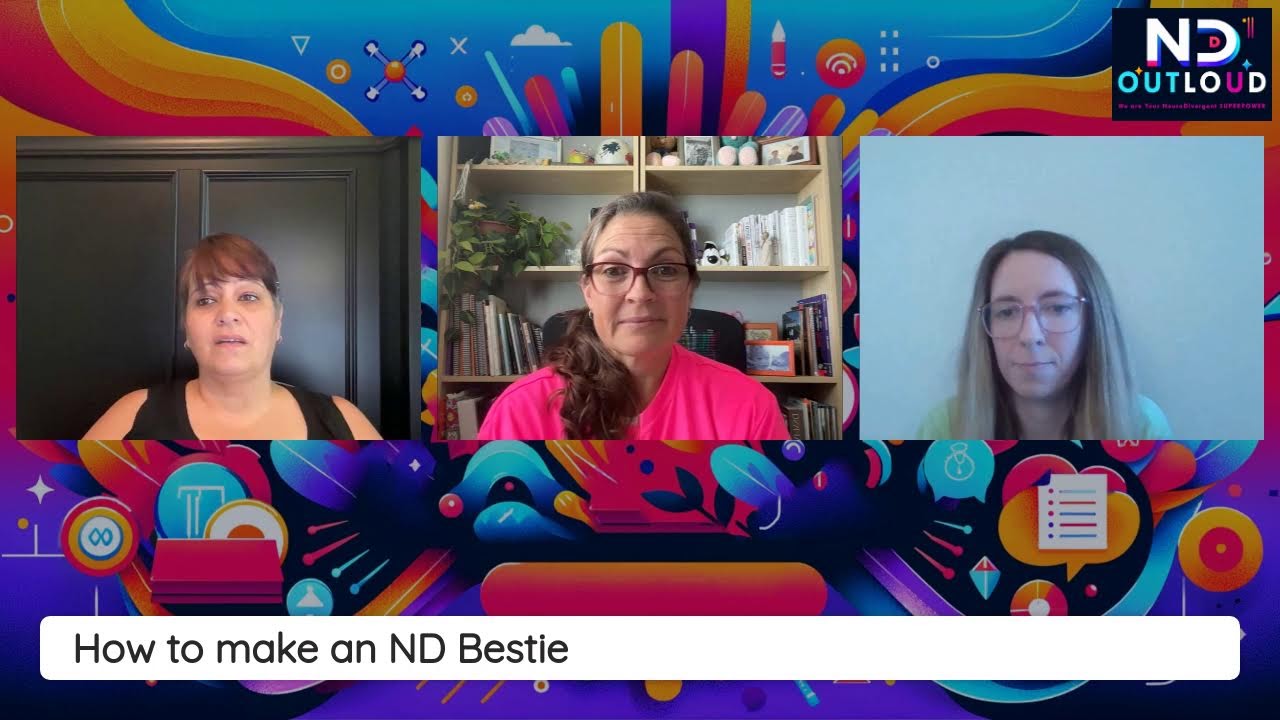
Danielle Ralston, Shay, and Tara discuss why neurodivergent friendships matter so much: no masking, no apologizing for delayed texts or RSD, and practical help like body-doubling for tasks. They describe their Disney retreat together and promote ND Hive, a community with monthly body-doubling sessions and group coaching for $19.99.
Chapters
Do do do, and then we always get on there and see that we've been live for a few seconds.
Yeah, I see that all the time. I'm like, gotta love technology. Gotta love it.
It doesn't count down until after it actually goes live by a lot, and I'm catching it. Yeah.
Mm-hmm. It is what it is. But I join it, and I'm like, okay, here we go.
Good morning, everyone. This is Danielle and Shay and Tara with ND Out Loud and D Hive. We are here to talk about making an ND bestie. And why is it so freaking hard when you're an adult to find neurodivergent friends who get you, that you don't have to mask with, you don't have to explain things to, you don't have to constantly be like backpedaling your goofy joke that you just— or rabbit trail that you went down.
Or explaining, explaining it, or Yeah, all of that.
Or apologizing for interrupting.
Yes. Oh yeah, all the time.
Yeah, constant. So how hard has it been for you to make friends that just get you?
Extremely, extremely difficult in many different ways, even within my own family. You know, whether it's married-in family, the in-laws, or it's my own immediate family, they just don't get it. And it's funny because even within our own families, we have a lot of neurodivergence, but they just don't seem to connect. They'll connect with some of the siblings, but not all of the siblings. Or with friends, it's like what you were saying, Tara, having to say, I'm sorry for interrupting constantly. But if there's a group of us that are together that are neurodivergent, we don't have to apologize, or we do, but everybody's like, stop. That's the S word. Don't say that.
Mm-hmm.
You know, and it allows us to just talk freely. Whereas if we're constantly saying, I'm sorry, or constantly apologizing, I think subconsciously that keeps telling us that we, we're not enough or we're not okay to be within this group. So we kind of feel that, you know, outta sorts or just don't fit in thing.
And I think for me, like, when I, you know, think about my friend group and the friends that I have that are neurodivergent, when they text me and it takes me like 2 weeks to get back to them, you know, I don't have to worry about like them being upset with me or it causing issues within the friendship because they just understand, you know, it's, I saw it and had all intentions of replying. And my brain just went somewhere else. I mean, there's something else shiny and flashy that caught my attention. And next thing you know, it's like something else 2 weeks later reminds me like, oh, this person texted me. My bad.
You know, I don't even have to say my bad anymore with my neurodivergent friends because you just ADHD moment. I responded in my head and move on and everybody laughs and nobody takes offense. Now, something you do, something I am very well aware of is I make sure to always say that ADHD moment responded in my head, something like that, because RSD is definitely something that all of us with neurodivergence deal with. So you don't want to, but just by saying that, even if they may have had been, been having a little bit of RSD in the moment, that is an apology enough to just move on because they get it. And I love, like, especially when we were at Disney World, people walking around us had to think we were insane because we— our changes in conversations went everywhere, went nowhere. Oh yeah, back. We're all over the place. If anybody was like listening, a fly on a wall listening to us, they had to be extremely confused.
Confused. It's interesting because we'll start conversation at one point, stop that conversation, not because we're stopping it, just because we diverted, and then we come back to that conversation and it could be hours later, days later, a week or two later. I mean, that happens in my own house, but to do it with like you guys at Disney, that was just— it was so fun and it was so nice because you could just breathe.
Just relax. You know, you have to mask your behavior or your thought processes.
And I mean, the people that were like behind us in lines or like on the Skyliner with us must have thought like, what has happened? Um, you know, because it's so true, you know, we were just having so many different conversations, but we all followed along. And I think that was The nicest part was I didn't have to say, or nobody had to say, like, oh, what you just said reminded me of this, and this is why I'm talking about this. It's kind of just like an unspoken thing of like, okay, that's where your brain went. Let's roll with it. We'll eventually make our way back at some point or another.
Mm-hmm.
May or may not be during this trip, maybe by a text message 3 weeks later, but we'll make it back.
We do. We always do make it back to the conversation. I think Shay and I have had a couple times in the last few months that we'll start a conversation and, and we'll jump back into it.
Uh-huh.
And I don't have to explain and remind you what the conversation was. Well, I mean, no, they're just gonna say that. It does happen though, because one of my other ADHD coaches on my team just said, hey, you remember that video set? And I'm like, no.
Well, it depends on how far ago it was, because sometimes it's that trigger because we start talking about something that's related in a in a tiniest way, and we're like, oh yeah, just like we were talking about a month ago with da da da da. And it's it cracks me up every single time because I'm like, oh, she totally gets me. You know, and I don't have to be like, oh, that time when we talked about this and then we talked about that and then went to this and here's the you know that whole lead on. Into the conversation that we already had. Sorry, guys. It's draining if we have to keep doing that over and over and over again.
Not only is it draining, but I forget what I was gonna say by the time I give the background about what I'm about to say.
Right. It's like by the time I give the precursor, I what was I gonna say? Yeah.
It's gone. No idea. And I think the other part of it though, especially as women, perimenopausal women, is both Shay and I had meltdown moments last week. Both of us. Tara was bad. Tad was not. So Tara kept Shay and I on the even keel last week. And there's always somebody in your group, if there's more than 2 of you, there's always somebody who is able, able to bring the calm. And the logic back to conversations.
And when it flows back and forth, because one week, I mean last week, Danielle, you and I were— Tara kept us even, you know. This week I hope that I'm not at that and we keep somebody else, you know. But it's— it flows back and forth because we can pick up on those cues. Something's off, something's not right, and you don't even have to say anything. Just, it's like, okay, Danielle, what's going on? And you're like, How did you know? Or, Tara, how are you doing? Because something seems weird. How did you know? We just do.
We don't even have to ask each other, how do you know?
Right. It's just implied. Like, you're just in my brain. You just know.
How many times have you told me that? Shay, get out of my head.
Yeah.
Yes.
And, you know, I think it's just so beautiful because I feel like I have like 2 extra brains now because there's times where I'm just stuck and I can just be like, ladies, what do I do? And one or both, you know, and it's so cool to see different perspectives. And then it's like, okay, I didn't have to, you know, put out the mental effort to, you know, get this question answered or solve this. You know, and that's saved me so that I don't go into burnout, you know. So I also think that when you have very close friends that are also neurodivergent, it saves you from burnout in so many different ways— emotionally, mentally, physically, you know— because you have people telling you like, hey, I've been on video with you for 6 hours and noticed you haven't eaten. Why don't you go eat? You know, why don't you go drink some water? I haven't seen your Stanley on screen, you know, this whole time, you know, and those are the important things that we don't think about, right? Mine's in the other room. Sorry, y'all.
I'm only laughing because that's very common with neurodivergent people. We don't have one. And I might have to start carrying a third one around so that I have like, This has water, and then another one has the drink with electrolytes. Yeah, see? Yeah, people laugh at me. They're like, why do you carry so many drinks around?
Right?
And I don't have to explain it to you guys. You get it. You know, you're not like, oh my gosh.
One is for taste, one is for caffeine, one is for hydration.
Right. And you might need a 4th one for something else. Who knows? But it's— you just get it. And, and why does it— why is it important to find indie besties? Because you guys, it— when you have that, I mean, you two along with some of the other ones have kept me at an even keel to be able to get things done with the body doubling, with just checking in with somebody because there's somebody who's just checking on me. Because around here where I'm at, There's not that many. Oh no, we lost Tara.
We lost Tara. Hopefully she'll be back. Tara, bestie, get back here.
But the reality is, is that we've got to have these groups. I've noticed that when there's a lot of things that— when there's a lot of things coming at us, when we have just that group to be able to talk to, or a couple people to talk to and bounce ideas, those ideas help us to Calm that brain down. I mean, you helped me with my meltdown that I finally was like, oh, maybe we should try this. You know, and it's things that you don't think of.
Absolutely. And we, I mean, when we're stuck in the moment, when we're stuck in an RSD moment, when we're stuck in a meltdown, when we're stuck in hyperfocus mode and forget to eat, drink, pee, all of those things, it's really good to have those people that get that. And, um, Not— don't judge you for not, not eating, not eating. Like, you don't judge me when I forget to eat for 3 days or, or forget to drink water or any of those things, but you do support. And I think the accountability is part of that, is there is accountability built into ND hive thought.
Accountability with compassion and kindness. Yes, with compassion and kindness. So if I'd say to both of you and be like, okay, when's the last time you guys ate? And you're like, oh crap, I haven't eaten since lunch yesterday. Okay, go get something to eat and then let's talk, you know, or get something and we'll talk while you're eating. But it's not like, oh my gosh, I can't believe you've not eaten for a day and a half or whatever it is. It's more of just, here's some kindness. Let's go get this done. Okay, now let's go. You know, roll with it.
And part of that is the acknowledgement too, because Tara just said to me, she was watching me eat breakfast and she's like, oh, I'm so proud you're eating. And that just brings a little bit of like a smile and a joy that somebody cared enough to notice. Yeah.
Yeah. And, you know, I don't feel the same internalized shame and guilt. You know, of not doing something when one of you are like, have you eaten today? Have you drank today? Like, why don't you take a second and go like, you know, get some trail mix? It just, it hits differently.
I don't feel attacked. I don't feel— I don't end up in that shame loop.
I—
any of those, none of those things come up because again, it's supportive. And, and maybe in a joke, maybe somebody will send me a GIF telling me to drink something that is in a way that my brain can understand today. And you guys also pick up on where my function— my spoons are for today, and will send me whatever it is that I need in, in the form that I needed it.
Well, and I think it also helps us to recognize some of those things. So like, If we start getting repeatedly told, "Hey, get something to eat. Hey, get something to drink." That's an alert for us too, and it's teaching us the tools and what do we need to do to be able to implement that for us, for ourselves. Like this last week, I'm very you know I've got a ton of stuff to do this this week, and I know that I'm not going to be paying attention to. So I've asked my husband, who's home during the day, and said, "Hey, can you let me know?" When lunchtime is, I know that sounds silly to a lot of people. Like, how do you not know it's lunchtime? Look at the clock. I'm like, you don't realize that when I'm busy doing the thing that I'm doing, I don't even pay attention to the clock, and it will be three or four o'clock before I even notice it. And that's way past the time I need to eat. And so we start building up those tools by having people like you know Tara and Danielle teaching me. Hey, you got to start recognizing these things. Because we're repeatedly telling you, but you're not like you need to recognize these things because I can't get to your list.
Yeah, yeah. That's okay.
Judgment of the to-do list. Oh, don't forget to write it down on your to-do list.
Yeah, right. Thanks, Captain Obvious.
Because I'm going to look at the to-do list. Yeah.
Where is your to-do list? Do you even know where it is? I mean, I know where mine is because I finally figured out how to do it, but. Do you know where yours is?
Yeah, in Google Keep, because Danielle showed me last week.
Mine's still written down because I have to— it's, it's that kinetic thing of actually writing something down. But I also keep it in electronic form because it has reminders.
Exactly.
And I think that that's also one of the most beautiful things about having an ND bestie is that we pull systems from each other.
Mm-hmm.
You know, and bounce things off of each other. You know, I'll be like, Danielle, like, how do I, you know, declutter my inbox that is telling me that I have 1% left before I don't get emails anymore? Um, you know, or just talking about different systems, and then, you know, you can adopt those systems or try out those systems, and if they work for you, great. If they don't, okay, move on, you know. But Like Google Keep. Last week, um, has been a lifesaver for me because I'm constantly losing my to-do lists. And then I'm getting like emails or phone calls about, you know, this needs to be done and this needs to be done. I'm like, oh, that was on my to-do list. That's like probably buried at the bottom of my laptop bag. Um, you know, so I think being able to bounce things off of each other or, you know, hey, Did what I just say come across a certain way? And knowing that with ND besties, like, we're gonna get raw, unfiltered, you know, advice, and that it's not gonna hurt each other's feelings because we're asking for it and we know full well what we're gonna get before we even ask the question.
And even if it is unfiltered and it hurts our feelings, we have the capability of being able to say something to you and say, hey, that kind of hurt my feelings. And then you can say, what did I say? But it's done in this way of coming back and forth, a flow that we don't necessarily have with others.
Nope.
And one of the big important things to know is we as neurodivergents are very terrible at meeting besties in the wild without support.
Wild. I love that. I love that. In the wild. I use that term all the time.
I'm gonna say that now when I go and do appointments. I'm going in the wild.
And, and sometimes we really need somebody else to provide the space for us to do that. And of course, y'all have heard me talk about Indie Hive, and it, and it was just through Indie Out Loud previously. We Rebranded because the app is coming out. Um, and we're— I've done this for myself for 25+ years because I couldn't easily make friends.
30 years?
Um, because I couldn't make friends the way that everybody else does. Going out to a bar and hanging out with people. Yeah, I kind of had friends there, but they were the friends that I acted a certain way and put on a certain show for this way. And then I had friends that I did over here that was the same thing. But I couldn't find those friends that I could completely unmask with. And it was really hard. So I had to create that space myself. And I now— We're building a custom app to do it with. But that's why I've always done retreats for neurodivergent women and now neurodivergent adults in general, men and women. This was the first time I had men at a retreat and that added so much fun for us. And it was so amazing. And getting to do things like Disney World, like we did, um, over a month ago now. Yeah, I know, been too long. Um, was life-changing for so many people. And I knew what it was, what that would cause for some people, but I, I have never experienced full neurodivergence unmasking to the level I did at Disney. And it was like, it was so amazing to watch all of you.
Yeah.
Well, and I realized that when we unmask, sometimes it's just way too much for people because we unmask, we are vulnerable, we allow A lot of sharing, and some people say it's oversharing. But to us, it's kind of like, "Hey, this is who we are. Let me just all over you," you know? And then they're like, "Too much, too fast." But I I love the fact that we can now do that, and we're not we're not being censored. We're not masked. We can I can say something to you or Danielle or to you, Tara, and be able to be like, "Okay, they get it." It's fine.
If it's oversharing, they'll share me, you know, with me and say, "Hey Shay, that's a little much." I don't think I don't think that there's ever anybody that said, "Hey, that's a little much." I mean, we might joke about TMI or something, but it's completely a right going. We got you. Keep keep going. There is no actual oversharing.
Right?
Right.
Which makes it so nice because then I don't have to censor everything that I say and how I say it, where I say it, what I'm gonna say, and how's the reaction gonna be? What are they gonna reply like? Holy cow! Did I make friends or not make friends. It's all that craziness that goes on in your head, and I call it the, the, um, King Arthur's court is in there. They're all sitting around the table and they're all like, and you're just like, oh my gosh, shut up. Let me just, just be me instead of all this Arthur's court.
And I think, you know, the night at Fantasmic You know, I that will forever be ingrained. You know, as a core memory, and like I so wish. And you know, Shay, you'll get this because you're a Harry Potter fan. Danielle, do you like Harry Potter? Okay, so the like the like the pensieve. Like I really wish that I literally could just like pull that out and like put it in a capsule because. The night at Fantasmic, you know, when I'm just sitting there bawling my eyes out, sharing like a really intimate poem that I had written, and just watching everybody looking at me and listening so intently with like zero judgment on their face. There wasn't like a, why is this chick crying right now? You know, it was just watching. And then I look up at Danielle and she's crying, and I'm like, what's wrong? And she's like, no, this is— This is what I had dreamed of. Like, when, when I made this trip, like, this is what— this is why.
Mm-hmm.
Um, and there's just something about that night that I will never forget because, you know, the mask came completely off. Um, you know, and for somebody who is autistic, ADHD, and struggles with anxiety, you know, being able to share that and not even have an afterthought of like, Oh gosh, you know, it was just, it was beautiful. And I think, you know, it's just left me, it's changed me, you know, it has changed me and having ND besties like the two of you has changed me.
So how do you make ND besties? I mean, honestly, find a structure that's already built that you can just join in that they're already gathering in. And Facebook groups, oh my gosh, are not the place.
That's a really difficult one because I've tried. You know, people are like, get in your group, get in the group on Facebook and, and connect with people there. And it's— I find it a real struggle. Yes, they're all our people, but at the same time, the levels are different. I don't know if that made sense, but—
It makes sense.
But a face— a Facebook group is not personal.
Mm-hmm.
Um, it's highly judged because even if there's only one person in there judging, somebody's gonna have a snarky comment.
Or—
and seeing things in writing is very, very different than connecting in human space in the wild. Um, because we need to connect face to face, and, and sometimes it can't be like at Disney World. I understand that Disney World is very hard for some people. Because of expense and sensory overwhelm, things like that. But, but Zoom, we use Go Brunch. Those things can really help because even people who didn't attend Disney are feeling our energy from Disney and can't wait to go with us this year. We had a couple team members that were like, we didn't go this year, we're going next year. We cannot miss this because your energy coming back has just changed everything. And I have a couple members that can't wait for me to put the challenge out for coming to Disney World because they're like, I can't afford it, but I want to go so bad.
So, hmm, challenge.
We have a challenge coming up to come to our Disney World trip with us next year for the crowdfunding and all. I'm combining all of the things together, but I want others to be able to make those best friends because having Yeah. Disney— well, not Disney besties. Having neurodivergent besties is the most amazing thing ever. And I have met one of my best friends, Mary Beth, through doing this ND stuff. And if I wouldn't have done that however many years ago, I wouldn't have met her. And she's become one of my best friends in the world. I will—
I'll tell you right now, It's the, the biggest part of it too is that this world needs a little bit more neurodivergence because we have a little bit of fun in the chaos.
Mm-hmm.
Even in the meltdowns, we are laughing and crying, of course, but we, we have this capability of being able to get through those ups and downs pretty quickly when we have others that understand and we don't have to mask in front of or Pretend everything's okay, and then go hide in the corner and cry and just, you know, struggle. When we have this group together, we have the capability of being able to brighten somebody's day quickly because we pick up on it. You know, we pick up on those little micro— what's the word— micro behaviors, micro— I can't think of it. That's another part of us. We just don't think of a whole thing. But everybody else knows what we're talking about, right?
Mm-hmm.
It's that fun. For me, that's what Disney opened up, is this— the fun side that I'd kind of, you know, you're an adult, you're supposed to behave, you're supposed to do this, you're supposed to do that. Really? I think of it, that's another part of our— we just don't.
So yeah, but it's because we're so intuitive, we pick up on each other and can support again the way we need to be supported. Because one day last, a couple weeks ago, my brain was just dead. I was so tired, so tired, and Tara just started sending me so many stupid videos, Disney videos and TikTok videos, and that helped. Yeah, and I didn't even have to ask her for that support because we just get it. So if you're having a hard time making people that get you, making friends with people that get you, come join us in DeHive. I've tried to make this as economical as possible. It's $19.99 a month, which is less than $5 a week to get up to— we have 5 coaching calls, group coaching calls. We have unlimited body doubling. We have our group chats on, on our community, which are Expanding and getting crazy some days. And we do entertaining challenges and we clean our houses and we declutter our closets and our dressers together. And, and we just make life better for each other.
Mm-hmm.
And sometimes freebie friends aren't always the best friends when it comes to being neurodivergent. Sometimes we have to invest in our friendships. And sometimes that looks a little differently.
And I will say, you know, for people who are watching this that have tried, you know, body doubling in the past, you know, whether it be through other Facebook groups or the free platforms that are out there, you know, I tried all of them, you know, prior to going on the Disney trip and joining ND Out Loud, ND Hive, ND all of the things. And what I noticed in terms of differences that made this unique was I formed connections with you guys, you know, and strong connections. And so when I'm body doubling, not only am I body doubling and able to get my tasks done, I'm getting some dopamine because it's like my friends are here, you know, and I'm working with my friends and it's So it even takes body doubling to a different level, you know, because it's a community and, you know, it's like you get excited to see each other and, you know.
Well, you can't wait to get out of bed. You can't wait to get to work so you can do the thing. You can't wait to connect with your friends, which increases your focus, helps you get things done. Because I'm gonna ask you, hey, what you doing today? What you up to today? And if you're rotting in bed and wanna read a book and still just hang out with us, go for it. If you wanna clean your kitchen, great. If you want to clean your bedroom, if you're working on— some days I'm working on my dissertation while I'm in body doubling and my brain needs hyperfocus. And having other people be in focus with me in the same space is the best thing ever for my neurodivergent brain.
Yeah. And even Danielle, the day I body doubled with you and we were working on our laundry in our closets, You know, just for me to be able to say like, this is what I'm working on and then say, oh, like I've hung up all of my stuff now. It's all done. Like, you know, it just brought a level of satisfaction that, you know, nothing else can.
Absolutely. So if you're looking for friendships like that, if you're struggling to find people who just get you, we're here. We are absolutely here. We have a Disney trip coming up next year. We only have two spaces left for said Disney trip next year. No, two spaces left.
Darn! Maybe we'll have to make another trip next year, Danielle.
Oh, what a shame!
Gee, what a shame! But two—we only have two spaces left for the Disney trip next year. If you want to come with us, please let me know. I've also tried to make that as economic as possible, and it's. not economic in any way. I, I am very clear about that. I, I do the best I can. I do give you, uh, no credit check financing from now until the trip to help you do that, because we all have bad credit. Let's be clear. Um, and we're here, we're here to make this as easy as possible and to have fun while doing it. Come do life with us, because life is fun with us, I promise. Have a great day, everybody.
Bye.
More from Danielle

Why Disney is what you need as an ND human #Neurodivergent #disneyadults #disneyscience #disneyworld



Follow along if you want to watch me finally finish what I started… #adhdcommunity #bodydoubling

The last 3 months I … wait no … all of us here at The Hive have been rebuilding from the ashes… we

The last 3 months I … wait no … all of us here at The Hive have been rebuilding from the ashes… we



What if the silence didn’t stop you because you never lived life alone? Katie Karayianis

What does getting ready for a road trip look like for you with adhd? #adhdcoach #ndhive
