Invisible Disabilities and Their Impact on Workplace Dynamics
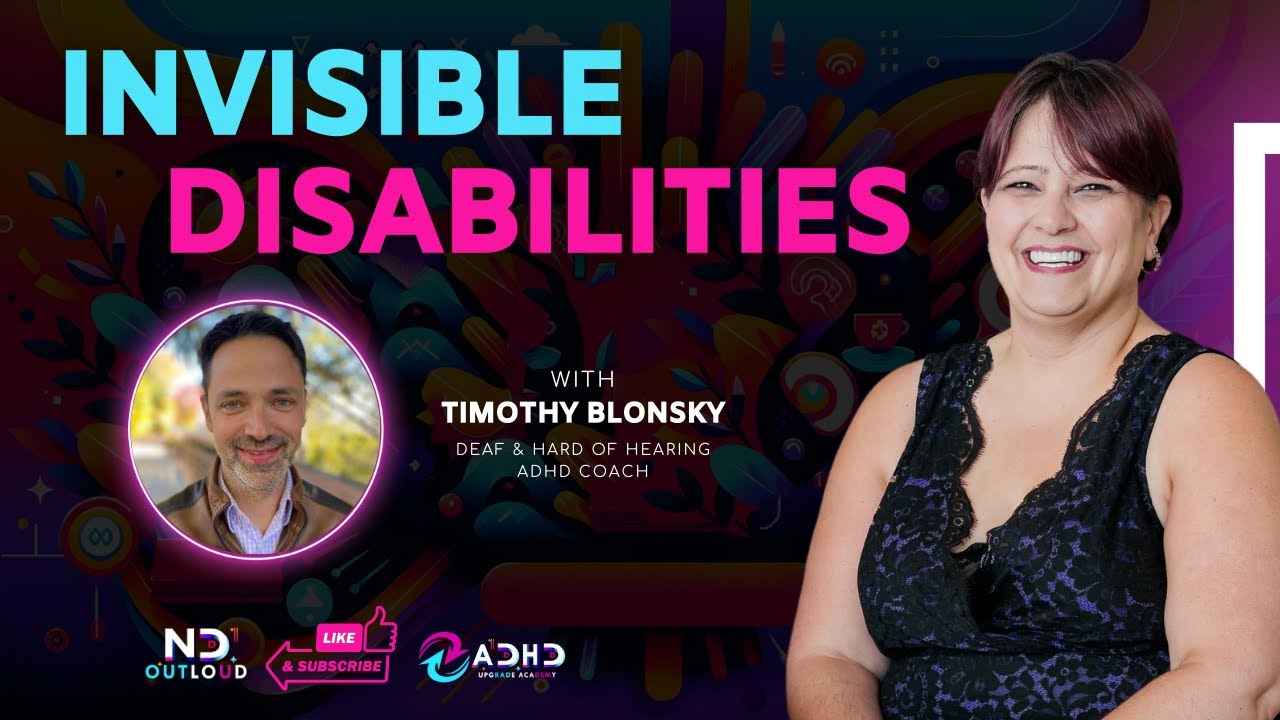
This content was created by Danielle Ralston. This content was uploaded by Danielle Ralston. This is a YouTube video titled "Invisible Disabilities and Their Impact on Workplace Dynamics" (created 2025-01-16). It is a conversational, informational session led by Danielle Ralston (founder and head coach of ND Out Loud) with her colleague Tim. They discuss invisible disabilities (e.g., ADHD, autism, deafness, MS, POTS, sensory processing issues, severe allergies), how these conditions affect people in the workplace, stigma and ADA-related legal risks, practical low‑cost accommodations, manager training, and strategies to build inclusive workplace culture. They reference ND Out Loud’s consulting and training offerings, upcoming Invisible Disabilities Conference in 2026, a May certification program, and data from Jessica Hicks’ initial dataset (reported 74% of employees have invisible disabilities). The tone is educational and promotional, with anecdotes, examples, and a brief demonstration of an AI-generated image.
Chapters
Hello there. I'm Danielle Ralston. I am the founder and head coach here at ND Out Loud. What is ND Out Loud? ND Out Loud is a team of neurodivergent coaches. We are neurodivergent, every single one of us. TBIs, PTSD, ADHD, autism, AudiHD, and so much more. Bipolar disorder, all of the things. We also have a passion for supporting others like us so that you don't have to struggle like we did in our past. We have all taken training. Trainings and certifications and all of that so that we can support you in living a better life and upgrading all of the things that are frustrating about your life. What is this session going to give you? This session is going to give you actionable tips. So yes, we're gonna talk about our programs and all of the things that we offer, but I want you to walk away with something actionable for something that is overwhelming, frustrating, or just plain annoying you right now in your life. Or if you're a parent or a spouse of someone with NeuroDivergent, To help them as well. I want you to walk away with something today. So please sign up today for a free call. We can learn more about each other. Hello, hello, hello. This is Danielle and Tim with ND Out Loud, and we are talking invisible disabilities. What are they? How do they affect people in the workplace? Real life, stigma awareness, all of the things today. And yes, you've heard us talk about this a little bit before, but we really want to dive into this a bit more. And Tim did a cool thing this morning that he is going to share his screen and show off first.
Yeah. So, well, happy New Year. This is our first conversation in 2025. And yeah, crazy. And it's gonna be one of many, many conversations we're gonna be having over the course of the year. I want to acknowledge that Danielle and I and the rest of the team met on Zoom last night. Wow, what a discussion. My head is full. I still haven't fully processed everything that we're going to be doing in 2025. And like, we have it all planned out and ready to go, but I think a lot more is going to happen that we haven't planned because it has really blossomed. It's really exploded. So it's really exciting. So yeah. In regards to this discussion, we're going to be talking about invisible disabilities. We're going to be talking about this a lot in the lead-up to our Invisible Disabilities Conference that we are going to have in 2026. Which, yeah, I mean, that feels far away, but like—
In planning world, it is. Oh my, I am so overwhelmed with what has to happen. And we've hired an amazing company to organize this conference who is an invisible disability expert. They're actually experts in neurodivergence, but they put on some very cool things. So I am deep, deep, deep in planning right now, and I'm very excited.
Very excited. So, so that's the purpose behind it. And the foundation for this discussion is a blog that Danielle wrote just recently. And, you know, we just kind of want to expand upon that. So, so of course, you know, in doing the prep for this, I'm in ChatGPT just, you know, fooling around with some things. And I was actually doing some other things because I wear several different hats in my consulting work. And the first time ever I used ChatGPT to create an image based upon the text from the blog that was posted. And it's incredible. And so there's a lot with that that comes from it. And so I'm sure our guru that does all the images and social media for what we're going to do is probably going to maybe help with superimposing that image. to this when we post it because, you know, it's hard to describe it because I'm not very good at describing visual things. That's always been a thing with me. But there is an acknowledgement to the fact that there are many pioneers that are before our time that forged this path for the idea of making sure that people with disabilities are gainfully employed in the United States and across the world. And, you know, there's a few layers and a few directions that I'm going to go with that in terms of where we are as the United States, and that we're actually in a pretty good place compared to other countries when it comes to helping people with disabilities. ADA was a bill that was passed in 1990 or 1991 under George H.W. Bush. And we're one of the only countries in the world at the time that forged that. And there's a lot of things that happened in the lead-up to that bill being President, now DPN, back in the mid-'80s was a big part of that, where they stormed the Capitol because they wanted to have a deaf president at Gallaudet University. And that was part of, you know, people with disabilities really kind of rising up and fighting for their voice in American politics. So, but that wasn't really that long ago. And we're at a place now where— Because of the shift in workforce in the United States and across the world, now is the time more than ever to acknowledge disabilities and to hire people with disabilities and to create the culture that is necessary to make sure that they are successful in the workplace.
Absolutely. I mean, I couldn't have said it any better. So share your image. I want you to share your screen and share that image if you can bring it up.
Yeah, let me, let me see what I can do.
I can do it if you would like, because it's pretty cool.
Yeah, yeah, you do it.
Okay, I am downloading it so I can share it full screen.
Okay.
And a reminder, this is just a ChatGPT image, but I just, I think it's such a cool representation.
Yep. Yeah, I just love, you know, that there's a representation of deaf individuals there that are the pioneers from before. You have somebody that's deafblind, you have somebody in a wheelchair, and then you have other people that, like, when you look at them, they look normal, you know, like what's normal, that's a whole other discussion, but that's just a wide cross-section of so many individuals that can be viable viable contributor to your personal workforce within your company, but then as a national conversation. So yeah, I absolutely love that.
Yeah, and we will have that image up and we will have an image description of it up as well for those that are— have some sight and mobility issues with that. We will obviously have the full descriptor up for that. So when it comes— what is invisible disabilities? Because I think there's— people don't quite understand what invisible disabilities are.
Yeah. I mean, you know, you could talk about the visible side first. So like if you see someone, I hate to say, but you see someone like myself with my hearing aid, you know, I'm not wearing a hat. You, you automatically, you automatically see that I, I have that. And I, you know, I wear that with pride. So it's not a big deal. And then, you know, but then it could be other people, it could be those in the wheelchair or those, you know, walking with a cane or, you know, like visible, you know, and—
Yeah.
That comes forward.
And we understand what those are, but invisible disabilities could be somebody with MS who maybe isn't using a mobility aid today, but yesterday they were in a wheelchair. And there's a misconception of what that means. Most people with things like MS and POTS and Ehlers-Danlos and things like that, some days are feeling more frustrating and need mobility aids, need other aids. to help them through the day, and other days they don't. That actually falls into the invisible disability. ADHD, autism, diabetes, anxiety, depression, dyslexia, or other visual, spatial, auditory processing disorders, sensory processing disorder. Because sensory processing disorder could affect somebody with the lights in the room or with a smell in the room, or I mean, there's a million different things.
Mm-hmm.
And somebody with severe food allergies is also invisible disability because working in an office where somebody ate a peanut butter sandwich, even 2,000 feet away in an office building, could be deadly to somebody with some food allergies. So there's a lot of things that you just don't know what somebody's dealing with day to day that are considered invisible disabilities and are supportable by the ADA.
Yeah. And, you know, I want to acknowledge that there are certain people in different demographics in our society that, like, have the mindset that acknowledging disability is a weakness or is, you know, just, you know, something that we spend too much time on. And, you know, brushing it aside is not going to make them disappear. Like, these are very much very real things that happen to people that are currently employed with your company that perhaps could be better at their jobs when they're in a place in which they are now seen and heard with what they struggle with every day that is not seen or heard. And then when it comes to creating that culture, because, you know, going back to statistics that I bring up over and over again in many of our conversations, is that we are in a worker shortage in the United States. Whether we like it or not, it is a fact. It's verified by innumerable number of statistics. We are in a worker shortage. And on top of that, we talked about this in our previous conversation. 40% of individuals over the age of 60 retire on December 31st, 2024. So that's 40% that's gone from the workforce. We know that 1.4 million baby boomers are going to retire every year between now and 2030. And then that's the end of that generational cohort and their participation in the American workforce. And then we're seeing on a worldwide scale, China is on the downturn. A lot of Chinese manufacturing is coming back to the United States. So manufacturing is expanding. So we're in an expanding economy that is facing a worker shortage. Immigration, you know, that's a minefield that I want to— I don't really want to get that much into, but that's going to change the makeup of our workforce in 2025 as well. And we are at a place now where companies really have no choice to be in a place in which they need to start creating that culture that is necessary to hire people with disabilities and also to help those that are already in your workforce that perhaps could be more productive. And perhaps that means you could carve job roles because now you have a current employee that's more productive because you've created that culture.
Yeah, exactly. So there's so much going on here, and there's so much that's changing when it comes to all of this. Companies would have historically ostracized, made it hard for someone with an invisible— purposefully hard for someone with an invisible disability or a physical disability, visible disability, to work in a company. And companies have got to change. They have those— they have zero choice right now.
Yeah, right, they do. And so like I would say, like one of the first steps that companies need to do, and 2025 is really a good way to maybe say, okay, you know, new year, here's some new things that we're going to be looking at going forward. And creating a way for your employees to be comfortable in disclosing disabilities is a good first step.
Step number 2 is, again, get out of the mindset that if you let somebody have an accommodation, you have to let everybody have an accommodation. Accommodations are for everyone. They aren't just for your people with invisible disabilities or visible disabilities. And 90% of the accommodations— and for those that are watching, listening on the podcast, I'm putting that in quotation marks— a lot of the accommodations are be a kind human and don't be For the lack of a better word, don't be a dick as a manager. And I'm talking at direct manager level, not CEO level, because it very rarely even reaches that level where there's an issue until there's a major problem and we have to bring the ADA in to sue you. That it's simple as let somebody use their PTO without guilt.
Yeah, yeah, exactly. No, I mean, we've both done this in the past. Like, for example, my first, like, real office job in which I was in a place in which I had a bunch of different cubicles and a bunch of different coworkers that were in the same space, and we all had to collaborate, you know, quite a bit. And I simply asked for them to change my desk orientation so that when someone comes up to me, they can— I could see them and start having that conversation with them about work matters. And Because as a deaf individual, coming up behind me and tapping me on the shoulder when I don't know you're there would scare the daylights out of me. So just something as simple as that was a worker accommodation that was given to me to help me be more successful in my job. So like, it's so simple.
And like I said, it's as simple as allowing somebody to use PTO that's already theirs without feeling guilty for using a PTO to go to a doctor's appointment or blocking their PTO. I hear this so much. I just dealt with this yesterday. I have a client who has chronic illness is also neurodivergent and needed to have a bunch of testing done and had to take a whole day off work for this. And her boss, her direct manager, was making her life miserable, blocked her PTO. Because if they allowed her to do it, they'd have to allow everybody to do it. PTO is part of their payment and, and, and their benefits. Hello? Yeah, yeah, you should be letting them use their PTO.
You know, one thing that employers probably should be wary of is the fact that ADA is— there's a lot— there's more awareness surrounding ADA more than ever, I think. And we know that 57.4% of ADA workplace discrimination cases involve individuals with disabilities. So individuals with disabilities know that they can reach out to their local ADA coordinator and start the process of actually suing the employer. For not acknowledging an acceptable accommodation that, like I said, it can be free or it could be very low cost.
Yeah. And it's always surprising to me where we have to bring the ADA in. I had a client not that long ago, we had to bring the ADA in, neurodivergent client, because they were taking notes during meetings and the boss didn't like that. And it ended up having to go to the ADA because the manager wanted to fire them because they took too many notes.
Yeah. I'm going to assume that that supervisor was probably someone older.
No.
Wow. Surprising.
They were actually in their early 30s.
Wow.
Yep. And this manager just— I mean, honestly, this manager lost their job. The company got sued. This person actually got a new job, someone else, and won a settlement from their old job because the manager wouldn't let them take notes. I mean, these things are not— almost everything that we see as coaches and that we see in consulting and stuff are very don't be a dick human things. I mean, a lot, a lot of them are. And ADA, 57.4% of workplace discrimination Issues are for people with invisible disabilities.
Yep. Yep.
That's insane to me.
So we at NDLA, we're in a place in which we're really trying to raise awareness on this topic and be in a place in which we as an independent entity can come in to you, the employer, and look at everything from a very neutral perspective and come up with a plan that you could develop That, you know, it involves training for managers to equip leaders to recognize and support diverse needs, create a career accommodation process. So promote empathy and professionalism. I mean, empathy, like, why do we even need to promote that? But like, you know, like, we do. The place in which, you know, like education is a part of this. So, you know, you have a lot of companies that are in sort of a kind of an old mindset. So we just want to come in with a new fresh perspective in that. Unfortunately, sometimes that involves emphasizing something as simple as empathy, but we do it in a data-driven way. And then when it comes to education, just increasing awareness of individual disabilities and reducing that stigma.
Well, in building that awareness that people might not even— and I've run into this a few times with consulting— is people aren't even aware that they could possibly have a neurodivergent employee on the team. People aren't disclosing because they are scared of the stigma. They're scared of the backlash and all of that. So something as simple as having an open-door policy with sharing that without judgment, the— without, again, coming back to the empathy, but people aren't even aware that they should be aware, which blows my mind. But that's partially because I'm in this world and I live with ADHD and autism every single day. But, but the other part of that is is there's no excuse to not be aware. And, and that's what we're trying to change, is give everybody that awareness, give clear accommodation processes, encourage disclosure, also encourage easier processes for accommodations. Because some companies do have processes for this, but they are incredibly difficult. And if you've got somebody especially neurodivergent or, or dyslexic, Whatever, those processes can become very difficult and a roadblock to them to, to make them a better employee. And something that I, I've done a lot of research and a lot of talking about is micromanagement of your employees. If you have neurodivergent, well, okay, if you have any humans on your team and you're micromanaging, you have an issue and it's you, the manager, not your employees. Managers aren't generally trained. They put people who, who do good at a job in a management position without giving them the leadership training and things that they really need to manage a team. And, and some of that's not their fault. It's the company's fault. And when you're micromanaging any employees, invisible disabilities, neurodivergence, neurotypical people, you're actually decreasing the overall productivity and value of your employees by doing that.
Yeah, yeah, absolutely. So, you know, well, there's a lot of value in creating an inclusive culture. And so, like, viewing individuals with disabilities as a part of human diversity. So, like, diversity is a beautiful thing. And, you know, like, it's looked at as, like, you know, it's only one thing, it can only be one thing. But, like, diversity is a really, really beautiful thing. And so you have diversity of perspectives. You know, there are so many examples, um, and with a lot of employers where it was the person with the disability that was on the team that had the idea that created the culture, that product that they are now selling and making a profit off of. We know that there are a lot of numbers and statistics out there that prove that when you hire people with disabilities, it really increases your bottom line. as an employer. So like, there's a lot of beauty in human diversity. Connection between inclusivity and innovation, problem solving, and workforce potential— huge.
It's really huge. And when you— if you look at history, all of history, Industrial Revolution, well, even further back than that, 90% of innovation Has been created by neurodivergent individuals.
Yep. Yeah.
People who are dyslexic, people who are ADHD, autistic. Einstein was autistic. And I can say that with actual data because I am married to his great-great-great nephew. I don't remember how many greats we've got in there, but I'm actually married to somebody in the line of, and, and every single person is autistic. Okay. There's, there's scientific proof for these things. Um, uh, JFK, they're pretty sure JFK was ADHD, and he had some amazing innovative ways and thoughts of how government should run, and he really had some amazing things that he did. FDR had a lot of amazing creative ways to support our economy and all of that. He was ADHD. You look at some of the most transitional, transformational things that have gone on in our country and other countries all through history, and you're looking at individuals with creativity, neurodivergence, dyslexic— dyslexia is a really big one.
Yeah. Yeah. Huge. And then like, let's talk about deaf people because I'm deaf. So this is something that really like touched me when I, when I heard the story. So taking, taking it back to September, me, the president of the Idaho Association Association for the Deaf, I hosted this story night at the world's only deaf art museum in Boise, Idaho. So it was outdoors on the lawn. We had a bunch of deaf storytellers that I met, and it was one of the most inspirational nights of my life. And one of the storytellers was actually a hearing interpreter who just retired, whose parents were deaf. And she's in her— I want to say she's in her late 70s, early 80s. And her parents were World War II individuals. So they weren't in World War II because they were deaf, but they worked in a community in Illinois where there was a big pocket of deaf individuals that were hired by the factory to create, you know, just different, different types of things that were needed for the war. And so they had hundreds and hundreds of deaf individuals that worked in the factory and they were incredibly productive and what blossomed into this Huge deaf community that's still in that town to this day. So to me, that the message that I got from that was: so here we have a world war happening. So much of the qualified workforce was overseas in the war. So what did they have to do? They just had to hire these people that were deaf because they nobody else that they could hire, and then they ended up finding out that they were the most productive worker that they ever had.
Mm-hmm.
And so that's kind of like where we're seeing history repeat itself, which it always does. And the fact that we're now in a place in which there's a worker shortage because of other circumstances, and as a result, you now need to start hiring people with disabilities, and you're going to find the benefit immediately when you do that, or creating that culture within your current company to do that. So, you know, kind of one of the first steps in that is you need to Acknowledge and reflect on your current policies and see what it is that you could change. And then the great news about this is there's a wonderful team with NDLA with several different experts with different areas of expertise that can come in to really help you with that from a neutral, data-driven perspective.
And our data is exactly what we really focus on in our new studies with the software that Jessica Hicks said that's on our team is ready for launch and we're ready to put that out there. But the data that's come into that is in her initial dataset, 74% of employees in your workforce have invisible disabilities. 74%!
Yeah, yeah, absolutely. And I'm not surprised by that. So you need to be in a place in which you can invite questions, experiences, and strategies to foster inclusivity in your workforce. And it's You know, that sounds like a heavy lift, but it really isn't. And, you know, we can come in and just a few meetings online or in person, and within that you'll have a policy and a plan ready to go. And then we can help you with implementing it as well.
Absolutely. So if you have questions, if you as a manager, even if your company is not looking to do something, if you as a manager, as a leader, want to learn how to do something, we actually do one-on-one consultations and are willing to consult and help you be a better manager. We have our And yes, it's in Disney World, but there is a reason because of leadership and science behind how Disney works, where we're going to be professionally certifying managers and therapists and teachers and all of that in May. We have so many ways that we can come in and step in and help you as an individual or you as a company just support your workforce better and hire better talent. I mean, we're getting to a point, as Tim said at the beginning of this episode, that talent— you're going to have to look for talent differently than you have in the past. So we are here to help with every aspect of it. And again, we're not basing this off of what we think it is just because we happen to be neurodivergent. We're basing it off of real data, science, and all of that. We are not pulling things out of thin air. I promise. If you have any questions, please reach out, message Tim or I at any time.
More from Danielle

Why Disney is what you need as an ND human #Neurodivergent #disneyadults #disneyscience #disneyworld



Follow along if you want to watch me finally finish what I started… #adhdcommunity #bodydoubling

The last 3 months I … wait no … all of us here at The Hive have been rebuilding from the ashes… we

The last 3 months I … wait no … all of us here at The Hive have been rebuilding from the ashes… we



What if the silence didn’t stop you because you never lived life alone? Katie Karayianis

What does getting ready for a road trip look like for you with adhd? #adhdcoach #ndhive
