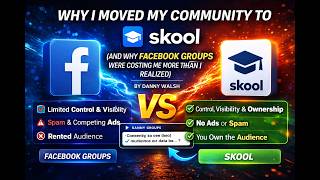
Danny Walsh moved his community from Facebook to Skool because Facebook Groups are rented containers where the algorithm controls reach and the platform owns your data. Skool costs $99/month but gives you member emails, a chronological feed, built-in courses, and gamification. He recommends it for paid communities and coaching programs, not free audiences.
Chapters
Why I moved my community to school and why Facebook groups were costing me more than I realized. I ran communities on Facebook for years, and for a long time I told myself it was working. People were joining, posts were going up, comments were coming in. On paper, it looked like a community. In practice, it was a content recycling bin with a group cover photo. Let me tell you what Facebook groups actually are before I tell you what school is. Facebook groups, what you're actually dealing with. A Facebook group is a free container that Facebook lets you borrow. You do not own the audience. You do not own the data. You do not control what your members see, how often they see it, or what else Facebook puts in front of them the moment they open the app. Your post goes live. Facebook decides whether to show it to 4% of your members or 40% based on criteria that change without notice and favor paid advertisers. You have zero input into that decision. The feed is a rented billboard on a road where Facebook owns all the other billboards. Then there is the spam. Facebook groups attract scrapers, bots, low-quality accounts, and people who have no intention of engaging with your content. They join to drop links. They join to sell to your audience. Moderating a group of 3,000+ people without help is a part-time job, and even with help, the stuff still gets through. Then there is the algorithm problem. A new member joins your group. They are enthusiastic. They scroll back through 6 months of posts trying to get up to speed, and Facebook shows them a random selection in no particular order with no structure and no way for the member to know what matters and what does not. You have spent 2 years building a body of knowledge inside that group. Your members cannot find it. Facebook has not filed it anywhere useful. And if Facebook decides tomorrow that your group violates a policy, or if the platform changes its rules around monetized communities, or if organic reach drops another 60%, your community does not move with you. It stays there. You leave. That is the deal you signed when you accepted the free container. What Skool does differently? Skool is a paid platform. That matters because the incentive structure is completely different. Skool earns when your community earns. The platform is built around the idea that community owners should have control, visibility, and a product they can be proud to send paying members into. Here is what that looks like in practice. The classroom. Every Skool community has a built-in course area. You can build structured modules, post video lessons, add PDFs, and organize your content the way you want it to be consumed. When a new member joins, they know exactly where to start. There is no archaeological dig through 2 years of feed posts. This is not a bolt-on feature. It is designed to sit alongside the community, so discussion and education are in the same place. The community feed, school's feed, is chronological by default. Posts appear in order. There is no engagement manipulation algorithm deciding that a post from 3 weeks ago should outrank something posted an hour ago because it had more reactions. Members can find what they are looking for. That sounds basic on Facebook. It is not. Gamification that actually works. Skool uses a points and leaderboard system that rewards members for contributing. The more they post, comment, and engage, the higher they rank. You can gate access to certain content or course modules behind a specific level which means your most engaged members get more and your passive members have a reason to participate. And this creates a culture of participation. Facebook creates a culture of scrolling. Member profiles that mean something. On Facebook, member profiles link back to their personal Facebook pages. You get a name and a profile photo. Skool gives you member profiles that live inside your community with bios, activity history, and a record of what they have contributed. You can actually see who your most active people are. No advertising. School does not run ads inside your community. Your members are not being targeted with competitor offers or distraction content while they are engaging with your material. Facebook serves ads inside your group to your members for products that are often in direct competition with what you sell. You own the relationship. School gives you member email addresses. You can export your list. You can message your community directly. You are building an audience you can contact, not a Facebook group that Facebook can restrict, flag, or dissolve at any point. The honest cons: Skool is not for everyone, and I will not pretend otherwise. It costs money. At the time of writing, Skool charges $99 per month to host a community. If you are running a free community with no monetization plan attached, that is a cost with no immediate return Facebook is free, and if budget is genuinely tight, free matters. Who Skool is built for? Skool makes economic sense when you are running a paid community or a community attached to a paid offer. The $99 monthly fee disappears when you have 10 members paying $30 each. At that point, you are running a community on a platform that is fit for purpose in a container you control with tools that reward engagement. If you are serious about building a membership, a coaching program, or an educational community that people pay to be part of, school is the most direct path from where you are to where you want to be. If you are building a free community as a top-of-funnel audience with no monetization structure attached, revisit the economics before you move. The bottom line: Facebook groups are a free product used by a company that makes its money from advertising. Your community, your content, and your members' attention are inputs to that advertising product. Skool is a paid product used by community owners who make their money from their communities. Your success is what Skool sells. That difference shows up everywhere. In the features, in the feed, in the member experience, and in who controls the relationship. I have built both. One is a place to start, the other is a place to build. Danny Walsh is the founder of The Affiliate Experience and Vantage by Walsh. He has built and operated online communities for over 25 years.