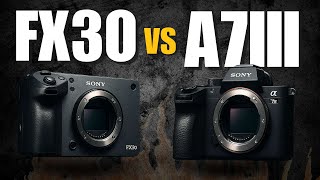
In this single‑host video, Darren compares Sony’s full‑frame A7 III with the Super 35‑sensor FX30 to determine whether the newer, cheaper FX30 can serve as the sole camera for modern content creators. He conducts side‑by‑side tests using the same lens, aperture, and settings, evaluating sensor size, rolling‑shutter artifacts, autofocus performance, low‑light capability, and color science. The FX30 wins on rolling shutter, color science (thanks to S‑Log3, S‑Cinetone, and 10‑bit recording), and offers unlimited 13‑hour recording, dual SD slots, and a compact form factor, making it ideal for batch video production and business‑focused content. The A7 III retains advantages in low‑light video and still‑photo quality, serving as a hybrid tool for thumbnails, portraits, and weddings. Darren argues that roughly 95 % of creators could meet their needs with the FX30 alone, while recommending the A7 III as a secondary or B‑camera for photo work. He ties the technical discussion to a broader business perspective, emphasizing that the camera is merely a tool for generating leads and revenue, and promotes his coaching services and a free “Video Content System” checklist.
Chapters
One camera sparked a revolution, but the other might just replace it. Let's not play. The Sony A7 III built the modern content creator on YouTube. It was the camera that every single creative wedding photographer, wedding videographer, YouTuber, all of the above, trusted to to get the job done right. But now we've got the Sony FX30. It's smaller, cheaper, includes 4K, 120 frames per second. There's no recording limit. And somehow it looks like it walked right out of a Netflix set. And now the real question everyone's asking now is, the Sony FX30 the only camera you need nowadays for content creation? And today we're going to be testing just that. We're not just going to go into the specs, we're going to put side-by-side comparisons to give you the best idea of which camera you actually need. Let's get into it. Let's start with the sensor size. Now the Sony A7 III is a full-frame sensor. The FX30 is crop Super 35 sensor. Now I know what you're thinking, more depth, more light, Yeah, I know, but hear me out. I shot these same two scenes with the exact same lens, the exact same aperture and settings that I could possibly get it to, and here is what it looks like. The FX30 looks honestly incredible. Now let's test rolling shutter here. As you can see, the A7 III definitely has some wobble. The FX30, a lot nicer to look at. Autofocus, I honestly think it might be a tie on this one. They're both fantastic. Sometimes the FX30 performs a little bit better, but in low light situations, the A7III wins. The FX30 color science, the FX30 wins on that one. The fact that it has S-Log3 that is actually good in 10-bit and an S-Cinetone profile creates opportunities to color grade very quickly, especially when we're batch creating content. This is a huge deal. For my specific situation, I don't just create videos. I create videos with intention and with a system in place to capture leads for businesses, because ultimately that's what actually matters, is making money, providing, and paying bills with this stuff. I personally believe it is the strongest way to market yourself, to create a personal brand, and the quickest way to make that happen. And I've helped multiple people scale and build their businesses and their channels, all using both of these cameras. And not one single time have I ever had a client ask me what camera I'm using or how much did it cost. The FX30 has served me well with the basically unlimited recording time of 13 hours. There's dual recording slots with your SD cards. And with the FX30, I have filmed 5-figure video projects with just this camera. I can't say the same thing with A7 I, I don't think it's there yet, but whenever I need to take photos, you better believe I'm picking up the A7 III. And so this is what I use for all my thumbnails or portraits. Any weddings that we do, we use an A7 III. Now you can use it on the FX30, but it's not designed for photos. So if you take photos, don't expect fantastic quality stuff. If you're in a pinch, in a bind, and you don't even have an iPhone on you, you can do it. There's a photo mode, but it's primarily good at video. So is the FX30 all you need to create content for your business? Yeah, I truly believe about 95% of you watching this video right now would not need anything more than an FX30 based purely on the fact that you get S-Cinetone profiles and it shoots 10-bit color. It's basically a no-brainer. But the OG A7III, don't sleep on it. Like, this is a phenomenal camera that I used for the first 2 years of my video production business. Since it's a hybrid camera, I can use it for photo and video, and it does excellent at both. There have been a few times where I've noticed that the old color science on these things tend to make faces and skin color a little bit on the green side. Nothing a little bit of editing can't fix, but it's just annoying to have. Now, if you already have an A7III, don't ditch it. Keep it as an extra B cam or even an A cam and bring on an FX30. As your second camera. It's still a beast and don't sleep on it. I'm not telling you to get rid of it. For our podcast studio here in downtown Abilene, we use the A7III as a middle camera and we use two FX30s for our side cameras. And so with that being said, nobody's ever complained about quality. It is still fantastic, even with the micro HDMI port. Okay, my final thoughts. You're saying, Darren, why do I care if my footage looks like Netflix quality? Well, You shouldn't really, if you're a business owner, entrepreneur, a creator. I know multiple creators who do very well and have amassed a lot of following with nothing but an iPhone. You don't need it to look like Netflix. You don't have to know how to edit everything on your own. There's people to outsource this stuff to, but it's important in my opinion to have at least one go-to camera that you can pick up and record stuff on that's easy to use, very reliable. and it's not your iPhone. So let me know in the comments below, which camera do you prefer? Have you used these cameras? And always remember, it's not about the camera itself, it's about the content that you create with the camera. This is just a tool to get it out there. Now I get it, once you get the camera, you're like, okay, what do I create now, Darren? Well, that's where we specialize in. There's gonna be a link in the description if you want assistance. We do coaching and consulting if that's anything that you need. We got you. And this isn't just like some random thing we threw together. These last 4 years that I've been in business, we've been able to help hundreds of clients do this exact same thing, creating extraordinary media for extraordinary people. I'm going to leave a link to the Video Content System checklist in the description below, completely for free. And it's exactly the strategies that we teach our clients, and it's free for you today. Thanks again for watching, and we'll see you guys in the next one. Peace.