Ask Me Anything! With Dave Gerhardt, CMO of Privy and Ex-Drift
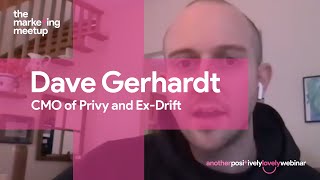
Dave Gerhardt, CMO of Privy and former VP of Marketing at Drift, answers questions about his marketing philosophy, leadership during COVID-19, and how to build a brand. He shares insights on copywriting, managing teams, and what he learned scaling a marketing organization.
Hello everyone and welcome to the fourth ever Marketing Meter webinar. Today we've got the absolute pleasure of spending some time with Dave Gertrude, DG to his friends, the CMO of Privy, and always in a hoodie. Very importantly, Dave for me, represents one of the most exciting practitioners in the marketing industry today. He's not just an academic who thinks a lot about marketing. He's there in the trenches doing it every day, which is sincerely impressive. Dave spent his time working in several of Boston's most well known companies, including Constant Contact, HubSpot. But for me at least, Dave came into view during his time at Drift. During these times, when everyone asked me who was the best marketing team in the world, generally speaking, I would respond with drift. And that's I've learned a lot from them. Since December 2019, Dave's been CMO of Privy, a company focusing on helping E commerce brands increase their growth through conversion and email marketing tools. And he's a busy dude because in his spare time he's also a guest lecturer at Harvard Business School and maintains his Patreon following the A list, which you can be part of too. There's two things I've really come to admire about Dave. The first is that he's a dedicated family man, and if you follow him on Instagram, you get to see that. But perhaps the thing that's most impressive is his willingness to share with the community. At this point, he could probably just sneeze on LinkedIn and get a thousand likes. But I know that I've personally gained a lot from Dave's work, so I'm grateful for him. Before we get going, I just want to say thank you to the sponsors of the marketing meetup, all of whom have been unbelievable in supporting this group even during these tough times. I won't go into depth here because there's a link in the email I've sent before and afterwards. But if there's a group of people I want to just thank, I want to say thank you to Pitch Content Cal Fiver, Redgate Cambridge, Martin College, Lido Brand Further, Third Light, Bravo and Human if there's one thing I could do to ask of everyone that attends this webinar afterwards, it would be just to drop them a message afterwards. Just to say thank you for their contributions to our community. Because without them we wouldn't be able to carry on doing what we're doing. The last thing to say is today is a Q and A, which means that you can use the Q and A feature, which is down below. I've got a whole bunch of questions written down old school style on the sheet of paper. But if you guys want to ask any questions, then now is the time. There is also an upvote functionality there, so you can also, if you see a question you like, if you give it a thumbs up, then we'll ask those ones first. So all that said, I want to say welcome, dg and thank you so much for taking the time.
Thanks for having me, Joe. I appreciate all the nice things that you said about me. It's the best part about having an introduction is you just get to sit there and listen. I appreciate that. I love marketing and it's what I love talking about and doing. So I'm happy to be able to be here and hang out and do it.
I'm grateful for you taking the time. I know you're a busy man, so I think it's wicked that you've even said yes in the first place. You're one of the first people I tried to get in touch with when this webinar program started. So the fact you said yes was not only amazing, but a great confidence boost to sort of get in touch with an awful lot of other people too. So that was awesome. So I just want to ask the first question, which very simply is, how are you? How are you doing? How are you adjusting to this new life?
Yeah, I mean, we're doing good. Everybody in my family is healthy and we're safe. And so from that perspective, we're good. It's tough to really say anything else other than that right now. I think, you know, we're lucky to be in, you know, to have jobs, to have a safe place to live and go and to just be in a position where like, my job is in, is in marketing. Like, I'm the furthest thing from the front lines. And so I think, you know, we're in a. We're in a lucky position and I think we've just made the shift to work from home, which luckily enough for us is it's normal for our industry. I have lots of friends that can't work from home and so I just, I think we're just feeling lucky, to be honest.
Sure. And have you like, I mean, you sort of alluded to it there, that we are pretty used to working from home. But have you learned anything during this time that you probably didn't expect or whatever?
Yeah, that my team is really good at what they do and I should get the hell out of their way and shut up because, uh, I mean, we've been putting up some amazing numbers and the marketing team at Purview has just been crank and it's the perfect mix. Um, I would say I'm not in the weeds. I'm not. I'm not like, writing emails, I'm not writing headlines. But I basically think my job is almost like chief editor. Like, I'm the editor of all of our marketing. And that's. That means, like, I want to know what the headline of the. Of that article is, I want to know what the subject line of the email is, but I'm not writing it. And like, so I've been very involved in that type of stuff. Kind of more. More so, like the overall strategy, like, what are we gonna do? And that, you know, most of the creative stuff. But the team is executing on everything day to day. And they're saying, like, no, crazy man, we don't need to do that. Cause we already got these three other things that we're doing that you suggested last week. And so, like, for me, it's just a really good fit for what I think personally I can bring to the table, which is like, energy and enthusiasm and creative ideas and matched up with a team who, like, wants to go out and execute and can push back. And it's really been so much fun to be able to do that again.
Nice. Are you 100% that boss that walks into the office or onto Slack in the morning and says, I've had an idea?
Yeah. I mean, most of the time, to be honest with you, most of the time it happens before I've walked into the office. And like, you know, the joke is that, like, I'll get to my desk and when we would actually go in the office, I get to my desk and I've already been talking to the team for an hour this morning. Or, you know, I've already sent five emails with ideas and, you know, that's. That's like the job that I signed up for. And I set that expectation with the team. Up front, though, it's like, just because I might be sending you 5 emails at 9 o' clock at night doesn't mean that I expect you to answer. But I don't want to have to, like, hold back when I'm sharing something with you because it just kind of ruins the process. Like, oh, I had to get this idea. I'll send it tomorrow. Like, I think people are grown up enough to be able to handle that. And I just set that expectation up front that, like, hey, just because I'm always sharing this stuff, doesn't mean, A, that you have to respond in real time and B, it doesn't mean that you have to actually do it. I want you to be able to, like, comb through the list of things and say, that's not important right now. Oh, shoot. That is actually a really good idea. We should stop and change what we're doing right now.
I guess that goes a little bit back to. Down to that trust element that you sort of spoke about at the beginning there. And maybe, I guess you might have more, even more trust at this point, having had this experience. Perhaps.
Yeah, I do. Honestly, I'm just like having to learn to just shut up more and like, like, why can't I. Why can't I remember that the team is super smart and I don't need to do all this? And like, that's been my daily reminder to just get out of the way and shut up for sure.
No, that's fair. That's fair. So many of you, the marketing meetup audience, are based in the uk and one of the terms that you use a lot is playbook. Now I'm pretty sure that probably originates from American football, but you probably just call it football over there. But like, could you explain the concept of your. What a playbook is and how you approach it and how you tend to apply your playbooks in the marketing fair?
Yeah, I think it's just a name, right? I think it's probably, probably a comparison would be like, you could also call it a recipe.
Yeah.
You know, you could all call it a formula. I think it's, it's. Any of that things you're asking about, like my playbook specifically.
Yeah, yeah, for sure. I'd love to know what's in it.
Well, I think so. I can tell you. I can never tell you what's in mine, but I think that to me, the best marketers actually have many playbooks and can go and like adapt that playbook to the new company or new product that they're at. And so, like, there's definitely things that I think were in my playbook right from my past company Drift. But just because I have a new job doesn't mean I can take everything that worked there and apply it into privy and it's gonna work. And I'm saying this because I see a lot of marketers doing this, like just blindly copying a playbook that either your old company or somebody's company has and assuming it's gonna work. So number one is like, I think it's almost like being an athlete. The Best athletes are versatile, right? Like they can do but be successful in a bunch of different sports. And I think the same is true in marketing. As far as my playbook goes, I think like, it always kind of starts with putting storytelling at the center of what we're trying to do as a company. And so that means like sharing who, who you are. Like, who, who are you? The actual people inside of the company that are going to be doing marketing. Like, how can you get your face out there and introduce yourself to that community so people can know like, and trust you? And then with that usually comes like a heavy content component. So like blog, video, podcast, social. My, my bias has always been to like build some type of content thing around the brand so you can start to build an audience before you actually have something to, to sell. And so like, I just believe so the power of like creating content and telling that story. So like when we went to Privy, the first thing that we did there was start a podcast. Not because we thought we'd be able to grow a huge podcast, but because like, I think that a podcast is basically like a Trojan horse for like capturing all the content you need from your brand. And that's a lesson that I learned at Drift working with David Cancel. Like, we started by doing a podcast together where I just interviewed him, like what was going on in the business at a time when we had no content. And that was a way to just get a ton of content out. And that's really the approach that I've taken anywhere. And I would take that anywhere that I go. Let's say that I go start an E commerce brand tomorrow. First thing I'm going to do is like make a video about why me? Why did I start this brand? What are we doing, what are we learning as you're going? And so like everything that I've done has kind of had that, I guess, formula in there somewhere.
Nice. That's awesome. You've actually sort of jumped out to my next question, which was what's been added, what's been taken away and what stay consistent across the jobs. And particular the consistency is what I'm really interested in because like you've gone from like one really high profile job where you've been super central to the growth of Drift over the course of time, you know, and the part of an amazing team as well. But now you've sort of got the eyes on you as well. So I mean like, is there some immutable laws of marketing which just like you carry close to your heart and use to inform the tactics. So, for example, you spoke about podcasting, which is probably a tactic within content marketing, which then falls into marketing as a general thing. So at a very fundamental level, what are those sort of marketing fundamentals that you've bought into? Privy.
This is good. Okay, So I think one of them for me is copywriting. Like, copywriting is everything to me as a marketer. And I actually think it's not just a marketing skill. Like, if you can write great copy, you can, you know, cold email somebody first for sales, you could write that passive aggressive email to your landlord to get 50% of your rent back, right? You could write that, write that message to your kid's school. Like, I think copywriting is like the ability to communicate clearly and sell through words. And so if you can't do that as a marketer, um, nothing else matters. And also, I think I love copywriting because copywriting is rooted in like the most important principles of marketing, which is human psychology, understanding, like what makes people tick, how to persuade someone. You know, understanding about emotions and wants and desires. And so like, if you can't write great copy, everything else is going to be hard. You could be the smartest product marketing tech, technical product marketing person in the world, but if you can't write great copy, no one's going to be able to clearly understand what, what you're doing. And so for me, it's always gotta be like, great, great website copy, great email copy. Like, you know, something that hooks you right away in all of your content. And with that copywriting comes, like really sweating headlines. Like it's 2020. Like, you have to accept the fact that everyone is just headline reading, right? Think about what's happening with Coronavirus right now. Like, nobody's actually reading the fucking New York Times 5000 word articles. They're just, we're all, we're all like, I do it too. We're all on Twitter scanning headlines, right? And so you have to, you have to know that, you have to know that as a marketer, like, okay, how are you going to use that to your advantage then? And it's not just using it to your advantage, but how are you going to, how are you going to cut through the noise, right? If somebody else has a thousand different headlines going on, what's going to be the thing that you, that you do to cut through the noise? And so in addition to copywriting, which is part of that, the other thing for me has always been trying to be like, what is that? What is that thing that's going to get people something that I, that I stole from. Gary Vee, who I think is incredible at this, is he calls it underpriced attention. And what that means is like, where are the opportunities for you as a brand where you can compete? And so when I went to Privy, like, you have to look at the landscape of what other people are doing in the market. And so we saw a bunch of other companies, they had good email lists, they had good blogs, but nobody in our space, at least from a competitive standpoint, really had a podcast. And so we said, hey, we want to own E Commerce marketing as a brand. Let's go start the E Commerce marketing show and have that be our hook. And I think that there's underpriced attention for starting that show. And the response has been amazing so far. And so like that to me is like, you have to be able to like see the playing field and see what the opportunities are. Like. Just because everybody in your industry has a blog doesn't mean that you should go start one. And like you have to in the early days look for the opportunities where you can have a unique advantage to go out and win. And for us I thought that's like, oh, there's a huge opportunity to build a podcast here. And I think this is going to be something that anchors everything else for us. So I'm trying to give you more because there's a lot. Copywriting is one, finding under priced attention is another. I think just like being authentic in all of your marketing is another thing for me that's really important because I think you have to understand the environment that you're marketing in, which is it's 2020, nobody wants to be sold to, nobody wants to deal marketing, nobody wants to click on ads. And so like the way you can cut through that is by being authentic, right? It's like when you go to a restaurant and you ask a waiter like, what's good here? And they say to you, everything's good. You're like, bullshit, that's not true, right? Like, we want it. Like, I want the waiter who's gonna be like, what are you in the mood for? Oh, just trust me. Like, I know pizza is pretty regular, but you gotta have the pizza here. It's ridiculous. Like that's what we want. We want real authentic experiences. And so I think like, even if you're selling enterprise from selling like hoodies online all the way to enter software, I think you have to find a way to like weave authenticity and tell that real story inside of your marketing. Those are probably like the core principles that I think then you can figure out. Like, okay, because of that, what does that mean from a strategy standpoint?
That's awesome. I love that. And, you know, so your background, your first job was actually in. Was it in press or something to.
Yeah, it was in. It was in prison. Okay, so did you internship.
So did you learn the ropes there or was it through reading as well that you sort of picked up on your copywriting and your best copywriting tips?
I don't know. I think, like, looking back, looking back, I've always. I've always been. Been good at writing. Not writing at, like, a perfect grammar, you know, English degree level, but, like, I've always been able to clearly articulate what I like. I've always been that person that my mom or my now wife or my friend has been like, can you write that email? Like, you know, what would you write to my dad? And I think that I just never realized that that was a business. That was a business skill. And now I'm like, you idiot. That's everything. And so I think, like, what. What happened for me is I had that PR internship, and I wasn't really interested in business. After graduating college, I just. I wasn't really interested in. I don't know, I just needed to find a job. And it was at that PR internship. It was the only place that would pay me at the time was $10 an hour. I realized that, oh, my God, I was good at this because of my writing. Like, I was, you know, getting reporters. Like, I was hooking them and pitching them and getting. And so, like, what. What changed for me is I saw this skill that I didn't think was that important, which is just, oh, it's just writing. I'm now using it to, like, be successful in my job and get promoted and make more money. And I was like, oh, wait, there might be something here. And then I kind of turned the. Into a marketing job, and it just became something that, you know, I naturally took a liking to it and kind of got, like, addicted to. And while I was at constant contact, I just always wanted to, like, I always wanted to start my own blog or have my own, you know, newsletter. Because once I got into marketing, I started to see all these people that, like, oh, they're marketers, but they also have, like, their own blog. How cool is that? Like, I'd always just like, I always want to have my own radio show or a blog or whatever. And that. That led me ultimately to starting this podcast that I did In Boston called Tech in Boston, where I'd go and interview local entrepreneurs. And that was the thing that really changed for me, like, because that taught me how to do marketing. Like that was I was like a 25 year old kid working at a 1500 person company. I wasn't really like touching anything important, but because I started my own thing. Like I had to build the website, I had to figure out how to do podcasting. I had the cold outreach to like famous in Boston CEOs and get, get me to show up at their office and let me interview them. Like I had to sell sponsorships, I had to build a mailchimp email list. Like that was when everything changed for me. And like that's when I learned marketing. Then I got to match that up with like being at a place like HubSpot and like learning from Mike Volpe and people there, turning that into my job at Drift. And like the only secret from Drift was I, I did the marketing. Like I wrote every word in the beginning and then scaled as we went. And so like I learned by doing. And now I'm at a point where I got to take a new job at Privy. And like every day I get so excited because I'm realizing subconsciously all these things that I've learned from that journey that I'm now applying. And it's just like the only way to really learn is by doing and I don't want to stop that. And so I'm always like tinkering. It's why I have, it's why I have this side thing called the A list, which is my group on Patreon, because like think I'm learning things through that group that I'm gonna get to take back and use that Privy that are gonna make us better as a company. And I just don't ever want to lose that. And like, I think there's an important thing in there which is like the way if you really want to learn, start something on the side. Especially today it's so easy. You could start a TikTok channel, a YouTube channel. You know, let's say you're a marketer, you're not crazy like me and you just don't want to talk about marketing. Like my thing is marketing, right? Let's say you're a marketer, but you love baking. What if you, why don't you go start a YouTube channel and learn how to do YouTube SEO and grow that channel? I'd rather hire that person all day over the person who has some like perfect looking degree on paper. And that's really because, like, that's the story that I lived. I think it's made me well rounded. I'm not, I'm not super great at any one thing in marketing, but I know enough about each area to like, be able to go and find the right people to work with to get.
It done for sure. And, you know, that's something that we spoke with Margaret Molloy two weeks ago, and she's the global CMO of Siegel and Gale, like a massive agency up in New York, you know, and she's done exactly the same thing. You know, like, she's gone back to roots. She started a new campaign called Wearing Irish and she said exactly the same thing that, you know, it gives her the opportunity to kind of engage with the lessons, which she wouldn't necessarily be able to anyway. I'm curious and I'll start taking some community questions in a moment, but you sort of touched on it in the second there, which was about your experience on Drift and now how you've gone to Privy. Are you kind of able to see into your marketing future? To a certain extent. I mean, obviously there's going to be, like, elements which are going to be changing. I mean, coronavirus for one, is like, obviously a huge thing. But hopefully when we get back to business as usual, are you able to sort of say, well, we're probably going to be taking those challenges at this point and if so, like, what are those challenges that you foresee when you scale in the business?
Yeah, I don't know. I honestly think this is such a unique time in history that for anybody to give you, like a prediction is just complete guess. I think right now we're taking it day by day, week by week. Everything is changing that quickly. I do think, though, like, you know, you're in an industry that's going to be impacted for a while. Right. Like, I don't think. I don't think that it's realistic to assume that inside of six months at least, we're going to be able to do large gatherings. Right. And so, like, I think that means events are out the window and events are such a huge part of business. Like, you know, we at Privy, we, we were just getting ready to announce our first annual event and, you know, to show you that I love events. Right. Like, so, so it's a bummer to miss out on that channel. But I think, you know, the challenge to marketing is going to be like, how can you try to recreate those experiences online and do it in a world where everybody else is going to be trying to do this, the same thing. So, like, how are you going to be able to stand out? That's kind of one theme is like, what are you going to do to replace events? I think the other theme that's going to bubble up is just empathy, right? And I think empathy is always the most important topic in marketing because if you can't understand who you're trying to sell to and communicate with, like, you're not going to be very good at that. But I think, you know, in a world where everyone is going to know somebody that was like impacted by coronavirus, how do you have a message that that's going to be effective, but also not come across as pushy, as insensitive, as tone deaf. And so, like, you know, you still have a job to do. You still have to go and try to build a business and sell stuff like, please keep your foot on the gas there. But how do you do it in a way that's going, you know, match what, what people really are ready to do in their life? And I think that's just a unique problem that each brand is going to have to figure out on their own for sure.
I can certainly sort of speak to that myself, that even if we had a quote unquote, perfect match on, you know, someone who would be a perfect marketing meetup attendee back in the day. One of my main challenges right now is that even if they were right on every demographic, on every previous behavior, they're probably going to be reacting to things quite differently at the moment. You know, they're going to be in different head spaces. So it's a real challenge and something I'm very mindful of but don't have the answers to in terms of how can we make sure that our communication is and copywriting is on point for as many people as possible who fit our demographic, you know, and that's a challenge and I don't know, I don't think it's the one that anyone has necessarily solved.
I still think though, like, this is something I've been thinking about a lot the last week or so. I think that this is like, this is the new, this is reality now. This is the new world that we live in. And so like my initial take was when, when the coronavirus stuff really peaked in the States. Here we kind of hit pause on marketing for a couple days just to like, not promote stuff for a couple days to see what, what shake. What kind of shook out of that. But now it's become Obviously, like this is, this is not, this is gonna be, we're dealing with this 6 months, 12 months, 18 months, 2 years. So my concern is from a marketing and business perspective is that like you, you can't be afraid. You still have to take risks and so you still have to like, you can't be afraid. You can't let that fear of, you know, saying the wrong thing at the wrong time limit you from trying to come up with that next crazy creative idea. It doesn't mean like, there's never a good time to be tone deaf, but I think like, you still have to find ways to be creative, especially now more than ever to go and like earn people's attention.
Definitely. I'm so with you. You know, it's right, it's, you know, it starts with empathy and it starts with good intentions. And I guess, you know, after that point, you know, you start pushing those, those barriers and trying to help folks in so many different ways. Right. So I'm going to take some questions from the audience here. One thing I'd say is that there's a Q and A down below for those of you who haven't found it so far. And also to use the thumbs up mechanism because then we'll just start listing from the top the ones, the questions that we want answering. So there's a question from my mate Baz here which says there's a trend around articles and blogs focusing on the new normal when lockdowns are finally over. What do you think the new normal for marketers will look like? If it will even exist? And potentially you might not be able to answer this because you've always said predictions will be very hard. So.
I don't know, I think we just touched on that like the new normal is going to look like. I mean, I'm feeling thankful to be in E commerce right now. I think the new normal is going to be much more spend is going to happen online. I think it's so tough to answer because every industry is different right now. Some industries are scaling up budgets right now. Some people are cutting back and doing layoffs. So I don't know, not to cop out an answer, but I don't know what the new normal is. I'd be lying if I had an answer.
I think you'd be also on a lot of money, maybe even more than now. So Alice Collie says, what do you think a CMO or marketing director's biggest challenge is right now?
Probably team, if you're, I'm assuming you're asking at like the CMO level or somebody who's running a marketing team. I think just, like, overall, how are the people on your team doing? Because I think, you know, there's a lot going on and you're not there to, like, actually see everybody in person. So team is probably number one on the marketing tactics side. I think it's just like, how do you keep. How do you keep the urgency on from a. From a sales perspective? You know, in a world where, like, you can't really push right now.
Nice. So I'll be interested. This is a question that I took from our mutual friend Richard Wood from Six and Flow. So I've been doing a podcast.
Has this question been vetted already?
I mean, I've taken the swear words out, if that counts. So he says, what's your biggest weakness as a marketer, and how have you mitigated that with your current team?
That's a great question. My biggest weakness as a marketer is probably I'm really good at starting things. And then there's usually one or two things that I fall in love with. You know, I'll be the first one to be like, oh, let's go look at the conversion rate of that, like, one campaign. But then, like, I have no interest in actually, like, doing that and going into Salesforce and running the reports. And, you know, I'm not going to be the analytical, like, slice and Dice chopper of campaigns and like, oh, if we put this here, we're going to double the conversion rate and we can move this around, then we're going to move this budget over here, like. And so the way that I've supplemented that is hired somebody amazing to own that and trust them to be great at it. And it's really been amazing. It's really been amazing to have his name is Ryan, and to be able to have somebody who's great at that and do it because it just gives me selfishly the freedom to double down on my superpower, which is the brand and the creative and copy, and I don't have to think about where I'm gonna spend my time. And I think my experience probably five years ago would be threatened by that. Like, oh, I need to know more than that person if I'm gonna manage them. I need to be smarter. I need to know all the things, things inside and out. And the answer. I did an interview last year with Heather Zinzak. It was for Drift, and she's good friends with the CMO of LinkedIn. And somehow we were talking about career paths as a cmo and I asked her because I read a book about the CMO of LinkedIn where she talks about how she came from a PR background and I was like, whoa, that's super interesting to see like a big name CMO who came from pr. And in that interview I talked to Heather about it and she said, look, you can be a CMO from any background, you just have to have that core discipline and be able to then like hire around the areas and build a team around. And so she said like in that area where she is, her background is PR@ LinkedIn, then she's got to like, she's obviously going to spend like more time there because that's what she's naturally good at and she could focus just to hire someone very good, better than her, who knows the demand gen, who knows the funnel, right? And so like for me that was priority number one in joining this company is like, alright, thing that I want to do right away. I know my first hire, I want it to be somebody who is super analytical, you know, the yin to my yang and can run that part of the team and we can have a great relationship. And that's been an amazing learning for me this time. And I think that just comes with knowing what is your weakness and how are you going to plug that gap for sure.
So you had a really strong relationship with David cancel and you know, I'm sure probably still do. Was he as a mentor, was he similar to you in the sense that he was a very creative chap or was he the Yingti Yang in terms of being very data driven and that kind of stuff?
He's super creative. I mean the most fun that I had in my career was just like riffing him. And I would always just be riffing back and forth on, on ideas, whether that's a headline or a hook or a video or a podcast idea. I think a lot of people don't know how creative he is with that type of stuff. And that was really cool for me because like I thought before, oh, somebody just writes a headline and it's done. And like what he taught me was like he would just be just, he wanted me to reach out to him when I was stuck on something. And so then we just kind of riff on something and I can't tell you how many, how many good ideas or headlines or intro or phrases came from like a back and forth text at like, you know, nine o' clock on a Tuesday night. And so I got a lot of like, I learned a lot about creativity from, from him and how to go. And I also learned from him, like how to go be inspired and get and get ideas. Like, I wasn't. I never thought of myself as that creative before, but I realized that that is my strength now because I learned from him, like how to go do that. And that's like studying, you know, studying other, you know, related topics and seeing how they do it. Hey, how does somebody else do it in this under other industry? Like, wow, did you know Porsche is like amazing at copywriting and advertising? Like, if we're gonna sell something high end, like go and study the lessons from Porsche. And so like I learned that that framework to help me be creative and that that's been a huge thing for me.
So that's awesome. That's really interesting. And like the relationship between the two of you, like in many ways I sort of saw you and the other day, you know, it's like the faces of the company. And of course that couldn't have been very easy, like first and foremost, like leaving Drift in the first place. But I wondered if there's any sort of lessons that you have for companies who are building brands around specific faces and specific people. Because no doubt that, you know, even in my introduction I mentioned Drift and you're not there anymore, you know, but you've still taken this personal brand and, you know, applying it to Privy. Will you do the same again in putting yourself first and foremost, or are you quite likely to sort of take a step back and make the brand sort of speak a little bit more?
Yeah, I think here it's different for different stages of the company. And so like joining Privy, they were already around 10 million in revenue. They had 60, 65 people at the company, 400,000 like merchants using that. And so like the challenge wasn't necessarily to come in and like find people who are interested in buying. It was more like elevate the brand. And so what I'm doing in this role is trying to make Ben, who's the CEO, like he should be the, he should be the face, he should be the spokesperson. But I'm gonna like, you know, marketing is my thing and I can go into E commerce and talk about marketing. So I'm gonna host the E Commerce marketing show. But I'm not the expert, I'm interviewing experts and like playing dumb. Like, hey, I don't know anything about E commerce. Teach me. And so I think we're kind of using a little bit of like a hybrid approach this time. I do think though that to me this is like, I Can't think of a reason why you wouldn't want to do this, because ultimately, people buy from people, and we're all looking for that. Like, we're all looking for that person who we can see and interact with and, like, actually communicate with as a person, not as a brand. And I think, like, for a lot of, especially in the B2B space or any brand, really, most products that you're selling are commodities today. And so the way to win customers is to build relationships with people. And, And I think you're just going to. You're able to stack the deck if you can do that for your company. So, like, I can't think of reason why I would not want to be the face of. Of anything. I just think it just, like, depends on what your expertise is. So, like, if I. If I went to a cybersecurity company, I. My whole shtick is not going to work in that industry. And so, like, I can't be the face of cybersecurity, but I would shift my focus to then be like, oh, how do I make this CEO? Like, why did she start this company? Like, what's her story? Like, okay, I'm going to make her the face of this. And I'd launch a podcast for her and write a book for her. And I think that that playbook, recipe, formula, whatever you want to call it, is something that I would apply to any company. So it's not. It's not about me and putting myself as the face of it. It's about who are the experts in your company and how can you make them the face of it versus just your logo, for sure.
And although I would sort of add to that that one of the things that's been quite interesting to see you do since December is that you've been posting on LinkedIn quite a bit about how you use the podcast as an opportunity to learn and learn from the best. So as much as you're sort of saying that you place your experts for first and foremost, there's also something in the. In the process that's quite captivating to kind of watch from the outside in. You know, someone getting better at something, learning something new. That's pretty cool. So I like that as a tactic. I think it's good. We've got a question here from Marie Helene who says, and it's a very big question, which is, do you pay more attention to your gut feelings or to stats numbers?
I don't think you can pick one. I think it's a blend of both. You know, it's like, which one of your kids do you love the most? Like, you got. You gotta be able to. You gotta be able to use them both. I think gut is usually the thing that gets me the most excited. And then I go and look at something, like, I got a crazy idea, let me go call up Ryan and see if he can actually go like, you know, give me some, give me some gut check on this. Like, hey, what if we did this in this segment? Would this be interesting? That actually doesn't make any sense. Okay, cool. Like, you got to be able to use them both together. But there's definitely times where it depends on what the thing is, where your gut might tell you to do it. Like, when we were going to do our event, the ROI math that we could come up with for, like, how much revenue would be able to generate from that was terrible.
Yeah.
The gut feeling is like, oh, we're not doing this event to generate revenue. We're doing it to generate content and brand. And so my gut feeling is that even though this is going to be a big expense, it's going to be worth it. And it's not going to be something that people are going to be able to articulate why it was worth it until after we do it. And then everyone's going to go, ah, no one's looking for the ROI analysis. So in situations like that, then I use gut. But usually it's like a combination of gut and data.
And how do you handle that conversation? Because, you know, there's MDs and CEOs around the world who, you know, they're putting a lot of faith into you. Right. You know, to sort of say, you know, you'll be able to see afterwards, you'll be able to attribute afterwards.
Yeah, I think you have to have upfront conversation. Like, I think a lot of, you know, you have to. To me, it's like, what's the goal of doing an event first? Because I think people have missed. People don't have the right expectations. And so if you're doing an event and then you got to go and your CFO thinks it's a sales event, and then you got to show at the end of two months later how there's no revenue from that, then your CFO is going to be like, what? But if you can go in and you can say, hey, look, here's the deal. We want to spend this. We want to spend this much budget and we want to achieve this, here's what we think we're going to get from it. We think it's going to be a great opportunity to make our best customers love us more. We think we can get three months of content worth it out of it. We think we can. Great, great new photos for our website. And so I think, yeah, it's going to be a loss for us, but here's why we think it's an investment. Can't you see how that's going to be a different conversation with the CFO up front versus like, well, we're doing an event and it lost money. I think you have to like have that expectation up front. And I always try to like, pitch, pitch. Like it's almost like I have to come up with a brief for the CFO or CEO or whoever about why we're doing something. I think a lot of marketers make the mistake of like assuming that everybody else knows why they know why. No, your job has to, you have to market internally. Also. I have to market to the CEO every day. I have to market to the CFO every day and explain why. And once you can effectively do that a year from now, two years from now, whenever, then you don't have to have those conversations anymore for sure.
I think that's entirely reasonable. It works out really well. So there's a question here which was sent ahead by Sarah. She says, for marketing generalists currently out of work who want to spend some time upskilling, what areas would you suggest that they focus on and why?
I think that's got to be personal to you, right? Like what I would try to find is sit down and write out, like, what, what are your true strengths? Is it video production, copywriting, you know, spreadsheets, analytical marketing, demand gen content. And I would use this as an opportunity to get great at something that you're good at, not go learn a new skill. But like, let's say you're pretty good at your okay, copywriter. What if you can use the next three months to become a great copywriter? Because I think that that's where the leverage is, is like, if you're a good copywriter, don't go become like an expert in, in you know, retargeting and spend, you know, six weeks learning courses about, about ads. Like, become a great copywriter to the point where like you are an in demand copywriter that people want. So that's number one from which skill to focus on. I would do that analysis for yourself. Then number two is then I would go try to find a way to apply that skill. And so like, let's say if it's copywriting. Can you go start a newsletter right now? Even if seven people subscribe and it's all of your aunts and uncles, that's fine. The goal is, like, for you to write every day, every week and like, just build up that muscle. Start a podcast that nobody's going to listen to and that's fine. Start a vlog that no one's listening to and that's fine. But like, I just hate the excuse that like, well, I don't have anywhere to go do that. Like, if you want to become a better copywriter, like, open up a Google Doc and write 500 words a day and you don't have to show it to anybody. But if you do that for three months, think about how much better a copywriter you're gonna be.
Sweet. Okay, there's a whole bunch of questions and we're gonna get close to time. So this can be considered quite a quick fire round, Dave, that might appeal to the Bostonian in you as well.
Okay.
So we're getting a ton of questions here on books, blogs, courses, podcasts, influencers. So I'm just going to put that to you first. Books. Top three books, if you had a gun to your head.
22 immutable laws of marketing, number one. Ogilvy on advertising, number two. And behind the Cloud, the story about Salesforce number three. Those will give you your most well rounded marketing MBA and three books.
Amazing blogs, if any.
I don't read any blogs. Privy.com blog that I read.
Nice podcasts. I think I know Joe Rogan's one.
Joe Rogan is like my, my wife Lee and I like. It's what we listen to whenever, you know, we just need to just unplug and hang out. Let me actually, let me, let me pull, let me pull up my podcast right now. I've actually been listening. This is really weird. Usually I don't do this. I've actually been listening to the E commerce marketing show, our podcast at Privy, because I'm really trying to soak in as much about E commerce as I can. And so, like, it's one thing to just interview you, it's another thing to like, then I have to go listen back to. And so I've been spending a lot. The other show that I just started listening to is. It's called My First Million by Sam Parr from the Hustle. I'm interested in. I like learning about businesses that are not traditional kind of SaaS. Businesses like, I'm interested in, like, oh, this person built $10 million email newsletter business. And that's where you get that from.
Nice. My right hand man, James, has been trying to get me onto that forever. So I might be the push that I need.
Too many. There's too many.
There is. I mean, if a marketer hasn't said, I'm starting a podcast in the last year. Are you even a marketer? That's what I want to know. So you mentioned Gary Vee. Influencers.
Influencers and what? Influencers in marketing.
Yeah, yeah, let's go for marketing. Most of the audience is marketing based.
Yeah, Gary. I mean, I think Gary's amazing. And I think a lot of people, I think a lot of people don't like him because of his personality and his bravado. But if you can cut through that, the reason why I listen to what he says is because he is a guy who through his agency, VaynerMedia, is working with the best brands in the world right now. They had the four most popular super bowl commercials that they created and produced. And so, like, if you're telling me you're too good to listen to that person, then I have no patience for that. And so, like, I think that if you can deal with the personality and get, and get through that and actually listen to lessons, I think there's a lot in there. Obviously, I love Seth Godin as a more classic. You know, you need, you need the balance of those two. I think you need one on each shoulder.
Could you imagine them in the room together? That'd be an interesting.
No, I can't. I actually, I actually though, I learned the most about marketing from people who are not named influencers, like people who've grown. A newsletter. YouTube is an amazing, amazing way to do this. And like, you know, my wife, she watches like, there's a bunch of like, either food blogs or there's one like, that's more of like makeup and hair products. And these people have 2 million subscribers on YouTube. And I'm more fascinated about, like, how did she figure that? How did she crack that audience? And like, what techniques do they use? Wow, that's such a good idea. They invited five people to this private villa and they did this thing. Like, I learned so much more from that than like, oh, I studied, you know Jane Smith, the marketing guru from.
P and G. Yeah, absolutely. Okay, so we're still quick fire here. What's the next big thing you want technology to enable you to do as a marketer? And that's from Jeff.
Man. What's it to? Just manage my whole budget.
Nice. Yeah, that'd Be quite nice. That would be nice.
Okay, like, there's bud, there's the budget software, but I just want to, like, just input it, just track it. Every. Track it all, spit it out.
That would be really nice. I'm rubbish at that part. I'm rubbish, too. So. Question from Oliver. What's your opinion on humor in emails? For example, GIFs, funny headings, emojis, that kind of stuff?
Yeah, humor. Humor is great. The problem with humor is that, like, you just don't always know if it's funny. Like, it might be funny to you. And so maybe that could be your. That the issue. That could be the issue. But I think to me, the rule for writing is, like, if you'd use it in real life, use it in business. And so, like, you know, think about how ridiculous that question would be. Like, hey, Joe, what do you. What. What do you. What would you think if I sent you a funny email? Be like, great. So I think, like, I think you have to. You have to. You have to use it and let the responses be the judge. I think more personality in email is always way better.
Awesome question from O here, which says about copyright and I've now lost it. Basically, he was looking for the hints and tips or even just thought process behind writing the first line of your copy. And then I've seen that previously you've always argued that the job of the first line is to get people to read the second and so on and so forth. But what's the tip for that first line?
The first line for me is often not even like a line. It's usually like a word. And I start a lot of things. Like, let's say Joe and I are going to host an event next week, and I got to send out an email that's going to invite people to. That most people would be like, join me next Thursday, April 29, for a exclusive webinar invite with Joe Glover. Right? Where, like, the way that I would start that email is, okay, return. So I was thinking that recently I haven't had anyone on who's really great at talking about events. So I thought, who do I know in my network that's great at events? Oh, my friend Joe. Joe's run hundreds of meetups over the last two years. And so I called. I'm going to call him up on Zoom and he's going to join me next week. That's how I'd write that email. Like, and just by saying, like, okay, that was a thing that cut through the clutter of that email and Got me started. And so like it's always like the first line for me is usually some type of story or hook or like, so, okay, hey, like really quick ways to just hop right into a conversation.
Nice. And that goes back to your, the point about natural language as well. You know, just sort of writing as you speak, which is so important. And particularly going back to your key tenant of authenticity. Also something that sort of feels more authentic if you're speaking as you write. There's conversation question here from Remy. I'm going to summarize it because it's long, but this question says you literally wrote the book on conversational marketing. Besides writing the book, where in practice do you get started?
Besides reading the book? Yeah, besides where you get started.
I mean I can say to Remy.
Yeah, I think, I think the place to get started is to think about, is to do an audit of your website and think about like what's a place that is, what's a place that'd be really easy to replace that or test that new functionality today. So like let's say you have, let's say you're a marketing consultant and you have a client server, you have a client business and you have a button that says like, you know, contact us or request a quote that's already like a high intent page where somebody's going to give you their information. Like that's where I would think about starting and testing my first like bot would be with something like that. So think of really easy things that already exist where you could see a clear lift. The biggest mistake people make is that they try to, you know, oh, I wish I had a bot on my pricing page that like could do these 15 things. And you ask them, they're like, well, what does that today? And they're like, nothing. It's like, okay, cool, like we can get there. But I want to start first in a place that's really comfortable, nice, sweet.
So you spoke about empathy and the focus on customers. Obviously that's something that's really important to you. But on a day to day basis, I think a lot of marketers get stuck in the tactics. How do you keep yourself and the team focused on your customers? And that's from Jeff?
Yes. So, so a couple things is number one thing that we did is we actually had everybody on the team set up a Shopify business and like go install Privy and create an actual e commerce site to go through and do that. That, that can, that can be done all the time. The other one is I think we use a We use a product called Gong G O N G. And it's, it's basically like call recording for all sales calls and customer success calls. But you can like, you know, hop to certain points and calls and I don't. Udi, who's a CMO from Gong, would kill me if I described GONG as that. But it's amazing. And so like what it's meant is like I don't have to bother the sales team and say like hey, let me know when I can come on a call. Because like also nobody wants to have the CMO on a call with them. And so, so I can just go into GONG and listen to calls a lot, which makes it really easy. And I think we just have like a natural curiosity in E commerce and like how our customers are using our product. And so we have this every Friday. We have show and tell inside of the company and people are always sharing customer stories or examples. There's a channel in Slack with examples. I think just part of the DNA of the company. Honestly at the end of the day.
Nice. Sweet. Last two, I promise. And these are fun ones. The first one is, it's from Steve actually he answered 50 minutes ago. So he's been waiting patiently on the Q and A which is does music support your creativity and if so, what are you listening to?
Does music support my creativity? It does. It's usually just like music usually just boosts the mood that I'm already in. I don't need to go listen to music to get creative. I usually for me it's like if I just go for a quick walk or work out, I can get something quickly. Let me, let me, let me give you an honest answer of like very last thing. The very last thing. The very last song that I listened to was the Beatles Come Together which was only because I was playing it during my kids bath last night.
That's awesome. That's really so, you know, we speak about the DG A list but you know we've got the DG playlist which I think could.
Oh, I like that. Maybe I could. Maybe I'll monetize that.
Put it in the Patreon. Put it in the Patreon. Last one. I know you're a sneaker head, so. Best sneakers of all time.
Oh my God, my sneakers don't even remember who I am. I saw a meme that was all my shoes ever remember who I am. And I have this closet of good sneakers that I haven't wore. My favorite best of all time. Like it's tough to I can't say best of all time and not own it, because that's like a fraud. The best is. No, you got to own it. So my favorite all time is a Jordan one. I think it just goes with everything. I think even if you're like. You're like, I'm not sure do I might go look funny. And Jordan's like, Jordan 1 is the perfect start for everybody.
Nice. And on that note. And on that note, we can say, and O has gone mental on the chat box with all the emojis.
So on that note, it's the right answer.
100%. 100%. So, DG, you know, thanks so much for taking the time for speaking with us. There are some questions which have remained unanswered, so I encourage people to find you on Twitter.
Yeah, do that. I'm around this afternoon, so just tweet. Tweet your questions and I'll try to go and answer them.
Legend, thank you so much, and, you know, I appreciate your time. I know you're a busy man, so I'm grateful for it and good to see you well and good to hear the family well and all that sort of stuff. So.
You too, Joe. Thanks for. Thanks for thinking of me, and I'm glad that you're figuring out a new strategy for this new world, and I'll keep watching what you do.
So thanks very much, ma', am, and thank you to everyone that took the time to attend tonight as well. The recording will be available on the Marketing Meet website. It will also be available on the Marketing Meter podcast. Please do thank the sponsors, all of whom have been incredible in supporting us throughout the course of all this, and, you know, for the rest of the time, thank you all and stay safe, and I'll see you soon. Cheers. Take care, everyone.
And using a little bit of, like, a hybrid approach this time. I do think, though, that to me, this is like, I can't think of a reason why you wouldn't want to do this, because ultimately, people buy from people, and we're all looking for that. Like, we're all looking for that person who we can see and interact with and, like, actually communicate with as a person, not as a brand. And I think, like, for a lot of. Especially in the B2B space or any brand, really, most products that you're selling are commodities today. And so the way to win customers is to build relationships with people. And I think you're just gonna. You're able to stack the deck if you can do that for your company. So, like, I Can't think of reason why I would not want to be the face of anything. I just think it just, like, depends on what your expertise is. So, like, if I went to a cyber security company, my whole shtick is not gonna work in that industry. And so, like, I can't be the face of cybersecurity, but I would shift my focus to then be like, oh, how do I make this CEO? Like, why did she start this company? Like, what's her story? Like, okay, I'm going to make her the face of this. And I'd launch a podcast for her and write a book for her. And I think that playbook recipe formula, whatever you want to call it, is something that I would apply to any company. So it's not about me and putting myself as the face of it. It's about who are the experts in your company and how can you make them the face of it versus just your logo, for sure.
And although I would add to that, one of the things that's been quite interesting to sort of see you do since December is that you've been posting on LinkedIn quite a bit about how you use the podcast as an opportunity to learn and learn from the best. So as much as you're sort of saying that you place your experts for first and foremost, there's also something in the. In the process that's quite captivating to kind of watch from the outside in. You know, someone getting better at something, learning something new. That's pretty cool. So I like that as a tactic. I think it's good. We've got a question here from Marie Helene, who says, and it's a very big question, which is, do you pay more attention to your gut feelings or to stats numbers?
I don't think you can pick one. I think it's a. It's a blend of both. You know, it's like, which one of your kids do you love the most? Like, you got. You got to be able to. You got to be able to use them both. I think gut is usually the thing that gets me the most excited. And then I go and look at something like, I got a crazy idea. Let me go call up Ryan and see if he can actually go, like, you know, give me some. Give me some gut. Check on this. Like, hey, what if we did this in this segment? Would this be interesting? That actually doesn't make any sense. Okay, cool. Like, you got to be able to use them both to. Together. But there's definitely times where it depends on what the thing is, where your gut might tell you to do it. Like, when we were going to do our event, the ROI math that we could come up with for, like, how much revenue would be able to generate from that was terrible. But the gut feeling is like, oh, we're not doing this event to generate revenue, we're doing it to generate content and brand. And so my gut feeling is that even though this is going to be a big expense, it's going to be worth it. And it's not going to be something that people are going to be able to articulate why it was worth it until after we do it. And then everyone's going to go, ah, no one's looking for the ROI analysis. So in situations like that, then I use gut. But usually it's like a combination of gut and data.
And how do you handle that conversation? Because, you know.
More from Dave



Asynchronous work isn’t a trend. It’s how teams actually get things done without burning out.

AI is changing product marketing. Here's how top B2B teams are scaling without cutting corners.

How Product Marketing Is Evolving in 2025: Lessons on AI and Leadership with Jennifer Cannizzaro

Why referral programs look different outside of SaaS (and why that’s a good thing)

The secret to scaling dual GTM? Give every marketer ownership and get out of their way.

From content to CMO: how Jess Cook made the leap (and built her first budget from scratch)

Leading B2B Marketing for the First Time: Strategy, Budget, Content & Team with Jess Cook

Most B2B advice is built for SaaS. But what if you don’t have demos, PLG, or lead goals?
