B2B Growth | Dave Gerhardt, Sangram Vajre, Kevin White | Growth Summit 2021 by Demand Curve
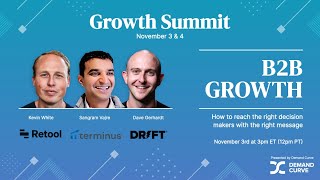
Dave Gerhardt, Sangram Vajre, and Kevin White discuss B2B marketing strategy, team building, and brand growth in a changing digital landscape. They cover personal branding, measuring marketing impact, and why understanding your business context matters more than following trends.
I don't wait to finish. Go on, click that button. I think we got it.
Yeah, I was left talking to myself back there. All right, welcome everyone. We're jumping into another session. This one is all about B2B or business to business for those. And we've got three really cool marketers here who work at three very cool companies. So really excited to dive into it. Forgot to mention last session, if you have any questions, you can always put it in that Q and A tab in the. On the right side where the session chat is and then you can upvote other people's questions and we'll, we'll leave time for that at the end. So I'm Stuart Hillhouse. I'm head of marketing at Demand Curve and I'll be kind of moderating today. Here we go. We've got Dave Gerhardt, who is the chief Brand officer at Drift, which is a conversational marketing platform. And he's also the founder of. He's the author of Founder Brand, which is a book that he's published recently and is also educating thousands of marketers in his DGMG community. Previously he was the CMO at Privy. We've also got Sangram Vajray, who is the co founder of Terminus, an account based marketing platform and the author of Movement. He runs a private community for CMOs and is the host of the popular podcast Flip My Funnel. I also remember when the pandemic was just starting, you were like live every single day on LinkedIn. So you. I'd love to hear how that.
Yeah, nothing else to do at that time. I'm like, how do we connect with people? I was driving, going crazy. So that was the thing.
Love it. And lastly, we've got Kevin White, who's the head of marketing at Retool, which is a platform that makes building apps and internal tools effortless. And previously he was head of growth marketing at Segment and he brought a special guest with him too. So we've got tons of people on stage today.
This is George.
Hey, George.
George is going to jump in here. Why don't we start? So Dave, you're back at Drift after being CMO at Privy for over a year and a half. What are some things that you learned about brand while working at a smaller company? And how are you going to bring those to Drift, which is a much larger company at this point, as the chief Brand officer.
I don't know if I learned any specific lessons about brand. Sorry to spoil the fun. I think the lesson that I learned, whether you're asking for this or not, I think I'm going to share it because it's the most important thing that I learned it just like everybody always says that it's all about the team and it's all about the people. And I always was like, yeah, yeah, that's some hbr. Like you know, hire great people. But like I felt that firsthand at Privy. That was like when I joined Drift, I kind of rose through the company. When I joined Privy, I was like the CMO coming through the outside and I had to build a team on my own from, from zero. And like it was amazing to have had the Drift experience to then build the right team of people. And just like I, I totally get that now, which is like literally your job as the CMO is you're not doing the day to day execution on everything. You're putting the right pieces of the puzzle together. And so we invested it. We like, we made a lot of brand bets but actually the, the biggest bet was just like assembling the right team of people who all believed in the same mission and kind of all had. We had a small team of seven people and everyone had a little bit of a different role. But like, damn if that wasn't the most powerful team of like six or seven people. And just like it re lit my fire that like the job of CMO or marketing leader is maybe you're doing some of the marketing in the beginning, but it's to literally build the best team. You are the coach, you are the GM and, and you have to help. Like you can't actually do the work. And that was one of my biggest crutches for me at Drift four years ago was like, because I grew from manager to marketing leader, I still was doing a lot of the things I think that actually like put the team in a bad spot because I was, I was a bottleneck for things or doing things that maybe I should have. So I just like, I relearned that lesson about how it really is all about the people and that's not. We love to obsess over tools and technology but like if you can't build a great team of people, like that stuff is easy. You can google how to set up Drift or you know, whatever. You got to have the best, best people around you to go out and execute.
Yeah. Sangam, did you feel that way as well because you co founded Terminus and so you've been around for a while. How did that transition? Was what Dave said similar to what your experience was or how did you differ?
Yeah, well, seven years into a startup is like a dinosaur years. Like, you know, who stays for seven years as a startup? And especially founders, they get kicked off pretty quickly. So I'm surprised the board is still keeping me on and having me do, like, write books and things like that. And honestly, in the last three years, I made. After the first three years, I made a conscious decision to long. Like, what Dave said is just like, for me, it was. I couldn't be the evangelist that I'm naturally am of the problem that we want to solve and at the same time actually be figuring out what booth we have and what tablecloth we put and what the banner. We couldn't really do that. Like, it just didn't work well. And so my excitement and everything was into that. So I'm so glad the board was recognized that and said, all right, just go do what you do best. Be in your lane of genius. Like, that's the part that I've been sharing with a lot of folks, the peak and others. Like, go find your lane of genius. There's no reason, like, for example, Dave and I, we could be successful at a certain company, but we could possibly be the worst marketers in a. In a gigantic company because we wouldn't listen to anybody and we would totally step on toes and we would get mad and say directly to something that it's not working, but that doesn't mean somebody else can be successful. So everybody has to find the lane of genius and the team that they can be and become the gladiator in it. But if you don't find your lane of genius and just try to become the marketer in a company just because you like the company, but you can operate in your lane, gosh, man, that is frustrating.
How have you dealt with situations like that? Like, when did you find yourself in those situations? Or how.
I went through like a year of therapy, like, literally a year of therapy to figure out, am I not good enough? Am I not a. Like, I'm a co founder. Like, how did marketing, sales, customer success, product, all of that, that reported into me, except finance, everything reported into me because we started that the way I'm a marketer, selling to marketers. What is it that I can do? Like, it was a such a big, like, thing. So it took me a year of therapy to realize that, oh, it's not that I'm not good at it. It's really the, the, the bottom line of this is that I had to learn the lesson of letting go versus giving up. I felt for the longest Time that I was giving up. And with that there was baggage. The failure part of it that I couldn't. I'm like, and I'm not better enough. Like, what's wrong with me? What's wrong with them? All that stuff versus, like, I'm letting go of all of this shit. Like, I don't love this stuff. I'm not excited about it. I can add value to it, but it's not something that I wake up thinking. I get to do these things that I love. I love talking to customers. I love building communities. I love writing books, I love creating frameworks. Let me go do that every day of the week. So now 80%, 90% of my job is what I love, which is very hard to find for everybody out there. But if you can find some Elaine, where 80% of your job is something you love, I think that's a gold mine.
Yeah, I mean, to add to that, not to make this a session on like mental health, but, but marketing, I mean, I mean, marketing and growth especially is a lot based around uncertainty and trying to do experiments and try and grow a company without like this very clear path of like, we're going to grow this much in forecast, you know, you know, 3x year over year, and it's going to be perfect. Like, you face a lot of challenges and uncertainty and I feel like that is something like giving up that control and just kind of like succumbing to that is something that is like, really hard to, you know, get over that hurdle. But once you do and like, you trust other teams and your team that they can like, deliver on those things that you can express to your board or execs or whatever that like, you know, we tried this, here's why it didn't work. It goes a really long way in earning trust. So that is something that is like, has been really challenging from taking over a marketing team where you just have this uncertainty. You're like building a team and expressing like, you know, where those challenges are and like, why things happen the way they are. That goes a lot longer than just saying, like, oh, we hit our number and we don't really know why.
Kevin, do you have any. Like, how have you found the best way to present, like a failure, but as like a learned experience? Like, if there, if there's all these things going on and some things aren't working that great, how do you present a situation that didn't go as hoped, but you've learned something more from it?
I think a lot of it is being upfront about the story and what you're doing beforehand where it's like okay, here's our hypothesis. We're going to invest in this channel, we're going to invest in this type of content and then just providing regular updates week over week and getting that kind of buy in up front where it's like okay, you know, I secured this buy in, we, I secured this buy in with our board, I secured this buy in with our CEO that we're going to do this thing and then we're reporting on it week over week and like maybe the conversions didn't, didn't pan out to like what our assumptions were or maybe the growth didn't, didn't pan out but like you were along it for the like you executive team and you board or along it for. With us on the ride and therefore like there's no surprises. I think, I think surprising the board or surprising CEOs where it's like oh we're like I'm going to hit our number. I'm going to, I'm going to hit the number and then all of a sudden like the last, you know, week before you present to the board or you present like your, your we're going to miss forecast by 30% or whatever. Like that's where you get in a lot of trouble. So it's like getting ahead of the situation is, goes a long way.
Yeah. All three of you are in, in the SaaS world if you describe it that way. How has, how has like B2B marketing changed now that like some companies are still half remote, some are hybrid. It's people aren't always at the same like working from the same IP address or at the same mailing address. So account based marketing becomes different. I'd love to hear kind of how each of you if at all like maybe, maybe I'm totally making assumptions how the marketing kind of situation you have has changed now that every, every company's kind of restructured and is all over the place.
I think it's better. I think you have, I think people are doing less of the like dog and pony show to get a B2B an enterprise B2B meeting and you have to actually win on story and value and ability to solve somebody's problem. It used to be like whole teams would literally spend the whole year going to three trade shows a quarter and like coming back and just like passing leads over the sales team or, or like I think all the, the in person channels have gone away. But like B2B or B2C we're still selling to people and people are spending the majority of their time especially around purchasing online. They are doing research, they're listening to other people, they're connecting with peers. Like I think that, you know, I think that the drift story like we have been talking about some this like shift to digital and the shift to Digital and Enterprise B2B was already happening and then the two years just like accelerated that. And so companies have had to learn how to you know, hit their pipeline targets without always being at that, that event in Vegas in, in November. And I think that that part has changed. I also think that there's so much noise and competition in every industry that like the best companies today are building, they're building audiences, they're building communities, they are positioning their companies as the expert in a given niche. Like you are. You sell financial services Software, you're an CFO's and you win that way. You're not just fighting over, over, over features and benefits.
Yeah. You know, tactically an example of that. What I think what DG is talking about is something like in the early part webinars. Let's just take that as a tactic. People are still doing webinars. People still have all these things. We found out that we started to do 20 people webinars, if they call that a webinar. And we said we're going to only focus on 20 people, no more than 20 people. We're going to invite CMOs because that's our target audience of a specific industry. We said we're going to have CMO financial services for this and then we only invited financial services CMOs to that, nobody else but them and let them actually have at it and talk about all the things that they have teed up. A few questions. Kid you not after we started do that every month and after a period of time people would like sign up for it. A CMO would sign up for it. And we're like oh sorry, you can't attend it. And the CMOs like are you kidding me? It's a webinar. Of course I can attend it. Because that's what we have got the entire industry to think it's a free thing. And they're like I'm sorry, you can't. It is supposed to be a closed knit event. It's supposed to allow people to talk about this thing without worried about it. We don't want too many people. We thought 20 is a good threshold. Join for the next one. Guess what? That CMO joined 10 minutes early for the Next Thursday's webinar, because he wanted to be part of it. So creating experiences where people feel exclusively about it, but the value is very clear to it and it's niched down, I think is way more powerful than, oh, we're going to do any and everything for any and everybody. That truly doesn't work.
Yeah, I think with things transitioning to just being mostly remote and digital too, it's like it kind of is a forcing function to say like, okay, we're spending all this on webinars or we're spending all this on in person trade shows or whatever. And you know, how much value is it actually driving? Were we able to hit our numbers like doing this type of remote digital work versus, you know, in person meetups and trade shows? Not that those aren't valuable, but you know, maybe there's better ways to do things at scale and just kind of like, you know, skim the fat that your spend. You know, you can spend up to like millions of dollars on trade shows and if you can cut that and have better performance, you know, that, that is a good way to say like, okay, going forward we're only going to do like the best trade shows because we can look back at the data and say like, okay, these, these trade shows or these meetups were, were actually valuable for us. And then, But I, but I do think like the fundamental pieces of marketing haven't changed at all. It's like, you know, who's your target audience? Like, what offer are you putting in front of them? Like, how can you like reach them with that offer to get them to convert? It's like, this is a webinar. There's webinar fatigue. Like, but there's thousands of people on this. And like the, the fundamental is that like demand curve puts out good content, there's good speakers here. People are going to show up like if you come to the table with a shitty product or shitty offer, like no one's going to attend. So that's kind of like the fundamentals are always going to be there.
That, that part is so true and I wish more people understood that, which is people are burnt out on shitty webinars like, and things that you don't want to, to go to where, like if, if somebody has a deep understanding for what's actually interesting. I think that's hard to do that. That is like actually hard to do and that can require budget or time or expertise or you or connections or whatever. But like, I think the, the thing that's true among, with Any industry is like, whatever it is in marketing, it's always about the offer. And the offer doesn't mean, like, 20% discount. The offer means, like, am I really gonna, like, stop what I'm doing? Like, and from three to four, watch this conversation? Well, like, if that was Sangram and, like, Casey Neistat and. And I could be one of only 100 people to, like, get to watch that conversation, then, like, I probably would stop what I'm gonna do from three to four and. And do that. And so I think, like, it's just hard to push to that level. It's easy to be like, we're doing a webinar. 40 people showed up. We're not sure if it was meaningful, but everyone's doing virtual events right now. It's like, you have to constantly be. Be questioning, like, why are we doing this and should we continue to do it? And I think that, like, a lot of teams make the mistake of, like, just because you've always done something one way doesn't mean you have to just continue to do it that way. Who's going to be the person on the team to say, like, question, we've done these webinars four weeks in a row now. Do we know if they're working? And what does working mean? Like, do we have a clear goal for this? Do we have a why behind this? Like, that is the symptom at a lot of marketing and growth organizations that I've. That I've either talked to or been a part of is, like, everyone's just, like, doing stuff sometimes. And. And that. That can be a really slippery slope. Like, it's so important to be so aligned on, like, what are. What are our goals? And I used to hate this as a man. As a. Before I was a manager, I used to hate this. Like, my freaking boss always asking me for, what's the measurable goal for that? Like, but now being that manager, like, I totally understand. You have to. You. You know, the. The EAS burn out. Your team is have everybody working on things that aren't contributing towards the goal. Then everyone's busy, everyone's doing stuff, but you're like, you're always falling short of where you're at. And so I totally see the importance of very clear, measurable goal setting, especially in marketing and growth today.
If there was a way to draw a chart two by two over here, I would. But just imagine in your mind, two by two. This is something I've done with my team. Like, almost every. Every quarter is, like, plot everything in two by two, where the top right quadrant is really the intersection of what is authentically your business and what is must do, right? Like, that's the spectrum that you're looking for. So authentically you. That is something that you as an organization does better than anybody else. Like, Salesforce could say, well, they do better events than any. Any other VP company in the world. Like, they just have figured that part out, and that's how they've done it. You know, you might say, like, in the early days, the seeking wisdom was the. Was the way they did that thing. And quite frankly, nobody else could do it the way they did it, right? Like, we did our Flip my Funnel conferences the way we did it, like industry conferences. So every one of us, every company has a DNA. So what is authentically you. And at the intersection of that one and the other one is the must do. Like, that actually drives business value. That actually can change something. If everything you point. And actually, as a team, you do this exercise and plot all the activities you do, sending newsletter that nobody reads, sending all these things that nobody goes to. Like, man, that will change the equation of what's really, really important. And every time I've done that exercise, you shave off at least 30% of the work. And it's a moment for the team because they're like, oh, I can do less now. And gets fired up. Like, okay, I can focus on the three things, the four things we talked about. So hard to do, but so fun to do.
And those are good examples too, like the specific podcast, specific newsletters and stuff. And you have to, like, do that thing better than anyone else. Like, like you said, like, that podcast can't just be another one. The newsletter can't just be a side thing just as another growth channel. Like, it has to be the commitment to it.
Yeah, to your point, I mean, nobody wants to actually do a podcast, quite frankly. What people want to do is have audience. That's what people want. People don't want to do pod. People want to do podcasts. Oh, somebody else is doing. No, no, no. What you want is audience that will listen. And you don't buy audience. You kind of build audience. People forget that. So there's a lot, lot, a lot there. But I think the intersection of authentically you, what you get to do and what is must do for the business is really where the money is.
I have a question about kind of growing. Growing an audience. Like Sangram and Dave, you both have audiences. And Kevin, I'm not sure if you have any interest in Doing that sometime in the future.
No, I'm the odd man out here. I don't have the podcast thing going. You don't need one time to start.
Yeah, you get George and you're fine.
Yeah.
Kevin and George podcast coming soon.
But a question about like because you both, it takes years to grow an audience. Both of you now have kind of reached the large enough that it is kind of. I don't actually know what your behind the scenes looks like, but you're able to get help with it. And it's not just you day to day writing something on LinkedIn or editing your own videos, right?
No, I have 60, I have 60 VAs that do all my social media for me. Actually I read it on an article on Reddit.
Yeah, Yeah.
I mean believe it or not, I don't know about. I think I would guess that about Dave about you know, he doing. But I write my own LinkedIn stuff. Like I don't have anybody writing anything for me like because it's not, I don't think we're measuring it of number of views and impressions and likes. It's like day in the life, go and do it, move on and sharing and learning along the way.
Right on. Yeah, no, I'm kind of coming at it from a different angle of like, okay, now you probably are managing employees who are interested in having their own audiences. What kind of advice do you give to them in managing both like doing a really good job at work plus trying to do side audience building. And if there's any examples you can give of maybe like times where you may have overstepped or realized you could actually go further than, than you you thought.
I mean first I don't think that there has to be a trait like you're not a bad person if you use your phone like while you're on work hours and like every one of us is on social media. So I actually think like it's not a work, it's not a work and personal thing. It's like it stems back to like forget that we're talking about this in a B2B marketing context. I think that like one of the coolest opportunities today is that if, if you're passionate about something, you can talk about it online and attract like minded people and spend your time talking to those like minded people. That doesn't matter if you are a B2B marketing person or you're into CrossFit or you're into CBD. Like that's true for any industry. And so I think like what in, in, in. In the case of, like, me and Sangram, for example, we're people, we're just people who love marketing. And we kind of like came up in an era where, like, you just share what you're doing in marketing on social media and you're, you're sharing what's happening, like, you know, experiments at work, things you're learning, observations. And like, that's not a. Like, I'm trying to side hustle. That was literally. That's Dave from. Go back through my Twitter timeline when I was at Constant. Whether I was at Constant Contact or HubSpot or Drift, it wasn't like, I've always been sharing my thoughts about marketing online. And it was over the years that, like, when I started to do more interesting things, like at Drift, for example, then more people start to pay attention and I have more interesting things to share and lessons to learn. And so, like, those things compound on each other. And so that's been my form of like, I guess expressing myself is like, I think marketing is interesting. I like to share that with other people. And so I've never been like, I'm gonna post twice a day to build my brand. But what I saw was that, like, when I did it, I attracted people who are also interested in this space. And it did help build my brand. And there's been positive things that have come from that. And so, like, I just continue to share the things that I'm learning. But this, this could evolve. Maybe I get burnt out on B2B marketing and one day I go start a golf business and you see me sharing that. Like, I would take that same approach. And I actually, like, coach founders on this. Like, it's, it's the, like, people have this love, love or hate relationship with Gary Vee. But I think the best thing that Gary V ever taught the world was this notion of document, don't create. Whether you're a startup founder or in sales or in marketing, like, you can basically document what you're doing in your niche in your industry and have that be the thing that, that helps you build an audience. And there is value that you can get from that personally. But it's also just like, it's a creative. It's a creative outlet. It's like, I don't have a blog. I use Linked and Twitter to share those thoughts.
Yeah, I would actually, as a test, I think you talked about, like, DG and I having some sort of audience. I would say DG probably has more than what I could possibly do. But I think Kevin if you started like Kevin and George show tomorrow and talk about everything you love about your cat, because you clearly do, I think you would actually have a pretty awesome audience right then and there. Because there are going to be people who actually love having cats and, and how you think about it and we talk about it. I mean, that's, that is literally something that you could do tomorrow. And you will build an instant love because people who have dogs and cats have instant love for people who have dogs and cats. So you just created that. You can start anytime, anywhere. It has nothing to do with one day waking up in the morning and trying to build it. That's what called personal brand, which absolutely, you know, is the problem because you would see them in a flashy jacket and having a perfect cover art and all that stuff in a big bold. Instead, two people like it and one of them is them themselves. Right. Like, so you don't want that for, for yourself. You want to be a genuinely authentic person. And I think that's why more people would follow you.
Yeah, Yeah. I do think people get caught up on like the, you know, it needs to be all polished and look great and beat all this, have great sound production and video and all this stuff. But like, if you, if you are empathetic about how, at least how I listen to podcasts or how I listen to watch YouTube, I'm like, I don't care about the quality so much. I care about the content. Yes, the content's what matters. You know, expert.
We all want, we all want expertise. And so like, I'm, I am super into golf. And like, I watch these like, golf vlogs and it's like not highly produced at all, but I know that that person is an expert. And so like, I just love that unique take. And I think that's the most important ingredient in marketing and brand building is like, we don't want to deal with bs. Everybody has a high BS meter right now. Like, we all want to feel like we're dealing with experts. And I think that when people talk about direct to consumer, they usually think of it in like a E commerce context. Right. But I actually think of it like anybody at any company, especially if you're the founder of that company, you can reach your dream customers directly simply by publishing interesting content on social media, like, and not spend a dollar on that. That's what I think is so valuable. And like, it's why Reddit is awesome. And like, you know, like where these very tiny, like, sub niches and communities and it's like what you're seeing from us is we've just done that in the B2B marketing space. But that's not, that's just, that's not unique. It's just like it hasn't been done that much in B2B marketing. But that's the approach that I would take to marketing any company, by the way. Like, I would, I would use that. I would. Most startup founders are crazy or weird or like they started the company because like that is who the founder is or there's some deep story, like some thing happened in their life. Like, I think you should embrace that and lean into it and make that part of the company story. And that's the stuff that's interesting on to be sharing on social media and like bake that into the company narrative. Especially today where people want the real stuff, they want the authenticity and they want to buy with brands that they feel like they have a same like common belief system system with.
I will add something very, very tactical here, which, which you know, we do at Retool and which I try and like instill in the, the team members, especially around product marketing, which is like, if you want to dip your toe in this stuff, it's like just talk to customers. And by talking to customers, you can extract the customer story, record that, and then eventually you can say like, hey, we, we wrote this, this customer story for you. Can we publish on our blog? Can we share it on YouTube? Can we do all these things? And like, you're going to get a ton of value from that. You're going to have more empathy for your customers. You're going to have messaging and positioning in place and you're also going to have this like third party validation. So it's not like I think people get scared of like, I got to start this podcast or I got to start this YouTube channel. And it's like going to be this big thing. But like, if you just start by talking to your customers, then that is, it's going to provide lots and lots of value and maybe not be this like this big brand thing, but it's, it's, it's a, it's a great, like tactical thing to get started with, I think.
Yeah, that's a good way to put it there. Kevin. All right, we're two months away from 2022, which is hard to believe. Let's fast forward and say we're 2024. Now. Looking back over the last two years, what do you think the most important activities at each of your businesses are going to be? To execute, to put you guys in the strong position that you're looking for over the next.
Wow, 2024, man. I'm like, it's already 2022 coming up here, right? I'll just give one just top of mind for as we, as we're building, like Terminus is Now like about 400 people or so. We were getting 50 million in revenue. And so. So we've kind of gone through the early stage. We've gone through the valley of death as most people will talk about from 10 to 50. And that's what the Move book is all about. But what's interesting that we are looking at is from a marketing perspective. We feel like every marketer right now in the company needs to understand the business of marketing. Same way we want. Every salesperson in the company needs to understand the business of sales. And what, like double clicking on that. What we have realized or what I have realized in the last seven years of building a company, being part of it, is simply that a lot of people have their own functional area and expertise and they just want to do that and they want to be good at that. And that's fine. But if you don't understand the business context, you totally miss the point. You don't know what's important. You can't prioritize. And every time we get into conversations, we're like, well, I want to do this versus that. The question is not this or that. It's paradoxical. You can actually. Two things can be true at the same time. You can miss a great quarter at the same time. You can have the best quarter in the year because you had deals that were over $100,000. And that means that now you can do multi year, multi product. Two things can be true at the same time. And it took me a while to really understand that how can two things be true at the same time? And the paradox of building companies and leading life in general. So when I think about 2024 looking bad, I just want every leader in the organization, every person in the organization, understand the business and how to build a business so that they can go either do it themselves or just become a better leader. I think the best leaders that have gone up the ranks, they actually understood the business more than the specialization of whatever function they were in. It's a big skill gap right now and that's kind of what my focus is going to be.
Any tips on how to close that skill gap or like resources you're, you're giving them?
Yeah, I mean, pretty much like if you're a marketer. Like we are literally asking when was the last time you talked to the cfo? Like, you know, you're forced to talk to the salespeople, but when was the last time you talked to the finance team and CS team? Like that kind of stuff. If you're in sales, we are forcing them to listen to the onboarding calls. Hey, you sold a customer and that customer actually did not renew. Go and listen to what happened. Why wasn't that a great fit? So we're asking salespeople to listen to onboarding calls. So this cross transformational process and now we're in a place where people are moving from in sales to marketing or marketing to CS, that's like the most beautiful thing. I think in 2024, if I were to look back and if we're still there, we're still building and doing all these things, I would love to see more cross functional movements happening in our organization because that just means that you have a healthy organization.
Well put. Dave or Kevin, what's 2024 look like? Looking back?
I'm thinking about 2022 right now, not 2024.
Yeah, right.
Like, who knows? I'm going to be a robot, I'm going to be AI.
Yeah. I'm just counting on GPT3 taking over and then my job is done.
You can re. You can rewind that. The timeline as tight as you need it to be.
No, no, no. We are definitely thinking about planning for 2022 and beyond. I mean I think planning especially on the marketing side is just like hopefully comes a little bit more tops down or a little bit more of like what is your actual strategy for the product and business and how can you, what competitive advantage do you have and how can you exploit that competitive advantage? And for marketing, I think a lot of the job marketing and growth, I think a lot of the job of that is just, it's kind of revolving around content. Like no matter what you do, you're going to be creating content. If you're investing in community, your community is creating user generated content. If you reach developers like we do, like YouTube and written blog posts are great for, for that developer audience. So essentially we're trying to get our message implanted into the minds of all of developers around what our strategic positioning is like and why we're better than the competition and trying to distribute that as widely as possible. So everything kind of comes down to that basic fundamental principle and the vehicle with which you distribute doesn't really matter. It's just really finding where your audience is and how to get outsized distribution channels in communication to that audience in my mind.
So that's like the channels, what channels are working best for you. Like and then you're going to continue into 2022.
So organic search, like people searching for things with a relatively high intent to use a solution like retool that's non branded. And then there's also like engineering type blog posts. And then YouTube is also like really good for, for, for our target audience at the moment. And then you know, we're exploring the fringes of like TikTok and Reddit and things like that. But, but so far, like just focusing on the fundamentals. I know it's boring but like that's what's working.
So no, that's the most important thing. Like that, that's the, to me that's the answer which is like I think, I think that especially with more tools, more technology, more noise, more competition, more skepticism from buyers and customers, more people because of the last two years willing to put up with like doing things not on their terms. One of the things that drives me nuts about like marketing advice and, and B2B marketing in general is that we talk so much about paid marketing and advertising and these channels. And like I can tell you that it's, it's less than 30% of most companies customer base comes from paid marketing. And it's all we talk about on freaking LinkedIn or growth hacking blog posts like where like the way that people buy is through organic, is through word of mouth, is through referrals, is through building a brand, is through building community. And so I think like the more you can understand that and then build a marketing strategy around that, you will be set up for success. And it's very hard to do that. And we love paid marketing because it's very easy to tell the CFO, hey, if I spend 20 grand, if I spend another 20 grand this month, I know exactly what I'm going to get out of it. But the way that we buy is through referrals from a friend. Like I found out that Sangram's company uses this tool. I could be in a sales process, but at the very last minute I'm going to text Sangam, say hey, did you guys ever use so and so? And he's just like, yeah, don't use that, it's not worth it. And the whole thing's derailed. And that's how real people buy. And so I think you have to understand that as a marketer and understand like how can you how can you like build a marketing strategy around that? So from my perspective, that means having a strong brand, having a strong community, having people feel like they. I think Wistia calls it like brand affinity. And I think that's the perfect, that's the perfect explainer for it. Because like when people have affinity for your brand, they're willing to not have all the features that they need, not have all the perfect solutions. They, they have a, they have a reason. Somebody posted this the other day and I want to give proper, I want to give proper credit to it. It's from the online geniuses Slack channel. But somebody posted in my, in my Facebook group and it was a quote from seth Godin about B2B marketing. I just want to. I wann it. He said the secret is with B2B marketing, the secret is understanding that the people who are buying from you are still people. But the one big difference is that they're spending someone else's money. And your job is not to deal with their story of money. Your job is to give them a story they can tell their boss. If they can't, then the only story they can. If the only story they can tell is that they bought what they bought last time or they bought the cheaper option, right? And if you're not the cheap one, then you need to come up with a new story about some type of status or affiliation, a story they can tell their boss. And so like I think that is so powerful. And I grew up as a marketer in an era where like HubSpot created this amazing brand with inbound marketing and people are like, we were doing inbound marketing. Like that's just, that's a story I could tell my boss. Hey look, I want to buy HubSpot for our blogging software. They might not have all the features but like I love their methodology. I totally agree with inbound marketing. I think that's. You gotta set yourself up for a business to be able to execute on those types of things.
Yeah, that's a really great quote. How would you like measure that? I know the measurements, like kind of a weird topic to discuss, like all over the place. But like now that you're all in kind of management roles, like what are your north stars that you're looking at and making sure that you're moving in the right direction. And when someone comes to you, one of your marketers comes to you and says, well yeah, we lost it, but it was be. We think it was because they called, they called their buddy and the buddy told them not to go with us like that. That's really hard to quantify. How are you wrestling with that? Those, those ambiguous kind of edge cases.
That, I mean that. I wouldn't. That part would be impossible to quantify. I would like it comes up once, twice. Like those get, those are, those are screenshots that get called out in a executive management meeting. That's like why did we, why did this five thousand dollar customer churn or whatever. Oh, that was a one off thing. They knew Sangram, whatever. I think ultimately the way that I would measure it honestly is look at the channels that are producing customers and, and where, where are they coming from? And have a story around that are, are 90 of your customers coming from paid channels or like are you starting to see over time that like, wow, like to, to the marketing mix Kevin had talked about, like the majority of our customers are coming through organic channels. Fantastic. I would be looking at as a CEO and be ecstatic. People are literally coming through channels that we're not paying for to buy from our business. Great. I would be looking at that mix, but that's just, that's how I would do it.
Yeah, yeah, go ahead Kevin.
I was just going to say I think, I think, I mean also coming from a company like segment that does attribution really well. Like we have really great attribution and like tracking of all things. But like I'm seeing just more and more this blind spot of attribution where we have no tracking which is people using like heavy ad blockers or things coming from Facebook or whatever that are being, you know, obfuscated by Apple. And then there's also direct traffic which is like both of those channels are probably like 40% of our inbound leads. So it's like, okay, we have this blind spot. So the best way to like figure out what is happening in that blind spot is to just ask people, maybe, maybe add it to your onboarding or just do like a survey of people like how did you hear about us? And you'll see that this attribution, even if it's from paid search or organic search or something that you think you attribute it oftentimes is not the actual way that people find you. They're like, oh, I found you on a Slack channel or a friend told me about it and I just googled it. So I think that tracking is great. It gives you one side of the picture. But then it's also good to look at what people are saying of how they found you too and investing in those kind of blind Spots kind of channels.
Do you have any of those capture mechanisms somewhere in your product, Kevin? Where does that live on your product?
We've had them as an open field and then taken them down to reduce friction because we see patterns. But then the way that I'm measuring it now is more just like a survey we'll send to customers or people who signed up within 30 days and just ask them how they heard about us. And it's like a pretty even mix between word of mouth, Google search and then a bit of like paid social and podcast sponsorship kind of stuff.
Yeah, yeah, I think we. There's like this is coming from a guy who invented Flip My Funnel and I'll say there is such a thing as dark funnel. There's truly is where you can't measure everything and see everything but the easiest way to do. But in the board meetings and stuff like that, to DG's point, this is not the conversation they want to hear. They want to hear like show me repeatable scalable thing that you do it every single day. And the best way to do and get this information is that we have a. We literally have it in the forum, both in the B community and at terminus too where we would just ask this one simple question every single time. Well, where did he. What did. Where do you hear us from? Like where you know, what was the channel like? And we know people don't always use the best. A lot of times they will use the first. We'll randomize it. We'll see some things in it. And 90% of the time it is either inbound or podcast or. Or Google or like really like referred by another customer of ours. And we know that's kind of how. Where they have coming in now go back and look at a multi touch attribution. You know what it's gonna say. They came from an event that it was two years ago when events were there. They came from the dinosaurs poop because we had the dinosaur poop at that time. Right. Multi touch attribute, all that stuff is just gonna go back there.
I think like the dream combination is like to have a cup to be. To have a company like segment like in Kevin's example where like you feel really good about the attribution setup. But I also think like attribution is not the end all be all. I think as the marketing leader attribution is a piece of the story. But you have to have a gut feeling for like how are people hearing about you? How are they finding about you, what things are working? And so like, you have your attribution and you have your model, but you also kind of have this gut feeling, like, we need to be more in this area. We need to be doing these more types of things. Like, as much as we have measured marketing, like, don't forget that it is still very much an art and a science. And like, so you have to have the art piece of it, which is like, I don't know. I think from what I'm hearing from the sales team, like, these types of events work really well. We don't really have it all in the data yet, but, like, I want to take that bet. And so next year we're going to double down and we're going to do two road shows every quarter. Like, that's how this stuff actually plays out inside of a company. And then you go and do those six roadshows. Then you look at the data, you're like, oh, shoot, that that did work. Or that was a mistake. And so let's try it again. And so I think, like, the good marketing leaders can articulate, like, just like the product leader has to have a vision for, like, the product roadmap. The marketing leader, the marketing team, or the growth team has to have a vision for, like, how are we going to, how are we going to get customers and how is it going to change if we just like laundry lists? Yes, we have a blog. Yes, we do Adwords. Yes, we have a podcast play. Like, that doesn't bring customers in. You have to have intuition. You have to be creative. You have to come up with new ideas to go and challenge these beliefs and go find new customers on new channels. And then to me, that's the part that's fun. You got the attribution, you got the model. But attribution doesn't just go tell you, hey, Sangram, you need to grow pipeline by, by 10 million next quarter. Just look at the attribution model and go do more of that. Like, it doesn't work that way. You have to. You have to have your own story around the strategy.
Yeah, I'll quickly add in here at Pardot, at Salesforce with the way we did this. And I wish more companies would actually do it. And I have my team do it once in an often, but they don't do it as often as I think they should do. Instead of looking at attribution as a way to say, where do we want to spend the next dollar? Look at it as like, what are the most important touch points that every customer goes through that turns them into an Actual customer. So one could literally go, because of all the tech that we have now, you could literally go and look at what are the last 10 customers, what content did they consume once you figure out the shortest path to revenue for them? Oh, they attended a type of webinar or type of content, a type of this, that and the other. Now they understand something. Now you understand about your customers behavior because chances are out of the 100 pieces of content they're touching four. Now you know that those are the four pieces of content that we want to get upfront ahead of it. So attribution software to me is more about how do I engage my customers and where do I want to go faster to the fastest way to revenue, more than figuring out where I'm going to put all my money in next. Because that is literally not the place to look at it. Sounds counterintuitive, but I've seen it work.
Cool. We're, we're getting close to the end. I want to end with one kind of like tactical kind of brain, brain dump that all four of us can go at and try and put together like a plan for some people in the audience who might be the only growth marketer at their company or the only marketer and they're kind of expected to figure out all the things. Got to figure out brand, you got to figure out attribution, you got to do the content, you got to do the conversations with customers. So let's say hypothetically it was you're selling to a VP of, let's say, finance. So you're kind of going after the money side of the business and you've got some SaaS product that helps do that better. What would be sort of like the first three steps you'd take as the first marketing hire to get the momentum going and get things rolling for the company?
Yeah.
Number one is how. What's the offer? And so you want, you want to sell to. So the question is you want to sell to this VP of finance. Right. How, what does it, what does that mean? Are they going to sign up for a free trial? A free trial of what? Are we going to have a sales meeting with them? If so, what does it take to get that sales meeting? And so like it's tough to answer that question in a vacuum. But like that's the, that's the lens. Like what is the offer? What is it going to take? The desired outcome is I'm having a sales meeting with this VP of finance. What do I need in order to get that? Well, I need Some type of. I need to have some story about some pain. I need to have some understanding of them. I need to have some understanding of some pain. I need to have some understanding of some problem they're going to have to solve. I need to have a story around how we uniquely solve that problem in our way. Okay, and then how am I going to convey that to them? Am I going to cold message them on LinkedIn and just like send them a word doc, or should we have a nice looking website that makes us feel legit even though we're very early? Or do we have this killer product led growth model that like damn, the product is so slick we want them actually to like hook into the free app, start using it for a little bit I think. And that that's where marketing is not just a. That's why marketing is such an essential piece of the who or you have to. To be successful as a marketing leader you have to understand the whole company strategy. And so I would start by like what is the company customer acquisition strategy and model going to look like? Is it field sales? Is it product led? That's the question that I would start with first.
Well, if you're a founder you should go read Dave's book founder because that will help you help you on that, on that stuff. If you're in a, in a 10 million plus business then I would say hopefully the go to market book that I've written might be a used to you. But if you were just asking three steps I would literally this is something I've done, I've had my team do was simply this to get to the answers that DJ has been asking on. This is go listen. If you have a sales team, go listen to the sales call document everything. Every time they get like hey, what about this? What you you'll get all the problems and all the obstacles they face. You go listen to one customer onboarding. If you have one customer, their tools for your recording, all that stuff, listen to one customer onboarding and feel the pain that they feel and what are they really trying to get out of. Typically the person hires might be the VP of finance, but the person doing maybe director or manager of finance, right? So sometimes there's a different things there. You will get enough list of problems, challenges, issues and everything that DG book is asking about then to turn about. Okay, now how do we create in content and how do we drive it? But to me unless you do those two things, marketer does not have the right to create a single piece of content. Like literally they should not create a single piece of content until they have at least done one of these two things to understand their customer.
Yeah, it's a really tough question to answer, but I do also think it kind of depends on where the stage of the company is and what. You know, if you don't have product market fits, then you're like, gonna be filling a leaky bucket. So it's like, I would try and figure that out first. And with what audience do you have product market fit? And then to Dave's point, it's like, okay, what offer is compelling to that audience? Otherwise doing marketing is pointless. You're just going to churn throughout all your customers.
Any tips on just go one level deeper there? Kevin, any indication of you don't have product market fit?
Well, there's this, the CEO from Superhuman. I forget his name. Rahul. He has this, like, survey on how to find product market fit that's really well documented and I think actually initiated by Sean Ellis. So running that survey, if you have enough scale of customers to figure out, like, I think the question that you ask is like, you know, how would you feel if you could not no longer use this product? And like, if 40% say that they would be very disappointed, then, you know, product market fit and then kind of like drilling down from there is a good starting point, I would say.
Right on. Yeah, that was tough advice because it's so broad, but I think we kind of hit all the points that matter is make sure you're getting the right. Someone just shared the link there for that article. But yeah, get the story right, get the person right, get the offer right, and then everything else will kind of flow. Sweet. Well, thanks so much for taking the time and sharing. Do you want to go ahead and let us know where else people can find. Find you and learn more about you and read your books and learn more about your cat and all the above.
I want to know. I want to learn more about cats. Okay. Dm. I'll. I'll dm, Kevin. But for. For me, you know, if you. I mean, I just released the. The Move book, as you said, you know, just hit Wall street journal and USA today. So it's doing really well. And 100% of the proceeds go to New Story charity, which is one of my favorite ones. So if anybody listening to this once copy of the book, you know, the first 20 people that DM, I'll just shoot them a copy of the book. So go for it.
Amazing. On LinkedIn, is that the best place.
To reach out to LinkedIn. Yep.
I don't have a, I don't have a book or a podcast. I have a cat. But we do have an. We actually have an offer from retail for the Demand Curve community. Already. I'm going to throw, I think I can just throw a link in the chat here and then we have a special code for an extra like 2k in credits if you want to use it.
Now see, that's an offer and that's a marketer right there on the call.
There we go. That's all like, oh, you can follow me on LinkedIn and just Google it. I don't know.
I think you can click on all these people, all the speakers faces and their socials will show up. So that's probably the best way to do it.
Cool.
Dave, how about you?
Oh, I'm just Dave. Just Dave. Geart.com is my site or I'm, I'm on social media with, with my name.
What's your. When's your new book out?
I'm waiting to find out the official date because we're printing it now and I just wanted to start telling people about it because I'm impatient and I'm like, it's done. What the hell is going on? And so I think, I think I, I hope, I hope I'll have an actual date like in the next week or two. And I. It's going to be before, it's going to be before January. So I hope like this hot, like end of November, December would, would be good. And if it's not, then don't. Then extreme ownership. Don't blame me. It's on the publisher.
Well done.
Currently, the last email exchange we had was back and forth with the proofreader about period placement and word. And specific word choice. And it was just 2, 000 lines of edits that I could, could have. I was very, I'm very indifferent on, like, I'm not a big grammar guy. I write so you can understand me and so I don't know a lot of these rules and so like this book, the, the whatever style guide we're using to get this book over line is like a whole new lesson for me.
Right on. Well, good luck with that. Sangram. Any. Any book, any book published, any book promo tips from. You've written like three at this point, haven't you?
Yeah, yeah. Well, I meant good. Like, I think he's just doing and unlearning as he's promoting and getting it out there. But for me, I think the, the biggest part is like the endorsements that you get and the people in. So right now, the reason my book went out and you know, we had like 10,000 plus people buy in the first week was pretty much because of the community and because of the endorsement. And I think right now, I mean, I published with Wiley, which is a traditional publisher. Then I published with kind of in between to kind of Idea Press. And now I'm publishing with Scribe Media, which is pretty much self publishing. And all three cases, I'm realizing that you have to market. And I'm still asked this question, what part is harder? And Dave, I'm going to ask you this question afterwards. You could give the answer now if you already have it. What's harder? Writing a book?
No, it sucks. It's been. It's not fun. The writing part is not fun. The writing and editing part is not fun. And this book I'm not doing with a company. I'm like funding this out of my own pocket. And so I'm like, not fun at all. We're gonna tell. We're gonna sell some books. I need to sell 10,000 in the first week to make that money back.
Well, I'll help you as much as I can, man. You got it.
No, I'm just kidding. We all know that it's a massively gen tool, and I'm just going to nurture you later.
So.
Awesome. Thanks a lot, guys. Well, I'll see you all backstage. And thanks everyone for tuning in. And in the next five minutes, there'll be another session coming up for you. I think it's. Which one is it? It is Audience growth. Oh, Bam. Dan Held, Sahil Bloom, Noah Kagan. It'll be a good one. Thanks, everyone. Check you later.
Thank you.
More from Dave



Asynchronous work isn’t a trend. It’s how teams actually get things done without burning out.

AI is changing product marketing. Here's how top B2B teams are scaling without cutting corners.

How Product Marketing Is Evolving in 2025: Lessons on AI and Leadership with Jennifer Cannizzaro

Why referral programs look different outside of SaaS (and why that’s a good thing)

The secret to scaling dual GTM? Give every marketer ownership and get out of their way.

From content to CMO: how Jess Cook made the leap (and built her first budget from scratch)

Leading B2B Marketing for the First Time: Strategy, Budget, Content & Team with Jess Cook

Most B2B advice is built for SaaS. But what if you don’t have demos, PLG, or lead goals?
