Doing Marketing in a Sales-Led Organization
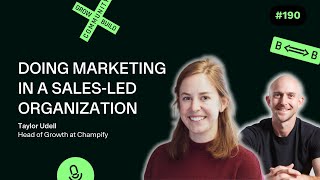
This is a YouTube video titled "Doing Marketing in a Sales-Led Organization" containing a detailed discussion primarily between two speakers, Todd and another unidentified speaker, about marketing strategies, measurement challenges, and alignment with sales in a sales-led company. The conversation covers topics such as marketing attribution, content strategy, outbound sales support, and advice for new marketing leaders. The dialogue is focused on practical marketing execution and leadership within a startup or growth-stage company context. There is no indication that Dave Gerhardt is one of the speakers.
Don't try and do it all. Just do one thing and do it well and do it quickly. And maybe it is even a favor for somebody whose credibility you're trying to get or trust yourself.
Favors go a long way. Like a little quick help for the sales team. Like, hey, we haven't had this field in salesforce. Boom. Now you do some, some nonsense like that, right? So you're doing a great job. You have the CEO and founder writing on LinkedIn. You got Taylor, you're in your lane. You're basically, I see your lane as like facts. You're talking about data, numbers. This is what we did. And then you got the kind of third amigo, which is will your SDR like being a little bit more funny, bringing some personality into that outside of you spawn, like running sponsored content for posts that, you know, work. How do you measure LinkedIn? How do you know that it's working for Shampify?
So I will say this about marketing. The past decade has basically been a little bit of a fun game slash trap for marketing because first marketers could measure for the first time and then the smart people could gamify those measurements. And now we've kind of exploited every channel or surface or like measurement to death. And so we're kind of reverting back to this place we're marketing is unfortunately for those of us who are data driven, a little less quantitative. And you have to get a little bit more creative on how you actually think about measurement. But you also have to get more creative about just kind of living in the gray or like not being able to get an exact ROI of everything. And when it comes down to this, for all the like, leaders who are scared of this approach and always want to quantify, you know, marketing, like, I'm tied to company revenue, if like we don't have revenue, then I am not doing my job. And so like kind of at the end of the day we're like looking at how much new revenue and what's our NR and like that's the metrics I'm really caring about and trying to build that kind of like long tail system to get there. But so with that said, some of the measurements are a little bit fuzzy about how we think about measuring the success of LinkedIn. So one example is, you know, I'm looking at our open ops. How many of them were engaging with like those thought leadership ads? Obviously LinkedIn doesn't let you export organic engagement, which is a big lever for us. But I'm going to be looking at like how do those deals move through the funnel comparatively? I did an analysis of like you know, Todd's new founders, how many of them are senior titles in our ICP list?
How do you do that? School me on that. Like how do you measure the, you know, you sold to this account? They didn't see the ad. How do you actually do that?
So I would love for someone to tell me a better way, but the way I'm doing it right now is exceptionally manual. I have uploaded my target account list in LinkedIn ads. It has under the plan section, kind of like the engagement. I download the engagement rates I in Google sheets, do a vlookup and see like how does that look and match to our target account list? What are the opportunities there? So basically Excel still runs the world despite all the software we've invented to ease the pain. Other things are like I built a nice little Crawler. Thank you ChatGPT to like look at all the followers who joined in a specific month or all of the organic engagement on a specific post. And then I enrich that and I will just like measure it against like hey, are these people showing up at accounts that I actually care about just to like sanity check. Like I am hitting the right message with the right people and so it doesn't give me at scale but I'm getting enough sample points.
Sure.
Where I'm building confidence and an argument. And then there's like the obvious ways where like 20% of our traffic is from organic LinkedIn and like that's great, that's easy.
Or maybe, maybe even your overall direct traffic in organic is growing since you all are doing more on LinkedIn.
Yeah, exactly. Yeah. We can see spikes on our traffic the days we have viral posts. Like that's direct correlation. And then we also look sometimes at like the self source, like which I think. Or the self reported attribution which is basically like what is the most salient data point in somebody's evaluation history is basically all that you're asking in that question. And a lot of people, like we saw an uptick on LinkedIn when we started posting on LinkedIn.
Yeah, cool to hear you talk about it this way. Because ultimately like the goal is it's not going to measurement is not going to give you this perfect output of like, all right here, go execute this play next and this play next. It's like your job. You're measured on company revenue each quarter, each year. You're trying to grow that number. You're trying to make bets on where are you going to Place bets to hopefully grow revenue more.
The easiest way to place bets at this stage is I'm only going to do specific things like one thing at various points in the funnel. So if I want to run an experiment on awareness and I see all of my awareness metrics grow, I'm only doing one thing. So it has to be that thing that's working and like, that's how I think about a lot of things. Like how do I test if it's working or not? What happens if I turn it on or what happens if I turn it off to like these other metrics to test kind of that causation or correlational relationship since I can't get that exact measurement.
Yeah, this is super. This is super. This can be super useful and relevant to a lot of people. How much do you think of your, how important is it for you to be gold on company revenue versus marketing specific metrics?
I think it depends on the state. I will say I think it depends on the stage of the company. I would say that both at very small and at very large companies, executives should be measured on revenue in general. Just because it's kind of like the lifeblood. If you're not doing it like at a startup, if you're not hitting those revenue targets, like you're just not going to have a company. So it is kind of the thing that matters. And then I think if you are at a very large public company, if you're like, you know, not hitting your revenue and growth targets, then like you're devaluing your, your shares.
And so I get what you're saying. It is hard. There's a middle ground where it's hard because like marketing might still be doing good things, but there might be reasons outside of marketing's control why revenue is not growing.
Right, right. I think there's some of that and then there's also some of that. Like in the beginning, like I, a ton of what I'm doing is like not scale. Right. Like, and it shouldn't be scaled because like it's testing and I want to get out the quick dirty data so that I can understand where I should be putting the effort to actually build something scale. Now it's not like total duct tape, but I think that there's like a big middle ground when you're like building for scale where like if you only incentivize marketing on revenue, then you are disincentivized from thinking about laying long term foundations. And this, this is true even at a startup at champify size, like Where I thought a lot about like, yeah, how do I want to be compensated? But I do think having the revenue kicker in there is important for match for marketing. Regardless of whether you're gold on total pipeline. I never think it should just be marketing because then you get into fights.
You said like, you, you do a lot of outbound and your, your company, you all are very effective at that. Or the hot dog man is doing cold calling. Right. In a world where you are only incentivized and I've been at a company where this is the case, when the world where you are only incentivized for marketing sourced revenue, then you're fundamentally not aligned to help will be effective at cold calling. Because you're like, well, if he cold calls, that's going to be sales generated. I'm not going to.
Right, exactly.
I got other stuff to do.
I think attribution is the evil of all progress. And I have. Yeah, this is where you came up.
You came up in that world. You were working at that. I came up with that stuff.
Yeah, I came up in that world. I came up being responsible for the reporting and having to like, mediate fights where like, you know, the BDR is like, no, but I was outbounding and that's why they came in and then they signed up. That's the exact same person. I called five times and I'm like, okay, but like, what if they saw an ad? Realistically, the way I think about marketing, especially in a sales LED company, which is going to be more outbound heavy in general, like, it's the way you buy. There's no, like, teaser. You don't have all these other levers to pull. You can do like kind of kooky campaigns to get emails, but at the same time, if you're doing something super kooky, the intent there is probably the same amount of intent as an outbound call. Right? So the way I think about it is like, how can I make it more efficient? How can I make it so that when will calls, they're like, oh, champify, I heard of you. Or I saw your content. Or like, you, you don't have to do that weird, awkward intro. Like, what company again? Right?
Like, this is so underrated. And I think this is why, like, the, the best thing that an outbound sales team could have is a strong brand. Right? Like, more people know who you are. That's. That's going to make it easier to go knock on doors and like, is. Is it hard for stripe or zoom to go, like, do Outbound? No, everybody knows that those companies exist. Right. But also there's a whole element. This is why I kind of asked about the measurement things because, you know, if you're incentivized on revenue, then you as the marketer you're going to figure out, well, like, how can we help Will? This guy's really good at cold calling. This is working. But he's got to spend six hours digging for phone numbers or he doesn't have good lists. Like, this becomes then something that you and your team should go work on and you're not have to worry about, like, who gets credit or like, how do we budget for this? Because it's going to drive, it's going to drive pipeline. I think it's just really important from an alignment standpoint. Maybe. I just, I was burned once by it and so I love, like harping on it with people. But I think when you realize that the, the company cares about revenue and then like you have sales and marketing are kind of two inputs to get to that number, it just does make things a lot easier.
I think so. And I think, I mean, we've all been in those conversations where marketing's blowing the MQLs out of the water and then sales isn't hitting the revenue number. And then like, like, what is, what is the point at that point, right? Like, it doesn't fundamentally matter how many MQLs you have if you aren't getting revenue. Like, sure, maybe it's nice to find levers in the funnel where you can optimize, but it's not like, hey, you did your job and your job was done perfectly right. And I think it's more about, I mean, at the end of the day, you're a business and so you have to be tied to things that actually move the needle in the business and then you get to poke out of the box or you get more collaboration. And sure, you can measure tactics for attribution, like, is this working? Is this not working? But you stop having those conversations where like, oh, marketing has the gap, or SDRs have the gap. And you can start moving the conversations to what can we do to actually close the gap? Because essentially most people kind of have a gap at this part.
In the SaaS era, you wrote in July, you finished one year at Champify and you have 5x the quarterly pipeline generation. These are three. I'm going to read you the three big marketing initiatives that you wrote about that you killed. And I want you to just do a quick commentary on each of them. So things that you killed were number one, direct response ads. Number two, selling to just anyone in sas. Number three, stopped outsourcing until we had a definition of good. So let's say what number one quickly first, why you killed direct response ads. What does that mean?
So all the ads that are like sign up, get a demo, download X, uh, we just, we got rid of them. Um, they are expensive. They. I don't know. I. I'm pretty big fan of some of the refine labs like analysis that they've done for intent.
But like so where do you drive people instead? I understand and I have some follow ups. So where do you drive people instead? Just nowhere. Just only do thought leadership ads.
It's like 90% thought leadership ads. Yeah, maybe. Maybe a little bit lower than 90%. We drive people to. If it's like top of funnel ad like the first time they've seen us, we will drive people to playbooks. So we just released a big playbook about building outbound culture at companies. It is champify adjacent. Like it works better if you have an outbound culture. But it's really, really great advice from people like Justin Geller at Gong or Doug May at Harness. It's like very tactical how to do your job. So we'll drive people to assets like that that'll help them regardless of whether they're using camper fire.
Is there a like a contact? Like is there some type of cat lead capture something on that or you just. Yeah, your engagement on the back end.
So I. It's a little bit of both. We need to get better. And this is like the first thing we really tried to do in the first part of the year was like how do we just even get people to know about us? Now I'm thinking about like how do I move people from being like, oh yeah, they're helping with me with their job with my content. Like let's shift down to like the product. But we have on the page just a way to subscribe for more of this. Like leadership newsletters for sales leaders. And we'll put like webinars on the page too so that they could subscribe to webinars and then we get their email. But basically the premise is deliver value and then earn the right to.
It's interesting because like even if you're selling to bigger companies and you can make the case that like, well everybody's contact info is available in zoom info. And so I don't need or wherever, Apollo, whatever and I don't need to like get their information in my Database, but it's like a signal, right? And so I know there's a whole movement of like not doing any, like don't do lead capture or whatever, but there's some level of signal of like, if you showed someone ad, it took them to this, like playbooks about, you know, how to run an outbound sales org. And then someone then like joins your newsletter list or something to get more of that content, then you can match that up with like, oh, a target account of ours is now interested in our content and that then changes the conversation that sales can have with them.
So basically what we do when we like launch content, content is basically every month, you know, we all have the intent what websites or what companies are looking at your website. We'll pull the list of companies who are like looking at it and use it for a nurture campaign. That's like I saw you were, you know, your team is checking out X, like here's X, Y and Z based off of it. So we'll, we'll, we'll rejigger that as like, use it as a marketing moment or an activation play for sure.
I like the idea of killing direct response ads only because one thing I've always struggled with in B2B is like, unless you have a PLG or freemium motion, it's like, know who we are and then get a demo. And that's just like such a big gap in between. Like, I don't want to, I don't want a demo yet. And I, I know that if I get a demo, it means sales is going to contact me and you're probably like, me. Taylor, the only time I reach out to get a demo is if I'm like pretty damn close to probably going to end up buying.
I'm like, I've already talked, I've already talked to people on who are logos on your website. By the time I reach out to you, like, I know you're down to two, right?
Like, I know that not all demos convert obviously. Right. Like 30, 40% or something would be fantastic. But like, I'm not taking a demo unless I'm like, already at the finish line of this process and now I have to see it because you're making me see it. And I've always thought, okay, how do you drive higher intent? But they're not ready to get a demo yet. And like, I like the idea of my friend John Short who runs Compound Growth Marketing. He's a big fan of like building middle of the funnel tools, like free tools and resources. Like A grader of some kind. And you're doing this now with content and reports. I think that there's just so much of marketing that needs to be done there. You can't just have like, get a demo and then like the head of sales is all over you because demos are down. Well, we can't just run ads that say get a demo. We can't just email our list and say get a demo. We got to build like different on ramps. I see you kind of nodding along. It seems like you've thought about this.
Definitely. I think I was just going to say like. So our first one is like pretty generic. Like, here's what the new, like, you know, spam, Google things means for you and how you should change your targeting. Here's what you know, how you think about measurement, whatever. It's very top of the funnel. There's assets involved a lot of the time that are just like interactive or like, here, I need an account planning template. Like, sure, we'll give that to you. And then like once people have visited our site or like really interacted with our content or ads, then it starts to be like, here's how I do my job from a customer and the role Champify plays in it. So we try and do case studies that are the generic case studies are great in that, okay, somebody's willing to go on record that they use you. But the actual content of the case studies are generally pretty weak. Like, it's not super tactical or like helpful. You're just like, great. Their trusted brand. That's. So we've been trying to rejigger how we do case studies to be much more aligned with like, hey, I run this team. Here are the four plays I'm doing. Yes, Campify is a part of it, but it's like not the whole thing. So then that's what people who are interacting are just kind of getting slowly pushed down to, like consideration of like, oh, I have that problem too. I will consider. And that's kind of how we think about the goal.
Our number two was selling to just anyone in SaaS. I'm going to assume the answer to this one. You started a year ago. My guess is before you started they just this early stage startup just kind of selling not a clearly defined icp. You did. That makes a ton of sense. Number three, this is a really good one. We stopped outsourcing until we had a definition of good. What does that mean?
I don't have a demand gen background pretty much at all. And we first started outsourcing Things like ads. And it turns out when you outsourcing but you don't know how it should be done or you don't know what it looks like, it's not that they're necessarily doing like a bad job, but it's just like maybe not aligned with your company or you'll never learn. And so what we started doing and once again I think outsourcing is like a weakness of mine that I'm trying to like build that muscle. I'm a little bit of a control freak and I like to have it all understood, what's working. But when we are deciding to outsource, we know exactly what we want, how we're going to measure, what the goals are, how it fits into our overall strategy and what the actual steps should look like. That way you know it's working or it's not. And there's no kind of like black box of I don't know, discovery and throwing away money because you don't know how to do it or measure, measure them.
It's my number one as a, as a former washed up VP of marketing.
And later CMO boy money because you don't know how to do it or measure, measure them properly.
It's my number one as a, as a former washed up VP of marketing and later cmo, I realized that basically any hiring mistake I made is when we. This is kind of a similar lesson. It's like any hiring mistake I made is when we didn't do the thing first and then outsource it. And so it's like, oh, we need to start running ads, let's go hire a demand gen agency or whatever. And I'm like, no, just something happens when you learn that first. Or I'll give you an example. Like our first event when I worked at Drift, we were gonna just like fully outsource it. We did it all, we did it all in house because we needed to feel it, we needed to know it, we needed to do it. We're doing that with Exit 5 right now. We didn't hire an agency to help us do our first event. We did it. We have a ton of data now. Now if we go into next year, I can look at the budget and say like, should we spend 50 grand on an event marketing agency? Maybe we should. And now I feel like we know how to do it. And this is where, you know, maybe I've made a lot of mistakes with agencies because we haven't wrote in the, we haven't come up with the best brief on the way in because we don't, we don't know what we want. And so I think if you can do it as 20% of your job or, hey, you want to explore partner marketing, can your product marketing manager do that and like 20% of her job for the next three months? And then let's figure out, like, if we should go higher full time. It's got to be. You got to test into these things. And it's hard because there's a, there's a solution for everything. There's an agency for everything, there's a freelancer for everything. Someone solved it. But there's just something about if you don't do it yourself in some small way first, it's going to be hard for you to do it effectively as you scale.
Then you learn lessons really hard in an expensive way. And then you also don't know what good should look like after the experience.
Okay, and then instead, instead you created a true brand strategy. I think we've kind of roughly talked about this, which is good. New messaging for the homepage and intro deck. Check out champlify.com, the messaging is very good. And then content audience fit. Okay, that was good that you wrote that. I want to ask one. I want to go deeper in this. You recently wrote about not. You did this big report and you are not gating it. You sell to bigger. You want to sell to bigger companies. You're doing events, you're doing cold calling, but then you're doing free content. How on earth are you measuring the success of content if you're not gating it? And that means you're not getting any MQLs. What are you doing, you crazy lady?
We're doing a lot. I think the first part was like, hey, are we getting awareness at the companies we care about? And that's super easy to measure because tools like Clearbit will reveal that for free. Or we use koala so we can see all the companies who are.
You.
Know, viewing that content. Now I can see that company. Are they in my CRM? Do I have an active op? And in that case I can see, okay, if I have an active op, do those opportunities close faster? Do we navigate to power more quickly? Are we able to loop in VPs of sales, which is who this content, for example, is for. And I can, at this size, get a lot of anecdotal feedback from, like, our reps on how it helped them in the deal if they're net new. I mean, I'm counting that as, like, hey, I got on this ICP account's radar. And so that's a really easy way to measure it. Can I open an opportunity now? We set up a nurture campaign for this one specifically, which was we did like a little teaser using our LinkedIn strategy, where we kind of shared a little bit of a report or a little bit of the findings and learnings and said, hey, DM me or comment on this post if you would like a copy of this. So now we have all these people who are kind of like opting in in advance. It's not the exact same thing as an mql, but you can bet that I can enrich those people and you know, do these really targeted outreach. And then it's also like personalized and it feels more conversational and it feels more relationship oriented. So now my founder and my sales team has all these threads with people who've like either opted in or liked that post or maybe their company was checking out the website and they can just start a casual conversation and be like, hey, like, saw your team was checking this out. Or hey, you look like you're building outbound strategies. What else is working for you right now? Or what types of initiatives are top of mind and you can come in with a more consultative angle than view my product. Check out this demo, right? And I think that starts to build trust and rapport. So we're also looking at like number of conversations started or number of ops reopened because of the content as well. So it's really like account visibility and conversations.
I said champlify.com, before it's Champlify IO should go check it out. If you go to Champlify IO, you can find this how to build an Outbound Culture content piece. And I love this style of content because it's very clear you're not just blogging for the sake of blogging. You're not just creating five blog posts a week to try to rank for something People talk about 10x content or content pillar content. If you go to this piece of content, there's an overview video, right? There's a clear, like just the layout of the page is legit. This feels like a meaty, worthwhile piece of content. Not just like, hey, let's crank out content. I like this, like, let's do less content, but let's do it more in depth and better. I want to end on just talking about you taking this job as head of marketing, AKA head of growth, since you made up the title advice for new marketing leaders out there. There's a lot of them that listen to this podcast. Advice on joining a new company, what you should look to do in your first week, month, 90 days or whatever. And you know, looking back on your early success at Champify, just give me advice to hey, I'm gonna go start a new head of marketing job next month. What should I be thinking?
I think like the first thing is one of the big reasons that I joined Champions actually that I had worked with Todd in the past. We had a lot of rapport which meant that I had already spent all that time building up goodwill and trust before even joining so that I knew I was going to be able to make decisions and kind of like draw hard lines in the sand from the get go. But I think knowing that whoever is running the company, knowing that they're going to like trust you or like let you do things kind of out of the box or experiment with things that are not necessarily measurable is really important. The, the next thing I would say.
Is identify that by the way that comes up a lot.
How did you know that, that he would trust me to like do whatever I wanted?
Because I think a lot of companies, it's the opposite. It's I don't trust you until I trust you versus think good leaders will trust you out of the gate until you prove otherwise.
Yeah, I think, well, like it's easier to like I've known Todd for a decade now, so that is an unfair advantage. I have had to earn credibility at a lot of places and like usually what that looks like is just getting the quick wins on the books. I can guarantee you if you walk into a company, there's a couple of things that are fundamentals that are just not happening well. And instead of looking for something big and flashy, look for the low hanging fundamental fruit and like don't try and do it all. Just do one thing and do it well and do it quickly. And maybe it is even a favor for somebody who's credibility you're trying to get or trust your strategy. Yeah, favors go a long way.
Like a little quick help for the sales team. Like hey, we haven't had this field in salesforce. Boom. Now you do some, some nonsense like that, right?
Like, like oh, I need an account less. Oh great, here you go. Oh, like we've been wanting to be able to run like a really small event. I'm, I'm huge on the favor economy. I will go out of my way to kind of like get trust that way. Because you also learn a lot more. You say okay, well we tried this thing you wanted, it didn't really drive the results. Here's a couple of other ways I think we could hit those same pain points. But if you can take somebody, whatever they're asking for a favor, and back it up to the business problem they're trying to solve, then you can come in with the next thing that you want to try really easily. And you. You have to be able to do that, mapping from, like, favor to actual problem. But I think about that a lot, and I think that's the best way to start any new job.
I love that. I think there's a lot of nonsense about getting in there and talking to customers and talking to people on the team and don't twist my words. I'm not saying those things are not important. They obviously are, but I think it can be a crutch for, like, the first 90 days. I'm going to talk to customers. No, like, you got hired because you're smart and you're good at marketing, and if something's broken, go and fix it or make things better in your first week. You totally can do that.
More from Dave



Asynchronous work isn’t a trend. It’s how teams actually get things done without burning out.

AI is changing product marketing. Here's how top B2B teams are scaling without cutting corners.

How Product Marketing Is Evolving in 2025: Lessons on AI and Leadership with Jennifer Cannizzaro

Why referral programs look different outside of SaaS (and why that’s a good thing)

The secret to scaling dual GTM? Give every marketer ownership and get out of their way.

From content to CMO: how Jess Cook made the leap (and built her first budget from scratch)

Leading B2B Marketing for the First Time: Strategy, Budget, Content & Team with Jess Cook

Most B2B advice is built for SaaS. But what if you don’t have demos, PLG, or lead goals?
