How Clay is Scaling Top-of-Funnel, Creator-Led Marketing, and SEO
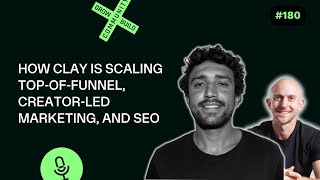
Dave Gerhardt talks with Bruno, Clay's growth marketing lead, about how the company scales through product-led growth, creator partnerships, and SEO. They cover Clay's brand positioning and what works in B2B SaaS marketing at the top of the funnel.
Every B2B product looks the same. They run the same ads, they sort of like use the same type of website template kind of. And, but like if you look at Clay, we're pretty different in terms of our brand. We're kind of like always borderline kind of weird when it comes to brand. And we do this very intentionally. Like we don't want to be looking and feeling the same from like a visual standpoint that's like one piece. The other one is like sharing the use cases of showing how play is actually different. Because you're right every time we talk about. And it's something that I've actually seen at webflow too. Whenever you're trying to theoretically explain what Clay does to people, they immediately think of what you just said. Like, oh, it's just like Apollo. Oh, it's just like zoom info, but it's not X.
All right, I'm excited to do this one. My guest on this episode is somebody who's responsible for marketing at a company that I have started to see everywhere. I don't know if that's some kind of bias of mine. I've been like liking stuff on LinkedIn. But more people are asking about clay in the Exit 5 community. I see it come up over and over. I'm sure you're happy to hear that. But Bruno, give me a quick introduction who you are and what is Clay.
Cool. Yeah. Excited to be here, Dave, and chat with you. So I'm Bruno. I lead growth marketing here at Clay. And Clay is basically a data enrichment and sales automation product that enables go to market teams to find, enrich and reach out to prospects in a prospect or current customers as well in a much more relevant way. And if you want to do that scale, you can as well. So basically a candidate enrichment sales automation product.
And how long have you been there? When did you get there?
So I joined Clay end of last year. So it's coming up about like 10 months now. Before that, I ran growth marketing at webflow for five years. For a long time.
Five years. Okay, so your webflow for five years and then roughly what like size, company stage that you talk about? Where is Clay at?
So now we are in terms of full time employees, we are crossing about like 65, 70 full time employees. When I joined back, it was like first week of December last year we, we were only 20. So we've been growing pretty fast.
That's, that's crazy. Crazy for you to go in a year like that is. The company must feel like it's like reinvented itself like you know, every, every month, right?
Yeah, I went through a very similar process. I went flow. I mean I wasn't that early but I was like around like 50, 60 when I joined left. Five years later we were like 700. So it was kind of insane as well. But yeah, Clay is also growing really fast.
Okay, we should get back to, we should get into some of the webflow lessons at some point. I think there's some, there's some good stuff there. And what was like when you joined Clay was 20 people. What was the mission for marketing? Like you got hired. Marketing can be everything. What have you spent the last year or so doing?
Yeah, so we focused a lot on top of funnel. So how do we acquire new customers through our self serve product? How do we get people to talk about clay? How do we and how do we continue to grow our self serve motion? Clay was starting to see some movement in terms of top of funnel activity from in our self serve product. And how do we actually double down on what's working? And we kind of didn't really know what was working. A lot of my initial role was like figure out what, what do we need to do, how we do it and then scale top of funnel. So that was like our main target. How do we grow this self serve business?
Is that the main funnel today like getting you, you want everybody to go? I guess if I look at the website, it seems to be the main thing like you want everybody to go and start doing something in clay for free. This is very much a product led growth type of motion.
It's a very much a product led growth motion. But the interesting thing is like, and I saw that at webflow too, as we grow the PLG motion naturally you start to see larger companies wanting to adopt this product. Right. So now we actually have a sales LED motion happening as well. And but just which is primarily driven by the top of funnel motion that drives a self serve product.
Interesting. This is an area where, especially if you have a free product, a product where you want to get people to use it, how do you drive predictable repeatable demand?
Yeah, yeah, that's a good question. I think like I can kind of talk a little bit about like how we, how we kind of like assessed on where we want, where we, we wanted to invest here at Clay. I think like one problem that I see especially on growth marketers and marketing in general, if you want to grow top of funnels that you go from one business to the other and then you kind of like apply the Same things and like, oh, we should do Google search or we should do this, we should put a webinar program. But the reality is that businesses are so different and the audiences are so different and the business models are different too. So we actually need to assess these things before we do. So that was kind of like the first step that we took which was like okay, where do we have really strong product market fit with how is our business model? In our case our model was like a PLG model, right? So that kind of starts to inform us like we actually need to a decent amount of volume to grow a top of funnel, right? So to grow. So that kind of starts to inform me like I can do like an executive dinner to grow a PO and a set that you can invest in that will give me this, this volume that I need. And where, where, where does our audience live? And so like really understanding this and I think the one thing that I wanted to call out here too is like, and I think I've seen you talk about this is like a lot of this is actually like talking to customers and getting self reported attribution and so trying to understand the actual details there. Because if you were to assess how we're growing based on cookie based attribution tracking, this is just like this is going to take you in, it's not going to take you anywhere. So the way that we start to uncover this is that then we understood that we were kind of growing through, starting to grow through like a user generated content motion happening. Which is, and the reason behind this user generated content is the product is really flexible. So whenever we get into clay, it kind of feels like an open canvas. There's like this sort of. And it can be overwhelming for some people too. You get into this kind of like spreadsheet format and then you can kind of pull data anywhere. You can do things that actually matter for your business in terms of enrichment. But what this results actually results in, after you build something, you kind of feel proud of yourself. You're like oh shit, I actually built something that I did this thing. So the immediate thing is like okay, let me actually share with others about this. And the last component is that our audience really early on was filled with service providers. So these are freelancers and agencies that they were using clay to serve their clients and, and they need to create content to grow their businesses, right? So they need to, so they're posting on LinkedIn, they're doing all of that. So us, our tactic was how can we build programs that enable them to Create more content? And how can we invest in them to create more content? And how do we. How do we invest in these ecosystems to get them to create more content about clay in general? So, like, tactically, what this means, which is very. And Spike, I think the one thing is people are probably listening to this podcast. Everything sounds super fancy, but at the end of the day, it's actually very dirty work. It's like, hey, how can you see people signing up? They are an agency. How can you get into a call with you and help you create content?
I had this experience the other day. Obed had DMed me and we were talking about something. I should do this in clay, right? He's like, yeah, absolutely. And I was like, all right. And he's like, why don't you get on a call with someone? I'm like, no, absolutely not. I don't like calls. I don't want to get on a call. He's like, I. All right, I got you. And then literally, like hours later, I get a message from Scott Housley and he's like, hey, Obed told me you're. You're looking to do some stuff. Like, I can help you. Like, I'll build these things for you. And I'm just one example of that. And I have a, you know, a small brand in this space, but I think it's like sweating who's signing up for your product, who's looking around and like doing some of the things that don't scale. And how do we enable this person? Because, know, if, you know, if I use clay, I'm going to talk about it in some way. And I have an audience in, in B2B. And so, like, I love, I love how you're talking about that being a non, a non scalable thing. The other thing, I'm reaching with things.
That actually matter for them. So depending on the company, the, the, the use cases are a little bit different. It's more like an inbound use case versus like an outbound.
I want to go back to the top of the funnel. So this is something that a lot of people want to do. Grow top of the funnel. Can we get into some of the tactics, like, other than. Yeah, you post on LinkedIn, like, what's been in the, in the playbook to actually consistently and repeatedly grow top of funnel.
That.
Just taking a bunch of notes as we do this, it made me think of, like, notion in a way, right? Like, how many people do you see who's like, here's my notion template for X here's my recipe. Like people love sharing that type of stuff and if you can identify those. So how do, how do you. So okay, so that like I get it how you, there's. You have a product that gets a lot of user generated content. But you mentioned before, like you need a certain amount of volume. How does this, how can you, how can you do that from a, from a volume? How can one, one person create enough ugc? It's got to be so many people. How do you, how do you make the volume play work there?
Yeah. So and then like after a while we sort of like started to realize, okay, what's, how can we enable, how can we make it super easy for them to create content? So the way that we did it was we actually created like a creator's program for Clay which is kind of common for like, for social platforms like Instagram has one, TikTok has one. It's a program that like enables people to create content. They are associated with the brand, they want to be associated with the product and get some resources. So that's initially what we did, which is a program of like they have to apply, they have to have some sort of content creation motion on LinkedIn already. They have to show that they mentioned Clay on LinkedIn already as well. And they use our product. And so we don't really accept. It's not really an affiliate program, it's more like a community based program. And then as they join, we give them resources of. For example, we actually just launched one which is really cool, driven by Tommy on our team, which is, hey, give us your profile, record this piece of text here with your voice and we auto generate a screen recording thing of this new feature that we launched on your brand with your face, with your voice, so you can actually look really good on social.
Do you have to pay that? It's not an affiliate program. Do you have to pay them to do it or are they willing to just do it because they want to be seen as like expert content creators.
We give them a. So like a lot of the benefits. Like we give them an affiliate link, we give them the sort of like pieces of content that they can promote. We promote their profiles on paid ads as well. We give them access to features in our product.
That's such a killer play now with thought leader ads on LinkedIn. The fact that you can get so much more out of that. It used to be very ephemeral. Somebody writes a LinkedIn post and it's awesome. But the shelf life of a LinkedIn post is six hours. Now you can request to sponsor that post. And it's like you've created this amazing organic ad unit that now you can go put dollars behind. It's a really good idea.
Yeah, exactly. And like, so basically we. We have this sort of, like, ladder of programs that we built. One, we have this creators program, which is like, people are getting started in clay. They. They want to talk about our product, and we enable them to talk about it. And then we have a selective group of clay experts. And these are like, freelancers and agencies that build their businesses on top of clay. And we have internally here, we have to make sure that these people are millionaires. We want to build a bunch of millionaire agency founders that provide clay services. And then we have the top rev ops agencies that are now adopting clay as well. This is more like an enterprise motion that they work with really large clients. So that's sort of like how we've been building this. This motion. We have this sort of creators, which is the people that we really enable to talk about clay. Then we have the service level, and then we have, like, kind of like the enterprise motion as well.
Okay, so that's. That's one play. I love that. And that I'm. I've always believed that, like, the best or not always. But since I've been in this game and from what I've seen, I think the best marketing is always in B2B. It is education. It's information like, how do you make people smarter at their jobs because of what you're doing, and how do you enable them to do that? It's not always about, you know, ads to get a demo and try our product. And when you have a product like clay that people can actually use, that's the perfect playbook to go and do that. Like, let's show our product. Let's show how people use it. Let's incentivize them to do that. Let's make them smarter, let's make them stars. And, like, they can teach other people. And then also it allows you to have this, like, content army of people who don't even work at your company. You can. You can build a really big moat there. Do you have any. I see this come up a lot in the Exit 5 community. And I don't know if you've done this, but I often see, like, hey, we want to work with influencers. This is somewhat related. We want to work with influencers in our space, but I don't know where to find them. How would you help someone answer that? I have a strong opinion on this, but I want to go second.
Yeah, yeah, it's, it's tricky because I think especially, especially if we're thinking about B2B. And like the one thing that I Learned on like B2B influencer marketing is that a lot of these people, they have, they actually have jobs, you know, so it's not, it's not like.
It'S.
A influencer e commerce store that you can pay on Instagram that you're going to promote this thing and put it out there.
Yeah, just like post a picture like in a bikini on the boat, drinking the seltzer and selling.
Exactly, exactly. It's very different. It's like, it's much more of like a deeper partnership. Like most of the time we want, you need to get people to understand the product. You need to show value to them. Like, hey, there's something that you can use. And like the way that we've, we've approached some of these is like we reach out to them normally through LinkedIn and be like, hey, I feel like there's like an overlap between our audience and yours. And the way that we've done this before is like, let's actually get you, let's actually build something for you that will drive your results for your business using our product. Because then it's much easier for you to talk about it versus people can sense whenever it's like a 100% paid post. So that's how we've been approaching it and it's been pretty successful because then we work very closely with them. We literally have a call which like, what's something in your business that you need help with in terms of growth and how can we help you? And then we build clay tables. You work together with them, we launch, you get results. And then whenever they go talk about it, they're like, okay, this thing is for real. This thing is legit. So it's kind of like, it's very different and it takes some time to disenablement session takes some time, but I think that's how we made it work. Curious to hear your thoughts too, Dave.
Well, I feel like people ask this and they expect there to be some magical database. And you go in this database and you search for your industry and they surface you this list of influencers. Right. And I feel like the only way to really work with influencers is even if there was that database, like, you have to know who they are, you have to know what they talk about, you have to know what their audience is. Like, and then you have to meet them in the middle and then match the content to that audience. And then the other thing is, like, even if that did exist in B2B, I think people just have it wrong. You don't need people with massive. I bet if I looked at some of the people in the clay creators program, you've probably driven like, you know, tons of pipeline from someone that has, like, you know, 6,000 LinkedIn followers, right? You, you don't need to be Mr. Beast. You don't need to have millions of followers for this to be meaningful. And I had Natalie Taylor on the podcast a while ago, and she runs marketing at Capsule. They did something smart, which is like, they found like 10 or 20 creators in the, in on LinkedIn in the. That are, that were making videos for their company. And I'm making up a number, but it was some small dollar amount where, like, Instead of paying one person a huge amount of money, they found 20 people and they pay, they say, hey, can we pay you 500 bucks? And we want to do this micro influencer campaign. And she didn't find that from some database. She found it because she's on LinkedIn. She knows her customers, she knows who they follow. Like, you're not going to get this, like, list. And then, by the way, even if you did get that list, what would happen is everybody would reach out to those same people. And so I think you have to be curious about the platforms, you have to be curious about the channels. The, on your team should be, you know, deep on social understanding, who's talking about related topics to your brand, and then you can find them there. There's no really shortcut to like, you know, getting a list of influencers to go and work with.
Yeah, 100%. And that's why, like, and I think, I think the one thing that you mentioned is like, something that we do, we do pretty well, which is like, what's, what's the content that you're creating? Who's your audience? What is something that will be relevant for them? And what are. Can. What. How can we build something that uses Clay, that it's also relevant for. For, for you? Because then whenever you kind of have all of these touch points and you have all of this, all these areas correct, you can kind of build something that makes sense. And I think the other thing too, that like, no one really talks about is there's the part of actually finding and launching the content. The other piece is actually like measuring results. And I think people, people often forget how they Buy things. I think that's something that I've kind of noticed. Whenever you in the seat that you're measuring results, you forget how do you make decisions. And most of the time you don't click on ads, you don't think about these things, you see people talking about it, then whenever you have the need, you go ahead and purchase it. And so it's really tricky if you want to do this type of influencer marketing, if you want to treat it as a less touch paid the search channel, you know, because at the end of the day it's top of funnel and people forget how they make, how they make decisions and whenever they are actually looking at roi, they don't actually think about this this way. Yeah, just something that I've kind of noticed over time too.
What else has been a contributor to top to top of Funnel? Are you spending a good amount of money on paid channels? What else can you, can you do to drive volume?
So we, we're not spending that much on paid channels. On paid search. We, we spent a pretty low amount considered to how much we could. We've been mostly focused on these programs that I mentioned and also SEO. We're starting to invest quite a lot in SEO, mostly because of we have so much data and we can actually build some really cool things using our product. And so we've been investing on some SEO motion that, that can drive like a top of funnel to our site as well. But at the end of the day we, all of our audience lives on LinkedIn. SEO is like another touch, another channel that we can, we have control over the levers and we can do this. So. But yeah, these are the core two channels that have been sort of focusing quite a bit. People often forget how they buy things. You know, I think that's something that I've kind of noticed.
Like tell me about SEO and what's working now. Seems like the SEO, the search landscape has changed a lot. What's the overall approach to how you're putting this channel into play? It's much different than it was 10 years ago where you just would try to like rank for a bunch of keywords or maybe it's not, I don't know, I don't have a lot of experience here. What's the SEO playbook?
Yeah, the few things that we have been doing is the one thing is through because we have clay in the background. We actually use clay to build specific tools for SEO. So if people need to find specific company headcount numbers, we can, we build. So basically the tech stack is good for me because it's clay on the back end and webflow on the front end. So we actually build the tools within Clay and then we export it to webflow. So we've had some, like, we built some email finding tools, we built calculators. So the way that we're seeing now, and also like, we're actually building some articles as well that are more top of. More bottom of the funnel articles and whenever people are making. Looking for reviews, looking for pricing data on some. On some companies. But we're mostly focused on these two. Bottom of the funnel from. From a. From a editorial point of view and tools and programmatic SEO using clay and other in other.
Got it. But bottom of the funnel is not necessarily. Is it an SEO play? Are you looking at like keyword volume and then deciding what, you know, this is a low search volume but high intent, or is it more just like this is product marketing content that we want to exist?
No, we're actually looking like both. Like, I didn't. Because like, we didn't really have anything, you know, so like a lot of the times it's like, okay, we actually need to rank from a product marketing point of view.
More from Dave



Asynchronous work isn’t a trend. It’s how teams actually get things done without burning out.

AI is changing product marketing. Here's how top B2B teams are scaling without cutting corners.

How Product Marketing Is Evolving in 2025: Lessons on AI and Leadership with Jennifer Cannizzaro

Why referral programs look different outside of SaaS (and why that’s a good thing)

The secret to scaling dual GTM? Give every marketer ownership and get out of their way.

From content to CMO: how Jess Cook made the leap (and built her first budget from scratch)

Leading B2B Marketing for the First Time: Strategy, Budget, Content & Team with Jess Cook

Most B2B advice is built for SaaS. But what if you don’t have demos, PLG, or lead goals?
