How To Run Marketing, Creating Categories, and the Role of Marketing in Revenue Growth
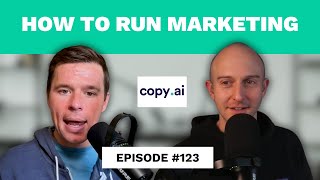
Dave Gerhardt interviews Kyle Coleman about his path from sales development to CMO, covering demand generation, sales-marketing alignment, and category design in B2B SaaS. Coleman discusses pipeline metrics, how to measure marketing's impact on revenue, and what AI means for sales roles.
Was the whole go to market approach at Clarity based on target accounts?
Yes, it was until very recently when after a string of acquisitions, Clarice ICP expanded pretty significantly. Upmarket down market, different industries, different segments, etc. But for the most part, it was a relatively focused ICP exit.
Exit. All right, Kyle, good to see you. Fresh branding on the. The Copy AI AI hoodie. I appreciate that. How. How is. How is life? What's up? You got a new role? Take me into that. When did you start?
I started on January 2, 2024. So very, very fresh.
Was it hard to hold off over the holidays and new, like knowing you're going into a new job? Did you. Did you get email access before? Did you hold off until January 2nd? What did you do?
It's a good question. So yeah, I had got my new machine and I got all my systems access all set up in December. But then we live in Denver and our my in laws are in Rhode island and we're going to Rhode island for winter, for. For the Christmas holidays and everything. And I just left the laptop at home. I was like, I know if I bring this, I won't actually take time off. And taking time off in between gigs or really just at all is so important. And so that was my forcing function to do that.
Yeah, that's a good idea. I'm the same way. Once I have a nibble, it's very hard to stop.
Yeah, I was pretty sure my family would have rather watched the Hallmark movies than listen to gong calls about Copy AI. So I figured I'll leave this at home.
Yeah, I like that. Hey, do me a favor. Pull that mic closer to your mouth. Eat it a little bit more. There you go.
How's that?
That's so much better. Yeah. Beautiful. So I want to talk about. Let's talk. We'll get to like when you. When you joined Copy AI and like what you. What you did, but I want to re rewind history a little bit. Can you give listeners your. The bridge version of your background and I'll jump into a bunch of questions about. About you in a little bit.
Yeah, yeah, sure thing. Sure thing.
Sure.
I hear the baby in the background too. It's adorable.
My son is home today.
I like that little negotiation.
It was. Yeah, it's. That is definitely what it is. It's a negotiation. There's a reason that was muted. All right, so take us into. You spent. You spent five years. Was it five years at Clary?
Yep, five years at Clary. Prior to that, I was six years at Looker, business intelligence company based in Santa Cruz, California. And then before that. Well, let me take you all the way back in time here, Dave. I studied marketing in college.
Okay.
And I didn't really know what, what that path was going to lead me down or what path that would lead me down. I studied marketing and psychology, but I took sales roles really for my entire life, including after college. I was a financial advisor, I was doing fundraising for US Senate campaigns, I was doing a bunch of like sales oriented things. And then I ended up at an Advertising Agency, a B2B ad agency in San Francisco, but it was still a sales role. I was an account executive, effectively serving as the intermediary between our internal creative team and the clients that we were working with. So I got a lot of exposure to B2B marketing and marketing strategy and, you know, the creative process and the production process and all those sorts of things. But I didn't end up pursuing marketing literally as a career for much until much, much later. Right after that agency, I went to join Looker. I was the sixth employee. I was doing a bunch of whatever you do at a startup that size. But I gravitated toward SDR because sales development is right between sales and marketing. And I had that kind of quasi marketing experience and I had the sales experience and I said this is actually a pretty interesting fit for me. And how did you, how did you.
Get into Looker that, that early? What, what got you to join a six person startup after working at an agency?
Well, I don't know if you are aware of this, Dave, but agencies not famous for their pay scale. So living in San Francisco on 45K was a little challenging. Little challenging. And so it wasn't super hard to convince me to make any sort of change. And one of the clients of our agency ended up going to be the founding VP of sales and marketing at Looker. And he recruited me. We had worked together on the client agency side and he, he recruited me and for whatever reason, I trusted the guy and it worked out pretty well. So luck is the answer.
And then you spent six years there in. Not in, not in marketing at all. Your direct, you know, kind of climbed the SDR path, ended up running sales development. How did that prepare you for a role to be CMO one day?
The first four years of my tenure at Looker, I reported directly to our CMO and my closest working relationship was with our VP of Demand Gen. Her name is Lisa. She's fantastic. So I learned sort of by osmosis about demand generation and event Marketing and branding and positioning and website and all these things. I, I got a lot of exposure to and contributed in many cases to many of those things as well. So my literal purview wasn't any of those marketing things, but my contribution was overlapping quite a bit with, with the women on those, those two female leaders that I work very closely with. So I got a lot of fluency of language of marketing and the metrics and what they care about and all those things. And I got a really good sense of what really good looks like because Lisa Daniels, our VP of Demand Gen, and Jen Grant, our CMO are world class. So it was this kind of accelerated learning environment for me that again, it's easy to connect the dots looking backwards. I didn't realize this at the time, but it gave me a really solid foundation for how to think, think about marketing and how at least if I didn't know how to do all the things, I at least knew what good looked like.
Can you talk about what the role of sales development did at Looker? For two reasons. Number one, to I think a lot of people that listen to this maybe have different definitions of sdr, but then also a lot of people listen to this might not even know what the role of an SDR in that organization does. So can you talk about that? And then also I'd love to hear how that has kind of taught you, I guess, the other side of marketing. It's like a lot of times in marketing we can kind of go and do all this stuff and we're far removed from the people that actually need to go and follow up on the leads that we're generating. And I think there's a lot in there that we can unpack.
The SDR role at Looker was primarily responsible for two things. One was processing the inbound leads, processing the inbound demand. And second was going out and hunting net new opportunities from an outbound cold call, cold email standpoint. This was 2013, 2015 in that era where the outbound channels were far less inundated than they are now. So it was, it was a lot easier. There wasn't as, as much noise. It was easier to generate outbound meetings. And the VC sort of area was booming. There were new seed companies, new Series A, new Series B companies every single week. So it was really, really well primed to sell our relatively new BI technology, business intelligence technology to all these newly founded companies. Just this kind of perfect confluence of time where cloud was becoming a thing. BI was already a saturated market, but cloud, BI was A new kind of spin, a new category that was interesting and we were able to capture a lot of market share for that reason. So working really closely with the marketing team to again process the inbound leads that were created from events or from content syndication or from SEM or whatever, you know, organic traffic to the website and then also going out and hunting net new outbound opportunities.
And was there any like, inbound, like, did the SDRs also own like inbound follow ups or anything that came in?
Yep. So every demo request, every event lead, every, every single person that came into the top of the funnel, the SDR team was responsible for calling, emailing, LinkedIn, getting their attention and getting a yes or no. Do you want to take a meeting with our sales team?
Why do, why do some people have BDRs and SDRs then? If you, if you have this role, that kind of combining both. Is that just a naming and a nuance thing? What's your perspective on that?
I think it's naming a nuance, Dave, but I also, I think it's because a lot of tech companies are obsessed with specialization. Over obsessed with specialization.
Oh, I've seen that. Right. So it's like, oh, we can't, we don't want this. Like, this group needs to own the follow up, this group needs to own outbound.
Got it right, exactly. And to a certain extent I, I see the logic there, but now look at 2024, I don't think you can afford to have that kind of over specialization where you have a certain cohort of people that are only responsible for a narrow set of things and then you have a whole separate group of people that are responsible for another narrow set of things. I think you have to kind of buck that trend and think back to first principles and be like, what is the actual efficient way to run this business, to process this demand, to create opportunities for our sales team and having, you know, a fleet of 50 people to go and do all of this is probably not going to be it for most companies.
It's kind of interesting to see your journey now that you're the, the CMO of an AI company. How many things do you see that you used to do in the role of SDR that AI can either improve or replace now?
Yeah, not all of them, but a lot of them, Dave. And, and this has been a trend. It's not just AI. You know, when back, back in my day when I was an sdr, we didn't have outreach or sales loft or groove, we didn't have the sales automation Type tools. Every single email we sent was one off sent via a Gmail inbox. And so then, you know, these sales automation things came and made it a lot easier to do a lot more volume outreach. And so that's what happened. SDR teams, myself included, ended up leaning a lot on those automation tools to just spray and pray and hope that you get some result. And so to a certain extent, a lot of the work that SDR teams have been doing has been getting easier because of the tooling. But because of how crowded and noisy the market is, it's also gotten a lot harder because now you have to be more creative and you have to break through in those sorts of ways. And so what's interesting about AI is that it's checking both boxes, which is making the, making the hard parts a lot easier and eliminating a lot of the menial, mundane, super time consuming, you know, update my CRM type stuff. And so that to me is the promise of AI is not that it replaces an SDR or an AE or a marketer or anything like that, but it eliminates all the friction from the process that allows people to think, be more creative, be more strategic, spend more time on the phone with customers, talking live. And like, if we can get to that universe, I think everybody's going to be better off.
Yeah. And it's like you almost, you have to do that now because the era of like, you know, I would say a decade ago, which is when we're talking about you could win by having, you know, we, we were early implementer of outreach and so we were able to like do a bunch of sales engagement stuff and generate a bunch of meetings that way. But when everyone is doing that and all the channels are crowded, it is going to be that targeted, thoughtful, why you, why now? Type of messaging. And that isn't going to be generated from a computer, it can be assisted by that, but it's going to have to be someone literally looking you up and understand your story and researching your business and then reaching out.
Exactly. And drift is the same sort of, in the same sort of universe where I lead. Like we're trying to optimize for how buyers want to buy. And if somebody goes to your website and you have Drift or Intercom or whatever chatbot, and you're basically having a qualification conversation that's run by the machine and that is, could be quote unquote, replacing an sdr because that's a lot of what an SDR would do is have that same sort of qualification call, except it requires a Live conversation. And when you're selling, especially when you're selling a tech, like to a technology Persona, data analyst, data engineers, cto, believe it or not, they, they don't want to hop on the call, on a call with the sales person unless they really know what this product is, how it can help them, et cetera. So there've been this trend of trying to reduce friction for buyers and trying to, quote, unquote, replace the job responsibilities of certain roles. This has been going on for a long time. It's informed a lot of what revenue technology and marketing technology has done. The difference in AI is that AI is so much more capable of, you know, quote unquote thinking that it seems like it's a lot more, and it is frankly a lot more capable than any of these other more static tools were in the past.
So you, you make the jump, you leave Looker after six years, you go to Clary, you take a similar role there you're doing sales enablement. Well, sales development and enable enablement. When did you make the jump to marketing?
Yeah, Summer of two. So I started at Clary in the spring, April Fool's Day, 2019. So a nice little harbinger of things to come. And I took on demand generation the summer of that same year when our VP of Demand gen, he left, you know, we went to another company and so I raised my hand and I said, hey, I was, you know, hand in hand with VP of Demand Gen at Looker. I know what good looks like. At the very least I can keep the train on the tracks here. We won't have a fiery explosion, I don't believe. And temporary became permanent. And I ended up running Demand gen and event marketing and marketing ops that Same year of 2019.
Let's go back to what you just said. This is something that is, it's kind of like Bigfoot or the Yeti or the Loch Ness monster. What does good demand gen look like? What does that mean?
Yeah, that's a great. So a lot of it has to do with the internal partnership that you have with the sales team.
The.
You can be creating all of the leads in the world and doing all of the events in the world. If the sales team isn't aware or doesn't care or is misaligned, none of that matters because you're going to end up creating a bunch of leads or you're going to create a bunch of marketing content or, you know, whatever that is going to fall flat because the sales team's not leaning in. And so that's something That I was again learned by experience at Looker and saw the way that, that our CMO and our VP of demand Gen were hand in hand with the CRO, with the head of sales, with the head of sdr. And I was, I wanted to mirror that same exact working relationship at Clary and say, we're not going to go off into our little marketing silo and do things that we think are going to be fun or, you know, creative or whatever. We're going to do things that are more on the nose marketing that are something that our sales team believes in, that has continuity for when that prospect is on that first call with a salesperson. I've seen so many times, Dave, where the buyer believes they're signing up for a thing because they respond to a marketing campaign and then they get on a first call with a salesperson, they're like, what the hell is this? This is not at all what I expected. And so we just wanted to avoid a lot of that disjointedness in the buyer experience and create a really, really solid internal working relationship with really good internal marketing. Here's what's coming, here's what to expect, here's the enablement, materials you need for it. All of that internal marketing I think is just as if not more important than what you're doing externally.
Well, it's interesting to hear you take that approach first because I do see a lot of folks default to talking about demand gen and it's easy to go to the channels, the digital, you know, there's an association in your head of demand gen equals digital, SEO, SEM, abm, you know, events, whatever. But to your point, it really is, especially at a B2B SaaS company where you're selling a considered purchase product. It's about helping sales win deals, win customers, and working backwards from there. And so I think that's what gets hard about demand gen is like one thing that I've struggled with is like you could almost put everything in marketing in the bucket of demand gen. You can make the case for, for it and all in all the ways. But I think when you, when you peel it all the way back and operate from this first principle of like forget all the channels for a second. Our job here is to help win customers.
Yes.
How do we do that? Can you talk about the set of goal, like just goal setting. How, how did you get, how did, how were sales and marketing measured to make that thing happen? Because I think this is one of those things that it's like easy to talk about. On a podcast like this. But yeah, I've seen it. Where it breaks down is like, yeah, that sound great. But like actually sales is comped and gold this way and marketing is comped and gold this way. Talk about your experience there.
It's, it's funny you asked, Dave, because this was one of the first questions when I took over what we call growth marketing. But it was effectively demand generation at clary. One of the first things, conversations. I was going to say arguments, but let's say conversations, it's a softer word. I had with our CFO and our CEO were exactly this question. And their question to me, Dave, was how many leads are you going to bring in? And my response was, I'm not going to tell you and I'm never going to report on it because it doesn't matter. Like if you want to give me a lead target, I can go and juice that lead goal. I could go hit the goal today. I go buy a lead list of 10,000 leads and then go to the Caribbean. Is that what you want me to do? The answer is no, of course not. What you want me to do is generate meaningful high velocity pipeline that actually turns into revenue. And if that's what I'm gold on and that's what I'm oriented against, guess what? That's going to make the company valuable and we're going to have a much better working relationship with sales.
Right, but is there, there, is there a metric in there that you can, is there something closer to it? Like, is it meetings, is it demos? There's got to be some type of metric in there that you can own and measure, right?
So it's two things for me, Dave, and I can go into as much detail as you want on this, but.
The people love this, give me all the details.
So for me, the two main metrics are, they're effectively the same, but it's a different lean one, is how many qualified opportunities are we creating? A qualified opportunity means the first meeting has to happen. It has to happen with the right person and then that person has to have enough buying intent for the salesperson to say, yes, I'm going to continue to invest my time, energy, resources into working this deal. So qualified opportunities is number one.
And that definition is something that you don't just say in the sales room in a vacuum, you need to co create that.
Co create, Exactly. So the definition of a qualified opportunity is who are we? I think about things in two different vectors. The icp, your ideal customer profile, which everybody, I think listening to this understands but the second is something a little bit different, which is the ict. What's your ideal customer title? And it's a combination of those two things and it's where this, that kind of intersection of that Venn diagram happens, which is your definition of a qualified opportunity. I want to get meetings with companies that are 500 to 5,000 employees and I want a director level revenue operations or a VP level sales leader on that call engaged in that deal. And it's again the intersection that Venn diagram. And that sounds really obvious, but it holds marketing to a much higher bar than just go get me a meeting with X account or go get me a meeting with X Persona. If you only do one of those things you could miss, you could end up getting a meeting with a CEO at a five person company that doesn't matter to your sales team, or you could end up getting that awesome meeting with a Fortune 100 company, but it's an individual contributor who doesn't actually have any buying power. So you have to find the balance. You have to find the middle ground. And being really, really narrow about your definition of that intersection of ICP and ICT is a great forcing function to make sure you're on the same page with the sales team. And then that informs the way you go and design all your campaigns and programs and events and content. And all the rest is to ATT right people from the right accounts at the right time.
And that's how you get sales being advocates for marketing. And you want marketing to help you close deals. You're not, you're not comp. Your marketing owns getting you something that's valuable, not a list of leads. But I'm going to get you meetings on your calendar.
That's right. That's right. So metric one is the count of opportunities and then metric number two is the pipeline value of those opportunities. So it's the same, you know, same sort of point in the sales funnel, but a different ways of looking at things. I want to make sure that we're generating a quantity of opportunities so that the sales team's capacity is full. But I also want to make sure that there's enough pipeline coverage, you know, this quarter, next quarter, next year, whatever, to support the company's revenue targets. So I'm always thinking about things through both lenses at Clary.
Where did pipeline come from? Or what were the best sources?
Yeah, it was about 40% outbound generated, about 40% marketing generated, and then the other 20% was sales generated or Bluebird or partnerships or some, some mixture of.
That and did you, did it matter, like outbound, like, did you only get credit for the 40% that marketing generated? Or is it a win if you generate? If there's pipeline generated, yes.
So this was another thing I learned at Looker and then brought over to Clary that fighting over who gets credit for what is such a waste of time. And no attribution is ever 100% perfect. And so what we, what we did was we had account based territories, we didn't have geography based territories. We, in partnership with our revenue operations team, every salesperson had a set of, you know, 50 accounts if you're an enterprise seller, or 200 accounts if you're a mid market seller or whatever it was. And so we knew all 8,000 accounts that were named. This is our universe, this is who we're trying. This is our definition of icp pass through to territories that ends up in our CRM that then informs everything that we do from a targeting perspective, abm, all of the things. And so when we get a meeting with those accounts, it necessarily means that there's going to be touch points from the salesperson, from the sdr, from marketing, whatever. And we're not ever trying to fight about who gets credit for what we're celebrating when we get a meeting with one of those named accounts, because that's what we're all trying to do.
Sure.
And so it was a little bit inexact. And our CFO kind of always had to raise eyebrows at me to be like, is this a worthwhile spend? Like, what's the ROI on your, on these ads that you're serving? And I was like, hey, you know Kevin, our cfo, Kevin Yao. Beautiful, man. It's like, Kevin, this is more of, think about it more as a billboard that we're serving to these accounts versus some direct response. See an ad, click an ad, take a demo type thing. This is something of a longer game that we're playing. And so I had to educate them on what the goal of each marketing channel was and what success looked like. And then the experiments that we ran, Dave, were here's a cohort of accounts that we're not running LinkedIn display ads for. And here's a cohort of accounts that we are running LinkedIn display ads for. And guess what? The percent of accounts that we got into opportunities and then the speed at which those opportunities moved, or way better for the cohort of accounts that, that got the brand impressions and those that didn't.
Yeah, this is, I think this is, this is what's great about Having this targeted account approach, I think this gets hard at companies that have like the multiple funnels. And that's where the credit discussion gets even worse. When it's like, yeah, if we have this universe of like 10,000 accounts that we're trying to sell to, then you can do stuff like that. And it's cool because you're not saying that we don't measure it. You just understand that it's not direct response. And so we're going to test this by splitting out the cohorts, showing these ads to the these accounts, and the meeting rate is going to be higher. Was, was the whole funnel, was the whole go to market approach at Clary based on target accounts?
It was until very recently when after a string of acquisitions, Clary's ICP expanded pretty significantly. Upmarket down market, different industries, different segments, et cetera. But for the most part, it was a relatively focused icp.
Yeah, this is great. And I think for anybody listening, what I like to hear, I like that you're coming at this not as the marketing guy, but as the, you know, you, you actually, if you add up all the years, you have more experience on the sales side than you do in, in, in marketing. And so you're coming at this from like a, to hear the sales guy say, let's not argue about credit is like, that's a message that everybody needs to hear. And I think this is where, you know, it's easy to write on LinkedIn and have hot takes and this and that, but it is 80% of like the success, I think, in, in, in selling, sales and marketing inside of a company comes down to this shared alignment of like, what is our, what are our goals, what is the strategy? How are we going to do this together? And we have one revenue number as a company, sales as a channel, marketing as a channel. And together we're going to work together to hit that number. And if we hit that number, everybody wins.
That's exactly right. Exactly right. And so it's not to say that attribution isn't important. It's not to say that marketing shouldn't be responsible for revenue. I hope I'm saying the opposite. Like our, our mutual friend Chris Lockhead, he will always say marketing that doesn't produce revenue is arts and crafts. And that's what it is. Like, it's, that's the easiest way to lose the respect and attention of, of basically everybody else inside the company. So your best friend, I'm talking to Mr. Mrs. CMO right now. Your best friend has to be the CRO, your best friend, second best friend, has to be the CFO and you need to be jointly presenting to the CFO with the CRO to say here's what our plan is, here's how we're approaching inbound, abm, outbound, everything in between. We're in lockstep. We believe that this plan is in support of our pipeline and revenue numbers. Let us run and if you can. Yeah, go ahead.
I had this, I had Dave Kellogg on my podcast a little while ago and he had a great way of framing this. He's like, if you're the marketing leader and the CEO, the CEO wants to go this way and the CRO wants to go this way. Who do you follow? And he said, I'm following the CRO every time. Because if you align to revenue and you help the company sell and win, all of the other issues over here are going to take care of themselves 100%.
And the CEO oftentimes, God bless them, is not focused on the quarter, is not focused on the super inter immediate term. They necessarily have to stand in the future and pull their company toward that future. And they can create some, they can create some initiatives that are misaligned from actual revenue targets. And so being in locks up with the CRO who their butts on the line every month, every quarter and they're, they have to be the closest partner because they care about immediate results, just like the CMO should. Now of course CMOs, you need to have some sort of longer term vision in mind and you have to be working in service of that. But you can't lose sight of the immediate results. You have to drive for yourself and for your closest partner.
So I had this guy on, Brian Kotley. Are you know who that is?
No.
He's. He heads marketing and growth at this company called High Touch. Now he was SVP of marketing at New Relic. He used to run Demand Gen and Intercom and he has a similar school of thinking about this stuff as you. And he, he told me an interesting story. He says that he now asks for the C. He, he says he wants a lower base. He wants to be paid like, like a sales, like the head of sales. So he wants a lower base and more variable and have his comp like he wants his comp to be exactly aligned to sales. What's your reaction to that?
It's very interesting. I, I really like it. I can't say that's how my comp is designed, but I really like the philosophical nature there. I think a lot of times people get into marketing because they don't want that direct responsibility. They like the, you know, the prospect interactions, customer interactions, they like the positioning and messaging and all those things. But they don't want the number hanging over their head. They don't like the variance in accountability. And I think a lot of marketing people will say, well, hey, like I did my job, my job is to fill the funnel. It's not to bring home the revenue. And if that's the way you think about things, you're older school than you probably need to be and you need to kind of adjust philosophically and align better with actually producing revenue for your company.
So you worked, so, so Clary, can you just give me a sense of the scale of the company? Maybe like when, when you left revenue. That's okay to share team size, that, that type of stuff. I just want to have context for a second.
Yeah, I can't, I can't share revenue numbers, private company and doing, you know, doing their thing. But we are about 800 employees globally, most of which were in the US but 150 or so in India and then a small but growing little faction in Poland and 400 something million dollars in the Bank Series F. We were a 35 person marketing team all in, including product marketing, customer demand gen events, all, all of that and then probably about 25 or so SDRs.
How did you balance the short term and the long term stuff at a company of that size? I think it's, and I'm asking because it's easier to do it when you're like startup phase, small team. There kind of only is the now and there's some things that you just need to build as the foundation. But one thing I always struggled with, and you know, you had a much, a much bigger company than I have worked at, is you need to be laying the foundation for future things and thinking strategically about one, two, three years down the road. But there's also this like, you know, hot breath coming up from behind you. Like that's the pressure of this month and this quarter. And it's very hard to do both of those things.
Yeah, you reminded me of my first trip to, to Disney. I actually went to Universal Studios and there was that Jurassic park, immersive Jurassic park experience. And it was like all the senses were engaged and one of the things that they had was this like hot air that blew on the back of your neck. That was the, the, the raptor sneaking up behind you. And that's a lot of what it feels like sometimes as a market. The answer Dave is category design. And being really intentional about category design sets a charter for your company that is both long term and short term. It doesn't necessarily mean that you need to go and invent or create a new category, although I think a lot of marketers would benefit from the exercise. It means that you need to have a really crisp idea of what your category is, what problem you're solving and evangelizing, and how your solution uniquely solves that problem. And if you can crystallize those three things, you have evergreen marketing opportunities and the campaigns you run, the marketing pillars you have, whatever it is, the things you do this quarter can and should be in service of bringing that category to life on a longer term horizon. And so that's kind of the balance that I try and strike is being really crisp about what category we're in, the problem we're solving and how we solve it uniquely, and then ensuring that all of our marketing messaging is cast can cascade up into that vision in some form or fashion.
So it's easier, it's easier to have a long term plan or to do things that match the long term plan when you have a road, when you have a roadmap of what you're going to do. Right. And so I, I think I have some experience with this. Like at Drift, when we created conversational marketing, there were things that our product could do today. And we talked about those in the people that are like in the could buy us now category. But we also had an idea of the 3, 4, 5 things that we wanted to build. And we had this vision of where the product and platform was going and so we could create content that was a little bit more future based. And maybe those things don't exist yet, but then you can have both. You can kind of show people where you're going, hey, even though we're not there yet, in five years we're probably going to be on this path. Is that kind of what you're, what you're getting at?
That's exactly right, Dave. And the other virtue of this is that you get a lot more predictability from the product team and you can architect forcing functions for them to ship on a schedule that you need them to ship on. And so if you haven't read the book Play Bigger, I'll invoke Chris Lockhead's name again. He's one of the co authors of Play Bigger category Pirates. It is basically this playbook to have this strategy that they call a lightning strike strategy, which is once or twice a year, maybe once A quarter. If you're a B2C company, you have a big, big moment that galvanizes the company that aligns marketing, product sales, everybody. And you put all of your eggs in one basket to make a beautiful, you know, omelette once, once a year or twice a year or something like that, as opposed to peanut butter. Spreading your marketing budget out and expecting some sort of like 15% incremental lead flow from February to March, like, that's not the way it works. And so if you can have those marquee moments calendared, and that's something I'm working on doing right now at Copy AI, we're doing a launch in middle of March. We're doing another launch September, October, and now our product team is aware of that. And they know I'm going to put them on a stage whether they like it or not. And so they damn well better have something to show at that time. And that's something damn well better be in service of the category vision that we're bringing to market. And if it's not, we will know well in advance and we'll be able to make the adjustments that we need to make.
Yeah, I think there's something really powerful to setting deadlines and having a roadmap in advance, even if you don't know what's going to be there yet. Like, HubSpot has always done this. They have Inbound, which is their big event. They always have it in September, like right after Labor Day, and they kind of always unveil some big product stuff. And that had always. That always aligned the marketing and product teams nicely as they're marching towards something.
Same with Dreamforce and Salesforce. Same with Apple and their keynote down the line.
Yeah, we took. We took a lot of inspiration from. From Christopher and Play Bigger and created a category drift. And even before we knew the concept of Lightning Strikes, we had something similar, but different. We called them marketable moments and we did them once a month because we were a new company in the space that wanted to go really fast. We were coming after the incumbent at the time was Intercom, and we wanted to just be faster. And so we said we're going to do a product launch every month. And. But we went even a step further and we didn't just say we're going to, because that's kind of arbitrary. Okay. Nope. We said we're going to do a product launch the first Tuesday of every month. And so I don't know what the July product launch is going to be, but I can tell you that, that first Tuesday in July, we're going to do that. Now. When you go monthly, there's not always going to be new product stuff, but there's, you can repackage stuff you can, you can do there, there can be marketing plays. It could be a content drop. There are, there are lots of ideas and I think creating some guardrails is really helpful. It's very hard to do this stuff when there's just like a sea of, you know, ambiguity. You can do it at any time. I love, I loved having that rhythm of doing something monthly. And we also figured out the reason that we did that the first Tuesday of every month is because they led to a big spike in inbound interest and sales. And if we did it later in the month, that would mess up the sales cycle and we wouldn't be able to capitalize on that. So we, we front loaded the month.
So a couple concepts you reminded me of, Dave, and then I have a question for you. One is this awesome David Ogilvy quote, if you haven't read Ogilvy on advertising, what, what are you doing? In fact, I think I read it because you recommended it, Dave. So coming full circle here and he says you're not marketing to a standing army, you're marketing to a marching parade. So it's okay to reuse some launch material because guess what? That the first time you did it and the whole world didn't see it.
It'S okay to read a funny related story of this. This. We started Replay. We started doing like a Replay podcast episode each month and I just take a popular episode from like 8 to 12 months ago and I repost it. And we did this a couple of weeks ago with an episode with Hilary Carpio, who is head of ABM at Snowflake. Yeah, she's awesome. And so many people listened to that episode for the first time. Not a single person messaged us and was like, I already heard this. How dare you? How dare you. And so like, I see this happening all the time. Another small way is like with social media content. I use this tool called SHIELD analytics and I can go through and I look at like popular LinkedIn posts from the past. I just take something that was popular 10 months ago and I repost it and it works again. And it's the same thing, like a music, you know, replay the hits. I, I took a lot of inspiration from this guy, Mike Troiano, who's now an investor. He was a CMO in the Boston area and he was an advisor to us at. @ drift. And he was always like, you need to. And Benioff has said this in his book behind the Cloud. Like, you need to repeat the message over and over and over and over and over again. And he's like, and by the way, when you're finally sick of telling that, and this happens all the time inside of company, like, man, we keep saying the same thing. Exactly. And if you're just getting sick of hearing it internally, people need to hear that four or five, six times externally. So there's. There's huge value in having that. And I think when you do it within the constraints of designing a category, it's. It's a great playbook to be able to do that.
It's more like a political campaign than a marketing campaign that, you know, the stickier your message is, the more you repeat it, the more the market is going to be aware and the better your sellers are going to tell that story. And again, the buying experience cannot be disjointed. And if you go and inspect all the handoffs that you have and how your. Your ads are appearing versus how your STRs are talking versus how your AES are talking, and then your CSMs and your AMs and your execs, I promise you, you'll be appalled by how disconnected a lot of the messaging is. And it's up to you, Mr. Mrs. Marketing Person, to go and actually solve that.
Did you say you have a question for me?
I do, yeah. So you mentioned the second Tuesday or the first Tuesday of every month you did these product launches. What was the reaction from the product team? Were their feathers ruffled by the fact that you were holding them to this, or were. Did they find the organizing principle helpful or both?
They loved it. It was like the. It was the best. Craig, who is a VP of product at Drift, at the time, we were like, best friends. Like, he was like, they would have an idea, and he would message me. He's like, dg. He's like, where's dg? I need to see dg. Like, he would go, he would need to come find me. He's like, we just had this crazy meeting. We got an idea of here's something that we could ship in December. And he's like, I need to talk to you now. Because my strength is, like, the. The storytelling, the positioning, the copywriting. And so he would want to, like, we'd riff on that together, and boom, we'd have it. And I tell that. I say that to say, like, I've also worked at a company where it was the opposite. VP of product wanted nothing to do with me. Like, nope, we're having the meeting without marketing because he's going to try to blow this up. No, hey, you want to know we're shipping marketing. Well, we'll tell you when it's ready. And I can tell you want to know which company was more successful, right. The, the, the one where. And I, I just wrote about this recently, but it goes back to this whole alignment thing, right? When you have the VP of Sales, the VP of Product, the VP of Marketing, the VP of customer Success, the VP Ops. And this was true at Drift. We all felt like one team. We all were like, working together on the business to win. That's the simplest recipe. This is very hard to do, but that's the simplest recipe for success. When that doesn't work is when the VP of sales doesn't want to bring marketing in. Right? But we had a culture where like, they wanted us to be there. They wanted us involved early in the plans, and that's why that worked. And so they wanted it now. There would be some months that it would be unrealistic to ship something entirely new. And so that's okay because I know, hey, we actually kind of looked at the year and we said like, of the 12 months in a year, maybe six of these are going to be like product driven, marketable moments. Six of them are going to be marketing driven, marketable moments. And so like one year we wrote a book. The book launch is a marketable moment, right? One year we did an event. The event is a marketable moment. Oh, shit. It's like the middle of the summer. We don't really have anything right now. Like we're. This is. That's the fun part to me is like, I'm fine being creative and coming up with something if we don't have it. It's the really draining culture is when the product team has nothing to ship and they ship once a year. And if you ask them about, like, my biggest gripe with the product people is it's everything always takes time. Well, it's going to take time. Well, it's going to take resources. No kidding. But we need to move fast. This is our advantage here, right? And so I think part of it is like, it's a little bit of give and take. And I like the exercise of like, let's get in a room, let's map out. We might not know the whole year, but let's map out like the next six months. Roughly what we think the marketable Moments should be based on this vision of being the leader in conversational marketing. That's the recipe. It wasn't a particular channel that we had. It wasn't a particular tactic. It was being able to drive off of that playbook.
I'm really glad you said that, Dave. And not at all surprised. I think a lot of marketers listening to this, they probably would have thought, oh, you know, I don't want to step on the product team's toes. I don't want to tell them how to run their business. They appreciate it. They appreciate knowing that you're gonna, you, if you have a plan to take something they poured their heart and soul in, do you have a plan to take that to market? They appreciate it. That's been my experience.
It's one of the reasons why in like the first couple years there, we had such a strong company culture. Like, we would, the product team is the creators, right? They're, they're making the thing. We're the ones that are gonna get people to know about it and use it. And so it was like this amazing combination where like, we would launch something and they would, all this customer feedback would pour in, usage data would go up. Like, they're now excited because we launched it. People are using our stuff. It's this, yes. It, it's soul sucking when you create something and no one uses it. And so they were bought in. They wanted us to be involved because they're like, oh, we built this amazing thing. Dave and the, Dave and the marketing squad are gonna like, help get people to use this. Right, Right. Hey, well, question for you about category design. So a lot of people have read Play Bigger. A lot of people believe in that philosophy. But there is also a lot of pushback, as I'm sure that you see. A lot of people are like, well, I don't, when should I what, you know, what's the difference between category creation and positioning? Category. Like, everyone's doing category creation. I don't know if everyone's doing it. Everyone's talking about it. Is there a certain, like, do you need a certain scale or size or to do it, to do it to create a category? Like, I think of Exit five. I'm building this business right now. I'm not intentionally creating a category. Is it because it's too small? Is there some scope? How do you, how do you frame that? Are you going to go and create a category with copy AI? Like, how do you, how do you approach that?
We have to, Dave. I, I, I don't think a company is ever too big or too small to think about this. And oh, let's just use Copy AI as an example right now. If we don't create a category, people will think of us as yet another generative AI tool and that's, that's all they'll think about. And we need to own the definition of the category that we're playing in to give people a better way to categorize the way they think about our solution.
It's like, so how are you going to go do that without, without revealing all of your secrets? Like, just give me some of the, the basic steps. So like how you'd go tackle that?
Yeah, it's, it's top of mind because I'm literally doing this right now, Dave. So hopefully this is the right process.
And if, well, it's also, it's also like the. I, I love Tim Ferriss and I listen to a lot of his stuff and he has this, he always kind of says, like, what's the one question that makes all of the other things easier? Or what's the one task that will make all the other things easier? And in this case it's like if you nail the category in the story, all of the other stuff becomes easier. If you just got in here and you're trying to do all the little tiny things and you don't do this one yet, it's much more difficult.
100. You have to do the, like, the hard work of planning gives you so much freedom to go and execute underneath this banner that you have planned. And so what I've done, Dave, and I have the benefit of being new at this company. You know, I've only been here five or six weeks and so I get to be kind of an idiot about what our technology is and what our solution does, which is nice. And I, my first few weeks here, I spent a ridiculous amount of time with customers with internal employees we do at this company. You know, I've only been here five or six weeks and so I get to be kind of an idiot about what our technology is and what our solution does, which is nice. And I, my first few weeks here, I spent a ridiculous amount of time with customers, with internal employees, with anybody, advisors, investors. And I asked them the same two, the same three questions, like, I'm a five year old, what does this company do? And just let them talk. And then the next question is like a five year old, what problem do we solve? Tell me, explain it to me. Like a question is six months from now, 12 months from now, what Problems will be. Will we be solving then? Or if I'm talking to customers. What problems do you want us to solve for you in that time horizon? Just those three questions. I probably had the same conversation with at least 50 people, Dave and I got 50 different answers. And so then my job is to go through and find the themes, find the patterns, find the power and turn it into here is the problem that we solve, here is the solution that people care about. And therefore here is the category that people are shopping in that need that they need a solution for. Here's the gap in the market that we're able to solve.
How do you come up with the name for the category? Does it matter? Does it matter if it exists already in G2 or if Gartner says it? Or can you just call it like the we are the blah because you like the name? How do you come up with the name? The.
I believe it. It depends on the size and scale of your company. It depends on how competitive the space is or how crowded I should say the space is. So let me give you the the looker example again. Back in 2013, 2014, that time frame business intelligence has been around, had been around at the time for 30 plus years and was a pretty saturated market. You know, MicroStrategy, ClickView, Tableau, all these companies that were already in business intelligence and so we could have looker could have just gone and said we're yet another business intelligence company. But then we would have invited comparison to all of the other BI companies that were already around and that would have been detrimental to us. We wouldn't have been able to tell the right story. And so instead we said we're not just a BI company, we are a cloud BI company. And people said well what the heck does that mean? And then we got to go and give them the value prop. Right now all of this data infrastructure is moving to the cloud. These old school BI companies are not architected to support that. If you're not already moving your data info to the cloud, you will be soon. And you can't compromise your BI capabilities when you do that. Learn more about us. And everybody was like holy smokes, that's amazing. And so we were able to, as a very small company, make major waves in the market just by one simple little word that we appended onto an existing category. And that I think is really important. And maybe you call that positioning. Some people call it category design. I don't care what you call it. I just really do think it's important that you have a really crystallized vision of how you're different. And you, the, the banner that you're under is communicating that difference pretty clearly.
So if I'm serious about building my business, what should I, how should I, how should I come up with a category for exit 5? Let's do it. Let's do it. Riff with me. Riff with me.
Yeah. What's the problem you solve, Dave?
The problem that we solve is that we help B2B marketers grow their career. And there isn't a, there isn't one great resource to do that where, you know, I kind of, I have this line that I use a lot. Nobody went to school to B2B for B2B marketing. There's a lot of information online. There's a lot of different places that you can go. You could join something like Pavilion as an example, but that's much more focused on like, executives. And there's much more in person events and meetups. I think there's an opportunity to educate, to, to build an amazing resource of online education. And so like a masterclass for B2B marketing, you buy a subscription to Exit 5, it sits alongside you on your journey of becoming a B2B marketer, of becoming a B2B marketing leader. And we build this library of all the things, resources, tools, database, vendors, recommendations, connections. We do that in a scalable way as opposed to having to spend, you know, thousands and thousands of dollars a.
Year or time and getting fired.
And there's a lot of different places that you can go. You could join something like Pavilion as an example, but that's much more.
I.
Often say, like, we're building the resource that I wish that I had more focused on like executives. And there's much more in person events and meetups. I think there's an opportunity to educate, to, to build an amazing resource of online education. And so like a masterclass for B2B marketing, you buy a subscription to Exit 5. It's. Or I was very fortunate to be like, at a fast growing popular company backed by Sequoia. I could build peer groups and ask our investors or CEO to make an intro and I could make four or five director of marketing friends at a B2B SaaS company, but that's not realistic for most people. And so I think there's an opportunity to create content that exists that's different than LinkedIn. It's different than asking ChatGPT. And I think it's built and curated by somebody who has a deep experience and network in this area. And so I'M hoping that people will trust that versus somebody else.
You just had a keyword which is deep experience. And so you can get to contrast the shallow expertise that you'll get on LinkedIn versus the deep expertise that you're going to get from this suite of offerings. The podcast, the written materials, the community, the access that all of those things. So that would be the next question is you're solving the problem that you're solving is this gap in the market to educate B2B marketers on how to develop deep expertise. Now the next click down is how, how do you do that? And you just started to explain that with all those different offerings that you have.
The way that I simplify that is through our content and community. Content and community.
That's, that's differentiated in, in what way?
That's a good question. That's the piece that I don't have. I don't have the explain it to my 4 year old son answer.
Is it the quality of the guests that you're bringing on? Is the experience and expertise that you have? Is it the distribution that you have? Is that the access that you're going to give to other community members for connections? Because networking is hard. Like what, what's the suite of things that you're going to make easier for people or make automatic for people?
Something I like to tell myself is that I think the opportunity is to do it in a non fluffy way. It's not like here's how Kyle built his career. Like we've talked about very in the weeds type of stuff on this podcast and that's the kind of level of content that I want to have across the board. I want it to be the, the practical and tactical stuff. I want somebody to hear this and be like, oh shoot, they measure it this way. I want to. Okay, pause. We're going to go do that. I want somebody to listen and like actually take something from this exact podcast and like go and implement it at their company.
So you have really an interesting sort of matrix here that you could think about. On the one hand you have depth and you have expertise, but then on the other hand you have tactical, practical, implementable advice. And at the set there's some way that all of these concepts overlap and I think that could be an animating word for what you end up ultimately calling yourself.
So, all right, so, so then, so ultimately it's the, the word. It needs a name, right? If I just want to be an. Otherwise it's going to be seen as another community or throw us in A community bucket. But if I call this. I don't even know of a comparison. Right? It's like. It's probably like, what you. To. You're trying to. You're like, right now, you're like, how do we not call this generative AI? Or how do we not be another writing tool? What do we call this?
Yeah, yeah, yeah.
And that can be anything. Can be anything.
You asked me on March 13, and I'll have the answer for you. That's the day of our lightning strike.
Oh, maybe.
Yeah, I know. Coming in hot. Coming in hot.
We got. We got to let you go. Maybe we'll have you back six months from now and we can talk about bringing this to life. I'm super excited to watch you@ copy AI. I hope you have a ton of fun. You seem somebody similar to me, who's just, like, very energetic about marketing, and you like to go and get your hands dirty and get the stuff done. And so I'm sure you're energized by. And I don't mean this in a disrespectful way, but going from a team of 35 and a company of 800 to, like, a small team of three people is fun. I'm. It's. I'm. One of the reasons I'm having so much fun right now with Exit 5 is because there's three of us, and there's just not a lot of. There's not. You know, you can just. We can go and do the things, and this is such a fun stage. So I'm excited to follow. I'm excited to continue to follow on your journey. We're going to be digging in and using Copy AI. I see so many use cases for how we should be using this product across our business. And so I think Dan was messaging me some. Some ideas last night about some. Some cool recipes and things that we can do. He. He said you. You gave him access to the product and everything. He's all fired up. So.
Beautiful. Beautiful. Well, hey, Dave, thanks for having me. We're cut from the same cloth. I really enjoy it. This time flew by, so would love to. Would love to keep the conversation going. And I'm tracking you as, you know and rooting for you in your corner. So if I can help in any way, you. You best let me know.
Thank you, man. All right, Go and find Kyle on LinkedIn. Kyle Coleman, follow Copy AI, a company to watch in this space. We'll do a whole podcast in a year talking about all the AI use cases and everything and the cool stuff that you do. Congrats on your journey. I'm looking forward to continue to root for you, man.
Thanks again. See Y.
Ra.
More from Dave



Asynchronous work isn’t a trend. It’s how teams actually get things done without burning out.

AI is changing product marketing. Here's how top B2B teams are scaling without cutting corners.

How Product Marketing Is Evolving in 2025: Lessons on AI and Leadership with Jennifer Cannizzaro

Why referral programs look different outside of SaaS (and why that’s a good thing)

The secret to scaling dual GTM? Give every marketer ownership and get out of their way.

From content to CMO: how Jess Cook made the leap (and built her first budget from scratch)

Leading B2B Marketing for the First Time: Strategy, Budget, Content & Team with Jess Cook

Most B2B advice is built for SaaS. But what if you don’t have demos, PLG, or lead goals?
