How to Simplify ABM
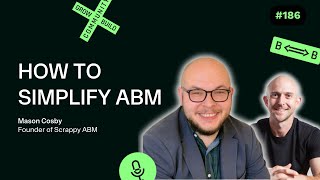
Dave Gerhardt talks with Mason Cosby about Account-Based Marketing strategy and how to actually run it. They cover sales and marketing alignment, the 4D framework, and how to measure what works without overcomplicating the whole thing.
Essentially, the core difference between any other kind of marketing program that's an EBM program is at the core, it's intentional orchestration from beginning to end around the set of shared target accounts. If you have a viable list of great individuals that you want to be outbounding to, why are we not also marketing to them? It's the core difference. One of the core challenges of building an ABM program is that sales and marketing alignment, because sales is really protective of their accounts.
All right, Mason, Good to see you. Good to see you, man. For anybody watching on YouTube, Mason's geared up and scratch in his scrappy, scrappy ABM official podcast official podcast gear. You're. You're a professional. The. You got the brand on point.
I mean, look, any opportunity to wear a shirt that has your brand on, you got to take advantage, right?
That's right. So we're going to talk about abm. I got a note a couple. Maybe a couple months ago from Tim Davidson, and he said that you're one of the best people to have on to talk about this topic. We ended up meeting at Golden Hour, talked about a bunch of other stuff, but I've been looking forward to having this conversation. I just. I think you. This topic of abm, it's usually anytime we talk about abm, it's. It's one of the more popular topics. Topics on the podcast. Why do you think that is?
Yeah, I mean, at the core, I think ABM is one of those things that, in theory, people are like, oh, yeah, I could totally do that. And then you get into it and you're like, this is really freaking hard. I always make the joke that, like, the worst thing that happens is a CMO hears about abm and it's like, oh, we should totally do that. They go back to the office and, like, throw it at our marketing manager. It's like, yeah, just go build the ABM program. So, again, in theory, it's not really that difficult. In practice, it's organizational change. So I think that's why people love it because it's. Everybody has their horror story.
Yeah. I think, first of all, before we get into this topic, want to just. We just do a quick, quick background and intro on who you are and just a little bit of your. A little bit of your career story leading into what you're doing now.
Yeah. I'm probably the only person you've ever had on the podcast that started their career in parenting magazine advertising sales in Jackson, Mississippi. So that's.
No, I had somebody else who wasn't in Jackson, Mississippi. But other than that, you had the niche nailed.
Yes. That is like honest to goodness, how, how I got the start is I was given the list of like go call 300 people a day and just like brute force cold calls. And I was a cradle to grave AE with no marketing support. So at the start that super sucked because I didn't know what I was talking about, didn't know who I was talking to, didn't know what was going on. And this crazy idea like inevitably came up of like, what if I with these list of people, instead of just saying in general you should buy advertising, I created an individual reason on why I was reaching out to them specifically and just said, hey, I have you on this list. And I'm like, you're on a list, but I'm reaching out for this reason. And that was revolutionary. And I became the number one seller, accounted for like half the company's revenue, sales team leader, all that was great. Eventually did that for a little bit. Eventually this really weird thing called Covid happened. And our distribution mechanism was the public and private school system. So all the schools shut down and then I had no job, so transitioned into a fintech company where I led the marketing effort there. And it's funny, I read this post from a guy named Dave Gerhardt that was like when you're a marketing manager or marketing director, like there's a difference between that and a cmo, even if you're like the only person. And. And at the time I was like, I don't know what you mean. I now totally understand what you mean because I was so in the weeds. Like I did the part out implementation myself. It was terrible. And then I inevitably recognized I don't know what I'm doing. So I transitioned into an ABM agency where I ran the marketing effort for the agency, which was the most fun job of my life. Marketing marketing to marketers. And essentially my job was to be an experimenter. My T was literally a biochemist. So he just was like, mason, you're going to figure out how to do stuff and then we'll teach our clients how to do it. And honestly, that's where a lot of the scrappy ABM frameworks started to be developed because I had zero budget. But we were an ABM agency and we wanted to eat our own dog food or drink our own champagne or whatever the framing is. So did that for about three years, transitioned in that organization to went from 25 to 600, was acquired by a global scale ABM agency closed about 2 million bucks in about six months selling ABM programs. So I learned the sales side of ABM again. So my entire career bounced between marketing and sales. And then before I launched Scrap the abm, I actually did a stint with a company called Sales assembly, leading their demand gen efforts, helping sellers learn how to do better sales. So again, if you track all of that sold marketing, did a weird stint in a fintech company, then marketed marketing, sold marketing, marketed sales education, and now I'm back to marketing and selling marketing. So that is my career journey in a nutshell.
Beautiful. Good, good context for everybody. And the topic that we're going to talk about today is this idea of simplifying abm because it comes up a lot and I think one of the misconceptions is we see it asked a lot inside of the Exit 5 community is that there's a connection between ABM and display advertising in some people's minds. You have an interesting approach. I do want to talk about podcasting with you later in this episode separately. Um, but your approach to ABM is not just go run display ads. It's this signal based go to market approach. And that's what I want to unpack with you. But maybe first let's start with, before we talk about the tactics here, who should do this? So one of the gaps in marketing I think is I'm actually, I'm a believer in that any tactic in marketing today can work. Podcasting works, TikTok works, YouTube works, email works, events work. Right it. But none of them work without a strategy. And I think where many marketers myself in past life, you know, past lives included, lax is in the strategy department. Like let's formulate a strategy and then we can go and figure out the tactics here. So if we unwind, if we rewind all the way back or we start at the top here, who should be as people are listening to this episode, who is ABM for which type of company might want to deploy this as a strategy for go to market?
Yeah, goes up saying B2B dedicated sales team. Generally speaking, you want to have an average contract value of at least $50,000 or greater. And there's an asterisk on that. They'll come back to here in just a moment. You would have clear product market fit for the kinds of audiences that you're going after. You want to ideally have a fantastic expansion opportunity. So not just like the one sale and then you're done. But ideally there's an expansion opportunity and the, the asterisks on the, the average contract value is if you're a vertical specific organization. So we've worked with some companies that are vertical SaaS. Prime example, one of our clients had a total addressable market of 500 total accounts because they were a compliance software for like the utilities and manufacturing space. 500 accounts total. So like the average contract value didn't super matter because their total address market was only 500 accounts. So. So if you're super vertical specific, I think you should pretty much only be running ABM at that point.
So I'm just taking my notes here. B2B sales team 50k ACV. Got it. But why? Why is that?
Yeah, I actually got this question yesterday and they really pushed on it and because it, they're like we want to do it, but like our ACV is 13K. I'm like that's cool. In that context you're likely looking for more of a transactional sale because when you think about in these traditional approach to building an ABM program, you're going to create highly specific personalized content and it's largely the time frame to create net new content that's really good. Like you can't necessarily speed that process too too much or you're going to get not great content that doesn't speak correctly to the audience. So from a setup perspective to build like the full scale ABM program and you can do it in phase and that's, that's how we recommend it. But let's say you didn't do it in phases. You're looking at probably a three to four month lead time to just build all the content, set up all the distribution channel, set up all the tracking, train the sales team, all of that is like set up. So again three to four months. And then if you have, let's say you're going from awareness to acquisition, so these people don't know that you exist. How long does it take to educate somebody on the problems that they're experiencing to then understand why they would need your solution? If you do really great marketing, it's still probably going to take a few months, at which point then you have a sales cycle. Now let's say your sales cycle is 90 days. So at that point we had three to four months of setup time, we had three to six months of education on the front end to get somebody to be even problem aware, solution aware and then see us as a viable solution. And then the sales cycle, which let's say conservatively 90 to 120 days, that means that when we started an ABM program to when we truly saw revenue for going from pure cold awareness to acquisition, we're looking at 12 months. So that's generally speaking why there's that recommendation is that a 50k ACV with the number of deals that you would see come through over an 18 month time frame, you can justify that level of investment on the front end before you actually see the returns. Whereas if you think about a 13k ACV, we need to close 3 to 4 of the same number of deals to get the same result from one deal at a 50k ACV.
So what would be the flip side? So okay, so I'm going to keep going on this. So B2B sales team, B2B with a sales team, 50K ACV, they're going to do ABM. What would, how would you articulate what type of marketing the companies that are. So that 13k ACV company, what are they doing digital inbound? Like just. I just want to, I want to frame it for people in, in people's minds. So like what is. Because there also might be people who are on the other side that are listening to. So what, how, how do you talk about what, what is their go to market approach called?
Yeah, I think that's just pure play demand generation. That's like we are creating great content that is not super targeted, super specific. I think you can create vertical specific content. Like again the 13 KCBA is an actual client conversation I had yesterday where like we've got 2,000 accounts we want to go after. They all have a 13K ACV. They're all in the same kind of like vertical in the niche. It was like health care associations and they wanted to close healthcare associations. They had 2,000 of them. It's like that's great. But like I don't know that you need to be running ABM because ABM is super specific, super personalized and like you're assigning named accounts for sellers ideally before you started the program. So like a seller knows when they're getting involved. So it's. If you don't have the right deal value to then associate a seller to an account. Like as a seller, I don't want 500 accounts at a 13k ACV. I would like maybe a hundred accounts that I'm going to work on over the next year.
Yeah, it's just too, it's too much. Okay, so, so it's almost like you need to. In the other, in the, with the ABM approach, it is sales led Mark. It's sales led Marketing assisted. So even without assistance from marketing, you are mason sales guy. You have a hundred accounts in a territory with or without help for marketing, you're going to go outbound, start reaching out to people, starting, start trying to book meetings. Where marketing comes in is to make that a bit easier versus in that other model with 13k ACV, it's going to be a little, it's not going to be outbound, isn't going to scale. Like you need to do the marketing, that's not going to scale. And on the 13kV you need more scalable marketing channels.
I would agree on all of that with the potential asterisk that I view sales as a marketing channel, which is sometimes a hot take. I think that essentially the core difference between any other kind of marketing program and marketing that's an ABM program is at the core, it's intentional orchestration from beginning to end around the set of shared target accounts. So a client of ours named Olga Karinikos, that's the CMO sales screen, one of the things that they started to do is if they are going outbound, they exclusively go outbound to target accounts, period. So there's no other outbound, there's no seller that's going rogue, that's saying I've got my own separate list and do my own separate thing. If you have a viable list of great individuals that you want to be outbounding to, why are we not also marketing to them? So it's, it's the core difference. And often one of the, one of the core challenges of building an ADM program is that sales and marketing alignment because sales is really protective of their accounts. Again, when I worked at the global agency, one of our clients was Airbus. And Airbus has a 10 year sales cycle because you literally have to. From an engineering and a manufacturing perspective, the engines that are inevitably going to be bought for the new jets have to be like designed for that product for that end result, which is a literal jet. The sellers have those relationships, they're super protective of those relationships. That's an extreme example, but oftentimes legacy based sellers are super protective. They don't want marketing touching their accounts because they want to control the entire narrative from beginning to end. The challenge is if one seller owns the entire relationship, what happens if that seller leaves? What happens if that seller has their relationships leave? And the last component is you do not get exponential scale and the ability to more effectively break into an account across every component of the different departments and divisions if you only have sellers involved. So the core Shift in an account based program versus an outbound program or an inbound program or marketing program, however you want to call it, is that it's the intentionality from beginning to end of how do we engage with these accounts and what team members are involved at every single stage. Beautiful.
Okay, so a couple times you've mentioned this abm and also I love what you said, that sales is a marketing channel. I think that that is a great way to think that. Think about this. I also think that, man, we just spend so much time having those things competing. And I think one of the reasons that I'm drawn to ABM as a topic, I know a lot of listeners are for their company is solely around the alignment. The alignment thing. I once worked at a company where the, you know, it was really challenging because we had a self serve. We. We had a self serve funnel where people could sign up for a free trial and converted a really low end. And marketing's job was to like generate those, but there was also a sales motion and we actually had different metrics and we were gold differently and comp differently. And so we, we just battled all the time because they were like, no, we don't want marketing to touch those. We close those and then another company. It's also hard to feed both funnels. I had Shane, who's the CMO at webflow on last week and he was talking about how they used to have one marketing, one team in marketing that focused on like their self serve funnel and then one team in marketing that focused on their enterprise and that just ended up leading to friction. And so now he's kind of combined them into like growth and they each have to think about feeding both funnels. So I like the ABM approach because I do think it kind of removes all of the nonsense. And the most popular podcast episode we've done is with Hillary Carpio from Snowflake who, who ran ABM there and she basically, Yeah, I don't know what you're talking about. We don't have any sales and marketing alignment issues because we have the same goal. And they view. They view sales as a marketing channel and marketing as a sales channel. They work together to get into named accounts. And I love that. I think it clears up a lot. But you mentioned you need to. It takes time. You need to create highly specific personalized content. I don't know. I've never understood what that means. So does that mean like, we're trying to sell to Snowflake and we're making a personalized PDF that We just wrote for Snowflake, like what the heck does that actually mean? Let's unpack that a little bit.
Super great question. We helped a client build like this partner EVM program because they just unlocked this like integration with SAP. So it's a huge opportunity for them to go after all of SAP's customers. So what we ended up helping them build out is they had generalized landing pages that were like, if you work and work with us, you'll see these specific benefits. Like they were software for the manufacturing space that helped with digitalization of SOPs. So greater safety on the floor, greater efficiency, all that kind of stuff. What SAP lacked was the actual correlation back to how does this increase our overall profitability as an organization. So what we then did is we married up lookalike accounts and said, hey, at the core, companies that are using SAP that made the switch to us saw these benefits. So it wasn't just hey, by partnering with our organization you'll see these benefits. Or companies that have an SAP like software saw these benefits. But it's the specific data of you work with SAP. When you work with us, this is what your life can look like. And it was then nuancing every component of the messaging, like what's the onboarding timeframe, what does the process look like? How difficult is it like getting really specific to that level of granular information? Because the goal of good marketing is not to necessarily convince someone of one thing or another, it's to tell them a good picture of what the future looks like when they work with you and an accurate picture. So what I like about account based marketing is when we get so specific we can, with a high degree of certainty and relevancy, say based on all these factors that we know about you, if you are like these other customers, this would be your life after. And like that kind of level of information and detail takes time. So it's that creation of core content and then it's all the peripheral content around it. So prime example, actually helping people understand, for lack of a better word in that context, what gaps does SAP have specifically for manufacturing companies and emea? So like you have specific enablement content that enables your sales team, but also maybe showing up in search. So it's, it's again it's the exact same stuff. It's problem awareness, it's solution awareness and it's viewing us as a viable solution and then painting the picture of their viable future when they work with us.
So it starts with con. So it starts with this like topic and there might be multiple topics that we're, that we're picking. And ideally this stuff is applicable to multiple companies. Right. You might, you might create personalized content for one, but it's kind of going to be like the same three to five challenges that each company has. All right, so, so we, we have a great content team. We spend two weeks doing research, writing this in depth article. Where does it go? Is it on the website? Is it a email campaign? I want to get really tactical and like show use an example to bring this to life. So let's talk about where does it live, what does it look like and then distribution of that content.
Yeah, I'm going to come up higher level and give us a framework that we use for all of our programming. So it's a 4D framework. The first is data. So who are we going after? Why are we reaching out and how do we have to those people appropriately? So again in this example that we're using, it's partners that use SAP. So that's who we're going after. Why are we reaching out? Well, the SAP integration just went live and it already has shown massive benefits for other companies like you. And then how do we message those people appropriately? We know that they're using SAP, we know that they would see benefit from us and we message them in such a way that helps to paint the picture of the future. That's data. Next would be distribution. So there's two sides to this one. Distribution is again this is where I call in. Sales is just a marketing channel because at its core outbound email is just, is just a distribution channel. So could be email, could be LinkedIn ads, could be search ads. Like we, if we want to get really tactical For a moment, HubSpot through the ad extension and somebody keep me honest, if this has been updated because update has been making some recent updates. But if you have a lifetime spend of $50,000 in Google through the HubSpot ad extension, you can actually do a list upload to search and you can do advertising to a thousand contacts in Google. So like very natively in HubSpot pretty easily, like that's a distribution channel. You can do the same thing through Facebook, you can do up to 300 on LinkedIn. So again those are all distribute that we get really tactical. We can go that route. Additionally you've got outbound sales sequences, you've got LinkedIn DMs. All of these are just channels. Additionally, if you really want to get into additional content creation, a webinar is both a promotional vehicle and A distribution channel of information. Additionally, quick context, how did we get here? Tim Davidson recommended that I come on the show after he saw me speak at B2BMX. B2BMX for me was a distribution channel. So all of these places are just how do we get information in front of our target accounts? So we've got a couple of clients that we're working with that are like a part of their ABM strategy is the event. So all of that is distribution. So again, core tactics. It's going to be some component around email is one of the things that we like to use a lot. It's going to be some form of ideally organic social and the other context. If you're watching this anywhere, you see a neon sign that literally says scrappy abm. So for us, we like to validate an unpaid channels and then scale through paid channels. So that's one of the reasons we like email organic social communities because again, at the core ads can get really expensive. They are a great way to validate messaging if you have the budget, but if you don't unpaid channels validate messaging, you scale through paid channels. That's distribution. Next would be destination. So again, what we haven't talked through is the idea of an account progression model. So like where is this person in their journey? Like the core functions that we often reference are awareness, initial engagement, meaningful engagement, marketing, qualified account, re engagement, a lot of engagement pieces. If you picked up on that, next is then qualification and then opportunity to quickly define those awareness. Like do they know that we exist? Initial engagement is more like problem solution.
Wait, sorry, sorry. So, so this would be like. This is. You're essentially like building out a journey, right? Because one of my questions for you was going to be I get that, I get the approach to abm, but one thing where I would get lost is like, yeah, man, we've been doing this for five weeks and we've, we've emailed the heck out of the context that we have at this account and they're not. And they're not answering. So this is like a, this is like a fun. This is a funnel that you've built out, right, basically which maps out the steps from to. And somebody might jump over all the steps and book a meeting.
I don't really care what it's called. It could be a fly bill, it could be a funnel, it can be an account progression model. At the core it's. We are stating at every stage of this approach what is the goal for our accounts? What do we want them to know? And to understand and then how do we then know to serve up new content? Want to be super clear? This is never perfect because, like prime example, Dave, you have a great community of people that talk about a bunch of stuff all the time that will never be tracked anywhere. So it's never going to be a completely closed model. But what you can do is, to the best of our ability, say at the awareness stage, the win is that we see these accounts hit our website. Period.
Got it? Yeah. Yeah. So, so you're looking, you're looking for little signals along the way, like little breadcrumbs of like, maybe we haven't gone through, we haven't booked a meeting, but like, we're doing something and now this company knows we exist and like someone from that company is visiting our website. Let's move on to step number two.
Yes. And the content that you share is dictated by the account progression model. Because at awareness stage, to your point, what will often happen in the first round of an ABM program is somebody will build out their target account list and they'll just email everybody and say, hey, you were showing third party incentive signals. You must be ready to buy. Let's book a call. And that's never the case. That's not actually abm.
But also to your point, you know, like, I see this question come up and I'm like, sorry, I'm not an ABM expert. What's fun about doing these podcasts is, I don't know, I just get to interview people and ask my questions and try to, like, understand from my, from my perspective. I'm good at copywriting. That's about it. But I, I, you know, people are like, well, how? Or, or I'll see like a new company. They're like, well, how do you get customers? I'm like, you, you email them, you reach out and they're like, that's it. There's gotta be other ways. But they're missing exactly what you said in there, which is like, for me, it's always, it's about the feedback loop. And so if I have a account list of a hundred accounts, I'm not just gonna email a hundred at once because we don't know what's working or not yet. So I'm gonna pick off five to 10 accounts. I'm gonna reach out to them with a different, with a subject line, with a pitch, with a particular offer, call to action, if that 10, then the next 10 batches of outreach that I'm going to do, they better not be the same because you're kind of like finding these pockets of what works for like that initial outreach. And so it is, it's this constant game of like getting feedback and adjusting your copy and your messaging. And so I actually think if you reach out to 20 accounts and you don't get a response, that's fantastic. We've now learned something. Right. Did we not get a response because we're just not recognizable in their, in their inbox and they have no idea who we are. And this is just straight up cold. Is the subject line not right?
Right.
Is the copy of what we're saying interesting? Not interesting? Is the ask in the email not right? It's. There's a lot to unpack there. And so I get frustrated when someone's like, well, it's just email. No, there's like 10 steps of the funnel just in that outreach alone that you have to then go back and adjust and calibrate before you go and do another round of outreach.
Yeah. So to like address. Directly address that. We are not typically recommending that a seller gets super high touch involved in an account program until the meaningful engagement stage. Because you can run marketing programs that, where the goal is, let's make sure that they know that we exist. Like nobody can buy from us if they don't know that we exist. And nobody loves to wear run awareness programs. But everybody likes to know that when a seller walks in the room they're like, oh, I know you.
It's like a one, two. So, so basically you're using marketing. So you, you're not doing the cold straight up sales outreach. Right away. You're. Let's start with marketing efforts to like warm something up to get some visibility into this market to lead with content, then we're going to have sales reach out when we've already done something.
Yes. And then depending on the client and the like their internal capabilities at the awareness stage, it might be that their, their inevitable AE is going ahead and sending a connection request on LinkedIn. Like working through how do we start to plant the seeds early that there's an inevitable conversation to be had. So again, it's hard to give like an exact prescriptive answer. But at the core it is, we need people to know that we exist. We need them to be problem aware, which is kind of our initial engagement stage. We need them to be solution aware. So for us, meaningful engagement be things like product page, case studies, pricing page, schedule a call pages. Like if accounts have already started to engage in other content that we're seeing and they Hit those pages. From my perspective, that's a high intent signal that we can then follow up for a re engagement. And with the goal then being.
This is great because I've battled in the past years and years ago. So I'm not, I'm not relevant anymore. I'm just a LinkedIn thought leader. But I love that signal based approach because I feel like so many times in my career in marketing, it's like we've done good stuff. We've gotten people back to our website, but they didn't fill out the form and book a demo and book a meeting. So like marketing stinks and we don't get credit for that versus in this world, like that just never worked for me because it's like, man, who's actually going to take a, like to be really ready to take a, like let's, let's just not even think like marketing and sales people first, second, right? To actually take the time out of your day to reach out and say, hello, I would like a demo of your product. Like, I recently bought a new car. I did all my research up front. I did not go to that dealership until I was like, no, I know this car. This is the one I want. I don't want to do with all this questions. I just want to make this as easy as possible. Like most normal humans are not just going to like fill out a form to get a meeting from sales because they know it's going to happen after that. But at the same time, the marketing team is like only credited when someone actually goes through and book a meeting. Versus I'd rather want to show like, hey, look at all these like interesting accounts and relevant people that we've brought back to our site. Right? And now I know there's a whole people, there's a whole world out there. People who don't like marketing like influenced revenue. But isn't that how marketing influenced revenue? Like we drove you to our website, you did stuff on a bunch of our, our properties. Then like weeks or months later, then when you were actually ready to buy, then you contacted sales. We don't need to worry about getting credit for that specific form. Phil, We've got you on our, on our site, in our store, you've walked around, you've sniffed around a bunch, then you're going to book with us.
Yeah. One of the best things that I learned from a CRO that was responsible for marketing is he said, the first year we launched an ABM program, I did not put a revenue goal on marketing. I said I want all of our revenue to be influenced by marketing. And they ended the year at a 90% marketing influence pipeline. And what that showed is wow, like we saw pipeline increase, which is great. We saw sales velocity increase, we saw deal values increase. Largely because what's the correlation? Marketing was more intentionally focused on influencing the pipeline holistically. Whereas years prior when marketing wasn't given credit for anything, that wasn't marketing sourced and it was just purely if you don't source it, you don't get credit. They weren't focused on pipeline acceleration, they weren't focused on increasing the deal sizes. They weren't focused on pipeline expansion of the account. It was only focused on how do we get more things in the pipeline. And then it sales problem.
Did I cut you off before you hit on all these steps of account progression? Did we, did we map out that point?
There's one other D that's really important in our 4D frameworks. I'm going to rattle it off really quick of data again. Here you go. After why we're reaching out. How do we message them? Distribution. What are your channels destination. What are you sending them to? Like what's the content asset? Which again that's where the account progression model comes becomes really important because you have to send right content based on the account progression model. And then lastly is direction. So how do we track any of it? So that's why I love tools like RB2B apparently like everybody else in B2B right now. But at the core you don't have to get a form fill. You can see some form of de anonymized website traffic where you can then see from a direction component. They hit the site. We know that they're aware. Awesome. Now how do we go to the next stage? So again how are you tracking to then progress the account to the next stage of the account progression model?
And how would you show this data to somebody? So like if you're a marketer listening to this and you want to show you have your weekly meeting with the sales leader, you're in marketing, you want to show that we're. We haven't booked meetings at any of these accounts yet. But I want to show you some type of Here are our goals, here are metrics. I want to show you that we're making progress with these accounts. How, how would you show, how would you guide somebody to show that?
I would. I know I'm going to throw us a curveball mid podcast episode, but I would actually before you go, build an ABM program started A website re engagement playbook or a closed lost program to prove out the model in the first place. Because if you start with closed lost or website re engagement then the actual clear metric of success is meetings booked and pipeline generated based on those that are brand aware, problem aware and solution aware so that you can more easily get sales stuff to work. And then when you've got buy in on that as a program, you then go fill the top of the funnel but they've already got stuff that they're working. And then you can essentially from there if you really think about the concept of website re engagement playbook, once that's built, the more traffic you drive to the website, you then already have a process for sales to then re engage those accounts. So I would not recommend starting your ABM program at awareness.
How are you driving traffic to the but like you're, you know, you're selling 50k ACV, you're not necessarily driving it through like high volume content can is email. One way that you're driving people back to the site because you might be emailing them like a useful resource, they're going to click on that link and then go read it on the site.
Yeah, I mean it's that exactly of hey, you were engaged in this content asset like you were checking these things out. I think of it just like what's next step content? So if you were reading a blog on all the ways that community is the future of marketing, then maybe the next step content would be how do I build a community based on where they left off in their journey, what's the next step that they should be taking and you just follow up with that next step content.
So you're saying for anybody that wants to do an ABM program before going and do like going and doing net new stuff, let's see what we might already have based on close lost and re engaging people that have already visited the site. So then we can kind of like figure out the motion a little bit versus trying to like measure too many new variables. Is that why?
Yes, it is exactly that. The goal going back to the 4D framework, if you look at that idea, the question would be how do I stack the deck in my favor? Like where do I have the best data, where do I have the best distribution channels for an intended audience, where do I already have the best content and where do I have the best tracking capabilities? This is why I love close lost because they're already brand aware. You already have a very unique distribution channel that is a seller that they're already got, they've got some form of relationship with, that's a leg up in that context from a content perspective, generally speaking people have pretty decent sales enablement, product marketing type content. So the goal here is again RE education. And when you go to build a closed loss campaign, if you're focused around what's the reason to re engage? Like what's changed in the past six months? Prime example, if you're a staffing firm with the FTC changing regulation around non compete agreements that dramatically changes the industry. So that's a great reason to reach out of like hey, six months ago you couldn't poach from your direct competitors, now you can, like how are you staffing your team with the best and brightest? Like that could be a great closed loss campaign. So what's the reason to re engage and then building programming around that, that shouldn't be a super heavy lift but proves the model and then allows you to get further buy in to reinvest.
This is why everything in marketing, like the tactics aside, everything in marketing to me just comes back to positioning messaging, the company narrative, the company story, period. Like what's our point of view? What are we selling? What's our point of view? Why, why should someone care about this? Why should they care about it? Now where companies struggle is like if you don't, if you have a stale, if you're in a very crowded industry or you have a stale point of view, you don't have anything interesting to say, it's tough to go out and do do that outreach. Right? And I think that that's where like well what, who owns that? That's got to be like CEO CMO level. Like messaging is going to drive. You can't be successful with ABM without a strong story and a strong hook. And that's how we're gonna, that's how we're gonna get in here. It's like the creative matters, the all the stuff you mentioned, account progression, distribution, all that stuff matters. But it's nothing matters without the story.
I couldn't agree more. If you don't have a good reason to reach out and that's why we always come back to it. That's why sellers like working with us is we don't just pass you a list and say good luck. Like we're always focused on what's our reason to reach out and how do we message those people. Like that's the data piece of like. And most people don't put messaging in data. But for us, if you don't have a good message and a good reason to reach out to even a right fit audience. Then it's a non starter for everything else.
Okay, what else are we missing as we wrap up talking about abm, what should we hit on?
Last piece here is again, just at the core. If you think about what we talked about as the 4D framework, the 4D framework are your tactics. So again, what's our data source, what are our channels, what is our content, how are we tracking it? That's at its core. Those are tactics. You can live there for a little bit. Like that is crawl stage ABM of how do I use things like again, website re engagement, close loss programs, customer win back programs, customer expansion programs, pipeline acceleration programs. All of those are signals and you can use those to build like really small play blocks. And once you've built a series of playbooks, again, you actually essentially create processes for your sales team and you can, for lack of a word, trick your sales team into building an ABM program. Because if everything for the sellers is signal based and it's trigger based programming, then when you fill more accounts into your triggers and into your signals, sellers follow the same process. So it actually becomes a lighter lift for sales in the long run. And the core difference is then how we reach out. So the messaging will be different but like the process should largely be the same for your sellers, which makes it more enticing for them to actually buy in.
What are the ABM myths that you see? Most people will be listening to this like you. One of them is one of them that I like, which drew me to you, is that you don't need 200k in tech spend to go and do ABM. So that's one. What other, what other myths or soap soapbox issues do you have?
People will push back on the ECV like we talked about at the beginning. It's. It's the tech stack, it's the channels, it's. It's a lot of these different components.
That's your decision. Like, I think this is what. Listen to what Mason says, listen to what other people say. Like you need to make your own conclusions and build your own playbook for abm. You should listen to this episode. Just because Mason has an account progression framework and this 4D thing, like use your own brain, think about what you're trying to achieve at your own company. I'm not even joking. Like, this is, you need to make this up. Everything is made up. Somebody made it all up at one point, right? This is why I, I hate positioning and messaging frameworks as a thing. Like, what if you and me can just like write good copy in a Google Doc without a framework? Like, we can get it done. Use your own brain. What is our business? We sell this. We need to get meetings with people to do this and okay, cool. What are the steps? How can we connect the dots? Okay. And soak this in. Like, I listened to this one podcast with Mason. I read this other thing like build your own, build your take, take little. This is what great marketers do. Like take ingredients from everything and, and build your own playbook Here there isn't one one way to do it. And so if you're listening to this and you're like, we're at 10K ACV and we want to do ABM, heck yeah, do it. It's just about, can you make the math work? Does it make sense for you to spend time in this area and to create these resources? If you can do it doesn't matter. It doesn't matter if you spend a dollar, right? Like make it up, please. Somebody made all this stuff up. At some point you got to do it. You got to figure out what's going to work in your industry and for your company.
The biggest final soapbox that would be separate from everything we've already talked about is just like time frames. So I really live in the crawl, walk, run thought process and the framing for scrappy ABM is we are the only ABN service provider for the crawl stage. Whatever. At the core though, if you follow me on LinkedIn, I have a 10 month old daughter. She is literally actively learning to crawl right now and I think it's timeframes. So again with the 200k tech stack that's generally purchased, there's this promise of we can build ABM in like no time and you'll have this full scale program that's just as good as Snowflake. When in reality like a, an infant takes anywhere from seven to 10 months from when they're born to learn to crawl. It's a seven to ten month time frame. That is the average. And like heaven forbid you don't have an above average child or an average child like some organizations are under performing.
Yeah, my daughter, my daughter didn't walk until. She didn't walk until she was like 18 months.
Yeah, like that's the, that's the back end of the average. So like crawl, walk.
Well I love.
Yeah.
I just think, I think there's an important lesson there which is like, I think we try to jump right to the scale. And I've, I've written about this recently where like I've made mistakes in hiring where I've been like, oh, I got a great idea for something that I want to do. Let's go hire someone for this role. And then we, we mess up because we actually don't end up proving it out or we didn't learn so much of like the what now you can be on this podcast talking about what works in ABM because you've done it and you have experience and you've learned what works and what doesn't. In the hiring example, I'd have an idea for hiring somebody, hire them without proving it out at all versus now. What I've learned is okay, we might want to do X. Let's have some someone do this as like 20% of their job. In the meantime, okay, we're going to do an event. So like Dan is doing a ton of event stuff for us right now. He's learning a bunch of that. Then we're going to have proven it. We're going to do a 201st event. We're going to learn, we're going to learn what we liked, what didn't what what we liked, what didn't like all that. Then we can make a better decision if next year we want to hire a full time events person. It's no different when you're building out a new channel or a new program. So I'd love the like go back to basics, crawl, walk, run. Simplifying abm. How's that to put a bow on this. All right, this is great. I got a bunch of different notes. Simplifying abm. Signal based go to market. I love the signal based go to market as a wrap up. Just like I like the idea of like let's incentivize marketing to get people back to the website. Not necessarily to. They only get points. You know the MQL form is on this page and marketing only gets points if someone fills out that form. No, like we drove people into the store. Let's keep driving them back. Let's keep getting them back to consume more information. They listen to, they listen to our podcast. They view this content on our website. Like let's get to that model. I love the signal based intent stuff. I like talking about highly specific personalized content. Your, your 4Ds was really good and then the account progression. So this is a jam packed, you know, 40 minutes for, for people on getting smarter at ABM Mason than for. Thank you for doing this. I Appreciate you coming and hanging out. Go to LinkedIn. You can find Mason. He is there. Mason Cosby, not to be confused with the legendary NFL kicker Mason Crosby, which is fantastic. You'll go find him on LinkedIn, send him a message, connect with him there, start engaging with him stuff. That's another great way to learn. You find somebody interesting on the podcast, connect with him on LinkedIn, like a bunch of posts, and you start to get that stuff in their feed. Mason, we'll do more stuff together. I have no doubt in the future we could do a whole other episode on like a podcasting as an ABM strategy. But we'll get there. But you'll appreciate this. So we're doing an event and all. All of the, like eight or ten speakers that we have, this isn't really an ABM play, but they're all people for our first event to the, to the crawl, walk, run. Point of this, like, all the speakers that I sourced for the event were people that I've already had on the podcast. I know that the audience likes their content. I know that they're good speakers, they're engaging, they're interesting people. They already know me. So if I go and ask them to speak, they're going to. They're going to most likely say yes. Like small things like that. And I know you have a whole playbook with podcasting for abm. So, Mason, good to see you again. Thanks for coming, hanging out on the podcast. Go and check out scrappy ABM and all. Amazing stuff.
Thanks for having me, Dave.
More from Dave



Asynchronous work isn’t a trend. It’s how teams actually get things done without burning out.

AI is changing product marketing. Here's how top B2B teams are scaling without cutting corners.

How Product Marketing Is Evolving in 2025: Lessons on AI and Leadership with Jennifer Cannizzaro

Why referral programs look different outside of SaaS (and why that’s a good thing)

The secret to scaling dual GTM? Give every marketer ownership and get out of their way.

From content to CMO: how Jess Cook made the leap (and built her first budget from scratch)

Leading B2B Marketing for the First Time: Strategy, Budget, Content & Team with Jess Cook

Most B2B advice is built for SaaS. But what if you don’t have demos, PLG, or lead goals?
