Inside Customer.io’s B2B Marketing Strategy: Org, GTM, and Growth Channels with Jason Lyman
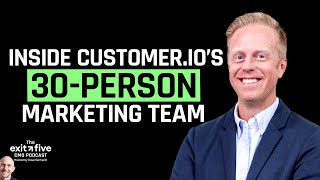
Dave Gerhardt talks with Jason Lyman, CMO of Customer.io, about how the company structures its marketing team and runs both sales and self-serve motions. They cover the org, go-to-market strategy, and which channels actually drive growth for a mid-stage SaaS company.
We were bootstrapped for over 10 years. We're like hidden secret inside of Martech. People maybe not be aware of us as a brand and that's something that I'm actively trying to change.
Hey, my guest on this episode is Jason Lyman. He's the CMO of Customer IO. I just wrapped up recording with him. I got a bunch of notes. We did an awesome conversation. They have a 200 plus person company at customer IO, about 25, 30 people on the marketing team.
So we're closer to 275 employees. And on the marketing side, we're almost 30. And again, I think part of that right stems from we support on the marketing side both a sales LED motion and a self serve motion.
We talked about how they set goals, OKRs, KPIs, their marketing strategy, the team set up the structure, what's working in marketing right now and what he's invested in in the past. That's not working anymore. It might be SEO, it might have to do with AI.
First and foremost, we have good clarity around what are our North Star metrics and what are our kind of okrs for the cor. We try to look at decision making through what do we need to prioritize to support our kind of commitments across those areas. So it tries to take the emotional side out of it versus we try to think holistically as a team of what's the most important to help us achieve those goals.
We talk about why meeting in person is so important, why events are back so hard right now. In marketing, if you're a B2B marketing leader and just want to get inside of of a high performing company with a top cmo, you're going to like this conversation. I got all these notes to prove it. Here's my conversation with Jason live.
1, 2, 3, 4.
Exit. Hey everybody. Thank you for listening to this episode of the Exit 5 CMO podcast. My name is Dave Gerhardt. I'm the founder of Exit 5, host of this podcast. I used to be a marketer, Jason, in my past life. Now they just. I'm just a thought leader now. I don't really do any marketing anymore, but I get to talk to the people who are. I get to talk to people like you on this podcast and I'm super excited to have you here today. This is my guest, Jason Lyman. He is the CMO of Customer IO. Jason, thanks for coming on the podcast.
Hey, thanks for having me. I'm super excited to chat more.
All right, so first of all, people who don't know customer IO, give me the elevator pitch for who you all are and what you do. It's.
Yeah. So Customer IO is a customer engagement platform that helps marketing teams build campaigns and journeys that engage and convert. We do that by helping you orchestrate all of your communications across email, push in, app, sms, pretty much whatever channel you want to use. I think we can help you deliver on that. I think we're really unique in that we take a very data driven approach to supporting those efforts. So we help you leverage your first party data to really drive campaigns that are contextual and adaptable based upon how customers are engaging with your brand. So we have well over 7,500 customers today. You know, we support companies large and small and we, you know, we're here to help.
Awesome. Okay, and what's the overall like as much as you, you're allowed to talk about publicly, obviously this is different as a, as a private company, but just the roughly stage size of Customer IO, it's kind of an, it's an interesting story in that like I remember using the product maybe over, over a decade ago and it's, it's one of those SaaS companies that has been around for a while and just like kind of slowly kicking ass behind the scenes. At least, at least that's my perspective on it. So how, how do you talk about the stage of the company publicly?
Yeah, so we, we were bootstrapped for over 10 years and so I think that's a lot of part of the reason why I've used the phrase that we're like the, the hidden secret inside because people don't maybe not be aware of us as a brand and that's something that I'm actively trying to change.
But we, yeah, it's funny interviewing the cmo, you're like, yeah, yeah, it's so great man, it's so great. Nobody's heard of us.
Yeah, it is. And I think we've made some really, really good progress since I joined. But yeah, we took some investment from Spectrum Equity about two years ago which has really helped us kind of accelerate our growth and our ability to really invest in the platform, in our marketing and really add sophistication to our broader go to market. And so while I can't get into the nuts and bolts of revenue, I think we're, to use kind of existing terminology, we're probably closer to a series C or series D type of company as far as kind of scale and growth. And so hopefully that helps it kind of put it in perspective for folks. So we are very Much not a, a startup. You know, we are a kind of mid stage, you know, maturing business that still has a ton of kind of upside and potential.
Yep. I guess I used to always ask like how many people are at the company and then now it's like these, these new startups are like we have six employees and we've done 7 billion in revenue. So. Yeah, but my, my sense is like, let me Just guess, like 200, 200 employees and 12 people on the marketing team.
So not too bad. So we're closer to 275 employees and on the marketing side we're almost 30. We're probably like 30.
Wow.
Okay, 27, 28. And again I think part of that. Right. Stems from, you know, we support on the marketing side both a sales LED motion and a self serve motion. And so given that we have this dual go to market approach, you know, we, our marketing team is maybe a little bit bigger than you maybe had expected.
Yeah, I mean what do I know? I don't know. Like I said, I'm a thought leader. I'm not in the funnel, I'm not, I'm not at all the events. But 20, 27, 28 marketers on a company of 275 that is this. I'm not a math guy. 10%. Not, not. Absolutely not Crazy. So you've kind of hit on, you've mentioned this a little bit. But actually maybe first let's start here. How do you define the ICP of customer IO? Because where I'm going with this is one of the challenges that I see from a lot of our members in the Exit 5 community and just kind of around our content and just marketers in general over the years is like the challenge of selling to you got the low end and the high end and you got the enterprise and you got the self service. How does that play into your marketing strategy as a company?
Yeah, I mean I think the easiest way to think about it is kind of how our business has evolved. So we started out as a very PLG focused company. Naturally we tended to support, you know, very small businesses to small businesses. And then what we found is, is as we continue to invest in, in supporting the, the kind of efforts of these marketing teams, we found that over time our product got more sophisticated and our customers were kind of pulling us upmarket with them. So we were kind of growing with them. So I kind of really define kind of our, our ICP today is, you know, any marketing team that wants to take a kind of a more data driven approach to how they market. You know, we could support, you know, companies of a couple thousand employees, but we also are approachable for, you know, those smaller, even startups that are, that are just kind of getting, getting going. You know, our startup day is super successful and we actually offer free access to our solution for as much as 12 months to help those kind of younger, more immature marketing teams kind of get up to speed and help them really drive product market fit in that really important stage where they're trying to figure out what is their product going to be and what is their ICP solution or ICP customer.
I guess if I could just like kind of, I want to kind of like crack through this layer a little bit and talk specifically to not, not even people who are interested in, not people who are going to use customer iOS product one day. Think about the marketers listening to the show and they're like, I'm at my company and it's challenging because we have competing Personas or multiple segments. And so, you know, you've, you've seen this at, at bigger scale at your, your last couple of companies. What I'm curious is like, how does this play out into the marketing strategy? Have, are there different segments of the, of the business that marketing has goals around, you know, revenue and, and pipeline around? Because I was at a company one time and one of the challenges was we traditionally kind of had a lot of inbound demand from smaller businesses and then the gravitational pull of the company was to go up market. And then so much of the marketing goals and the things we're doing in marketing actually were supporting the wrong audience. And it created a lot of tension and friction inside of the company. And so I'm always interested in hearing from marketing leaders as to like, how do you set up the org to be successful? Is it quite literally we have a goal for this channel and this segment and they're responsible for filling it. Do you have shared resources? I'm just kind of curious like on the marketing strategy side of things, how you would explain some of how the inner workings are there.
Sure. So at Customer I.O. we've kind of tried to design our org to support both kind of broad user journey that companies kind of go through as they engage with us, as well as the kind of scale that we have across these kind of dual go to market motions. And so the structure is really centered around three what I call targeted focus teams and then two centers of excellence. And so the targeted focus teams, they have this really kind of deep sophistication around certain aspects of our marketing strategy. And so at Customer IO we have a PMM team that's responsible for storytelling across the entire kind of customer journey. And then they work with our demand gen team and our marketing growth teams, the other two kind of targeted focus teams, to then figure out what is that specific narrative that we want to tell to really help them achieve their goals. And then within the demand gen team, we've actually become much more opinionated around the specific funnel that they're focused on. So within demand gen, you're either aligned to our sales led funnel or you're aligned to our self serve funnel. So that way you don't have these competing interests where I have to figure out how do I balance these kind of broader needs where they know what their core metrics are and what they need to drive even further. Within self serve, we have someone who's over trials versus someone who's over our startup program.
Nice. Okay, that's exactly what I was trying to get at. Hell yeah. Thank you. So the, the. And can you just break down the. You have three targeted focus teams and then two centers of excellence. And so like which one of those is demand gen? And maybe if you could explain those. Those three and two.
Yeah. So the three targeted focus teams are demand gen, marketing, growth and product marketing. And then the two center of excellence teams is our brand studio team and our marketing ops team. And so because those teams have these very defined skill sets, they need to be able to flex those across the kind of broad ICP that we support. And in some ways too, they're responsible for driving that kind of consistency across so that we don't over rotate towards supporting one aspect or the other. Because clearly when people make requests of those teams like they're, they want it to be optimized for their specific goals and metrics. And so they're, they're kind of the countermeasure, if you will, to make sure that we don't lose sight of our brand guidelines or that we don't, you know, over invest in a certain funnel at the expense of another one.
Nice. Okay, that, that's really useful. And I love the model of like even just the framing of them like this, the centers of excellence, like we have creative and brand that sit across the whole thing and support each team. I just saw this question come up today, so I'm curious if you have an answer to it, but how, how do you manage, how do you manage the request? Or how does the creative and brand team at your. In your org. He knows where I'M going with this. How do they manage their request? Because it's like it's always the most burning thing for that team. And I, I have yet to find a great system to do this other than we used to call it, don't get, don't get me in trouble for this. We used to call it drug deals. And so whoever could be good at, better at the drug deal was like, you know, I, I'm super tight with the designer. So like this, I'm gonna get, I'm gonna get her and we're gonna get this thing done by behind the scenes.
Yeah. And so this problem is not unique. I think everybody has to kind of figure out the best way to, to solve that. I think the way that we try to do it@customer IO is first and foremost we have good clarity around what are our North Star metrics and what are our kind of okrs for the quarter. And so we try to look at decision making through what do we need to prioritize to support our kind of commitments across those areas. So it tries to take the emotional side out of it versus we try to think holistically as a team of what's the most important to help us achieve those goals. And then honestly we have a weekly sync where the kind of leaders of those targeted focus groups are meeting with the brand studio team or the marketing ops team. And they then debate what is the prioritization for the week, looking at it through that lens of what's needed to help us achieve our goals. And so that's where the kind of push and pull kind of comes and avoids use drug deals. I use who bangs the table the loudest. Like that, that's typically like how I've described it is I don't want to get into a world where that becomes what drives our decision making. And so if we have this North Star that we're going towards, it takes the emotion out of it and then it allows us to make more data driven decisions or more kind of evidence based decisions versus emotional decisions. Which is why I feel like where you get yourself into trouble and then you find yourself kind of over rotating into, you know, over investment in areas of, of your marketing strategy that probably are not optimal.
Yeah, totally, that's, that's super helpful. You mentioned whoever bangs the table the loudest. Something that I think about even, even with my own small and growing company now is, and I think something that I struggled with as a marketing leader is like each team has goals. And so you're demand gen person, you mentioned demand gen growth, product marketing, brand ops. Right. Each one of those teams has their own goals. But what makes a great team is when you have people kind of all rowing in the same direction. And even though somebody might serve the small business side of the funnel versus enterprise, I want people on the team that are really never going to say, oh, that's not my job. And so I'm just going to let that thing.
More from Dave



Asynchronous work isn’t a trend. It’s how teams actually get things done without burning out.

AI is changing product marketing. Here's how top B2B teams are scaling without cutting corners.

How Product Marketing Is Evolving in 2025: Lessons on AI and Leadership with Jennifer Cannizzaro

Why referral programs look different outside of SaaS (and why that’s a good thing)

The secret to scaling dual GTM? Give every marketer ownership and get out of their way.

From content to CMO: how Jess Cook made the leap (and built her first budget from scratch)

Leading B2B Marketing for the First Time: Strategy, Budget, Content & Team with Jess Cook

Most B2B advice is built for SaaS. But what if you don’t have demos, PLG, or lead goals?
