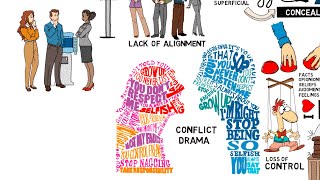
A short motivational talk promoting "revealing" over "concealing" for leaders. It contrasts unconscious leaders (who withhold facts, feelings and judgments out of fear and desire for control) with conscious leaders (who face fears and choose to reveal). The clip outlines costs of withholding—lost integrity, energy, authentic connection, poorer decisions and extra drama—and presents a stepwise practice: check what you would fully say, notice the gap between revealed and concealed, welcome fears and examine control motives, assess the cost of withholding, then decide whether to reveal. Practical tips: reveal to be known (not to win), speak with an open heart, and choose kind, respectful language.
Chapters
Are you revealing or concealing? Brought to you by the conscious Leadership group? Find them on the web@www.conscious.is. unconscious leaders conceal relevant facts, opinions, beliefs, judgments and feelings about issues and the people involved in the issues. Withholding happens because down deep, leaders are afraid. They may be afraid that if they really said everything they have to say or one or more of the following would, they would look and sound selfish. They would lose the ability to control the outcome and the people involved. They would appear odd because no one else is being totally candid. They would be judged and criticized for their thoughts and feelings. Other people's feelings would be hurt. Their lives would be filled with conflict and drama. Conscious leaders face all of these fears and choose to reveal. They do this because they know from experience that the cost of withholding is greater than the cost of revealing. When they conceal, they know that it costs them personally. It costs them their integrity, and this leads to a loss of energy, passion, drive and creativity. It costs them their freedom as they have to pretend to be something they aren't. It costs them deep, authentic connection with themselves and their teammates as people relate in increasingly superficial ways to one another. Conscious leaders also know that withholding costs the team and the organization because all relevant facts, stories and feelings aren't shared. The best decision often doesn't get made. It takes longer to make decisions, and once they're made, people don't fully align around the decision because they've withheld their true self in the process. When people aren't candid in meetings, it often leads to something we call the meeting after the meeting. In the end, more drama is created by concealing rather than by revealing. So what does a conscious leader do? First, they check with themselves and they ask, if I were to reveal everything about myself and this issue, what would I say? Sometimes it helps to actually write this down. Second, they notice the gap between what they're revealing and concealing, between what they're saying out loud and thinking silently in their head. Third, they welcome their fears and get curious about what they can learn from them by asking, if I were to fully reveal, what would I be afraid of? This fear is usually coming from a desire to control. They notice how their concealing is an attempt to try and control other people, themselves or the outcome. They welcome the fear and the wanting to control. Fourth, they notice how withholding is costing them and their team. The cost of not being candid must be greater than the fear of losing control or they'll keep concealing. Finally, they ask themselves, am I willing to reveal yes or no? Try this for yourself. If your answer is yes, then reveal yourself by doing the one. Let go of being attached to being right about your view of reality and this issue. 2. Reveal yourself for the purpose of being known rather than to win an argument or make a point. 3. Speak your truth with an open heart. Being candid isn't being blunt, aggressive, bullying or toxic. Once you decide what your truth is, ask yourself, what is the most loving, kind and respectful way for me to say this? Conscious leaders choose to reveal. So are you revealing or concealing.