The Visionaries: How Venture Capitalist Deena Shakir and Adobe Exec Hannah Elsakr Are Driving Change
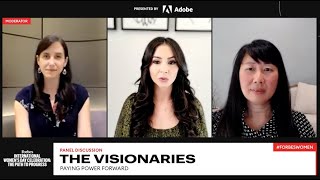
Venture capitalist Deena Shakir and Adobe executive Hannah Elsakr discuss their non-linear paths to leadership and how to close equity gaps for women. Shakir moved from the State Department to tech investing; Elsakr shifted from engineering to corporate development. Both stress mentorship, calculated risk-taking, and the need for leaders to sponsor women and value diverse thinking.
Chapters
Hello everyone, thank you so much for joining us today for this very important conversation about equity at work. I think we all can agree that over the last 2 years the pandemic has exposed fundamental inequities at work and at home, and I'm joined by 2 very, very powerful women who are going to talk to all of us about how they've achieved their paths to power and how you can achieve yours. And I want to start with a simple but complicated question, which is You both sit in very powerful positions. What were the conditions that allowed you to get to where you are right now? Be it mentors, be it training, be it your own stick-to-itiveness. I want to start by giving our audience a sense of exactly what it took for you to get to the seats that you're sitting in. Hannah, I'll start with you.
Well, thank you. And it's wonderful to share this time, Maggie, with you and with, with Deena. And I hope to learn as much as I can share with the team. For me, I, you know, I think it is a combination of all the things you said. There's no silver bullet. I was apprenticed by a lot of people in my career who believed in me, probably before I even knew, knew what I could achieve. And in principle, like, just taking it forward, I— that's one of my key things is paying it forward. So I look to apprentice others who work for me, who don't work for me, because I feel like you really learn by doing and watching others. So that was one big piece, I think, of my journey. And the other probably piece was, um, we talked about this the other day, I, I'm not a risk taker per se. I don't like the word risk, but I do use both my head and my heart to calculate what the next opportunity is. And they don't always look linear. The career doesn't always look linear. Um, but in— but I like to seek out learning opportunities. And so I always took the chance to raise my hand for learning opportunities, different opportunities in different countries and different sectors. And I feel like that really added to the toolkit and allowed me to be in a position where I am today.
We'll get back to that risk-taking point because I think it's an important one, especially as someone who— I have confessed this publicly— I'm afraid of a lot of things: heights, market risk. I am the most risk-averse person you will meet. But I think when it comes to a career and taking chances, that's where you do have to have a little bit of gumption or a lot. But Deena, I want to turn to you. How do you look at your journey? What was your path to the seat that you are sitting in?
Absolutely. Thank you, Maggie and Hannah. A lot of what you said also really resonates with me. I think starting with the idea of paying it forward, even predating my own childhood, my ambition was really marked by this knowledge, this gratitude, this awareness of the serendipity of my good fortune. My parents are both immigrants from Iraq, and I was lucky enough to be born in the Bay Area. And not Baghdad and coming of age during a time of one war after another, it really helped me. It actually gave me a sense of urgency that I had no choice but to take advantage of every opportunity that I had and to pay that forward. It was literally my responsibility. So that drove a lot of what I wanted to do even as a child and certainly into my professional career. And the other piece of it was really following my North Star, which, you know, there can be more than one North Star in your world, a commitment to learning, and really being humble enough to recognize that when you're 18, when you're 22, when you're 25, heck, when you're even 30 or 40, you don't necessarily know exactly what it is that you are meant to do and what your 10-year plan will be. Some people do, more power to them. I love that. But for me, it was recognizing that each experience that I undertook would open up a door to the next one, as long as I was staying true to that North Star. And I had a lot of nonlinear dots along the way. I was a journalist very briefly, nowhere near Maggie, the career that you've had, but that was something that I was really passionate about and wanted to do. And I was covering a story that moved me so much, I had to be a part of it. And that's when I joined the Obama administration. And then again, after several years, I saw what was happening in Silicon Valley and how technology was having an impact on a lot of the problems that I was seeking to solve through policy. And I needed to be a part of that. And that's eventually what led me to tech. And it was working on something at Google that led me to venture ultimately, even though, again, 10, 15 years ago, it's not at all what I thought I would be doing. So a commitment to learning and the humility of recognizing your own good fortune and wanting to stay committed to that path of learning.
I want to go back to a point that Hannah made about risk-taking because, like I said, not a risk-taker. I really, really am quite a creature of comfort. Hannah, what is a risk, a calculated risk, if you will, or a decision you've made that you see as instrumental to your path right now?
So I would say I have struck the word risk from my vocabulary. I look at everything as an opportunity. And Deena's an investor too. Everything comes with considerations. You just have to weigh them and decide if that's what you want to do. And I appreciate Deena sharing some of her personal story. I too, I feel like— the family and the upbringing and the responsibility you bear in the family also probably for both of us drove a lot of our own inner workings and where we are today. I was a software engineer when I started at MIT. I was one of very few women in applied math and computer science. And I pivoted out of that actually, which was interesting at the time. Ended up doing banking, moving to Asia. All of these you might— Maggie, probably you would tell me, whoa, that's a lot of jumps to make. And I've done CPG. I've worked doing turnarounds in the US and run businesses for eBay. All of these things, back to the nonlinear comment Deena made, I really just try to use my head. I'm an engineer. I like to calculate and figure out things, but also intuition. Those two things, I think, come together. As a business person, you're going to have to make the call without perfect information. That's what we do. That's what I try to grow my teams to do, which is you can paralyze yourself by trying to get more and more perfect information. Probably the puck's going to skate away in that time, either in your career or on a business decision, and you'll have missed an opportunity. So don't think of it as a risk. I mean, even, you know, again, I've suffered certain situations where you, you might look on that and say, oh, that wasn't the most successful career opportunity. I view everything as learning. You know, I've learned so much in the tough, tough situations, right? Because you put that into your mosaic of who you are as a leader. So I would like, Maggie, I'd encourage you to strike the word risk from your vocabulary, because I think if you view things as opportunities, you'd be much more inclined to take the call or go, you know, move to another country or something else.
I'm very much a do as I say, not as I do person. I have a friend who is at an academic institution and considering a separate academic institution, and I'm like, go, go, go! And she's the one looking for the perfect information. She said to me, I don't know what skeletons there are. I know the skeletons where I am, but You, you can't know before you jump. But Deena, I want to turn to you. Is there a moment in your career? I mean, I'm thinking about joining the world of politics, that feels risky to me, but I don't want to put words in your mouth. What's a moment that you see as pivotal to getting to where the seat that you sit in, and that perhaps our audience could learn from as they're grappling with their own risk calculations, their decisions to advance their own career?
Absolutely. I mean, so much of what I do now on a daily basis is about making decisions and following my gut constantly, all day, every day, and ultimately taking risks. That's the nature of early-stage investing. But when I, you know, if I look back on my career, there are many of those moments. I think one that stands out in particular is when I was at the State Department and when I felt that urgency to understand tech, to be a part of building a product. I saw what was happening in the Middle East where I'm from with the Arab Spring I was beginning to witness the early days of what we're now calling the Fourth Industrial Revolution with software eating the world in the early 2010s. And I could see that there was something happening. Now, keep in mind, I had a social studies and Near Eastern languages and civilizations major as an undergrad. I, the last technical class I had taken was probably early in high school. I had never worked in the private sector. So it was a really tall order for somebody with that background working in policy to to want to work in product at a tech company. And I tried doing it by hedging, by staying in my current job and doing what I needed to do and looking on the side. And I was met with rejection after rejection. And I recognized that this was going to be such a fundamental shift that for the first time in my adult life, I needed to actually take the plunge and leave the job I was at. I knew I couldn't get to where I needed to go and do both same time. And I paid for college and grad school by myself. I've worked anywhere from 1 to 3, sometimes 4 jobs at a time since I was 18. I didn't have the ability financially as a public servant to, you know, to just take some time off and go, you know, travel the world. So that was hard for me. I ended up, you know, finding some opportunities to consult on the side while I was pursuing finding the right job full time. But I still remember that feeling of holy shit, for the first time in my life, I'm going to be unemployed. What am I going to do? But I knew that's what I had to do. And I don't think I would have made it without that.
You both have such compelling professional journeys. But I want to zoom out now that we've established your expertise. As I alluded at the beginning, it's been a tough 2 years for everyone. But I think we've seen women at work under immense pressure during the pandemic. I'd love to hear from each of you your viewpoints on your industry, your sector. They overlap, but I'll start with Deena. What is your take on female investors, female founders, the state of equity for women in your field right now?
So much. How much time do we have? There is so much going on. I don't know how many of you have kids and have seen Encanto, but I cried the first time I heard surface pressure in that movie just because I felt it was like not just me, but every working mom that I know and everyone trying to battle with all that's going on. In the world, in a global pandemic, now with a war, and still trying to kill it in everything that we do. You know, I've been very vocal about my conviction, not just around women entrepreneurs, but underdog entrepreneurs, underestimated entrepreneurs in general, not because it's good for the world or charitable or philanthropic or because I'm a woman, but because fundamentally we make better leaders. That is now you know, just absolutely documented in data. You know, you've written about this, Maggie, it's clear. And yet we continue to be underinvested in. And, you know, going back to this question of risk, I see this a lot with entrepreneurs that we're backing, where they may feel they need it to be completely perfect before they go out there and fundraise, or they've got to bring in a co-founder who complements them in that way. It's not dissimilar from how women, you know, apply for jobs when they're perfectly qualified for it, whereas you see male candidates applying for jobs that they're 7 years, you know, junior for. That happens a lot in the fundraising environment as well. I will say, you know, in the last several years, I have been proud to invest not only in a number of remarkable founders who happen to be women, but many of whom who have been pregnant during the process and had children and who have absolutely outperformed across the board regardless of their gender. And there are incredible people that I'm seeing every day that are continuing to do that. So I'm super long on, on that space. And I think women leaning into their personal stories and the challenges that they face are opening up entirely new categories that were previously relegated as niche, like women's health. And those are going to be generational businesses.
It is insane to me, by the way, that women's health is niche. I just think that's a separate panel. But Hannah, I want to turn to you. State of women in tech. It's a big subject, but from your position, how are we all doing? How could we be better?
How are we doing? Again, having been trained in software and been in tech for a while, so one theme I have for myself, and I encourage others younger who I mentor, is just know your worth. As an individual in your career, understand what you bring to the table. Understand your towering strengths. Understand what you want to learn. You know, and what you're, what you're doing. And that's gonna, that's gonna give you a very strong compass to operate from. So I sit in a very different seat from Deena, but I meet a lot of founders in different contexts. And I also have, you know, corporate development and integration team. So I'm fortunate to be able to hire a lot of folks onto the team as well. And the state of it is, I think, you know, We need more leaders who value diversity of thought. And it— that doesn't come with a gender or a color. It comes with diversity of experience. And so when I look to hire, I'm very involved in the hiring experience all up and down in my chain, only because I want to encourage people to free themselves from, you know, the typical cookie-cutter background that you would expect in corporate development and M&A, or the pedigree that you're looking for. Like, I value grit, you know, like Deena and I both talked about, like, just raw grit and, you know, the intelligence that the street smarts, the work ethic, there's a lot more that goes into success than just a pedigree. Pedigrees are not bad. But, you know, I think that's, that's, that's kind of part of the story. And so the way I look at it is back to the paying it forward, you know, folks gave me an opportunity, it sounds like Deena was also given opportunities. She made something of it. I made something of it in every opportunity I was given. But it's my job as a leader to make sure that the founders I meet, the people I hire, I provide that exact same opportunity to test their mettle and for them to thrive and survive. So honestly, you know, I don't want to talk about women in tech, you know, in general. I think it comes down to each of us as a leader and in the sphere of influence that we have. To affect that change and to create, you know, to demand a diversity of thought and a diversity of experience in the people around us.
I want to dig into that concept of your own sphere of influence and demanding change within there, because I think, you know, you start at home and then if everyone does their part, change can happen, right? So what is one thing that you're particularly proud of? Maybe it's a hire, maybe it's a mentoring moment that you've had. Maybe it's even reaching out to a mentor that's helped you and that in turn has fueled your career. I'm just getting you to think about spheres of influence. And I'll start with Deena. What is a moment of connection with someone else that maybe our audience could learn from and do for themselves?
Yeah, I mean, like Hannah, I'm so grateful for the folks who have taken chances on me and for those who open up their hearts and their experiences to me. And I do a lot of that myself. So I know how valuable that is and how generous it is. So, you know, there aren't a lot of women who came before me, unfortunately. There are some, but we need more. We need more now, we need more in the future. And there are a few that I really lean on and learn from. One of them is, is an incredible investor, Maha Ibrahim at Canaan, who has been a source of wisdom and real talk with me and continues to be in terms of not only being the only in many cases, but navigating the challenges of motherhood and two working parents in addition to the craziness of the world that we're living in, in this job. And I'm so grateful for that. And I, I do some of that myself with some of the women that I mentor.
And Hannah, what about you? I know we've talked a little bit about leading your team and in the pandemic showing up to work authentically. What's something that you feel you've done well in terms of helping the next generation of women or even just the women on your team?
Yeah, and again, I think, you know, we all stand on the shoulders of others that apprenticed us and showed us how to do things— men, women, like all different folks. And I take that mosaic of learning from them, and I again try to apply it in my life and teach as much as I can. And so authenticity, being genuine, you know, is— it doesn't mean being nice all the time. And I had really a really great woman leader, Liz Smith, who used to be my toughest you know, she was a tough critic, but she grew— I felt like I grew so much under her. And she gave me so many opportunities to really put myself out there and to run things, you know, build product, like launch things in different countries. I try to be honest with my team. And, you know, you and I talked about, like, it's a crazy time right now. And we are all juggling 5 different roles between home and career and kids and all these different things. So What I try to do is just keep— give people permission, right? I'm a very outcomes-driven leader. I don't want to— I don't want to monitor anybody's inputs. Like, you know, we're, we're beyond that. So for me, it's like, do what you need to do, you know? Like, it's, it's— as long as we contract on the outcome, then in whatever time you need and however you need it, I'm, I'm perfectly fine with that. We're— we live in a global society, right? And I'm sure Deena is working with founders all over the globe. We work with people all over the globe. So, um, I think just people permission, just like I was given permission to be my who I am, the kind of you do you. That's, that's what I ask my teams as well. And I think in those environments, we can make mistakes. You know, we can learn, people can find comfort in a job and not feel alienated. So that's a general answer to what you're saying versus a specific one.
Well, I think we are coming down to the final minutes. And with this, I want to close on advice for everyone watching. So I'm hopeful that all genders are watching right now, and we've had a very women-focused conversation, but I'd love to hear from each of you one thing that you want a man to do for a woman that he works with, and one thing you want women to do for themselves. Hannah, I saw you, I saw you sigh. I'll start with you.
Oh gosh. Oh no. I got cold-called first. You know, I don't want to split it. By men and women, I really feel like I'm just going to go back to the apprentice others, like make time to apprentice others and teach. And that takes security, right? That you're going to teach people what you know. And I'm always excited about that. I'm excited to have people be better at something than I am. And so I would actually encourage men and women to find people, find those diamonds in the rough, go invest in some people, take the time out of your day and teach others, you know, whether they work for you or they're in your partner circle or something else, like make the time because no doubt you got to where you were because somebody took the time with you. And so my advice for us and for anybody else is make the time to pay it forward and apprentice others.
Deena, what about you?
Yeah, I love that. I mean, I would add that bring someone along with you. And again, this is for men or for women, for senior folks in their career. There have been some incredible opportunities that I had access to, people that I was able to meet way above my pay grade when I was younger in my career that had an absolutely formative impact on the rest of my journey. And so to the extent that I can, bringing those that I mentor and those that are more junior along with me, and whether that means using an opportunity that I have or a microphone that I have to spotlight them, or literally opening doors for them. I think that's really helpful that anyone can do it as they're advancing in their career and helping others along. And for those that are still forging their way, I love what Hannah said about instinct. If there's anything I've learned to continue to learn, it is about following our instincts. And I think a lot of us, perhaps it's women or maybe it's it's more than that. But a lot of us try to over-engineer and overthink decisions and trick ourselves out of something when our gut told us all along what to do. And I continue to learn that lesson every day. And it's something I coach a lot of my founders on as they reach positions in their careers where they have to make many, many decisions on a daily basis. Lean into that gut.
Lean into the gut. Such good advice. Both of you are fountains of knowledge and information. Thank you so much for joining us. Us today. I so appreciate it. And thanks to everyone at home for tuning in.
Thanks for having us.
Thanks so much.
More from Deena
Bringing Diversity and Equity to VC Capital Funding: Why Deena Shakir is Betting On The Underdog

Iraqi-American Deena Shakir "From Baghdad to Boston: Dropping the Global H-Bomb"