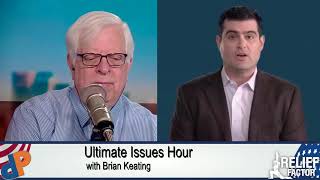
Astrophysicist Brian Keating tells Dennis Prager that following science means questioning, not blind acceptance. He builds instruments to detect faint signals like potential biosignatures on Venus, and warns scientists against self-deification, citing the Jewish teaching that even the best doctors go to hell.
Chapters
So we're talking about follow the science, and you were— do you want to continue your thought, or do you want me to pose a new question?
Now I want to continue this because actually you brought up eyes totally serendipitously, um, and actually I was thinking we discussed the Catechism of Judaism very briefly. It's the analog of Our Father that Catholics have, that our Catholic, uh, brothers and sisters have, and it's the Shema. And the Shema says, do not follow after your eyes and your heart, after which You Prostrate Yourself, or I guess it's Prostitute Yourself, your rational Bible has made a tremendous impact on me. I urge everybody to listen, read it. But look, Dennis, as scientists, what do I do? I make my living making eyes. I don't make them literally, I make them electronically. I make eyes and make ears that listen to the universe, that look out on the universe. I augment the senses that God, if you will, gave to me. That's my job as a scientist, to see the invisible that people thought was witchcraft or sorcery just 100 years ago. This is not something that has been around for thousands of years. And so I'm asking you for advice on how do you balance that as a scientist with the power to create extrasensory perception with the benefit that it's real, that it works, that I can detect a faint molecule on the planet Venus and it could be a harbinger of life on Venus, for example. How do I balance that, that awe that we should feel that man can create and women can create such exquisite augmentation to our God-given abilities, but not get haughty that we start to believe that we are as gods ourselves. How do I do that? Because a lot of scientists listen to your show, and this is something I'd love to hear you opine on.
Well, I think you know that I have cited the Talmud, 2,800 years old, second holiest text in Judaism after the Bible. A rabbi in it says, "The best doctors go to hell." PhDs too, PhDs. Well, there he just might have said all PhDs.
Maybe not all.
But this is a terrible danger. Obviously, it's millennia old that people, which is ironic since doctors until the modern period actually usually made people worse. But that people who are there to heal can easily think they are the healers, and then they capitalize the H in healer, and it becomes a self-deified thing. Do you know this? You don't know. You will find this, I'm sure, compelling. Many, many years ago, I lectured at a hospital to the doctors at the hospital. One of the doctors there was a fan of my work, invited me, doctors showed up. It was the— in all of my life, I have been booed twice at a lecture. Once I was invited, it's hilarious, on the anniversary of Deep Throat to speak on a panel of movie critics. And I was the only one there who didn't think it was a great moment in American history when Deep Throat was released.
Despite seeing it 5 times in a row, Dennis.
I'm sorry? Oh, why do you mention that?
I'm joking.
Yeah, exactly. Well, the irony was it was playing behind me and I even looked at the audience of men and women and I said, You know, I'm not a prude on this. I don't care what you do privately. It's a non-issue to me. But somehow men and women sitting together and a giant screen showing fellatio is not— it's not an uplifting moment, no pun intended, in life. You know, it's just— this is not a healthy moment. And I was booed loudly. The only other time I was booed was when I spoke to doctors at a hospital. And I said that doctors run the risk of self-deification, and they booed me, which only proved my point, in my opinion. Anyway, look, I just want to get back to this follow the science. I don't even understand what the word means, what the words mean. You, you, you point out that we have to constantly— scientists are constantly questioning. So follow the science means question the science. But morally, I'll talk about that with you. Professor Brian Keating, astrophysicist, University of California, San Diego.