Brian Kilmeade: The Fight for Racial Equality
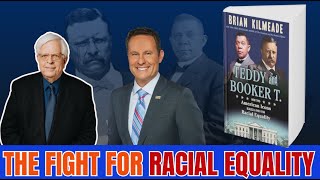
In this YouTube interview, Dennis Prager talks with Fox News host and author Brian Kilmeade about Kilmeade’s eighth book, Teddy and Booker T.: How Two American Icons Blazed the Path for Racial Equality. Kilmeade explains how he became interested in the intersecting lives of Theodore Roosevelt and Booker T. Washington while researching a new Civil‑War‑focused book. He recounts Washington’s harrowing childhood, his self‑education in a salt‑mine household, and his rise to become a leading educator. Kilmeade also outlines Roosevelt’s frail health, elite upbringing, and his admiration for self‑made men, noting Roosevelt’s habit of speed‑reading and his personal connection to Abraham Lincoln’s death. The conversation highlights the historic 1901 dinner where Roosevelt, then president, invited Washington to the White House—a groundbreaking but scandal‑provoking event that illustrated both progress and the entrenched racism of the era. Kilmeade situates this episode within broader Reconstruction politics, the Compromise of 1877, the rise of Jim Crow, and the influence of figures such as Ulysses S. Grant, Andrew Johnson, and John Wilkes Booth. The hosts then pivot to contemporary concerns, lamenting widespread historical ignorance (e.g., low awareness of Auschwitz and the Gulag), questioning the depth of knowledge among modern protest movements, and referencing the October 7 Hamas‑Israel conflict. A brief sponsor plug for Relief Factor’s sleep product is interspersed. Throughout, both speakers emphasize the importance of studying history to understand current societal challenges.
Chapters
Brian Kilmeade is so well known for his work on Fox News, and the man has written— let's see, what is it now, 8 books? Yeah, this is his 8th book. He's a, he's a serious thinker and a great man in the media, and I've been on the show a number of times and I've loved it. He has a new book on a subject I knew nothing about. You realize I'm speaking to somebody who has written a book on something I know nothing about. I mean, I'm not talking a book about particle physics, about which I know nothing. So, Brian, it's an impressive achievement. It's Teddy and Booker T: How Two American Icons Blazed the Path for Racial Equality. I mean, Brian, first of all, how did you come to know about Teddy Roosevelt and Booker T. Washington?
I'm on Long Island. Dennis, thanks for having me on. And I always love talking to you, too. Especially the first talk radio show. You and Bob Grant were the first two I ever listened to.
Wow.
Probably.
Wow.
But you didn't yell at your callers like he did. That's right.
That's true.
Right. But with Teddy Roosevelt, you grew up on Long Island, you know about Teddy Roosevelt. In fact, you're surprised there are other presidents. Sagamore Hill was a trip for every kid they would go to. That's where his home is. And I was trying to figure out what to do after Sam Houston and the Alamo Avengers, because I'm about to go to the Civil War, the most written about war in America. And I go, what can I bring new to that? And while I'm reading, I read up from slavery. Which was the autobiography of Booker T. Washington. And he describes how at 9 years old he was brought to the plantation house and a Union soldier read what he now believes was the Emancipation Proclamation, says you're free. His mom grabs him and starts crying. He's held with joys and tears, him and his brother. They go back to their, their room without, uh, without a floor, without any windows, and think, what do we do now? They never knew his dad, never knew his birthday. He wants to start a life. He played with the other white kids but couldn't go to school. And how does he start? What does he do? Well, she gets her future husband, Wash Ferguson. They get their carriage together and they go to West Virginia and he's got to work in the salt mines. But in his head, he's got to get an education. He's got to learn to read and write. He wanted more out of life. He had this drive and he wanted to get out of the salt mines, but they needed the money. And finally, he convinced his mom, if I go to one class, and find out, would it just one, if I just learned the alphabet? And his mom goes, I got you a dictionary. And he would just try to memorize the dictionary. And then he saw a 1 and an 8. That was the number of, that was the bucket he had to fill up with salt. And that would be later we'd find out 18. He couldn't believe that was the first numbers. And then he takes you to becoming one of the most important men in American educational history, who was as well known in Europe and England as he was here. And I read this story and my jaw was on the ground. And then the more you read, the more you see Teddy Roosevelt in it. And I went to Tweed Roosevelt, the great-grandson of Teddy, who's a historian himself and knew Teddy's wife Edith because she outlived him by decades. I go, am I overstepping to think these guys were special and this is not plowed ground? He goes, pretty much. Yeah, Teddy had blind spots, but he worked with this Black guy 50 years out of slavery in order to move America forward through the Jim Crow South. So I got to tell this story in the most, the quickest, most concise way possible to let people know how far we've come with race relations in America and how much we owe to unlikely people like Booker T. Washington. And I would even say Teddy Roosevelt for making it happen.
So you came to this through your interest in Booker T. Washington.
Absolutely.
Because you kept seeing references to Teddy Roosevelt.
Yeah.
What a fascinating— that's why I'm glad I asked the question, because who would think of this? By the way, when you describe Booker T. Washington, I just finished a couple of months ago the long, phenomenal autobiography of Frederick Douglass, which I believe should be required reading. If one reads one book about slavery, the Civil War, etc., it should be, I think, Frederick Douglass' autobiography. And it is so well written. By the way, the same drive to learn animated Douglass as Washington. Some people are born with it, and apparently even if you're born with it, it's somewhat knocked out by the American educational system today.
The drive.
Yes, exactly. It does seem to squash intellectual curiosity. Okay, so was this friendship of longstanding?
I wouldn't say so. I would say this. So Booker T. Washington is making his way up in life, and Teddy Roosevelt, just to give you a qualification, yes, I know the Roosevelts had money for 7 generations. I get it. But how many kids got asthma and had intestinal problems that kept him from leasing the house. How many kids never went to formal schooling because they were afraid he was going to die? And when you have asthma, can you imagine being in 1870, 1860, 1869, 1871, and you watch your kid lose his breath? They lived in fear that he would die. And he was about 80 pounds, been beat up every time he went outside. His first formal schooling was Harvard. And then he overcompensated because he said, his dad said to him, you got a great mind, you got a bad body, you gotta build it up. And he did. And I fundamentally think after reading everything that he wrote and other people wrote almost, that he felt like a blue collar guy in a white collar world because he felt as though he had to fight to survive the rest of his life to make a difference. In my humble opinion, he felt as though he couldn't waste a day. Because he didn't know when, you know, when you can't breathe and people around you tell you you're gonna die, I think it changes you. And when they met each other, we found a letter, Dennis, from Teddy to Booker T. I just read up from slavery. You're basically, I am so motivated to meet a self-made man like you. When can we meet? Me and my wife were motivated by your story. Let's meet.
And they met in Detroit. Why was Teddy Roosevelt's political position then? Was he president? What was he when he wrote this? He was vice president. McKinley.
McKinley was president.
Right. So, okay, now, so this is later in life that he, that they developed. So he read the book, which by the way is a credit to Roosevelt. I have big problems with Teddy because he gave the presidency to Woodrow Wilson. So don't start me. I think that's unforgivable. But he obviously was an impressive man in many ways. So the fact that he read Booker T. Washington's autobiography and then reached out to him is impressive.
He was probably the first speed reader. He read a couple of books a day. I mean, he read the definitive book on the War of 1812, naval operations that they said they still look back on, the Navy today. He wrote it in college and then updated it, made it more readable. But when he read it, he loved self-made men. He loved people that just overcame things. Also, his mom was from the South. Her two brothers fought for the Confederacy. So he had— and, you know, he, he was born and the Civil War was going on. There's a shot we have in the special we have on Fox Nation of 6-year-old Teddy Roosevelt looking out the window as Abraham Lincoln's body comes down Broadway. And I go to the same exact spot. We look up and we see that floor. And then you see Broadway looks a little bit different. A lot more people, a lot more skateboarders and electric bikes than there was in Roosevelt's day. But you see, he said at that moment, he remembers that moment. Lincoln was always the person he looked up to most, and that was his first time. And Frederick Douglass went to Tuskegee and spoke, and he was a hero to Booker T. Washington. And I wrote the President of Freedom Fighter, you were kind enough to have me on for that, how they worked together to move America forward. And they knew of each other. They finally came together at exactly the right time. And the biggest, I think the person who did the most damage to American history is to America, period, is John Wilkes Booth. Because I believe if you had Lincoln for 8 years and maybe 12 in the 1860s, we might not have needed the 1960s because he knew it had to be done after this war ended. And unfortunately, Andrew Johnson was not a partner. Ulysses S. Grant was. But unfortunately, the compromise of 1877 led to the segregation and Jim Crow we had to overcome for decades later. And that's where Booker T. Washington grew up. He never hated people. He said, my self-esteem was not for sale. And if you hated him because of the color of his skin, that's fine. I'm going to work with the people that don't, and I'm going to make it better for the most people possible, not by making myself famous, but through education. And you're not going to just learn the book.
All right, let me, let me restate. The book is up at DennisPrager.com. Teddy and Booker T, back in a moment. You know how I admire Relief Factor? The product and the honesty, their approach have both impressed me. They now come out finally with another product It's called sleep, and it's pretty obvious what it does. A lot of you need help falling asleep or staying asleep. My heart goes out to you. I don't have that problem, but I know how effective it is because when I went to England last week, 12-hour flight from LA to London, so I wanted to induce some sleep. Works like a charm, and there's no hangover. So give it a try. Go to relieffactor.com and click on the sleep banner and give it a try. It's, uh, it's drug-free. Again, relieffactor.com sleep. A man who does not put you to sleep is Brian Kilmeade. I'm glad you laughed.
Light transition, I love it.
Yeah, you know, I'm talking to such a pro, I forget It's such a joy. It's like, you know, two ballplayers talking the sport to each other. You picked up on good transition, right?
Because we work without a script.
That's right. Exactly. Brian Kilmeade is one of these extremely popular with the public through Fox News and and a serious thinker. This is a very interesting book and it's an example of why I think, Brian, I believe truly the most important subject people can study is history. And the ignorance of it is at the root of our crisis. Do you know 45% of young people never heard of Auschwitz?
I did not hear that stat before.
Yeah. And I'll bet 95 have never heard of Gulag. How do you know anything about the 20th century if you don't know about Auschwitz and Gulag?
Hey, Dennis, how many of those people that have been protesting in the streets, 100,000 in D.C. on Sunday, thousands in front of McDonnell Douglas and all these defense manufacturers, How many people are those protesters for Palestine, for the Palestine that doesn't exist, for the Palestinians, know anything about that or believe that the Holocaust happened? You know, this is the problem.
A lot of them don't believe that October 7th happened.
I know. Listen, I know. And by the way, October 7th, the BBC, you had a guy in the BBC who's running Hamas One of the political wing, I guess they're the good guys, the political wing. They said that no civilians were killed on October 7th.
Right.
Don't believe it.
That's right.
Hey, don't believe what they—
and in much of the Muslim world, that is, that is what is believed, that it is all made up by the West. You know your stuff. This, by the way, I didn't get a chance because I didn't want to interrupt you. You threw out a thought that gave me the chills. The most destructive man in American history was John Wilkes Booth. Do you know, I— the second you said it, I agreed with you. And I had never put that into words like you formulated it. It would be fascinating to ask people, who do you think did the most damage to America in its history? And I, I, I, I would say bin Laden.
They probably say bin Laden. They probably, you know, well, even though one American, even one American.
Yeah.
Yeah.
You know, maybe say people will say Benedict Arnold. I don't know. People who gave Stalin the nuclear bomb secrets. But you're right. It is John Wilkes Booth. Had Lincoln lived, You, you made a— you're really good because you said another great line, because then we— if we have had him in the 1860s, we wouldn't have had the 1960s. I, I listened to you very carefully.
Well, thank you. And for, for someone like you that, that writes the books that you do and does the shows you do, that's truly an honor. But like, I sit there sometimes when you read about slavery and you read about Lincoln and you see what he intended to do, if you really care, the frustration gets so great you almost have to walk away because you think about what could have been if these two guys worked together after the inauguration. And think about this, after Lincoln's second inauguration, do you know everybody, you know all this, everybody was so disappointed because they wanted to hear about, we won the war, now we're gonna do things our way. And Lincoln's like, no, we're about coming together, we're about healing. Now the hard part begins. And it was short and it was right to the point. And that's exactly what Frederick Douglass said. He should have been bitter. These people enslaved me in the South. I had to escape. If I got arrested, I would've spent my life in jail or been killed. I was a fugitive. Instead, he's like, we're all about reconciliation, coming back together. That's the only thing that put our shit back together. And when he looked at Douglass and they met each other, and Douglass wrote this down, If you saw and you read the biography, he looked at Douglas, had to sneak back into the White House 'cause he was invited. No one believed the Black man was invited to the inaugural ball back at the White House. He goes, "My friend Douglas, what did you think of the speech?" And Douglas said, "Mr. President, you got a room full of people. Don't worry about my opinion." He said, "Mr. Douglas, there's nobody else who's more important. What did you think of the speech?" And he said, "It was a sacred effort." He goes, "It was a sacred effort." because he knew the big picture. You put those two guys working together, let me tell you about the Black community. Let me tell you what we need in the South. Let me tell you what we need in the North. You put those guys together working together with Ulysses S. Grant, now that we know the goodness in that man, we knew the South was gonna be tough. I'm not saying there wouldn't have been a KKK. I'm not saying there wouldn't have been people saying, I'm not gonna buy into this equality thing, but I'm telling you, Lincoln wouldn't have allowed it. He would have enforced it, and he wouldn't have worried about his political fortunes in his second term, knowing that Grant was there for the third. And we wouldn't have had Johnson.
Well, he should never have had Johnson as his VP, right? That was a tragedy. That was a tragedy. You, you know your stuff. You're a joy. I love your passion because these are things worth getting passionate about. So Booker T. Washington and Teddy Roosevelt, what did they in a nutshell accomplish?
A couple of things. Teddy Roosevelt, he's famous for inviting Booker T. Washington over for dinner. And he said, you know, after he wrote him a letter, sorry, I can't make that visit to Tuskegee. I became president. McKinley died. It's almost like a funny letter. So they had— he had promised to visit. So that's all. So when Washington hears that Booker T. Washington— when Roosevelt hears that Booker T. Washington's in Washington, he sends a courier over. He says, can you come over for dinner? It's a nice idea. I want you to be my advisor. That sounds great. He had a slight hesitation, but Washington shows up and he eats dinner with Roosevelt's family. And afterwards, they return to the study and they talk about all the things they're going to do with each other. And then one person looks at the guest book and says, Booker T. Washington at dinner with the president's family. This ends up being a national scandal, not so much in the North but in the South. You diminish, you hurt the white race, you hurt Black and white relations. Booker T. Washington had to always worry about Tuskegee and didn't want any crazy KKK burning the place down. They had to take a step back and lower their profile. But he would utilize Booker T. Washington for nominations. So he would use them for judges, for the postmasters. The dockmaster was a prestigious position back then. And he at one point says, don't give me, don't tell, don't give me the person because of their race.
All right.
Or their gender.
Brian, let me tell everybody, the book is Teddy and Booker T. It's terrific. Brian, I salute you, my friend.
It's an honor being on, Dennis. Thanks so much.
More from Dennis



Life, Legacy, and a Dangerous Mission in the Soviet Union | Sunday Fireside Chat





