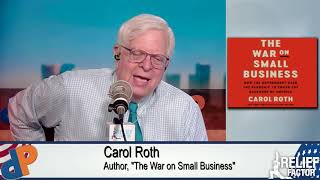
Carol Roth on pressures crushing small businesses: 9 million job openings unfilled, 35% of business owners unsure they can pay rent, and supply chains wrecked by government shutdowns. She argues consumers can help by buying from independent platforms like Bookshop.org instead of Amazon.
Chapters
—have closed. Those who have fought to survive, many of them are being crushed by debt that they took on before the pandemic even began, because, remember, small business owners invest in their own businesses. A lot of that is personally guaranteed. Now they have to compete with the government, who has put out enhanced unemployment benefits and other things that have kept people out of the workforce. So they're competing for labor. We have 9 9.3 million jobs that small businesses primarily can't fill. They're raising their wages. They are offering signing bonuses. They can't get people back to work. They've seen the supply chains completely disrupted because these genius central planners thought that you could just turn off large swaths of the economy and then flip it back on like you were power cycling a modem and there would be no disruption. So they're having a hard time with everything from raw materials to production to shipping and transportation. And then they're dealing with the inflation that's coming out of the monetary policy and some of the fiscal policy as well. So, you know, if you weren't already a small business owner that had been shuttered, you're having a really hard time. And Alignable did a poll for June, and they found about 35% of their respondents weren't sure if they were going to be able to pay their June rent. That's very staggering. Yes.
Well, I want to end with a suggestion to my listeners and have you react to it. I, I've made it, but I don't think I've made it often, but I live by this. I mean, for it— for an inexpensive item, this doesn't apply, but if you buy, for example, a camera, uh, or an air conditioner, I don't know what, anything that's above $25, let's say, just make an arbitrary amount. I just tell people, why would you want to buy it from Amazon when you can support a small business on the internet if you want to use the internet? Does that sound like a good idea to you?
I think it's a great idea. I mean, capitalism is freedom and choice, and you're voting with your dollars. And one of the things that I've been doing as I've been talking about the book is suggesting that if you want to buy the War on Small Business and educate yourself about this and support small business advocacy, you can go to a website called Bookshop.org, and Bookshop.org will actually fulfill the book from a local small business bookseller. So instead of me complaining about how the playing field is tilted away from small businesses and then saying, oh, go to Amazon, we've been telling people to go to Bookshop.org, and I think that you supporting small businesses independently and voting with your dollars is one of the greatest things that we can do to ensure economic freedom in this country.
A young man I know, wonderful, wonderful young man, conservative, he's in his early 20s and is often at my home and really enjoy this kid. Anyway, he is into photography and showed me a brand new lens which was $2,500. I know the lens. And I said, where'd you buy it? And he said Amazon. I said, but you could have got it at the exact same price from, you know, 100 other dealers on the internet, or not to mention a local camera store. And, you know, it registered, but he didn't think about it before. And he agrees that we have to keep small businesses alive. So that's why I think this is a worthwhile suggestion.
I think it is, and it is having more awareness that you're not doing that automatic response. And so educating yourself on the plight of small business and what's happening will hopefully make that less automatic and will make you think, you know, just 2 seconds more to go to a different website if you want to do it online or go patronize your local business and make sure that we preserve that half of the economy economy that represents decentralization and stops the centralized power that's happening.
Well, you're a delight. Carol Roth is the author of The War on Small Business, which is up at DennisPrager.com. Makes the ordering very, very simple. So Carol, thank you so much for the interview and the book.
Thanks so much, Dennis, and again, thanks for your advocacy for economic freedom.
My, my pleasure, to say the least. Okay, everybody, let's take some calls here. David in Irvine, California. Hello. Hello, Dennis.
I've been listening to you religiously recently, but you've been using the term lockdown. That's appropriate for prisoners. It's not appropriate for school children, not appropriate for American residents. What would you like me to use? I find it really—
sorry, what term would you like me to use?
Oh, uh, uh, I don't— uh, stay at home. Okay. And actually, that's BS, as you well know. But I find the use of the term lockdown and its common use, even by you, to be offensive because it's for prisoners. It's not for people.
People were prisoners.
Prisoners or slaves.
Prisoners or slaves. Okay, I just, for the record only, because we have a few seconds, as you hear people dying in hospitals that cannot be visited by a single friend or relative, or prisoners of an, of a, of a mean-spirited, irrational, medically unsound government and medical profession.