Dennis and Julie - Airplanes Hold The Dregs Of Humanity
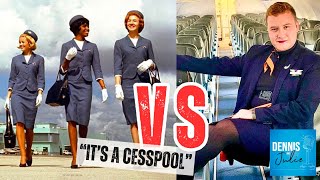
This content was created by Dennis Prager. This content was uploaded by Dennis Prager. This is a YouTube conversation titled "Dennis and Julie - Airplanes Hold The Dregs Of Humanity" (created 2023-11-10) between Dennis Prager and Julie Prager. In an informal back-and-forth they critique current airplane passenger behavior (dress, hygiene, manners), reminisce about the glamour and service of past air travel, discuss airline deregulation and its impact on service and seating, and touch on broader social trends (self-esteem movement, lack of shame, changing norms for flight attendants).
Chapters
It is endlessly fascinating to me to people watch on planes. And my gosh, I'm just going to say it, there are some dregs of humanity on airplanes these days.
Like, the airplane today is essentially a flying Greyhound bus.
It is really— it's gotten like, like the—
you know what a Greyhound bus is?
Uh, no, I don't.
I didn't think so.
You don't miss a beat.
That's true.
You don't miss a beat. Yeah, I don't know what it is.
Okay.
I tried to play it off like I totally knew.
Great.
So I'm just 24.
Correct. Greyhound bus, though, still exists. That is the, that is the cheapest mode of transportation. I think it's the cheapest. And it is. It's so you don't have generally the highest class. I don't mean economic class, just the highest class of people on those buses. So, and there's, Greyhound has stations or depots all in every city in the country. I mean, if you want to go from Oklahoma City to, I don't know, Stillwater, Oklahoma, if there is such a place, you take a Greyhound bus. What else are you going to take? There's no train, there's no plane. So, right? Train, plane, and bus basically. Okay, so that's all.
I feel like plane, The crowd on planes has gotten worse. I don't know why. I have no—
the reason is because they dress like they're going to the beach.
It's also just— it's a dress. It's, it's that— I'm sorry to get TMI, though. All of us have been there. A lot, a lot of people are very unkempt. They seem dirty and like they're not being sanitary. I mean, there are— I was next to a woman and she was like eating a burger next to me and the ketchup was dripping and I was just like, oh my Oh my God, just, and sometimes you see these people and they look really creepy and some of them look kind of drugged out and you're just like, I would love to go around with a pen and paper on the flight and go, where are you going? Or, well, we know where you're going. Why are you flying to New York? What do you do for a living? Are you married? Do you have children? If you could distill your life motto into a sentence, what would it be? Like, I wanna, I just wanna get a profile. Who are these people? People, just weird, weird people on these planes. Has society gotten more weird? By the way, were you reading a book about that, about weirdness?
Oh no, no, no, I was, but that was a serious book. It's about how Westerners are weird in, in the best sense, that we morph to a different drummer. No, that was not about weird people.
I feel like society— this is either going to land totally or not land at all. I feel like people have gotten more weird. Well, and more delinquent.
That's probably true. And what I, what I think about— remember, this is back to my old question to you: who has it worse, you who didn't know America as I knew America, or me who knew America like I knew America? I mean, when I used When I flew at your age, people didn't show up in shorts and t-shirts. I sit in first class at 6'4" and traveling every single week of the year.
You don't need to explain your story.
Exactly. Okay. Anyway, I sit in first class, so I see everybody who comes on board. And I think the next flight I am going to count the number of men— it's more with men— wearing t-shirts.
You know what, you and I disagree on this. I don't have a problem with comfortable clothes on a plane. The thing I agree with you—
society in general. Well, and a big reason is because you didn't see society when it didn't.
That is just—
we're comfortable.
That's totally fair. I think on planes especially, you're so cramped, they're freezing. You probably think they're wonderful. I think they're freezing.
You think planes are freezing?
Are you— you don't think planes are freezing?
The first thing I do is turn on the air vent on top.
The first thing I do is turn off the air vent. I'm sure I bring scarves.
And this is a classic male—
I will wear two long sleeve shirts and a sweatshirt and I'll have a scarf and I'm freezing. Oh, gosh, you are so wrong about this. Wow.
Wrong is the word. Go ahead.
Yes, it is the word. I hear you, society in general. We have definitely just succumbed to the dregs with regard to dressing. But on planes, because they pack you in like sardines and it's so freezing, I get the comfortable. But again, to me, it's more like the sloppiness, the unkemptness, the The unsanitariness, just people who are kind of, who seem drugged out, who kind of smell bad. That's the kind of stuff that I get very worried about. Because if you look at footage, I mean, you know, this is your whole, I actually knew America. I look at footage of 50 years ago, what people looked like walking down the street. You just didn't see people who looked like delinquents. I'm sorry, you do, both in the dress but also in, in the sanitary-ness. And you didn't look, you just didn't see people like that.
Have you seen, uh, we may have mentioned this in the past, but have you seen pictures of the way people dressed up for baseball games?
Yes. It depresses me.
In the 1950s. And we're not talking about the 1850s.
I know it depresses me.
In the 1950s, Everybody watching this or listening to this should just look up pictures. It's easily found. Baseball game in the 1950s. Just, I guess, Google that. You— people dressed so much better for a baseball game then than they do for church today.
Yep.
Let alone for an airplane. And why does it matter? We've talked about this. It doesn't matter to me. It matters because one has to ask the question, why did people dress up whenever they left the house? That is an important question to ask. Baseball game, restaurant, airplane. Why? Because the underlying thesis was, I— it's my way of showing respect to my fellow individual.
Yes. Well, we have talked about this, how there's no sense of respect for society, respect for the other people around you. And the thing I was just thinking about as you were speaking, and I was contemplating why it is that we see, as I call them, way more delinquents or delinquent behavior today than we did back then. And it's because there's no shame anymore. People don't have any shame if they're on a plane eating a burger and their ketchup's dripping and they're playing the video game like that. There's no— there's just We live in this society where it's like, let your freak flag fly.
Well, it's particularly interesting given the high status of the self-esteem movement.
Right.
So you would think, doesn't self-esteem demand that I dress and act in a certain way comporting with my self-image?
No, no. The self-esteem movement means do what is authentic to you.
That's right.
Despite whatever people around you may, like, if I were, I don't care how hungry, and I eat on planes. I'm not against people eating on planes. I'm against the ketchup falling. If I had a burger and I thought that it was gonna make the person next to me, you know, my soppiness, I would— I don't care how hungry I was, I would never do it out of dignity and self-respect. I would just feel so ashamed, even if I didn't know the person. Well, I wouldn't want people around me looking and being like, oh, thank God I'm not next to that girl.
It's amazing how I resonate to your statement So I'm a big fan of tuna salad. I love egg salad. I love tuna salad. I love chicken salad. I just like that food. And I don't eat the tuna salad on the plane because a lot of people don't like the smell of fish.
Yes, yes, yes. I'm very careful with what I eat on planes. It's a very good point.
No, no, you made the point. Oh, so it is.
It's a great point. It's an excellent point. It's a very good Yes, if someone needs to— I'll watch the movie on airplanes because some— we have to do another movie on airplanes and how just utterly miserable. And you know another thing, I'll say this one thing and then I really want to get to your judgment point. There's no customer service anymore. It's really— well, in every area of life, right?
So here's— boy, this will blow your mind. Uh, do you know that there was only one time in my life that I was for government regulation rather than free enterprise.
Yes, airplanes. Yes, it was under Jimmy Carter.
Yes. Had I told you this?
No, I heard you say it on the radio.
Oh, it— and I remember at the time thinking, am I embarrassing myself? Because it so contradicts what I stand for, right? But I strongly suspected that once airlines compete only on price They won't give a damn about how they treat you. So, and I was right. They don't, they used to compete on comfort and service and on-time dependability.
Wait, so I don't understand. So you were for the deregulation?
No, I was against. I said it was the only time in my life I was for government control rather than deregulation. The government controlled airfares. That's what happened until Jimmy Carter. And then it was decided, and it made perfect sense, especially those of us for pre-enterprise, etc. They said, no, let the free market rule in airline travel. But there's no such thing as the free market ruling in airline travel. First of all, there's no free market, no matter what. Because— I mean, there is to a certain extent, but there isn't entirely because there's a limitation on the number of gates. See, the argument, the free enterprise argument runs as follows: you make, you sell frankfurters. Well, in the free market, I'll sell better frankfurters at a cheaper price. I'll win because there's no limit to the number of frankfurters you can sell. But there's an inherent limit to how many flights you can schedule. It's based on the number of gates at an airport. End of issue. So it was always limited. It was never really fully free enterprise. But even putting that aside, all I knew was if the government regulates the fares, how will they compete? On excellence. When they stop competing on excellence and only compete on fares, you don't get excellence. The seats got much tighter. There's, there's less legroom today than there was before. They would even advertise, oh, fly United, we have more legroom than American, or something to that effect. This must, this must blow your mind. Do you even know that everybody even in coach got a meal?
No.
Wow.
That's amazing.
It is amazing because this is not that long ago, but it's in your life, it would not have applied. I— everyone, if first class got a meal, economy got it.
That's equity.
That was equity. That's right. That's the joke. It was equity, but it was inclusion because they competed on food. You'll have a better meal on Delta, but not anymore.
Wow. Okay. Wow. I'm starting to feel bad for myself that I didn't live in the old America.
Oh, well, that is funny. It's not funny, but I know it's funny. I mean, the memories. There was, there was glamor to airline travel.
I'm sorry, come again. There was glamour.
That's right.
Oh, wow. That, that, that would take an athletic—
Well, so here, so this will really get me in trouble. But that's fine.
You're already in trouble.
Exactly. Anyway, the question is not whether it's politically correct. The question is whether there's any truth to what I'm about to say. So here's another interesting example, and I'm torn. I fully admit it, I'm torn. But until I don't know what year, I assume the '80s, the airlines hired I don't remember any male flight attendants. They were called stewardesses. That's what they were. You— they weren't flight attendants. They were stewardesses because it was basically always female. They were almost always young, and they had to meet certain physical requirements in terms of weight, for example.
Oh, really?
Oh, totally.
In terms of weight?
Yes, because it was a glamorous position.
Wow.
And you had to retire at a certain age. I don't know, was it 40? I mean, it was clearly a young age. Then totally understandably they said, no, no, no, no, it's not fair. We want to work as long as we want. We don't want any weight requirement. And now you have a fair number. And I'm hardly thin, but I'm not a, I'm not a flight attendant. And for talk show hosts and writing, weight doesn't matter. But in the airplane today, it is not glamorous, obviously, in terms of who is serving you, because weight doesn't matter and age doesn't matter. Now, this sounds sexist, this sounds ageist, and all of that stuff. The issue is not is it sexist or ageist. The issue is, is it true? And I totally get it that people don't want to retire at 40 and look for other work. But if you know in advance that is the nature of this job, then I don't know that it's inherently wrong. But all I'm saying is there was a sense of glamor.
Well, look at models. I mean, models have I think, I think they've kind of tried to move in a different direction.
Yeah, though they're moving back now. It's interesting. I was just reading Victoria's Secret, I think, is going back to its—
But model, I mean, my God, to be a model, you— they're ruthless with your weight and your age.
Well, they were. They're crazy on the models. The models are almost anorexic. So don't even start me. The models— the models world is not healthy. But the— believe me, the stewardesses. I mean, let me tell you something. If I would say to a friend, you know, I'm going out, which I did, I remember once I was saying, oh, I'm having dinner with this American Airlines stewardess, the assumption was she was really beautiful and glamorous and so on. And they were right. That was the assumption. So all I'm saying is that was a different time. So is it a better time in that regard? Well, it's certainly better for the women who enter flight. There's no question. But I don't think people should argue that no price is paid, but it's all of one. The stewardess was special and this passenger was special because they dressed special. And so it's all gone.
It's just amazing in general to learn that, that there was that glamour and that it was—
Again, what you should do is Google Airline stewardesses, 1970s or 1960s.
And you know what, I'm sure like, look, and I think it's been, you know, there are some more strict things like weight and I think that stuff was better to have been done away with. But, you know, it must have been more fun for the stewardesses to show up every day to work and feel beautiful and maybe even like flirt with a, you know, I feel like, Well, it was a freer world in that way.
By the way, I want to, I want to, I'm really of two minds on this because I fully understand that a flight attendant could do her job, talking about the women now, can do her job and be overweight. That's clear. Even in terms of if, God forbid, you know, there's an emergency. I totally get that. But we're fooling ourselves if we deny the impact of the physical body on public persona.
More from Dennis



Life, Legacy, and a Dangerous Mission in the Soviet Union | Sunday Fireside Chat





