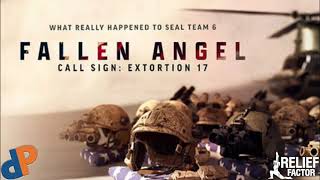
Don Brown, author of Callsign Extortion 17, discusses his investigation into the 2011 helicopter crash that killed SEAL Team Six. Brown presents evidence of possible internal attack, swapped Afghan passengers, a missing black box, and alleged Pentagon concealment of what really happened.
Chapters
So he wrote a book, Callsign Extortion 17: The Shootdown of SEAL Team Six. Based on that book is the new documentary Fallen Angel, and it's at the salemnow.com. Uh, did you make this film?
The film was made by, um, Steven Spivey and Carl Horstman are the filmmakers. Steven Spivey's RPM Films. Carl Horstman runs Triple Horse Studios Atlanta. They had the Atlanta area, and they are pretty well-known filmmaker down in the area. So I'm one of many folks who was interviewed for the film. I see, probably in it, you know, a couple of times, as you'll see. But it was a team effort. We had 30 US Army Rangers come up from Fort Benning to take part in the film. God bless them, they were really professionals. We had folks come forward who, after my book came out, Dennis, you know, they Everybody says conspiracy theory, conspiracy theory. I was hoping that when my book came out, people would come forward, and people have come forward because of my book and for other reasons. And so we interviewed a US Air Force officer who saw the events leading up to the shootdown. We interviewed— or the filmmakers, I should say, Steven Spivey and Karl Horstmann interviewed a US Navy mortician who received the bodies when they came in, interviewed US Army Rangers who were first on the ground. The interviews are riveting. And I think the filmmakers do a great job of, for the first time, letting the nation know who these guys were, these 30 Americans. I mean, there's a dual tragedy here. One, we don't know who these guys are. You know, say their names. My goodness, they're the best that we've had to offer. And then two, the inexplicable chain of flip-flops and, you know, hide-the-ball tactics by the Pentagon.
I don't know if you're free to give away— well, first of all, is there anything to give away? Does your film come to a resolution?
The film comes to a resolution in one respect by giving honor to the fallen, as it should. But there are more questions than there are answers. The film still has more answers than we did when my book came out. But the film and the book raise even more questions that the Pentagon doesn't tell us. And of course, no book and no film can cover the whole story.
Right. So what is your theory? But even beyond the specific questions, why did this happen? Why would anybody at the Pentagon hide what the Taliban did?
Dennis, my theory is that there could very well have been a green-on-blue attack inside that chopper. There was a switch-out. You know, I did not know what I'm getting right now.
Wait, wait, wait. What is green-on-blue? What is green-on-blue?
That's what green on blue means, an Afghan ally attacking our American forces.
You know, there were, there were Afghan allies on that chopper?
Well, there are Afghans on board the chopper, yes. And the thing that I did not realize at the time, at this time in the war on terror in 2011, we were forcing our special operators, our U.S. Navy SEALs, U.S. Army Rangers primarily, to fly these missions with Afghan commandos. We call them APUs. And I, and you can see what, because 'cause I reviewed 1,250 pages of the military record that had been declassified, and testimony from our Navy SEALs and our Rangers, they did not want to fly these guys. They were not reliable. And not only that, but there were a rash of green-on-blue attacks whereby the Afghans would shoot our guys in the back. We even had a major general, Major General Green, who was shot in 2014 by Afghan bodyguards and killed. No one was beyond, you know, them switching on a moment's notice. Not only that, Dennis, but there were 7 Afghans who were swapped out on board this chopper, and their names did not match the flight manifest. Wow. We since found out that there was some bad blood with the Afghans and the troops.
Okay, so why would the Pentagon seek to suppress these facts?
Well, I believe if you stop and think about it, it's 2011, a year before the 2012 presidential election, and I'm speculating at this point, but based upon— there's a lot of circumstantial evidence in my opinion that points toward an an internal attack on that chopper. Why? Because it could be politically embarrassing on multiple fronts. You know, if you have Afghan forces attack, pulling the trigger on an internal bomb or getting into a firefight with Navy SEALs inside that chopper, number one, that blows away the theory that they're as reliable as the Obama administration wanted us to believe. It's extremely embarrassing from that standpoint. It would be a political embarrassment, you know, to the Karzai administration at the time. And the disappearance of the black box— there's an inexplicable disappearance of that helicopter's black box, which contained a voice, a cockpit voice recorder, which would have told us what happened. Remember, this helicopter was hanging in the air for 7 minutes longer than it should have been hanging in the air. We're flying these missions at night. These CH-47s, they're dual rotors, one in the front, one in the back. They're very, very loud. If they hang in the air you know, and aren't moving, of course, they become targets, right? And inexplicably, we lost contact, radio contact, for 10 minutes with this chopper.
Wow.
There's no reason.
So something happened inside the chopper? Yeah, right.
I mean, I believe so. Yeah, yeah. You asked me what I thought happened. I believe that may have happened. I can tell you this, that since then, uh, Billy Vaughn, who's one of our Gulf Star fathers, and I have been working with members of the Congress. In 2017, we went up and met with the late Congressman Walter Jones, who was on the House Armed Services Committee. We met with former Congressman Duncan Hunter, who you know is no longer in the Congress but was also on the Armed Services Committee, and with Congressman Brian Mast from Florida. We talked about this case, and Congressman Jones contacted Matt Thornberry, who's the chair of the Armed Services Committee, and they put several questions to the Pentagon, okay? One of the questions— see, they brought the bodies of the Afghans back, or they brought the remains back here to Dover Air Base. And so one of the basic questions put to the Pentagon to— was what happened to the body of the Afghans. The question was this, from the House Armed Services Committee, the Pentagon, simply this: are there Afghans buried at Arlington? Okay, that was one of 7 or 8 questions.
All right, you know what, we're going to do a part 2. There's too much to ask. I got to remind people, you can see this, the brand new documentary Fallen Angel, at SalemNow.com. Thank you, Don Brown.