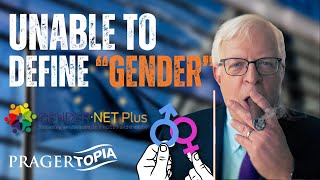
Dennis Prager discusses GenderNet+, an EU-funded research project that ran for five years with nearly 400 scholars from elite universities and $4.2 million in funding, yet failed to produce definitions of sex or gender. Prager argues the failure shows the concepts are unnecessary to force into all academic research.
Chapters
EU-funded scholars fail to define sex or gender after 5-year research project. Do you know what the part of the headline that most blows my mind? 5-year research project. So the answer to that, that, what, the, um, the Matt Walsh documentary What Is a Woman? Is I gotta do 5 years research. That would be the appropriate answer. But then that doesn't work. And I need 400 researchers. A group of international scholars. Do you understand the state of scholarship? A group of international scholars funded by the European Union. I'd love to know how much the European Union paid. I can't— by the way, I can't believe it's so painful. It's a National Review article, and they got the grammar wrong. Were unable to define sex or gender. It shows you the state of education. The subject of the sentence was group, not international scholars. A group of scholars was paid, unable to define sex or gender after studying the topic for more than 5 years, but nevertheless concluded that both concepts should be incorporated into all academic research going forward. GenderNet+ is an initiative that, beginning in 2018, funded 13 transnational— ah, you see, it makes sense— transnational research projects with nearly 400 researchers from 12 countries. According to a grant agreement, the EU awarded GenderNet+ $4.2— nearly $4.2 million. As the various projects under the GenderNet+ umbrella concluded, 40 researchers met for a 2-day workshop in November 2022 to, quote, share experiences, discuss challenges, and consider the best way forward to incorporate sex and gender in research. The authors are affiliated with a number of well-known universities. Including Yale, Oxford, and McGill. Okay, so, so now you will get more and more this great distinction between sex and gender. Why isn't the answer to the, to the question of preferred pronouns— why isn't the answer that we just continue doing what we have done forever. That we, we know of no exception. We, we meet a human being, and based on how they dress, how they look, facial hair or not, we just— in 99.99% of our interactions with other human beings We assume we're talking to a male or a female. Why isn't that enough? Why do you need to tell people your preferred pronoun? Why isn't it obvious? Even if you're trans, why isn't it obvious you are what you feel you've trans— transited into? For the full episode of The Dennis Prager Show, go to pragertopia.com, sign up, and become a full member.