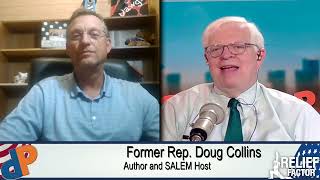
In a conversational interview on Dennis Prager’s show, former Congressman Doug Collins and Prager examine what they describe as a pervasive, class‑based contempt that the political left holds toward conservatives and non‑elite Americans. Collins outlines a historical pattern of liberal mockery of Republican presidents—from Reagan and Bush Sr. to Trump—arguing that each was dismissed as an “idiot” by a self‑perceived superior elite. They discuss how this disdain translates into concrete actions, such as law firms and businesses blackballing individuals associated with the Trump administration, and how it manifests locally in school board politics where liberal officials look down on parents. Collins shares personal anecdotes of being treated condescendingly by D.C. lobbyists and other elites because of his non‑Ivy League, working‑class background from North Georgia. Throughout, the hosts frame the issue as less about policy differences and more about an intellectual and cultural superiority complex that alienates mainstream Americans.
Chapters
the most important subjects in contemporary, in modern American life. He's now a podcaster for Salem Now at salemnow.com. Doug Collins. All right, so I want to tell you what I thought was very insightful and worthy of further discussion when I asked you the obvious question, why the obsession and the hatred? It's not just obsession, hatred. He was, you said, beneath them. I can't tell you how important I believe that is. I think that much of the left's disdain for fellow Americans is entirely class-based. Not economic class, class. We are smarter, we are more powerful, we are more sophisticated than those who are not on our side. Is that fair? Do we have the sound for Doug Collins? Oh, these are the things that drive me crazy. Okay.
There.
All right. I'm sorry. Hey, you are.
Yeah. No, I believe you're exactly right, Dennis. And it's interestingly enough, it has festered over time. Remember, over the past my lifetime, they thought Ronald Reagan was a slow actor. They thought George H.W. Bush was this sort of klutz. They thought Bill Clinton, of course, hung the moon. Then you went to George W. Bush and nothing except, you know, making fun of him. He wasn't paying attention. Attention. And he had a short, you know, and then you went into Obama, who they treated almost as a second coming. And then, then it got to Donald Trump and then he got very real because at this point, they, as I said, they thought he was beneath them. Notice what the liberals did in that class issue that you talked about. They would even go into law firms, business. Most presidents have the pick of who they want to come into their administration, even if they're in, especially the marginal political types. We always have the the main political types that you put in. But filling those jobs typically will come from a perspective, and the liberal side would actually go to these law firms, go to these businesses, said, look, you will not work for the Trump administration or we will blackball you out of this because they had such a disdain for somebody that they believed was not as sophisticated as they were, that was not as smooth as they were. And this is affecting our politics all the way up until just this past election this past week. In Virginia when you had, you know, school board members who basically believe— now think about this, Dennis, school board members one step removed from the general population because of an election sitting there looking at parents saying, you should be happy that we're even speaking to you. That's the underreported story of this, this last few years.
This is so important and so rarely noted. The, the disdain of the left for the non-left is, is partially ideological, but it is primarily a sense of superiority. We are better and smarter. Every conservative president, every Republican president, except maybe the first George Bush because he didn't bother them, was an idiot, is just an idiot. From Ronald Reagan, as you pointed out, to Donald Trump, they're all idiots. So here's a question that my listeners might want to pose to their Democrat, Democratic brother-in-law, and that is, can you name an intelligent conservative? That's a riddle for them.
Well, they would scratch their head. They would, because then they're torn. If they say yes, then they've undercut their entire argument about the conservative movement. If they say no, then they know that intellectually, here it goes back to Biden, intellectually they can't say no because they do know that there are conservatives out there that they may disagree with and they try to downplay but are, you know, intelligent. Remember, there was a, there was an old saying. I don't know if you remember the show The West Wing. Yeah, there was a discussion, a very interesting show. Not— it was very liberal, but there was times of conservative balance. At least they would at least attempt it. And there was a conversation one time about between, I think, one of the characters, a Rob Lowe character, and then the Ansley Hayes character in the thing. And so they were talking about, you know, how could you be against this? You know, the intellectual, you graduated from, you know, good schools. How could this happen? And the Ansley Hayes character makes this comment. She said, you seem to forget it was the— it was basically the Harvard Club of the Washington— the Harvard Washington Club that got us into Vietnam. And just making those kind of comments that bring it up, the fact that just because of establishment elitism you believe your thoughts are right doesn't mean that there's not another side. And that's the thing that the liberals can't assess too. I saw it firsthand with Jerry Nadler, with Eric Swalwell, with Steve Cohen, Mr. Chicken Bucket himself, which I talk about in the book. And Jamie Raskin and these others who believe themselves intellectually superior, and because they believe their ideas are what is right, when in actuality they're disconnected from mainstream.
It's a very much a class issue. That's why when they look at the map of the United States, that old New Yorker cartoon cover of the way a New Yorker looks at America, this New York, then there's there's nothing, and then there's California. And that, that's, that is how they look at it. And, you know, you're a congressman from Georgia. How bright could you be? That's, that's truly what they believe.
I experienced that, actually. It is amazing to, to see the, some of the underlying comments among some of the, not only other members, but even some of the I bring this up, the lobbying class in D.C., they, they come to you as if you really don't have a good idea because you're a very conservative congressman from North Georgia who didn't go to an Ivy League school, who did not go to the— I didn't check the box. I'm a trooper's kid from North Georgia who earned my way through college and law school and master's program. But and then so they would just talk down to you. And we see it all the time.