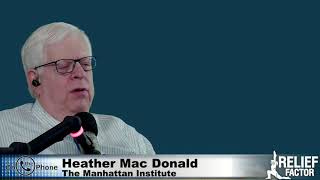
Heather Mac Donald argues the early COVID death toll was low and exponential growth would need to be massive to rival everyday risks. She points out essential workers can't stay home while knowledge workers can, and warns that prolonged shutdowns could trigger worldwide recession, with costs exceeding health benefits.
Chapters
Heather, have you changed your mind since you wrote this piece?
Well, Dennis, thanks for having me on. I certainly understand the compounding problem and the, the fear that this simply jumps the fence and takes off, but I'm still looking at these numbers. Currently 69 deaths in the United States, 60,000— 6,700 deaths worldwide. It still is going to take a lot of exponential growth to come close to the deaths that we take for granted in our daily lives, whether through other diseases or other risks that we assume voluntarily. And I can tell you, Dennis, what I'm seeing here in Manhattan, in New York City, is just a really remarkable class divide. You know, the knowledge workers like myself are able to obey the social distancing rules, work at home. We send our work product over the internet. And yet in my residential building in Manhattan, a 34-story high-rise, we're expecting the maintenance workers to be now doing round-the-clock cleaning. They go floor to floor cleaning every elevator button, every door. and as soon as they finish, they start all up again. Uh, the people who are keeping the airports going— I flew on Friday and Thursday of last week. You know, the Dunkin' Donuts stores are still going, that luggage is still getting loaded and off. So there seems to be some very odd decisions being made, uh, as to who gets protected by these quarantine rules, social distancing rules, and, and those The basic workers in our economy that we assume will keep soldiering on, and the basic functioning of our extraordinarily beautiful free market system that, as our elites strip our stores of goods, the next day manages to put the products back on the shelves. It is a thing of absolute glory and miracle.
Do you know, uh, the government actually told people the national government and local governments to stock up with 2 weeks of food and water? I saw it. This is not just— I actually saw it. Did you know that?
No, I didn't, but it's not surprising because frankly, in one sense, you know, what you have is when it becomes rational to be irrational. This is a fantastic live experiment in mob psychology and social psychology where if everybody else is hoarding, it's a tragedy of the commons, and it becomes rational to hoard yourself, lest you be the one person when there's nothing on the shelves. So in the government's case here, if the measures continue and those supply chains are broken and trucks can't come into, say, the island of Manhattan or, or Pacific Palisades, I don't know, then that becomes reasonable advice. But of course it only prolongs and compounds the problems. So it's a very, very difficult issue to sort out. I can't say that I know where an alternative middle ground is between a reckless, let's say, fair attitude and hyperhysteria, but I do think that our cost-benefit calculus has to be perhaps more sensitive to the long-term, even the health effects of a worldwide depression or recession.
That's exactly my position. That's— my piece will be out tomorrow. The, the You mentioned that there was a two-class system at work here. I think there's a two-class system at work with regard to the hysteria, or even if one doesn't want to use the word hysteria, the concern. All right, I'll use a neutral word. Because the intellectuals driving this in the media, for example, and in academia and in science, They are not affected. They're going to keep their jobs. They're saying to tens of millions of Americans, go broke because this is such a serious illness. I won't go broke, but you should.
That's absolutely right. It's an exact parallel to what I've noticed of who's doing the allegedly contact-creating jobs right now. Now again, I would say they would say yes, but we understand that it's necessary. It's like chemotherapy, you know, you kill the cells now in order to save the patient, and we need to shut everything down now because if we don't, it'll get much worse. So it's a, it's a real empirical question, uh, what would happen if we did not impose these draconian measures. But for sure Manhattan storefronts are already shuttered. All of the small entrepreneurs that have put their life's capital at risk are no way going to be able to hold out through this.
That's right.
They employ millions of people.
That's right. That's correct. And it remains over a number that is socially inconsequential. Every human being is precious. That's not the point, of course. But their only answer is, it's exponentially growing. So how do you answer that charge?
Well, you know, the numbers haven't moved all that much.
All right, hold it there, hold it there one second, Heather, hold it there, 'cause I don't want to interrupt your answer. By the way, I want to talk to you folks. There's some good calls up there. I am so interested in getting your reactions to all of this. I'm Dennis Prager. We shall return.