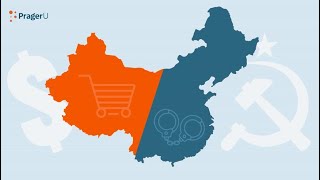
Helen Raleigh describes how 18 farmers in a Chinese village secretly agreed to keep grain profits, producing more in one year than the previous decade. Deng Xiaoping saw the results and used the example to justify market reforms that transformed China's economy.
Chapters
Tells about how capitalism saved communist China. We did— we do— I don't remember all our 500 videos. Did we? I'm just asking Alan Estrin here. Helen, one second. Did we do a video on what Mao did? The destruction of Mao?
We—
so I— because I've done on communism, but not on that specifically. It's hell. What he produced was hell. So Helen Raleigh is a China expert and she's Chinese and she's American and she explains what capitalism did. So some farmers went to the Communist Party officials because you can't do a thing other than perhaps go to the bathroom without, in a totalitarian regime, without permission. They wanted to give the party what it wanted but keep for themselves and sell items on the black market. Is that what we're up to, Helen?
Yes, that was correct.
Right. So this is— is this a remote place in China where this happened?
Well, it was in the area that— well, it's remote, but the province the village was at was not necessarily remote. It was actually known as 'cause it's known for its grain production in China. So it's historically known for grain production in China.
Okay, so they say, so could we try keeping some profits after you get what you want? And what did the Chinese local officials say?
Well, the local official basically said, you know, yes you can, but if we get caught, I myself will be executed by the party, so you have to promise to take care of my family for me.
Oh my God, that's amazing. Go ahead.
Yeah, so the Communist Party leader at the village level, he made the farmer promise they would take care of his family if they got caught, and that's how they signed that secret agreement. With each other. And what's the amazing thing is at the end of that year, the 18 farmers produced more grain than the entire village's production in the last 10 years combined.
It is probably the most dramatic lesson of the need for the profit motive to get people out of poverty.
Yes, it— because it's a— because when you let people choose for themselves, right, and they work hard and they're willing to, you know, take as much risk as they can to do better for themselves and their family, and that's the ultimate motive.
That's exactly right. So what happened? Did, did news of this great boom in production reach Beijing? What happened?
Yes. So obviously they couldn't hide this great production news. And it is from the village level to cities and province, eventually reached to Beijing. At the provincial level, just like the village leader predicted, you know, they got caught and he was going to die. But the supreme leader of Beijing, Deng Xiaoping, he was a very pragmatic man. And when And once he heard about this example, he spared their life because he thought this example gave him idea for economic reform, because he didn't know what to do, how to revive China's economy. But what happened with these 18 villagers gave him idea how to do economic reform. So he actually spared their life and launched a sweeping economic reform by opening China up investing. It's amazing.
The story is truly amazing. One would think that Mao or others who truly wanted to feed their people would have said, gee, why is America so wealthy? And then they wouldn't have needed the 18 farmers. Correct.
Yeah. Well, you know how the rhetoric actually Amazingly, the rhetoric back then in China from the Communist Party is very similar to the radical leftist rhetoric today. They will not credit America as the wealth was built on free market. They will say it's built on exploitation, built on oppression. So of course the Communist Party would not learn from America.
Ah, so I see. The suffering of the Chinese people as a result. I know a fair amount about this because I've studied it, and it's a very depressing subject. If I may ask you, and you can— you're not obligated to respond, but it's obviously— and it has nothing to do with your video— but as a Chinese individual who is American, but Putting the American aside, do you experience anti-Asian bigotry on any regular level or even irregular level?
Well, I do not experience on a regular level. I actually wrote an article last year for Fox News to talk, you know, talk about this very subject. Um, you know, because I'm very outspoken. So yes, I do get, I do receive hate mails. Actually, many of them came from the CCP trolls, you know, from China. But also, I received hate mails both from the far right, as well as from the far left. So from the far right is more, you know, discrimination-based, you know, telling me to go back to where I came from, you know, I do not belong here. But also, interestingly, from the far left, they were just as racist and discriminatory because The far left is obviously disappointed that I'm a minority conservative. Somehow they feel like I betrayed my skin color. Oh, that's right.
You're a traitor.
Yeah.
Like conservative blacks are race traitors.
Exactly. That's the kind of hate mail I get.
I understand. Well, for whatever it's worth, we at PragerU love you.
Oh, thank you.
You're welcome. It's such a powerful video and you'll learn so much. It is up at PragerU. We thank Helen Rowley. I love courage. She has it.