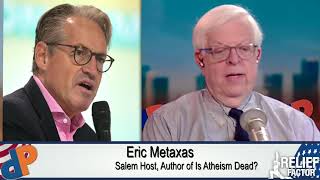
In this YouTube discussion, Dennis Prager hosts author Eric Metaxas and takes a call from an atheist identified as Bob from Orange County. The conversation centers on Metaxas’s claim that atheism is effectively dead. They debate whether a non‑physical creator can be eternal while the physical universe cannot, with Prager asserting that God’s non‑physical nature answers the question of eternity. Metaxas cites the Big Bang evidence (13.8 billion‑year-old universe) as undermining the steady‑state, eternally existing universe favored by atheistic cosmology, arguing that a universe with a beginning points toward a creator, though not proof. He further argues that DNA’s complex informational content is analogous to a computer requiring a programmer, citing philosopher‑turned‑atheist Anthony Flew’s 2005 shift toward theism. Metaxas criticizes prominent atheist figures such as Christopher Hitchens and Richard Dawkins for shallow or dishonest arguments, and mentions his own debates with Hitchens, including a moral scenario about feeling safer if attackers had attended a Bible session. The dialogue is marked by back‑and‑forth exchanges, with the atheist caller challenging the physical/non‑physical distinction and labeling it artificial.
Chapters
archaeological perspective, and I guess even existential perspective, he makes the case that really atheism is dead.
For out of curiosity, Eric, I am just going to go to a call from an atheist because I encourage people who differ to call.
Bob in Orange County, California. Hello.
Hello, Bob.
Hello.
Hi.
Yeah, hi.
Um, you know, your side and your guests and Krauthammer describe the theory of the universe always existing as preposterous, but you substitute a far more preposterous theory of a creator God always existing. If the creator God could always exist, why couldn't the universe always exist?
Because God— because wait, wait, if you ask a question All right, if you ask a question, you need to stop for an answer. The answer is God is not physical and the universe is physical and nothing physical is eternal.
No, it's not even an answer.
It is an answer.
Tell me why it's not an answer. Why is it not an answer that God is not physical?
It's an artificial differentiation between the physical and the non-physical.
Okay, all right, listen, I thank you for calling.
Actually, I, I could just say a word to that, is that, um, the universe— scientists don't believe that the universe always existed. They used to believe that, but when the, uh, really, uh, incontrovertible evidence came in for the Big Bang 13.8 billion years ago, that's actually the first chapter or first two chapters of my book, Is Atheism Dead? It really stymied them because the steady-state universe, the idea that the universe always existed, is consonant with the atheistic view. But the view that the universe began 13.8 billion years ago out of nothing, for most scientists, especially atheistic scientists, it pointed to a creator. It doesn't prove a creator, of course, but it does It does make you lean in that direction. It begins to make that thesis at least plausible.
Yeah, the reason, by the way, for my listeners that I let the listener go was once he said there's no distinction between physical and non-physical, I thought we were really not talking on the same intellectual wavelength.
I might add about this that there's another very powerful very powerful thing for me anyway, and that is DNA. The existence of information is as determinative of there being a God as the existence of a computer implies a computer maker. We are—
It's open and shut, Dennis. It's open and shut. We didn't know this. I mean, the thesis of the book is in 1966, you could make this kind of a claim.
Yes, yes.
But the more time has passed, the less possible it is. And so people are stuck. When you have the tremendous coding of DNA in the singlest, simplest cell— you can't find a, a, a cell simple enough, you know. You find the simplest cell has the most complex information. And that is what led the arch-atheist, um, uh, Anthony Flew around 2005, he said because of that and some other things, he was a lifelong professional philosopher atheist, and he infuriated his colleagues. You know, that's different from Camus and Sartre, but the point is that those who look at this very seriously tend to come out on the other side. Folks like Hitchens and Dawkins, whom I deal with in the end of the book, I mean, I'm embarrassed at how shallow and in some cases dishonest they were. It's amazing how much press they got and how much attention they got.
You'll find this of interest. I debated— who was it you were just mentioning?
Hitchens.
I debated Hitchens quite a few times, and interestingly, in his autobiography, he mentions Dennis Prager asked me this question that he asks a lot of people who don't think God is necessary for morality. If you were alone in a bad section of a city that you were renting a car in, it was midnight and 10 men were walking toward you, would you or would you not be relieved to know that they had just attended a Bible session? I will tell you how he changed my question.