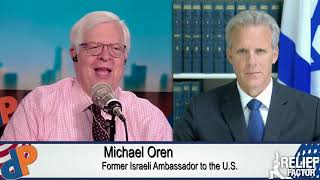
In a candid interview with Dennis Prager, former Israeli ambassador Michael Oren attributes the recent Israel‑Palestine escalation to several intertwined factors. He argues that the long‑delayed Palestinian elections, kept off‑track by President Mahmoud Abbas to avoid a likely Hamas victory, have pushed Hamas to justify its attacks by targeting Israel rather than Abbas. Oren outlines Israel’s three critical dependencies on the United States during wartime: ammunition resupply, a diplomatic "iron dome" to shield Israel from UN Security Council vetoes and ICC prosecutions, and "morning‑after diplomacy" for reconstruction and cease‑fire negotiations. He suggests that a Trump administration would have guaranteed these supports, whereas the current Biden administration’s more restrained stance may embolden Hamas. Oren notes Hamas’s rhetoric explicitly refers to Israelis as "Jews," underscoring the ideological nature of the conflict. He then shifts to the internal fallout within Israel, describing riots in mixed Arab‑Jewish neighborhoods, the burning of three synagogues and a renowned Arab‑run restaurant, and the broader tragedy for Israeli Arab citizens. While highlighting the recent socioeconomic gains of Israeli Arabs—higher per‑capita education and income, especially among Christian Arabs, and their essential role in coalition governments—Oren laments that the recent violence threatens to reverse these advances. Personal anecdotes, such as his relationship with a Muslim greengrocer, illustrate the nuanced coexistence that is now under strain. Throughout, Oren balances analytical assessment of geopolitical dynamics with emotional concern for the erosion of Arab‑Jewish harmony in Israel.
Chapters
Ramadan holiday right now as I'm talking to you. The, the muezzins in the mosques are blasting for the holiday. Tension around the Temple Mount, the Jerusalem Day Parade, which marched through some of the Muslim areas in Jerusalem. All those factors. The biggest, biggest factor by far, the Palestinian elections, or rather the non-holding of Palestinian elections, as Mahmoud Abbas The president of the Palestinian Authority enters the 16th year of a 6-year term, and he keeps on delaying those elections because he knows he's going to lose. He's going to lose to Hamas. This time Hamas wasn't going to put up with it. So the way you prove that you're a good Palestinian is not by attacking Mahmoud Abbas. The way you prove you're a good Palestinian is by attacking Israel.
Wow, that was perfect. That was concise and understandable. So Let me give you a question, as we say in America, but you're familiar enough, from left field. Do you believe— and I'm not looking for an answer, I really am just curious— do you believe that if Donald Trump were still president, this would have happened?
It could, but the reaction on the part of Israel might have been different. Why? Because whenever Israel goes to war with the terrorists, whether it's Hamas in Gaza or Hezbollah in Lebanon. Israel needs 3 things from the United States. It needs ammo because we pretty much run out of ammo after about a month, or certain types of ammunition. The United States is supposed to give us that type of ammo back, resupply us. We need what I call the diplomatic and political iron dome. Now, who's going to cast a veto in the Security Council? Who's going to prevent the International Criminal Court from finding us guilty of war crimes. And then the third thing we need in the United States is the morning-after diplomacy. Who helps rebuild areas that have been shattered? Who negotiates ceasefires? Now, I think with the previous administration, we could have been 100% certain that we would have gotten 100% of all three categories. With the current administration, that's yet to be seen.
So did that play any role in Hamas's decisions or Israel's decisions?
Well, I can't vouch for Hamas, but I think Hamas understands that there is a new American in town, America that's less involved, more pulling back from the region generally. And we've seen it in the reaction of the administration so far in this sort of calling on both sides to exercise restraint. Israel is facing rockets that are designed to massacre men, women and children. And we're defending ourselves. So when you call on both sides to de-escalate and calm down, you know, that's putting us on a moral plane with Hamas. It's actually giving Hamas a prize, saying, you know, okay, keep shooting rockets at the Jews. We're going to treat you respectfully. And bad message.
By the way, I'd like to note to my audience something that very few people in the media note. You said the Jews, and that is exactly how Hamas always refers to Israelis. I actually played, Michael, you'll find this, I think, very interesting. I played a translation done by some major U.S. network, I don't recall which, where the speaker, I know enough Arabic to know what the word Jew is. In Arabic. The speaker said Jews and the translator said Israelis. I just, I find, yeah, no, Hamas refers to you as Jews. Yes, right. So that's their battle. Their battle is with Jews. And I think it's significant that it was because when you mentioned it, you were simply echoing exactly how they speak.
Exactly. Interestingly enough, some of the people have been killed by Hamas rockets have not been Jews, including an Indian foreign worker and two Arabs.
Yes, two Israeli Arabs. So that leads to, for me, one of the key questions, and I'm afraid of your answer. I'm hoping against hope I don't get the answer I don't want. What are Israel's Arabs, not the Palestinians in the West Bank, what are Israel's Arabs saying?
Well, it's difficult to generalize. There are riots that have gone on in some of our communities, which are both Arab and Jewish mixed communities. I live in one of them, in Jaffa, and there's a massive police presence on the street tonight in full riot gear, poised for upheavals by the Arab residents of my city, with whom I lived side by side, and lived, I think, in a great degree of coexistence. But that was true in a neighboring town of Lod, where there was actually a pogrom. 3 synagogues were burnt in the state of Israel. 3 synagogues went up in flames. In the city of Acre, a great restaurant, one of Israel's best restaurants, Uri Buri, the owner of which, he made it his life's work to work together with poor Arab kids and teach them how to cook. He actually brought them to the White House. They served the president once. The Arabs in the synagogue burnt the restaurant down. This is an immense tragedy, Dennis. It's an immense tragedy for Israel, but first and foremost, it is a tragedy for Israeli Arabs. They have made great leaps in recent years. Israeli Arabs are actually more socially upwardly mobile than Israeli Jews per capita. Israeli Christian Arabs are more affluent and better educated per capita. Than Israeli Jews. And in the recent elections, the Israeli Arab parties proved that you can't even make an Israeli government without Arab participation. They've become part of the Israeli political game. All this was actually very good news for the state of Israel. And in one night, in one night, it has been set back years, maybe irreversibly.
That's what I was afraid of. It's got to be for you living in an Arab-Israeli city, Arab-Jewish city, whatever one wants to refer to it. It has to be disconcerting. You think—
It's depressing.
Depressing. That's even better.
It's depressing more than disconcerting.
Yes. It's like, so it's sort of you're thinking, so it's hopeless. I, Michael Oren, not a naive man, former ambassador to the United States, historian, world traveler, writer, and I'm thinking this whole time, look, we seem to be getting along really pretty well and their advances are enormous and then, poof, they try to burn down my synagogue and my restaurant.
And you know, you don't want to blame an entire population for, you know, for the ravages of several hundred radicals. You know, I have a greengrocer down the street where I buy all my vegetables from Mohammed. And Mohammed pulls me aside and says, don't let anybody fool you, we are the luckiest Arabs in in the entire Middle East. No other Arab in the Middle East have what I have. They don't have my democracy. They don't have my security. They don't have my economy. He says, you know something? I got criticism of this place, but I love the state of Israel. So he says to me, Mohammed the greengrocer. You know, I don't think he's gonna be out there burning cars and burning synagogues. And I don't want to tarnish Mohammed the greengrocer. With the rapaciousness of these other people. But it is still very depressing.
God, is that true. I have a few more questions. Michael O'Loughlin, by just great coincidence, a novel of his just came out yesterday, To All Who Call in Truth.