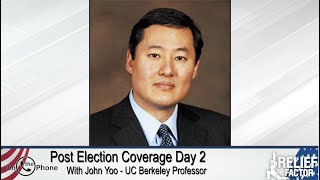
Constitutional law professor John Yoo explains why Pennsylvania's Supreme Court, not its legislature, changing the mail-in ballot deadline from November 3 to November 6 raises a federal constitutional issue. State legislatures, not courts, have the power to set election rules under the Constitution.
Chapters
All right, everybody, you're listening to The Dennis Prager Show. Professor of constitutional law at UC Berkeley is John Yoo. And John Yoo, I'd just like to note, has a new book, Defender in Chief: Donald Trump's Fight for Presidential Power. By the way, I think I always ask you this, but I'll— so I'll ask you again. Are you sort of on the outs at Berkeley? I mean, you know, when you walk into a room, do they stand up and cheer?
That would be an unusual experience that I've never had before. To be on the outs, I think you had to be on the ins at some point. Uh-huh. Uh-huh.
I'm not sure. No, you could be permanently on the— you could start on the outs. Okay, so I think you answered my question. Fair enough. So I really, I love clarity, so I really want to get this for me and my listeners. If the Supreme Court, okay, the people, I'll start at the beginning. The people who make the rules on how a state votes is the legislature of that state. Is that correct?
Yes.
However, you threw in something I was not aware of, which is a little monkey wrench in my brain now, but the US Congress can also intervene.
Yes.
Has it ever done so?
So when you read about laws like Congress giving out money for election security, trying to encourage people to secure their systems, That's the extent of it. Actually, Congress has been very reluctant to use this power. They generally defer it to the states. That's why, as you've pointed out, Dennis, the states basically run the election systems, and most states push that, that down to the county level. And it's really the counties that are—
okay, so then I'm back to my earlier question. I don't understand— well, I guess I don't understand who passed the law with regard to fudgy smudgy postmarks? Wasn't it the Pennsylvania legislature?
No, see, this is, this is why you put your finger on the constitutional problem. It was the Pennsylvania Supreme Court that did it, not the legislature. And so if you're Justice Alito, you look at that and say, where does the Pennsylvania Supreme Court get any right at all?
Yes, yes, right. That's, that's the question. But okay, all right, but why? Okay, that's a Perfectly unbelievably legitimate question, but why does the U.S. Supreme Court have a say in that?
Because they have to defend the right of the Pennsylvania legislature under the U.S. Constitution. It's the U.S. Constitution that says it's the Pennsylvania legislature that decides.
Oh, then I am stunned that 4 justices did not take the case.
Well, therefore, there's a thing you need to fix.
I know. No, no, I'm well aware of that. And they may now have a fifth. But I have to say, prima facie, I don't just— I just don't understand. I just threw that in because you're a lawyer. But on the face of it, isn't it obvious, this case? I mean, the Supreme Court of Pennsylvania has as much right to determine electoral law in Pennsylvania as I do.
Yes, that's about right according to the way these justices are reading it. You rarely see justices say this, but Justice Alito, with these other justices joining in, he said, I already think the Pennsylvania Supreme Court has violated our Constitution, right? This is a nationally important case and we should intervene.
And what was the argument of the other four?
They didn't say anything, but Justice Roberts later said, well, it sort of plays on your initial instinct on this. And it's a state court, they're interpreting Pennsylvania law, we don't have a role. And that's why Justice Souter said, but that's wrong because actually the US Constitution that says the legislatures decide, not— we're not— this is not under Pennsylvania law.
Right. Okay. Then there's the nonjudicial question of how many envelopes came in with smudgy postmarks in Pennsylvania. In other words, Is it a fight over principle rather than over effect?
That's interesting. You're quite right, Dennis. There's two kinds of cases that are going to come out of Pennsylvania. You know, one is, was it legitimate to change the date from November 3rd to November 6th? That's pending at the Supreme Court now. The other case, the other issue which is going to have to be litigated, you know, there's going to— it's not at the Supreme Court. You're going to have to see cases filed right now at the trial level, which is Are the state officials, city, county officials who are in charge of counting the votes right now, are they doing it in a careful legal way? Or are you seeing shenanigans like, oh, 10,000 votes all coming in for Biden and none for Trump from certain jurisdictions or for certain groups of mail-in ballots? You're hearing stories coming out. You're going to have to involve the courts there too.
So what— I mean, I'm asking you for a prognosis, which is not entirely fair, but it's, it's an educated prognosis. What could you see the Supreme Court of the United States having to rule on this year?
Interesting. So it depends whether Pennsylvania is crucial to the outcome of the election. Suppose Trump doesn't win Nevada and Arizona and Biden clinches without regard to how Pennsylvania goes. He doesn't— Biden doesn't need Pennsylvania. Then I could see the Supreme Court stepping back and saying, we don't need to decide this. It doesn't make any difference. Why get involved in the middle of this political fight when the Electoral College has already picked Biden? But if Pennsylvania becomes the state that determines the election, just like Florida 20 years ago, And I think the Supreme Court will decide that first issue, November 3rd date being switched to November 6th without authority by the Pennsylvania Supreme Court, especially if those votes that came in in those 3 days were determinative between Biden.
I actually think that it would be important and easier to take the Pennsylvania case or any other, if it didn't determine the results nationally, then they can't be accused of putting their thumb on the scale of the elections.
I agree, that would be good for the country that we have these rules.
Yes, I have that odd idiosyncrasy. I think what's good for the country.
But I don't think Chief Justice Roberts is thinking that way. I think he just wants the Supreme Court to be as small a political target as possible.
Right.
No matter what.
Yeah. Well, all right, my friend, you're, you're a clarifier of issues. So, uh, by the way, are you, are you having classes now? What's, what's your story at Berkeley?
Well, uh, we are having classes by Zoom. Uh, I'm actually surprised more students, and more particularly their parents, are not filing for refunds.
I'm stunned. I, I, the This is a sad statement I'm going to make, but the supine nature of the American people over lockdown laws and over tuition at colleges has actually saddened me.
Hmm. But I think maybe the one good thing to come out of this is that people are going to now realize how much fat there was in the system.
You're my hero, John Yoo, as book defender-in-chief. I'm Dennis Prager. We continue.