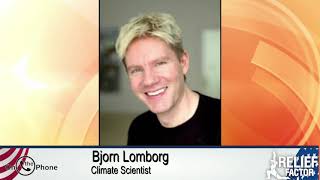
Bjorn Lomborg argues that media coverage distorts climate risks. Satellite data showed 2020 was one of the weakest hurricane years despite headlines. Climate deaths have fallen from 500,000 in the 1920s to 8,000 today, and weather damage has declined for three decades.
Chapters
It's frightening. So I asked you before, what is propelling people to put the Western world into a form of bankruptcy?
Obviously, I'm not privy to, you know, what Joe Biden is thinking. But when I meet with a lot of these people who are really earnestly very, very worried about the world, I think there's a couple of different things. If you look at the news, which is now just overwhelming 24/7. You know, you see one hurricane after another on CNN, and you get the impression that there are just more and more hurricanes. And of course, lots of people will tell you that. They will carefully curate the data such that it looks like this is a catastrophe and it's just getting worse and worse. So you may remember back in 2020, we were told this was the extreme hurricane year. It was a record-setting year. We ran out of names for these hurricanes. Remember, That's because we now have satellites, so we can see all the hurricanes also out in the mid-ocean that never go anywhere. But if you actually look at the power index, so how much damage potential were there in those hurricanes? Yes, the North Atlantic was over the average, but that's to a very large part of El Niño, but the rest of the world was actually halfway under. So overall, 2020 was one of the weakest hurricane years in satellite history. Yet you never hear that. You just see one more hurricane, then one more hurricane. So a lot of people get really scared. Then why do politicians say this? Well, politicians have never seen a bandwagon that they don't want to jump on, right? This is basically a way of being able to say, vote for me, I'm going to save you, I'm going to save your kids, I'm going to spend lots of money on different things. And so in that sense, I think the The scare campaign that we see now is very much like, if you remember back in the 1970s, we were very worried that there wouldn't be enough food for the world. In the '80s, we were worried about acid rain, the ozone layer. Remember, all of these had some real points, but much of it was just vastly exaggerated. Of course, there was lots and lots of money spent on it that was just wasted. Unfortunately, climate change has the very same tendency as what we've seen over the last 50 years.
So the, what Bjorn Lomborg explains in his books and his articles among other things is, and as soon as one asks this question, I'm now speaking to my audience, Bjorn.
Yeah.
But you're more than welcome to react if you wish, but I've said for all of my broadcast life, the question, what is the price, means that you are no longer— and I don't expect you to get political, I'm just telling this to my audience— the question, what is the price, what are the consequences, is a conservative question. It is never asked on the left. What are the consequences of our policies? So that people live in this world of it can be free. So he asks, that's what Bjorn Lomborg asks. He doesn't deny that fossil fuels are making the world warmer. He denies that it's a catastrophe, and he shows what we are spending, how we are hurting the average human being much more by what we're spending than if we don't spend this money. So you gave the data now on hurricanes. I'll bet most Americans believe it was a terrible hurricane year last year. Is that fair to say?
Yeah, and it's also wrong. And it's also, if you look at the actual damage that we see, again, you know, the New York Times had, it was twice as much as last year, as in 2019. But that gives you no context whatsoever. What we actually saw was, again, weather-related damages were on a downward trend, and they've been that for the last 30 years. Moreover, if you look at the people who die from climate-related disasters— so storms, floods, droughts, heat strokes, so on— if you look at all of those people over the last 100 years, the number of people that die have declined from about half a million on average in the 1920s to about 8,000 today. It's declined by 98%, and of course at the same time we've gotten to be 4 times as many people on the planet. What that tells you is we are not close to an exploding catastrophe. We have a problem, yes, and by all means let's think about how we smartly fix that problem, but let's stop talking about a catastrophe.
All right, get his book False Alarm and his Article is up at, uh, DennisPrager.com. I thank you. He's doing great work.