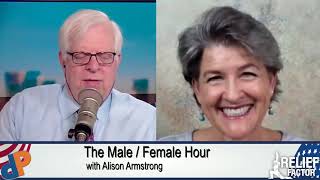
In this interview, Allison Armstrong reflects on three decades of studying men and gender dynamics, revealing how she once believed men were inherently bad and how that belief led her to unintentionally "emasculate" men. She defines emasculation as the deliberate or unconscious act of diminishing a person’s ability to produce results, which she ties to the masculine identity of achieving and problem‑solving. Armstrong argues that many women instinctively fear male power, yet are simultaneously attracted to it; this fear prompts a knee‑jerk response to weaken men’s strength when they feel unsafe. She extends the concept to women, explaining that diminishing a woman’s capacity to produce results also constitutes emasculation. Armstrong emphasizes that emasculating oneself or others is a normal, widespread human behavior that does not require malicious intent, and that recognizing this pattern is essential for healthier gender interactions. The conversation also touches on common misinterpretations of gendered actions, such as men opening doors for women, which can be mistakenly seen as patronizing when it is intended as a gesture of respect.
Chapters
Thank you. Thank you. I'm really glad to be here. And you know, when you said you're a good person fan, I was reminded that before I started studying men 30 years ago, I actually believed that men were not good people.
Fascinating. Well, that makes— go on.
Yeah. And then, you know, You know, my friend was called a frog farmer, right? Someone who turns princes into frogs. And I realized I was bringing out the worst in men and thinking that's who you really are, but I had no idea how I was doing it. And so I'm excited about what we're doing today, 'cause it's really how we bring out— we bring out the worst in men and in women and even in ourselves. So this is a good 30th anniversary. Anniversary show for me to do with you. And this is our 18th year. Us being together would be like, you know, legal this year.
Wow, our 18th year together. You're by far the longest consistent guest of my show. Wow.
Well, we like each other a lot.
Yeah, and we started in high school. We've come a long way. Allison has affected a lot of people. I think that that is a very important thing unto itself, which we should visit one of these visits. And that is, why did you think men were bad? That's worthy of a subject. Do you agree?
Yeah. Yeah, they— the unpredictability of men to women drives us kind of nuts. And men already think women are unpredictable, but you grant us a little more grace for being unpredictable, like, okay, they're magical, so they can be unpredictable. But we think men should act like women, and when you don't, we're afraid and we're frustrated. And our knee-jerk response, unconscious response, and winning response, and sometimes deliberate response, which I definitely did a lot back then, is to emasculate.
Which is the subject of today's show, emasculating men. And when we spoke before the show, you said, and emasculating women, which was, as I said to you then, sort of a curveball. Not the, not the term that is normally associated with anything inimical to women. So let's, let's get your understanding. I do believe emasculating men has taken place, so I need your definition since you believe it applies to both sexes.
Yeah, well, so when I first was learning, I was bringing out the worst in men. The word— well, a harsher word than emasculation was used, but it's really— I can relate to it because I was deliberately, I could say, stealing power from men, taking the wind out of their sails, diminishing them, punishing them, weakening them, because I was terrified of men being powerful. The assumption that many women have instinctually and then deliberately is that men use their power against women, which I have found to be 95%, at least 95% false, wrong, not even close to the truth. But if you think of the masculine, if you want to, as being all about producing results, getting things done, accomplishing, right, hand— solving problems, right? So producing results, being effective, all associated with the masculine. And so to diminish someone's ability to produce results was one of the best ways that a man actually defined emasculation. When you diminish my ability to produce results, you've emasculated me. And women need to produce results as much as men do, even if they're So if the result is, say Dennis, Sue supporting you, effectively supporting you, that's a result that she has to produce and she's committed to producing it. And if you diminish her ability to do that, then in effect you've emasculated her, even when you didn't mean to. And I just, if I can, I just want people to know it's normal. Emasculating ourselves and others is normal human behavior. It doesn't take a bad person to do it. It doesn't take a bad intention to do it. It's actually extraordinary to not emasculate.
Well, so let me go to one of the earlier points in that very illuminating little monologue. Women are instinctively afraid of male power. Is that what you said?
Yes, I would say that. Yes, we are.
Right. Which is illuminating. I think that's very helpful to, to men to understand. At the, on the other side of the ledger though, I, I think you would agree that that is what renders men attractive to women.
Yes, and that's a problem. We're attracted to you for your strength and then If we don't feel safe around you— emphasis, feel safe, which is different than factually safe— if we don't feel safe, we will diminish your strength. So yes, we're attracted to your strength, and then we will take it out if we're scared. Wow.
It's a wonder that any men and women get along.
It is, and I was thinking about that before we started, that we believe if we just meet the right person, it will turn out. But no, it takes so much more than the right person, because instinctually, we're pitted against each other already. We have opposing instincts, and we misinterpret each other all the time, but we don't know that we are, so we rarely ask, "What did you mean by that?" We just assume that we know and then battle on. Um, and that's what 30 years has been for me, is just finding out how wrong I have been. That men don't do things for the reasons women think they do. Well, like opening— even opening a door, right? Opening a door for a woman became an insult to her ability, and women assumed, you know, that's like something the patriarchy does. No. No, men open the door for women to honor women. It's a saying, it's a, I'd rather you spent your energy on something more important. Let me do this for you so you can do something better.
Fascinating. Truly fascinating. All right, we will continue. Allison Armstrong, her contact is up, her website. Dennis Prager, or just go to AllisonArmstrong.com. More on men and women and the problem of emasculation when we return.