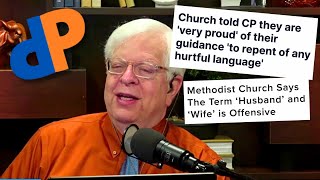
In this monologue, Dennis Prager condemns the Methodist Church of England's inclusive language guide that advises ministers to avoid the terms "husband" and "wife," labeling them as potentially hurtful. He frames the guidance as a symptom of left‑wing cultural decay infiltrating religious institutions, arguing that such changes undermine traditional moral values. Prager questions how LGBTQ+ advocacy groups, particularly the Human Rights Campaign, will respond to the push for gender‑neutral language like "partner" and titles such as "Mx." He highlights the guide's emphasis on chosen pronouns and non‑binary inclusion, mocking the rarity of non‑binary identities compared to trans identities. Throughout, he uses rhetorical questions, sarcasm, and dismissive language to portray the policy as absurd and indicative of a broader moral decline in both secular and religious spheres.
Chapters
If this does not symbolize the state of the Western world because of the sick, despicable folks of the left who are within churches as much as outside of churches— Methodist Church brands terms husband and wife offensive. This is from christian.org.uk. The Methodist Church has claimed that ministers should avoid using the terms "husband" and "wife" because it conveys an assumption that is not, quote, "the reality for many people." What does that mean, it is not the reality for many people? Because many people are not a husband or a wife? We'll find out. I'm just reading this in real time. The denomination made the statement in its inclusive language guide. Wow, these, they're, this, these people are a combination of sick and bad. It's a bad combination, but I don't know, can you be healthy and bad? Huh. I gotta think that through. Can you be psychologically healthy and be a bad person? The inclusive language guide, which will be updated every 6 months— because the left changes language every 6 months— to advise congregations how to, quote, repent of any hurtful language. Now, here's a perfect example here of the deterioration of moral thought within the religious community as well as the secular community. You know, when I say only secular people say men give birth, I may be mistaken to the extent that these people are to be considered religious. If you affiliate as a Methodist in England, I, I guess you consider yourself religious, then maybe that is not fully accurate. Repent of any hurtful language. So, you know what, wife and husband is hurtful language. I can't think of a more beautiful term, two terms, than wife and husband, frankly. When addressing groups which have been, quote, marginalized and/or demonized by common culture, who doesn't use the term, however? Gays use it. They're particularly fond of using it. A woman married to a woman will say, 'This is my wife.' A man married to a man will say, 'My husband.' They're actually adamant about saying it. I wonder if gays will— I don't mean individual gays, I mean spokespeople supposedly representing gays, but they represent gays as much much as feminists represent women. But will they take an objection to this? Will they not have gays call the people they're married to husbands and wives? Interesting, isn't it? The LGBTQI+ Human Rights Campaign. What will their position be? The most active and radical, or one of the most radical, of the pro-LGBTQIA+ organizations. What is their position on this? Will they drop the— do they want to drop the words husband and wife? The guidance argued that, quote, relationships come in many varied expressions, and using the term parent, partner, and child are a good place to start. Really? You prefer partner to husband or wife? Wow. In sections addressing gender identity— again, this is from the Methodist Church of England— In sections addressing gender identity, the guide claimed that, quote, using a person's chosen pronouns is helpful as it honors their identity, noting that those of different genders may choose to use a gender-neutral title such as Mx. Uh-huh. And outside of the university and the Methodist Church of England, who will say Mx? Not Ms., not Mr., but Mx. It added, language such as brothers and sisters, while intended to be inclusive and friendly, doesn't take into account our non-binary friends. That's an interesting thing, the non-binary friends. How many of you listening have a non-binary friend? Is that a fair question? Our non-binary friends. Do you have any friends who identify as neither male nor female? You realize that that is considerably rarer than someone who is trans.