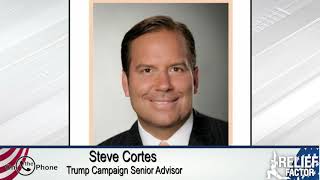
In a November 11, 2020 interview on Dennis Prager’s show, Trump campaign advisor Steve Cortez argues that President‑elect Joe Biden is refusing a full audit of the 2020 election despite a narrow margin (max 0.67%) in four key battleground states—Georgia, Pennsylvania, Wisconsin, and Arizona. Cortez outlines the legal timeline (electoral college deadline around Dec 7‑8, final vote on Dec 14) and asserts that the Trump team is prepared to pursue hand recounts in up to three states, citing the 2000 Florida recount as a precedent. He claims the Democratic Party overwhelmed the voting system with mail‑in ballots, leading to unusually low rejection rates: Pennsylvania rejected only 0.03% of mail‑in votes versus a typical 1% rejection, and compares this to New York’s 21% rejection in a recent primary, suggesting massive fraud. Cortez criticizes the media for prematurely declaring Biden the president‑elect, likening it to a football referee’s instant‑call strategy that prevents review. Throughout, he balances optimism about legal challenges with realism about the uphill battle, emphasizing that the campaign will continue fighting.
Chapters
If you actually want to be a healer, if you actually mean that, you know what you would do, Joe Biden? You would say, I want to make sure, I want to convince the Trump people. I want to convince the deplorables that the votes are accurate. So let's do a full audit. I mean, why wouldn't he? Why wouldn't he say that? Hey, there are questions here. We have 4 states that are in play. The maximum lead he has is 0.67%. Okay. Fewer than 100,000 votes among those 4 states of Georgia, Pennsylvania, Wisconsin, and Arizona. I'm saying 100,000 all in added together. If he wants to be a healer, one quick way to heal would say, you know what, we need to make sure these votes are legitimate for everyone's sake. And yet, of course, he's doing exactly the opposite. He's been crowned as the president-elect by people like Fox News and CNN. And I think there are the belief— it's almost like Dennis, you know, it's football season now. There's a trick in football that I'm sure any fan has seen where when there's— when you get away with a controversial— the ref calls it your way, but review would probably overturn it. What does the team do in the NFL? They get right up to the line and snap it immediately because then you can't review the play. That's sort of what the media is trying to do here for Joe Biden. Well, let's just call him president-elect, and if we say it 5,000 times over the weekend, it's going to reinforce in people's minds that this is all decided when it is not decided.
Well said. So the problem as I see it is December 7th, I think it is, is the deadline, correct?
Yeah, I think the 8th, but right in there, and the 14th they have to actually vote, correct?
Yes. So electors What can the Trump people do within a short time span?
Well, no, listen, it's formidable. And I don't want to— look, I'm optimistic and I think we have to fight, OK? But I'm also realistic. And I will be the first to admit that given the condensed time frame that you're talking about, it is an uphill battle for us. Now, I think it's still a battle worth waging. And we are doing it. I'm speaking to you from campaign headquarters in Arlington, Virginia. And believe me, we are not done fighting. This president isn't either. But to answer your question specifically about how can we get it done that fast in just a matter of weeks. Uh, hand recounts, you know, we know from the Florida 2000 experience they can be done relatively quickly. And if that's what it takes— but, and, you know, by the way, if we win Arizona, and it looks like we're going to by, you know, by a hair, but it looks like we're going to win Arizona in the next 24 hours, could even be today— um, if we win there, we're then talking about two states really in play, Georgia and Pennsylvania, you know, potentially Wisconsin as well. So, you know, realize we're not talking about a hand recount potentially of 10 states, we're talking about two, possibly, uh, possibly probably 3 at the very most. You know, that's something America can do. It's something, again, we did in Florida under highly contentious circumstances at that time. Can we do that again? I mean, we think it's realistic to at least try. You know, again, is it going to succeed? I don't know. And if I'm being honest with the audience, you know, I don't want to give people false hope. You know, I think that, I think it's an uphill battle for us. But I also believe we have to wage this uphill battle because I firmly believe, Dennis, I firmly believe that we won the legal vote. I think what the Democrats did, particularly in states like Pennsylvania, is they used the virus as an excuse to absolutely overwhelm a system with mail-in voting, knowing full well that there would be no way, no way that they could properly vet the validity of these votes. And by the way, instead of just my opinion, let me give you a number on that. So Pennsylvania rejected— in this election, they rejected mail-in votes a total of 0.03%. Were rejected. Now let's put that in context. Typically in Pennsylvania, they reject about 1%, so 3 times that many. In terms of first-time mail-in voters, because they just make more mistakes, Pennsylvania typically rejects 3% historically. Um, so not 10 times more, 100 times more than they rejected this time. Uh, and compare them to next door New York, their neighboring state. New York had a primary election in June and they went to mass mail-in voting. And just to show you how much worse the mass nature of it is, you know, of so many people sending in New York, Pennsylvania rejected 21% of ballots in June. And so think of that. We're now talking about New York rejected, in its most recent election, it rejected 700 times the rate that Pennsylvania just did.
Wow. These are huge factors. Huge. Stay with me, please. Steve Cortez with the president's campaign.