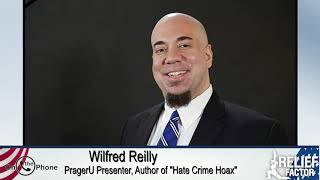
Political scientist Wilfred Reilly challenges the 1619 Project's core claims: that the Revolution was fought to preserve slavery, that African Americans fought alone for freedom, and that slavery built American capitalism. He argues the New York Times' revisions don't go far enough and promotes his alternative 1776 Unites curriculum instead.
Chapters
Some of the leading historians of America who are liberal, and the leader, Sean Wilentz of Princeton, is a— was an anti-Trumper. He wanted Trump impeached, and he said the New York Times lied in this because he's a liberal. Told you every day, every day I tell you liberalism has nothing in common with leftism. Professor Wilfred Riley, political science, Kentucky State University, gives the new course, What's Wrong with the 1619 Project? And he's got books up which we, we have as well promoted because they're, they're important books that he's writing. I'll tell you their names again before, before I say goodbye. So you were saying things are a lot more complex than 1619.
Yeah, the 1619 Project says a number of things that simply aren't true. And obviously the goal of academic research isn't to advance the left or the right, it's to advance the truth. So I mean, the most obvious critique of 1619 is that the lead author for the project, Nikole Hannah-Jones, at one point openly says that the primary cause of the American Revolutionary War was the desire of the founding fathers to keep slaves. And this is an extreme example, especially insidious thing to say because it implies that what's unique about America, the fight for freedom, the defeat of the mighty force of British redcoats, that was all done to preserve class and race oppression here. But it turns out that's simply not the case. If you look at the records of the founding fathers, I mean, there were massive debates about taxation without representation, French and Indian War debt, the simple desire to be free, to chart their own path as the leaders of a country, these young ambitious men, and not to be subjects of the king. It's very difficult to think of the import of that phrase today. But at any rate, slavery wasn't really on the docket. There was a discussion of emancipation in Britain itself at the time, but slaves weren't freed in the British overseas colonies until— I don't have my notes in front of me— but I believe 1833, 1834. It's about 60 years down the road. And there are a number of other statements of this kind that are made. I mean, one is African Americans fought almost entirely alone for our freedom. Freedoms. Speaking as a black man, that's simply not accurate. I mean, you obviously have to give a debt of gratitude to the Union Army. Slaves can't free themselves. When the Civil Rights Act was voted on years down the road, I mean, the US Senate consisted of 98 white guys, 2 men of color, and they were Chinese. I mean, so many of these statements— the final one, virtually everything unique in America comes out of slavery, like competitive capitalism. That again is nonsensical. The most competitive economies in the world generally are Singapore, Taiwan, places like this. So a lot of these claims, they're not just disturbing to hear as a white person or an upper-middle-class Black person. They don't just challenge you or whatever the term might be. They're wrong. So I think that's why there was such a strong reaction from Dr. Wood, from many of the people in the field of history, in my own related field, which is politics. A lot of this just didn't ring true. And when people looked at it, it really wasn't.
Yep, that's exactly right. They claim now that they have toned down their thesis. Is that true?
Well, I mean, it's—
The New York Times.
Sort of, but yeah, well, the attempt there originally, and by the way, there's a lot of very questionable, if you've ever taken the basic undergrad journalistic ethics course, stuff that's going on with very major papers these days. I mean, generally, if you update a significant article, you note that at the top, you perhaps send out an email or a press release. I mean, it's become more and more frequent if you read through the US media to simply see words change. Dictionary definitions don't mean what you think they did anymore, and so on. But at any rate, what the Times basically did was attempt to say that they hadn't really made some of these claims. I mean, they had proposed an alternative interpretation of history, almost in the style of a good English class, but they hadn't intended to say a lot of this was the truth. But I think many people would say that that's emphatically not true. I mean, their Twitter screenshots and captured the old materials and so on that say things like, what would happen if we assumed a different date for the founding of this country, different motivations for the founding fathers? And I think that those things aren't valid assumptions. And by the way, there's a great deal more of this slavery is the thing that made America wealthy. That's the theme of, I believe, 4 of the essays. Economists like Thomas Sowell have looked at this and said, no, no, I mean, slavery made slave masters wealthy. But if you look at what it did to slaves, what it did to poor whites, what it did to the entire region of the South, you know, 600,000 battle deaths during the Civil War. Slavery was a massive net negative for the country. I mean, it prevented the development of giant industrial cities like Birmingham and Atlanta for 100 years. It's the reason the Confederacy lost the war. So I would say, one, the attempt to redefine is a bit weak, but also two, there are plenty of things that are still being asserted that are racist. False.
That's exactly right. They were the poorer part of the country. It's so demonstrably false that the country was enriched by slavery, economically enriched. It's— I don't know. I don't know other than lie. I don't even know what an appropriate word is. But tell me, and with this, I'll get your final comment. Do you know if it's true that thousands of schools will be teaching this? Thousands of high schools?
Um, yeah, no, I will say this is where the free choice that we have as Americans because of the founding fathers comes in. There is a 1619 curriculum. You can simply Google it. Many local school boards are doing so. I also will note that I am a member of a group of successful black businessmen and academics that have responded to 1619 with nearly the same level of coverage. 1776 Unites. And if you go to 1776unites.com, you can find an alternative curriculum. And there are dozens of others promoted by institutions from the federal side.
Oh, that's very good to know. I'm very happy to hear that. 1776 Unites. That's great. Well, you're doing—
Yes, they have a curriculum.
You're doing great work. Let me just remind everybody, I will be reading immediately, I'm getting taboo, 10 Facts You Can't Talk About. Taboo and Hate Crime Hoax: How the Left is Selling a Fake Race War, both by Professor Riley. Sir, you're a courageous man and a truth lover. Thank you.
Thank you. Bye.
All right, watch his video. It's up at PragerU, about 16, 19, especially if your kid's in high school.