BREAKING NEWS: Alan Dershowitz Explains Why He Sees No Smoking Gun In New DOJ Charges Against Trump
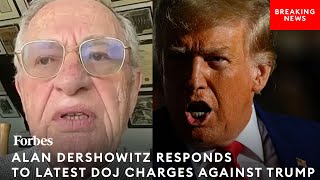
Alan Dershowitz argues the new DOJ charges against Trump lack a smoking gun proving corrupt intent. He says proving what Trump believed about the election is difficult, invokes First Amendment protections for opinions, and criticizes the special counsel's procedures and judge selection.
Chapters
Hi, everybody. I'm Diane Brady. I'm here with Alan Dershowitz, noted lawyer, author of Get Trump. Alan, we've had a very serious indictment come down for Donald Trump. How does this rank against some of the other charges you and I have spoken about?
Well, it's far more serious than any of the previous indictments. It really alleges a scheme to undo American democracy and to deny voters the right to elect their president. The problem is the evidence doesn't seem to support those very serious charges. In order to prove the case, the government will have to prove beyond a reasonable doubt that Trump himself actually believed he lost the election fair and square. That's going to be difficult to do. The charge itself is very serious, far more serious than mere possession of classified material, waving a document in front of somebody and bragging that he could have declassified it, and certainly far, far more serious than the absurd New York indictment. There's yet another indictment likely to come in Georgia, but this is probably the most serious indictment with some of the weakest evidence. So we have to wait and see if they can come up with more evidence than they already have. But I don't see a smoking gun here. I don't see anybody who can credibly testify that Trump himself believed that the election was fair and. And that he legitimately lost. And if he himself believed it, even if he talked himself into it, that may be a complete defense to charges of corrupt intention. Remember, a politician can't be prosecuted for not telling the truth or for expressing an opinion different from the government's. The Supreme Court has held that under the First Amendment, there's no such thing as a false opinion or a false idea. The answer to false ideas and false opinions is the marketplace of ideas, not criminal indictments. So they will have to prove that he actually believed that he was defrauding the public and the people who he asked to be as serve as alternate electors because he knew that the election had been fair. I don't think they can prove that.
And so just the rhetoric alone is not sufficient, because it's always hard to get inside somebody's head to know what their intent was. You think they'll have to prove what he actually believed as opposed to what he said and did.
If not, then we're going to have to see Congress meet in Ellenwood Prison instead of in Congress, because how many congressmen are there and senators who have campaigned on what turned out to be false statements? You know, and being having false statements has been part of American politics since we overruled essentially the Alien and Sedition Acts in the beginning of the 19th century. So.
This is a result of. Came down from the special counsel. I know you've had experience with this in the past. I mean, talk about that whole system through which these charges came about. Does, does it make sense?
It's a terrible system, a terrible system. Special counsel is appointed, you know, by the Attorney General of the United States. It used to be independent counsel, appointed by three judges. The whole system is totally distorted. We ought to move toward a system that they have in most other democracies which divides the function of attorney general into two one, the political adviser to the president, a member of his cabinet, a loyal person to him, and the other. The chief prosecutor in England, for example, is a Minister of justice who's the advisor of the prime minister.
And.
And then there's the Director of Public Prosecution. The same thing is true in Israel. The same thing is true in many other countries. But here we merge those roles, which is why we need special counsel, independent counsel, and all of those inadequate mechanisms for trying to show that we're really doing justice here. The American public is not going to be convinced that this is a nonpartisan justice, because if you're going to prosecute the man who's running against the incumbent president, if the Attorney General is going to approve an indictment against the man who's running 44 to 44, according to new York Times polls, the indictment has to be so strong, so beyond dispute, and this indictment doesn't come close to meeting that standard.
There's been a lot of attention on the judges in these various cases. The most recent, this particular case, the judge is an Obama appointee. I know in other cases it has been a Trump appointee. These are randomly picked to some extent. But talk about the importance of who the judge is and whether that impacts how the public perceives this case.
This is the worst possible judge to sit on this case. Her experience all comes from being a lawyer in the Boy Schiller firm, which is a firm that has been accused often of corrupt misconduct. I got them disqualified in a case recently in which I was on the other side. It's a highly partisan Democratic firm which pays money. In one case, they contributed a lot of money to the District Attorney of Manhattan and got him to drop an investigation, in my opinion, at least. So her experience in the Boy Shilla firm, I think, disqualifies her from the appearance of justice. People will know that this is unfair. She's also been very, very tough on the demonstrators on January 6th. So I can't imagine a worse judge than this one and I can't imagine a worse place to try this case than the most extreme anti Trump district in the United States of America, Washington, D.C. this case should be transferred to a different judge in Virginia or West Virginia or some purple state where you can get fair justice. I don't think that the American public will see that justice has been done with this judge and this venue.
Do you think the judge in the documents case we referred to earlier, which is in Florida, is that equally problematic that one is an appointee from Trump himself?
I don't think it's the appointment, I think it's the background. I don't think that the judge in the Florida has shown any real bias in favor of Trump. And we'll wait and see whether this judge shows bias against Trump. But I'm very suspicious of her background in that in that law firm particularly.
I want to switch over since we're talking about, you know, fairness, justice. Of course, we now have an equal amount of news on the side of the Biden family with the this Hunter Biden deal breaking down. What do you make of that?
Well, I was, I think the only person who predicted on national television and predicted in my writings that the judge would not accept the Hunter Biden deal. CNN mocked me for it and others mocked me for it. They said judges always accept these deals. I knew that she wouldn't accept it because we don't know what the deal really entailed. Was there total immunity from everything or only immunity from the narrow investigation conducted in Delaware? And I think the judge will accept the revised plea bargain and then it'll be up to Congress to decide whether or not the investigation should go forward. I think there are a lot of unanswered questions and there are a lot of allegations, unproved allegations so far, but allegations that need to be assessed and validated or invalidated by the adversarial process.
That we've heard from the business associate Devon Archer testified this week. I'm curious if you gleaned anything from that since that there's a lot of conversations about who was in the room, who was on calls, including the president himself. I don't know if you felt there were any revelations.
Well, just because somebody's a whistleblower doesn't mean they're telling the truth. Remember too that one of the lawyers for Hunter Biden firm that represented Hunter Biden is exactly the same firm, the Boy Shiller firm that represented him during the whole Barisma stuff. And so there May be a conflict there as well. But the revelations of true are very serious, but I don't believe them necessarily. I want to see corroborated hard evidence. That's why we have an adversarial process. That's why we don't believe mere indictments or mere allegations made in front of a congressional committee or even a grand jury.
Now, you lived through the, the first impeachment hearing for Donald Trump. Is there grounds for impeachment of President Biden since we're starting to hear, you know, rhetoric around that?
Absolutely not. Absolutely not. You have to prove treason, bribery or other high crime crimes and misdemeanors committed while he was president. All of these allegations are before he was president. And I don't think you can impeach somebody based on conduct that occurred before he was the incumbent in the Oval Office. So I don't think there's any grounds for impeachment. There's grounds for investigation to determine the truth and, but I don't see grounds for impeachment at all. And this is the very same Republicans who voted with me when I spoke on the floor of the Senate. And I argue that in order to be impeached, you have to commit criminal type behavior akin to treason and bribery. And now changing their mind and hypocritically saying, oh, no, no, no, no, we can impeach Trump because we don't like the way he's handled the border. We can impeach Biden because we don't like the way he's handled the borders. We don't like the way he handled this, handle that, that. Those are not impeachable offenses. It needs to be criminal type behavior akin to treason and bribery.
If we step back a second, just look at the Department of Justice, you know, we've talked about how politicized the process has become. You've talked about it in your book, Get Trump. What is the, what do you see any signs of hope here in terms of, you know, because each indictment that comes down, it seems like Donald Trump's poll numbers go up. There's so such a lack of trust in the system. I guess I'm curious about the end game.
It's moving in the wrong direction because every indictment provokes a reaction on the other side. And what we have is tit for tat justice. We have the weaponization by both sides of the criminal justice system. And the only way of ending it is to have a prosecutorial authority that is non political, which has a 10 year term appointed as a civil servant with confirmation by, by the Senate and a totally nonpartisan deciding who to prosecute. I think this business of jerry rigged special prosecutors or independent prosecutors has proved its own failure. And so I think we have to look at the whole system and try to reimagine it as a system where we divide the political function of the Attorney General from the prosecutorial function. We haven't done that.
In the absence of that, are there any immediate fixes? Is it to be dropping the cases or what is it that's going to get us to some period of normalcy in terms of at least the election being fought on the issues and not on these legals. Legalities, I should say.
I can't be encouraging about that. Our country is deeply divided in that respect. We're like Israel, like France, other countries, Spain. Deeply, deeply divided. People don't talk to each other. People just yell, you know, bumper, bumper sticker slogans at each other. You have to pick sides. You have to choose sides. There's no nuance, there's no calibrated discussion, and we're heading in the wrong direction. I would love to see somebody emerge from either party as a centrist candidate saying, enough of this. Let's try to unite the country, bring us together. Let's rebuild our criminal justice. FBI, in a way that people have trust. When I was growing up, we love the FBI. I still love FBI agents. They're wonderful. They put their life at risk and they protect us. But the FBI as an institution has, has suffered some diminution in its credibility, as has the Justice Department. And I don't, you know, I don't blame it on any particular person. I blame it on institutional structures which don't assure bipartisan justice and the rule of law. And I'm very worried about our future.
If Donald Trump does get elected. He's currently leading in the polls. There's nothing preventing him, it appears to, from getting elected. What, what do you foresee in that situation?
Well, if I had tried to send in a novel, I've written three novels in which the President of the United States is elected and then sentenced to prison and has to govern not from the Oval Office, but from the sealed bar office, people would reject it as, oh, that's ridiculous, it'll never happen. I don't think it's going to happen. But there is a possibility that President Trump could be convicted, sentenced to prison, and then win the presidency. So we have to be prepared for that. The framers didn't think of it. And as John Marshall said, it's a Constitutional, we are expounding that has to last forever. And it has to take into account the changes in our society and the change in our society. We've moved exactly away from George Washington's model. He didn't like partisan politics. He didn't like parties, and he would certainly not like what's become of our party system. I like the fact that there's a new group called no Labels that's beginning to emerge with Joe Manchin and Joe Lieberman. I'd like to see us move more to the center, but I think that's a, that's a dream that is unlikely to occur as I turn 85 in my lifetime.
Anything else on your radar coming up? You'd put on hours to keep an eye out. Obviously, there's lots going on. Lots of swirl. If you to cut through the noise.
I think we'll see possible indictment growing out of Fulton county in Georgia. If it's based on that telephone call, it will be a flawed indictment because in the call, as I write in my book at Trump, I go through all of the four alleged crimes. But in Fulton County, Georgia, all he said was find me, find me votes. Find means that they're there to be counted. They just haven't been counted. He didn't say concoct votes, make up votes, manufacture votes. So I don't think they'd be on that telephone call at least a basis for criminal prosecution. But wait and see. The special prosecutor is very aggressive, very creative. Prosecutors shouldn't be creative. They should base everything on the past law. You know, Thomas Jefferson once observed that the criminal law has to be so clear that the average person can understand it if he reads it while running. Imagine that, that image, he's reading this law book and suddenly he reads a statute and he's running. It has to be so clear that he can read it. Well, I have read this indictment of, well, sitting and there are a lot of parts of it I just do not understand.
Well, definitely more to come and more conversations. And thank you as always for joining us, Alan.
My pleasure. Thank you. Thank you.
More from Diane

BREAKING: Alan Dershowitz Assails Claudine Gay After Harvard Board Votes To Keep Her As President
Mary Callahan Erdoes, Bruce Flatt, Dambisa Moyo Talk Geopolitical Risks | Forbes Iconoclast Summit
This May Be The Real Reason Why China Is Flying Spy Balloon Over US: Gordon Chang | Forbes Exclusive