Mary Callahan Erdoes, Bruce Flatt, Dambisa Moyo Talk Geopolitical Risks | Forbes Iconoclast Summit
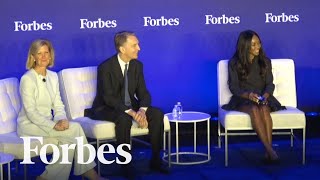
Mary Callahan Erdoes, Bruce Flatt, and Dambisa Moyo debate what global markets are getting wrong. They disagree on recession risk, China's reopening, and whether long-term compounding can overcome structural decline in Europe and beyond.
Questions this video answers
June 12, 2023
About 2,800 delegates
About 1,500 clients (historically)
Almost 20% compound annual return over 25 years
Over $4 trillion
Chapters
I feel we have to start with a round robin since we're talking about global opportunities. Let's start with what's overhyped right now. Mary?
Oh, probably the word recession is all everybody talks about. And I don't think that that's actually what is most important on the minds of all of us investors. It's whether the markets are valuing it properly and whether we figured out where the stock and bond market is going to go from there.
Okay, Bruce, you have almost $1 trillion, is that right, in assets. So you can tell us what you think is overhyped.
You know, clearly the word of the day is a I. But I would say maybe even AI is overhyped. It just everything gets overhyped when everyone's into it. But I would say maybe more importantly, I think it's negativity. When we hit bottoms of the markets and we're trailing along, everyone's quits investing and they worry about politics and recession, interest rates and you name it, there's 15 other things. And I would just say that's when people should be investing. So I'd say negativity is overblown.
We Canadians are positive people. Right.
You got it. Stay positive and stay invested.
Baroness.
Dumb visa.
Dumb visa, of course. So what about yourself?
Well, I'm going to sort of be the foil here. I actually think a recovery is actually overhyped. I think the notion that we're going to somehow go back to the way things were, or at least moderate in terms of the global environment, global economy, both in terms of geopolitics and the economy, I think is heavily it's got too big a premium on it. I think if you look ahead, I fundamentally believe we're going to structural structurally lower growth, higher inflation, which I heard David Solomon sort of suggested as well. I think the geopolitical environments are actually deep schisms that are very much reminiscent of what happened at the Gilded Age and the period that subsequently led to 25 years of progressive politics and slow economic growth and de globalization. So I'm fundamentally bearish. That doesn't mean that they are. There's a place for negativity, but there are opportunities and we'll get to those, I'm sure. So just because I've given you such a sort of harrowing snapshot of the global economy and geopolitics doesn't mean that there aren't opportunities for investment.
It's because you just came from the House of Lords. Right?
That's true.
So there's that, well, let's Talk about underappreciated. Mary, I'm going to go back to you. So let's look at the other part. What do you think is underappreciated right now?
I think in most portfolios that I see, whether it's from a sovereign wealth fund or an individual, the most underappreciated thing is assets outside your home country. Home country bias is a real thing for everybody. But it's become even more so during this era of lack of travel, lack of confidence as to what's happening outside of your own world. And there are real opportunities when you get out there and maybe we'll talk about some of them.
Definitely.
Tremendously, tremendously underappreciated. What's out there.
Okay, so I think that underappreciated, the difference in my answer and debis answer is the fact that my answers are always long term in thinking. And I'd say the most underappreciated thing in the world most of the time is the long term compounding of wealth. And I'm not, when I say be positive and keep investing, it's not for the next six months, two years, three years, it's the next 20 years. The markets will compound and great wealth is created by compounding. And so stay invested. Buy great things with great people and great companies and no money, you're going.
To make a lot of money. Bad strategy, I think. No, I think you're absolutely right. And of course, if people had invested back, was it I think 2000 naive, you've had incredible what's, what's, how much wealth.
So look, our, our compound return for 25 years is almost 20% compound annual returns. So that means a lot, it compounds a lot. And that's really it. You go north of 12%, the compounding over long periods of time is the greatest miracle of finance. And look, if you pick wrong people to invest with, you can make big mistakes. But the compounding of wealth is an amazing miracle. And you just have to pick, you just have to pick this point in the cycle. It doesn't matter whether you're on the way down. It feels bad for a while sometimes. It's usually the best. The ones that you've picked here usually are the best because you've hit them going like this on the way up, sometimes you miss it and you just have to pick that bottom portion because.
That'S a good point.
We're going to talk about short term, long term, because I think we have to think about both, obviously. Let's go to you underappreciated So I.
Would say history is underappreciated. And one of the benefits of the pandemic, if there was such a thing, was it gave me an opportunity to suspend my understanding of the world from the lens of being an economist and to think about the world from a historical context. And actually I now much more believe that there are many aspects of history that do repeat themselves, as I intimated a moment ago. The Gilded Age, I think, is one of these things that we sort of go and look at beautiful homes and you forget that actually it was a period of a lot of globalization, enormous growth, unfortunately, mass inequality. But in terms of real opportunity, the opportunity set, the role of government, role of private sector, it was really very similar to what we've experienced from 1950 to 2008. And that period was punctured by three things that happened in quick succession. A war, 1914 to 1918, a pandemic, 1918 to 1920, and then the crash of 1929, which just as a data point that keeps me very focused. My recollection is that the Dow Jones industrials peaked at 381points in 1929 and it never got to 381 again until 1950.
You think we're in a pre crash period?
I think we're in a period where there are a lot of structural effects. And yes, it's not precisely analogous, but because obviously we now have fiat currency, we have different types of globalization, the systems are much more complex. But I think fundamentally, with 90% of the world's population living in the emerging markets, the fact that we now have, I think the estimates, around 100 million displaced people, I mean, these are unique aspects notwithstanding AI and technology, which could be, for better or for worse, ideological splits between China, which I know we're going to get to, and the United States, deep ideological split splits. We have a competitor technologically, militarily and economically. I mean, these are things that make this environment to me much more testing. And maybe the last point, I'll just say very quickly is because I live part of the time in Europe, you know, looking at things like off balance sheet debts, thinking about slow growth, a society society, broadly speaking, that hasn't been very immigrant focused. Thinking about the dynamics there with a war going on there right now, I think these are aspects that are underappreciated and I think it's history becomes underappreciated in how we end up with world wars and how we end up with massive risk. So that's what I think is more.
Concerning before we move on to China, I think that's an obvious one to go to next. Any thoughts about that in terms of, for both of you? Do you feel like we're in any sort of pre crash period? Do you feel the same trepidation that.
Feels, I mean you always have a risk of. And I don't know what the word crash means and I don't know what, what asset class that we're referring to, but there's, there's always a question. Back to the question of recession. The, the word itself doesn't mean anything to markets. It's just a technical time period. Whether you hit it or not is not the issue. The issue is whether the markets have overcompensated for it, under compensated for it, whether you've stress tested your portfolios, whether you're properly diversified and as Bruce said, whether you are in it for thinking for the long term. Is your portfolio properly ready to weather any storm? That's the most important thing. And there's seismic shifts all over the world, but there have been since the beginning of time and so finding good managers to continue to invest, to continue to help you to find those opportunities and to zig when others are zagging and all those, all those great things. And that's why when you think about the world at large, the opportunities in Europe, just think about the banking system, the banking system here in the US versus the banking system in Europe. Banking system in Europe didn't make two different decisions for large banks versus small and midsize banks for regulations. They have the same, so they're not going through the same thing. So there's massive opportunities to think about. When interest rates are going up and your NII is giving you a great lift. Think about European banks. I mean there's just always, for every zig there's a zag and for every crisis there's an opportunity.
Well, let me stay with you a second. Do you want to add something?
Look, I would just say I buy everything dimvisa said.
Except we don't want that.
No, I would say I buy all that stuff except what I would say.
Okay, good.
Yes. When everyone is as negative as that, the market is at the bottom and we're turning and that is always what occurs. And the fact is what Mary just.
Said, the multiples I don't think are attractive.
When you say reverse indicators, there is always stuff happening and why private assets are really important. Remember what's happening in the world is credit, private, private equity, private infrastructure, private. Everything is going to private. Why it's not the extra return you get from private. Yeah, that's sometimes important, but what it is is you lose the distraction. You get rid of the distraction of the public market. The value of a company is this. The price goes up and down along.
The way and you don't have to pay a premium for it to be ready and available for you eight hours.
A day, every hour. And in fact you don't want it readily available every hour because it distracts you. Even I, I'm the longest term investor you can find, except I, I get distracted by the markets and they're terribly distracting. And that's a bad thing for long term returns for investors. And that's why private investments are extremely important for institutional clients today. And increasingly they're going to be for wealth. And Mary can talk about that more than I can, but increasingly those products are all shifting into private individuals because of the just, I'd argue most of it's because the distractions. You don't have to worry about it day to day.
I wonder if I could just, you know, react to that because, you know, I want to be clear that I'm not saying there's no opportunities for investments. I mean it would be mad as far as I'm concerned to just sit around and wait for the shoe to drop. So there are absolutely investments. But I think you make a very important point, Bruce, which is that even in these environments there are opportunities. But I think that where are those opportunities? And I know we're going to talk about infrastructure and credit, etc. But for me the biggest shift that's occurring, which has also occurred in history is that is the private capital actually starts to step into opportunities. And I know hopefully we'll get a chance to talk about the energy transition. But that is a classic example where private capital has stepped in because a lot of the public markets did not like traditional energy, conventional energy companies. And now we are seeing, I mean everyone, Warren Buffett, I mean whether or not call him private. But the fact of the matter is that there are opportunities they're stepping in and longer term I think society will find that the inequality in society will widen because the returns are going to continue to get to go to people who are making those, making those bets. But I am very much of the view that there are opportunities. But you asked me what was the risk or what did I think was underpriced. And for me as a long term investor also I am very concerned about these drops, structural changes where you don't get an engraved invitation. You Just find out that you're in the middle of a crisis anyway.
Well, let's talk about some of these specific opportunities. Mary, you were just in China. You just had a big event in China. So, you know, obviously politically, we hear a lot, not terribly positive. What's your. What's happening there?
Give us.
Well, give us a report from the front line.
So JPMorgan always has, for a decade, held a conference every June where we bring together delegates from across the country and then across the world. So think CEOs of local Chinese companies and CEOs of multinational companies that are in China, and then CEOs from outside. And generally speaking, we get about 1,500 clients come together for two days. And it's a very intense time period. We haven't had it in four years, and we just had it last week, maybe the week before last. 2,800 delegates intensely focused on the reopening of China. The excitement in the room, the feeling that you had to be there to understand what is happening in China. Even if you never invest a dime in China, if you don't understand the dynamics of what's happening in the EV market and one out of every four cars sold in China today is an EV car, you're not going to understand the dynamics of everything. Any other car company you want to invest in in the world and the vertically integrated dynamics that they have, the AI focus that they're on. We just finished closing our joint venture, which we're now 100% ownership of, and I have 400 new employees that give us on the ground research with CEOs, CFOs, management teams, and the insights that you get in terms of what's happening. But the excitement was there. But for sure, the trepidation was there. What about these two great nations? Is the dialogue? Is the dialogue happening? Am I going to invest in a country where the rules are going to change? And I will tell you that I had one of the most fortunate moments. I was interviewing Dr. Henry Kissinger and Dr. Condoleezza Rice.
He's 100, by the way.
It was the day after his 100th birthday, and he and Secretary Rice made the opening interview with me for the event. And Dr. Kissinger said two things that were critically important. He said our two nations have an unusual obligation to seek dialogue and understanding with one another. And our two countries have an incredible capacity to do good in the world if we do it right. And then he encouraged the audience of 2,800 people that if it isn't happening at the governmental level, don't wait. Make it happen at the company level. Make it happen in business and in economics. And it's your responsibility to open the dialogue with your counterparts around the world.
Do you think people should be invested in China now? In essence, there's lots of opportunity. And again, Bruce, I don't know if you want to weigh in.
Yeah. So look, we're in 30 countries. China. We're a significant investor. And I would just say the difference for us versus many is we can choose whose money we take there. So some of our, some of our investors are very interested in China, Middle Eastern investors very interested in China. Asian investors very interested in China. And obviously Chinese investors very interested in China. There are others that are not interested in investing in China, but that doesn't American investors. That would be a fair assessment.
Okay.
So I would just say for us, it's a little different. We have a great business there. It's always been phenomenal. We've made a lot of money over a long period of time and we're going to keep investing there. It's just whose money we bring there is the difference today and in past. That's, that's changed over the past five years.
So. Don B. So I'd like your view on China and then let's switch to Europe since you're there. But anything to say?
China, to state the obvious, is the largest, largest trading partner, investor and lender to many countries around the world. I think the vast majority of countries, including the United States, it's know at least one of the top two or three largest foreign lenders to the US Government. So I don't think China is going away. That being said, a boardroom view because I serve on a number of boards that are invested there. It has become much more complicated for US Companies and Western companies in general. I think the question is if we are moving into a more siloed world, how do we think about running global businesses? Do we, can we be global? Do we have to have more siloed sort of business structure and how we fund ourselves and how we operate these businesses? And I think those questions, I can tell you we're discussing them at fever pitch, but I don't think we have answers as yet. And then maybe just at the high level, because I also serve on the Oxford University endowment, thinking about how do you put money to work over the long period of time? I mean, we're looking at also, as Bruce said, looking to the long term, I think it's going to be very challenging because, you know, notwithstanding all the good points about camaraderie and coming together. I do think that there are ideological splits. You know, we know that 40% of the energy produced around the world is from three countries, Russia, Iran, Venezuela that we're all offside with. And actually China is on side with them. And so, you know, is there going to be a Petro and Mimby world? I don't believe that the US is no longer going to be a reserve currency. But I think we have to be realistic about the complications and the difficulties that businesses will have to operate there.
Can I ask for just a quick. I know because the time's running down a little bit about Europe because I'd also like to talk about the energy transition. ESG I call. But what. Any thoughts on Europe?
To me Europe's been very difficult. I hear Mary's point but you know I've been. I was at Goldman Sachs for a decade there. People talked about capital markets and we just need to capital markets in Europe the place is incredibly fragmented. You would have seen Germany slipped into recession. I was just in Spain. Spain as inflation at 2.9 it's a very mixed picture. How governments are addressing even something as specific around inflation is quite varied. You look at the question. I was at Bilderberg for the conference a couple of weeks ago. The question of Ukraine is also an open ended question. There are basically three or four countries that are dominating in terms of delivering capital. It's the us it's the uk, it's Canada and Greece. But where are the big European countries? And so these are things that need to be worked out, I think. And I served on the bank of Barclays bank for 10 years there. It's a hard proposition with low growth. The immigration issues that they have and I think maybe most poignantly for an investment community fundamentally I find that Europe tends to be much more a risk mitigation approach for very big issues such as the energy transition. Whereas in the us US there's very much a leaning in where can we invest, how do we think about capital, how do we think about the cost of capital and generating returns above that.
So I think it's a more to the energy transition. I'm looking because.
What.
Tell me. Because a lot of your portfolio is in infrastructure. Renewables.
Yeah, look, the. One of the greatest investment areas for capital to go over the next 25 years is the energy transition. We need to get less. The way I'd say it is we need less carbon in the system. And what's really important and the decision we made is we're not making decisions on black or green or good or bad.
We're just funding the Chevron board.
We're just funding. And this is. Chevron's happy with our strategy on this. We're just funding less carbon. So when. So we're in the midst of buying a utility company. 100% generation is coal and gas. And we will transition it over the next 10 years and we'll spend $25 billion transitioning from those to batteries, wind and solar, which we've built for years.
The Inflation Reduction act must be very.
Helpful in the US what it does is it just. If you would have built 50,000 megawatts because of IRA, we're going to build 100,000. So it's just advancing projects forward to today and that's going to help us get there quicker.
So some opportunities, I mean, they're very. All of the things that they're both discussing, they're in almost every country. But just think about something as simple as buying a tree or buying a forest. We own one of the largest forestry companies in the world, based mostly in the US the laws and regs that are happening in Europe about the taxation on things like for new construction, on cement and brick make it so that you want to buy wood for the first time. The US Is going to start exporting wood to Europe in order to be manufacturing new buildings and homes, et cetera. It is a very exciting time. So it's not just the IRA act for the sake of the trillion dollars that will be extra invested, but it's all the ancillary space on things that happen and where you can take advantage of it and where you can put your extra dollars that are not only going to do good for the world, but help the transition to exactly what Bruce and Danvisa are both focused on in their respective areas.
There's so much we want to continue in this conversation. I want to give each of you a chance to give some final thoughts. Haikus, whatever. I'm going to start with you.
Yeah, look, I don't think the world's going to end on our watch, so. So we shouldn't flatter ourselves. And so, you know, going back to the comments that were made by, by Bruce and Mary, I think there are opportunities to invest. I think that it's going to state the obvious. I think multiples in the US in particular, still too high for me to get excited about them. There are other opportunities outside the United States. I'm not a big buyer of the emerging markets. I do think China is not going away, but I think how you play China and how much appetite that you have to stay there if, God forbid, things get a bit more aggressive. But I would still end where I started by saying that that doesn't mean we should be naive about the structural challenges and how the world could turn on a dime given the complexity that we're dealing with. So I'm fundamentally bearish, but I'm looking for opportunities.
I'm a fundamental bull. Good, make the market. And after 35 years of doing this, I found it to be healthy to be that way. But what's really, really important is do not ever get yourself in a position where if the markets don't go with you, you ever get called out on your position because you can make a lot of money in the long term if you compound wealth, but if you get called out in the middle, you're done. So you need to be really fiscally prudent in what you do. But on top of that, I think the situation we're in, yes, all of the issues that are talked about are here, but the AI and the things that are going on in the world today with technology are raising populations around the world out of poverty. And every day we get more educated people. And that means wealth is being dispersed to them every day. And that's going to be better and better and it's good for everyone.
Great. Last one.
I am neither a bull nor a bear.
We should have put you in the middle here.
We manage over $4 trillion for clients that are mostly balanced portfolios. And what I've seen of the successful portfolios that last for over a century are the ones that are the most diversified. That stress test exactly what Bruce was just talking about. You heard David Solomon earlier saying, we're not sure where interest rates are going. It doesn't matter where interest rates are going. You just have to be prepared for if they go to 6% or if they go to 7%. If you can withstand that, you're going to be fine. It's not that anyone hopes or prays that that's going to happen. You have to stress test your portfolio. The only answer to every equation is diversification, which leads you to compounding which are the two most beautiful things that come together. And I think that that's the most important thing in the portfolio. And most importantly, the things that are hyped and exciting to talk about are genuinely not always the most helpful to the portfolio. Sometimes it's the most boring, difficult to assess. Slogging through investments that are the base of clients portfolios. And that's why things like transition and companies that may not be the today's highest.
They called me boring, I think.
No, no, no.
Boring is beautiful. And if you can compound it, 20% a year, I'd take that.
I can't think of a better place to end than there. Please join me in thanking Mary. Bruce Dambisa.
Thanks very much.
More from Diane

BREAKING: Alan Dershowitz Assails Claudine Gay After Harvard Board Votes To Keep Her As President

BREAKING NEWS: Alan Dershowitz Explains Why He Sees No Smoking Gun In New DOJ Charges Against Trump

This May Be The Real Reason Why China Is Flying Spy Balloon Over US: Gordon Chang | Forbes Exclusive