How Past Trauma Controls Present Relationships with Vienna Pharaon [Episode #13]
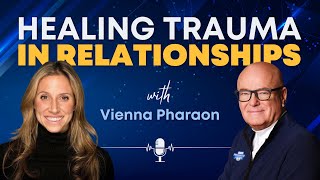
This podcast episode features Dr. Don Wood interviewing Vienna Pharaon, a licensed marriage and family therapist (Mindful Marriage and Family Therapy), about how unresolved childhood wounds shape adult relationships. Vienna frames patterns through family-of-origin work and describes 'origin wounds' (e.g., worthiness, prioritization, belonging, safety, trust) that manifest as repeated relational patterns and health/reactivity issues. Dr. Wood describes his memory-reset/brain-mapping intervention that reduces trauma-driven reactivity by changing how memory-driven visual/occipital activation triggers autonomic responses.
Chapters
Welcome to my podcast, you Must Be out of youf Mind. My name is Dr. Don Wood. I use my knowledge of neuroscience to create what I call a memory reset. This reduces and eliminates the impact of trauma. I can't wait to share with you how the impossible is possible and why you must be out of your mind.
Well, welcome to another podcast of youf Must Be out of youf Mind. And as you know, My name is Dr. Don Wood and I'm your host. And I usually try to bring in some really exciting guests that tie in with what we do with the Inspired Performance Institute. And today I have an amazing guest that I think is going to really relate to everybody that we talk to. Her name is Vienna Farren. And so what we're going to talk about is Vienna is a marriage and family therapist and she has her own business called Mindful Marriage and Family Therapy. Has been doing this for a long time and very, very successful at what she's doing. So welcome Vienna too. You must be out of your mind.
Thanks, Don. I'm happy to be here.
Well, I'm so glad you're here because this has a lot to do with people that we're talking to and what we do. So can you maybe give a quick little description of what you do and how you help people?
Sure, yeah. So as you said, I'm a licensed marriage and family therapist. I work with individuals, couples and families within context of relationships. And you know, the lens through which I see patterns and relationships is really through understanding the family of origin, the family system or systems in which we grew up. Right. So for example, if you have a divorced, divorced parents, you may have had multiple family systems and learn to operate in each one of those systems a little bit differently. So, yeah, my work is in the exploration of what it was like for us to grow up, how we were affected by that, what we saw and witnessed and observed, what we experienced, and how that comes along with us into our adult lives, into our adult relationships. The work for me is really about addressing the unhealed, the unresolved stuff, pain from our past. So, yeah, I like to do a lot of origin work. Sort of the first time that something very impactful.
Happens in our lives that sets the trajectory for a lot of patterns and maybe dysfunction in our lives and really just working back to understanding where it originated so that we can heal the origin wound as opposed to just changing the present day behavior.
Beautiful. Well, and that's one of the things that we talk about all the time too, is if, if you don't heal that unresolved, you know, whether that's trauma. I wrote my second book I called Emotional concussions, right? Because I said there's not always a big T trauma. It can be that emotional concussion where maybe an overly critical parent or something like that, that. That hits you when you're a child, and then those things show up later on in life, in your relationships.
Even in health. I mean, do you see a lot of that also in the way people, their. The way their health is changed by not getting any of that stuff resolved?
Yeah, I think that, you know, so I use a lot of the. The language that I use is wounds. I talk about that in my book.
And yeah, I say our wounds, they want to be healed, right? And they'll find ways to poke out, right? Whether it's through dysfunctional patterns, whether it's through health, as you're alluding to right now, right? It's like they'll find a way to grab your attention because they don't want to just be tucked away, forgotten, banished, right? They want to be healed, right? They're not there to ruin our lives. They're there to be healed. And, yeah, it can manifest, I think, in a number of different ways. Ways from health to patterns to strong reactions, angry outbursts, you know, the list is really endless there. But when we're having. When we're noticing something in ourselves, like a health issue, which, listen, doesn't always have to be tied to something like this, right? There could be something that's just playing out inside of you physically that does need medical attention. But when you notice, like, oh, I am super, super reactive about this thing, I get so angry about this other thing. I find myself in the same types of partners over and over again with people who never prioritize me or people who never can commit, right? Like when we find ourselves in these types of loops, right? It's a really good indicator that there is something that's unresolved going on that needs more attention from us, right? That needs us to witness it, that needs us to feel alongside of it, because we probably skipped over it at some point and just tried to put our heads down, grit our teeth, move forward with life, deal with it later, don't worry about it, get on with it, toughen up, you know, whatever narrative it is that maybe was given to you or one that you offered to yourself. And again, I think maybe what both of us are saying is that we have to turn back. You know, you do have to turn your head around and say, yeah, that stuff from the Past. It's not just done because we're no longer in the past. Right. It's tugging at me, it's pulling up my shirt, it wants my attention. So, yeah, it can manifest in so many different ways. There's a lot of different indicators that let us know that there's an unresolved wound that's looking for us to see it, hear it, listen to it, be with it, feel alongside of it. And I think that our work is to pay attention to that and then, yeah, dive into, you know, the healing, you know, as are so many different healing modalities, but to dive into the healing modality that aligns best for you to, to really begin to resolve some of that.
Do you find too, a lot of times the reason people get into those patterns or they get into, you know, you mentioned something interesting, how they end up with the same kind of part. Right. What I sort of explain that is that they're looking for that safety, even though it may be dysfunctional, it's. It's familiar. And so the mind does not like uncertainty. And so even if it may not be a situation that's the best for you, at least, you know, it's a little easier to deal with.
Yeah, our internal systems really like familiarity. They like status quo. They want to go back to that because it's what we know. And, and so, yeah, we can find ourselves, unfortunately, when we're not doing the work to resolve the stuff from the past. Right. Our systems, our internal systems will be drawn towards what is familiar. As you said, it's like, it's the illusion of safety. And I think familiarity is really the better word. Right. But it's the illusion of safety. I know this, so I go there, but I keep choosing the same types of people, different person, but somehow I still feel deprioritized in these relationships. Right? Because whether it's a partner who drinks or whether it's a partner who puts work before you, or whether it's a partner who golfs for, you know, I don't know, 20 hours a week, that's me. You're like, shoot, you're pointing to me, but. Right, but whatever it is, right. And that might not be an activation for someone, right. Who doesn't have a prioritization wound, for example. Example. But when you have a. I get into this in the book, I talk about worthiness, prioritization, belonging, safety and trust as five core wounds that can originate in childhood. And so when you notice a complaint that you have in your current day life, oftentimes in your current day relationships, we might likely most of the time be able to find a link to its origin. So somewhere before this moment with that person. Right. And so when, if you notice that you keep choosing the same types of people or the complaint that you have of different partners sounds very similar to the last. Right. Even if the content itself is not exactly the same, then there's a little bell that's being rung there that says, ooh, you know, like maybe there is a wound. Maybe you didn't feel prioritized in your childhood. Maybe other things were more important to you. Maybe you felt that way. And so instead of us begging, pleading, screaming, crying, trying to get our partner to just prioritize us and make us important, sometimes that work is about going back to really connecting to that origin wound that set it in motion in the first place.
And you find sometimes too people don't even know what it is. They're not even aware of it at times. Until you sit down, down and you can start reviewing it with them. It's almost like a revelation that they never connected that up to. It could be just an event that happened in their life. We see that all the time.
Yeah, right. I think sometimes there are, you know, cyclical things. There might be ever present things that, that we feel in childhood. Sometimes there's a one off thing that happens that, you know, it doesn't have to. It could be. I remember a client of mine, this was connected to a worthiness wound for him. He shared that in fifth grade. A girl that he liked, girl that he had a crush on, had said, oh, I would like you if you were taller and remember him, you know, just sitting there like this is just this, this tiny little sentence, right? In fifth grade, who cares? Right? And yet here's this moment in history that sets this worthiness wound in motion, right? I'm only worthy of your attention. Your. It's fifth grade, but like your attention, your love. Right? Whatever love looks like in fifth grade. But you know, I'm only, I'm only worthy of your attention, your presence with me, your love, your desire of me. Right. If I was taller, if I wasn't as short. Right? And that stays maybe not with everyone, but that stays for some and it stayed for him. And it's really tied to the way that he navigates dating present day. Right. I need to be friends with, with anybody who could potentially be a partner of mine for a long time before we move into that romantic space. Because if we're friends, then they're more likely to overlook the fact that I'm shorter.
Interesting. Yeah, yeah. Just little things. Even with the best of intentions, a parent can, can do something. Yeah. I had a lady, same kind of thing. She said, oh, I never really had any trauma. And then as we started talking, she. I said, any kind of an event that you can remember that. And she was talking about in church. She Sundays, I was six and I was talking and my grandmother took out her hairbrush and hit me on the head and said, stop talking, you're in church. And the waterwork started. And she goes, I lost my voice that day. I just realized that I never stand up for myself.
Yeah.
But she had never connected that.
Yeah. Right. So, you know, oftentimes we can find a moment or that sort of ever present, you know, parent who is a workaholic, who will stay up late working on their computer, doing the things that they knew. They're always traveling for work, whatever it is. And again, whether it's intentional, unintentional, meant to do harm, not meant to do harm. Right. A lot of the time is not meant to do harm. It's just, it's just the effect that it had. Right. And I think a lot of times when I'm working with people that they're like, my parents did the best that they could. My caretakers did the best that they could. Right. We have this resistance a lot of times to the idea that you might be throwing somebody you love under the bus. Right. That, you know, you want to hold them in some type of high regard. What I say about this work is, you know, it's not about throwing people under the bus. This isn't about, oh, look at all the ways that you failed me and look at all the ways in which you, you know, destroyed my life. This is about calling the thing the thing. This is about naming what was. We don't have to minimize it or maximize it. We, we can't distort it. We have to be able to name what was so that we can work with it. And so, you know, that's one of the big resistances that people have is to, to say, you know, parents, caretakers, they can mean well and they can disappoint. Right. They can mean well and they can hurt. They can mean well and they can let down. Right. That's part of the human experience. And sometimes it's terrible, sometimes it's well intentioned, but it still misses the mark. And our work is to be able to look at our past, to be able to look at these relationships and call the things that they.
Yep. And a lot of times too, you get a child, you know, especially a five, four year old child that doesn't have enough life experience to interpret this event. So the parent may be thinking that the child is absolutely fine the way they handle the situation, but you've got a five year old trying to figure out what does that mean.
Right.
In a really funny sort of way, I remember my parents, my mom, every saying, once in a while, go, it's difficult to make ends meet. And I remember as a child, I never understood what that meant. I thought she was talking about meat, like really meat. And I was like, what do you. What meat meeting? Like, why would you do that?
Right.
But because I didn't understand what she meant.
Yeah.
So that can really, you know, start to affect a child if it comes across as a negative experience.
That's right. I mean, I think when were kids, right. Our perspective, our lens through which we see things is really limited. Right. If a parent.
If a parent wants to change us, if a parent wants to prioritize something else, we're not sitting here thinking, oh, my parents is maybe going through a really stressful time in their lives and. Right. We personalize it. It's about us. You don't want to spend time with me because I'm not good enough. You don't want to be around me because I'm not smart enough. You don't want to be around me because I speak too much. Right. It becomes personal. We don't have this wide perspective that sees the complexity of humans, that understands that our parents too were once children at one point who are also probably walking around this earth with some unhealed wounds potentially. And the way in which they manage that might trickle down into us in a way that is hurtful to us. But exactly like you said, Don, when we're kiddos, we don't have that perspective. When we're kiddos, we personalize it. We see it as it being a flaw in us, that there's something wrong with me. And then we're having to navigate the reconciliation of that and the repair of that as we get older and move through life and relationships, hopefully in a healthier way.
Which is interesting because I wonder how many people you've had like this with. I had this amazing childhood, right. I thought everybody had my childhood. And we talked a little bit about this before, but my parents never raised their voice, never yelled, never hit us. My brother and sister and I can't ever remember them arguing. Now that's a unique home to grow up in, like, that was very, very nurturing. So I always felt safe. So my nervous system pretty much stayed regulated. And if I got bumped by a, you know, a friend or a teacher or a coach, as soon as I would come home, I'd come right back into regulation and safety. And, you know, I often talk to people, you know, I've been on podcasts, and they'll say, what's the best advice you can give to a parent? And I said, make your home safe. It's got to be the place. My wife had none of that. And so she lived with a very violent, angry father, so she was living in fear all the time. And if I said something like, no, I don't like that, she could tear up and start to cry and say, why are you upset with me? And I'd go, I'm not upset at all. Like, it's. But she wasn't wrong, and I wasn't wrong. So she could hear this little tiny tension change in my voice. If I was just tired. Right. Or maybe a little frustrated on the drive home, I'm not upset at her. But she hears that, and then her mind immediately activates into, I'm in danger. And then she starts to, you know, start to feel like, what do I have to do to get away from this danger? Even though she's not in danger. And a lot of people don't understand that. They'll just say, well, I'm very emotional. Right. Well, there's a reason why. So for me, I think that that had a big effect on my health over my entire life. It had a major. I've been healthy all my life. You know, even living in Florida 30 years. Never get to the doctor because I don't get sick. And I believe that that came from very early in my life, having my nervous system stay regulated.
Yeah. I mean, I think there's absolute truth to that. And being. When your body can rest, you know, when your body feels stabilized. Right. There is. There is a health to that. Right. And a lot of times we think emotional health, health, mental health, physical health. Right. All those things. But the interconnectedness of that. All right. Makes. Makes a whole heck of a lot of sense.
Yeah. I'm curious.
Not to. I'm turning the tables here, Dawn.
Okay, good.
Because I'm curious about. In your relationship with your. With your wife, you know, to have grown up in a family system where, you know, there was no fighting, there was no arguing, you never really saw anyone upset. In many ways, I imagine that that communicates like this is. This is how we operate. Right. This is. This is how we do things. This is how we stay. We don't. We don't really leave from this space. Right. We don't deviate from calm. Kind connection with each other. Sorry. Kind communication with each other. And so, you know, was that then the expectation that was left in you? Right. Like, that you have to always stay in that space when you're communicating or, you know, moving through conflict with a partner, with your wife? Like, what was it like for you to experience something different other than what you experienced growing up? And then did you take that personally at all? Like, I'm so curious if that felt like, shoot, am I doing something wrong as a partner for you or what? Yeah, like what that activated within you.
It did. It made me feel like, how can I make her happy?
Yeah, right.
Why is she, you know, and it was really interesting because I talk about her story all the time and it wasn't that she wasn't grateful and. And, you know, we had three beautiful children, a beautiful home, a good business, but she never looked like it was like, oh, this is fantastic. I'm loving my life. And I couldn't understand it. So it put this constant drive in me that I've got to maybe make more money, do something better, make her happier. What is it that I'm missing? I didn't realize it was that loop of trauma that was stopping her from enjoying it because she got hurt so many times as a child. She was really protecting herself. And I tell people all the time when people say, oh, I sabotage myself. I said, I don't believe that's possible. The brain is survival based. It's protecting you. So for my wife, it was protecting her because at times her father, right, would be. He was a Jekyll and Hyde. He could be Mr. Nice Guy, Mr. Generous Guy. And then on a snap of a finger, right, a wall gets punched and a door gets slammed. And so she was living with that when's it coming? Right. Even though she was not living in that world at all. And never yelled at my wife, never raised my voice, but I felt like she was feeling like I could do it and she was just waiting for it.
Yeah. You know, that's when there's the absence of safety. You're describing the unpredictable. Right. The unpredictable parent, you know, the lack of safety. Certainly a safety wound and potentially even, you know, a worthiness wound. Right. Like, what do I need to do to make you stop? Or how can I be different to get you to be nicer? If I'm A little more this or a little bit less that. Right. Like that again, that's oftentimes where children can go, right. How do I make this stop? Because this is, you know, unsafe. This is uncomfortable for me. I don't like it. I don't want it. And again, when we're personalizing it, right. Sometimes it's tied to if I was different or if our family was different. Maybe you wouldn't behave this way.
Right. And what my wife, I think, had learned as well is she got very emotional, which that actually was more for her protection because her father didn't like that. He didn't like the crying.
He.
So he actually took it out harder on the boys. And even her sister, who were more defiant, right. They wouldn't show that he was getting to them where she would just immediately break down. So she would then, I think, do the same with me to sort of get that back off even though I wasn't doing anything.
Yeah. What a. What a brilliant coping strategy of hers, huh?
Yeah.
You know, such a. Such a brilliant system, right, to figure out how to. How to self protect a bit. You know, and. Right. Part of healing is, you know, as some partners will say, and it sounds like maybe you. You didn't say something like this, Don, but, you know, one of the common things that you'll hear is, I'm not your father, or I'm not your past partner, or I'm not like your ex.
I shouldn't have to pay the price of what they did. And.
Part of this work is not, you're safe with me. Right. That doesn't work. You're safe with me. It's okay, I'm not him. I'd never do that. Don't you see all the evidence? I've never raised my voice, I've never raised my hand. I've never done this. Right. There's probably all the evidence in the world, but this isn't about logic, right? This isn't about rationale. This isn't about that. Right. And so. So.
Of course, part of her work, and it sounds like you guys have done a lot of incredible work over your years together, but for the listener is that the safety does need to be established in the body. That safety needs to be established in this somatic way so that a wall can start to drop ever so slightly to let you into.
Essentially a new ending. Right. To be able to say, I may not actually just be safe in the world with anyone. Right. But I can start to feel what safety is like with you through these experiences where we have a hard conversation about something, but I can stay in my body, I can reconnect with myself. You'll stop when I ask you to stop. You'll support, you'll. You'll honor my boundaries and then start to build that out more and more and more. So it's a very relational thing. I. A lot of, A lot of our healing is individual, but I always say, if it's relationships that wound, then relationships are required to help in the healing. And, and so we can take ourselves so far, but at some point, right, if we want to be able to trust someone again, if we want to be able to feel safe with someone again, if we want to feel a sense of worthiness in someone else's life, right, then we're having to do some of this relational work to write a new ending and not let the wound.
Stay in the driver's seat.
Right? Yeah. And one of the ways that we're working on it, I was explaining that my daughter had experienced some trauma that was affecting her, not only her health, mental and physical. Physical health.
The thing that I found from my research is that we're creating these glitches, what I call glitches or error messages, the way the mind is viewing old memory, which is activating our nervous system. So when I would say to my wife, no, I don't like that, and she'd tear up, I thought it was what I said. And I kept saying, well, I've got to say it differently. I've got to change the tone, the cadence, the all of those things. But it wasn't that. That is when I was saying, no, I don't like that. But she heard that little tension. What her mind was doing is basically a Google search. What do I know about these kinds of situations? And a flood of data would come in about her father. That's where the tears were coming from. It wasn't me, but I kept thinking it was me. So the key and what I've dealt with our program tip is we're going to take some of those events and experiences, you know, two or three of them, and we're going to get your mind to reset that high definition traumatic data into a lower format so that the mind stops responding to it. So I've worked with, you know, Boston Marathon bombing survivors, Vegas shooting victims, people.
Veterans who have had post traumatic stress for years, and we can eliminate it because the mind stops calling for an action. What I always say is the reason you have an emotion is the emotion is a call for an action. The purpose of Fear is to escape a threat. The purpose of anger is to attack a threat. So if you think about something that happened five years ago and your heart's racing, it's because your mind is looking at the information from five years ago and responding to it in real time. We've been doing a lot of work with brain mapping and one of the things that we found is, particularly when people are experiencing post traumatic stress, that the O1, O2 area at the back of the brain, the occipital lobes, are lit up. And so when I was looking at that, I said, why would those areas be lit up unless they're looking at something? They're looking at memory. And then that sets off the autonomic nervous system. Even though nothing is happening, but it's calling for an action. That's what I found that we could fix. And when you do that, it's life changing because now they can heal in their relationships because they won't constantly be activated by their partners.
Now they can still get activated on a current thing.
Sure, sure.
But at least the old information isn't going to put them into a response.
Beautiful.
Yeah. And so, so it's a very effective way. It's very quick. We can do that, you know, in a very short period of time. We did a brain map study, sort of showing how much of the brain can actually change. So it did from 15 year olds up to 60 year olds with a whole bunch of different things from depression, anxiety, panic attacks. And we got a average of a 46% change in brain plasticity.
Wow.
Which is amazing.
Significant. Yeah.
And the thing that was fascinating is it wasn't just in the limbic area. We actually got a lot of changes in the frontal lobe, which was fascinating. Which shows it's the entire brain that's responding. Right. So that logical, reasonable part of our brain. Right. That knows we're not in danger, but we still respond, it's the, the limbic system that's actually responding because of the, the memory loop, the trauma loop.
Right, right. Yeah. Well, it sounds like you're doing incredible work with people.
Yeah. And I love what you're doing because it's the same thing. It's healing that wound. Understanding that you've got to get back to that. So what kinds of things are you seeing most in your type of work?
Yeah.
I work with.
More from Dr.





When you’re in the middle of a panic attack and someone tells you to “just breathe”.

Once a panic attack starts, you can’t stop it. Here’s why and what you can do about it. #panic


The first sign of healing wasn’t what happened. #anxiety #emotionalpain #fightorflight

The threat ended. The situation changed. Your life moved forward. #weneedtotalk #anxiety

